Orthopedic examination template: Free 6-stage form (PDF)
An orthopedic examination is a structured physical assessment of the bones, join...

1
Last Updated: Oct 16, 2026

The Modified Ashworth Scale grades muscle spasticity across six steps: 0, 1, 1+, 2, 3 and 4.
You grade the resistance you feel while moving the limb passively through its full range at a slow, steady speed.
Agreement between clinicians is moderate to good, so serial scores are most trustworthy when the same person tests the same joint.
The American Physical Therapy Association does not currently recommend the scale for multiple sclerosis, citing thin evidence and validity concerns.
Record the joint, the side, the speed and the patient’s position, or your next score will not be comparable.
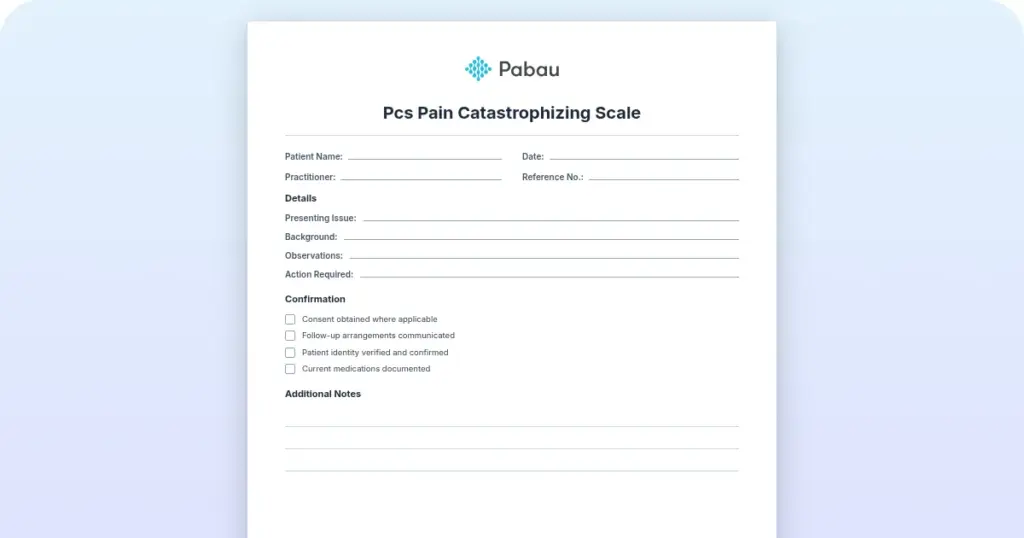
A single printable page carrying the Bohannon and Smith testing instructions and all six score definitions. The recording area has a name and date header, one muscle tested line, a score column from 0 to 4, and an additional comments box.
Download templateThe Modified Ashworth Scale grades how much resistance you feel when you move a patient’s limb passively. Scores run from 0, meaning no increase in tone, to 4, meaning the affected part is rigid. Bohannon and Smith added the 1+ step in 1987 to catch changes the original scale kept missing.
Physical and occupational therapists use it after stroke, spinal cord injury and traumatic brain injury. It takes around two minutes and needs nothing beyond a goniometer. What it does need is discipline, because a grade only means something next to another grade taken the same way. This guide covers the six steps, the technique behind them, and how to write the result into a patient record.

The Modified Ashworth Scale, or MAS, is a clinical tool that grades muscle spasticity on a six-point scale. It runs from 0, no increase in muscle tone, to 4, affected part rigid. Bohannon and Smith built it in 1987 by refining the original Ashworth Scale of 1964. Their addition was an intermediate grade of 1+, which catches tone changes the five-point version could not separate.
Spasticity itself is a motor disorder characterized by a velocity-dependent increase in tonic stretch reflexes. It usually follows an upper motor neuron lesion. The scale gives you a quick, repeatable way to record resistance to passive movement. Because it needs no equipment beyond a goniometer, it has become the most widely used spasticity measure in rehabilitation.
Spasticity limits motor control, adds fatigue and closes down range of motion. Without a measure you are left with impressions, and impressions do not survive a handover. Tone is better than last week means one thing to the therapist who felt it and nothing to the colleague reading the note.
A grade gives the team one shared language. When someone writes Grade 2 for the right ankle plantarflexors, anyone reading the record knows what that hand felt. Occupational therapy and physical therapy teams often share the same patient, so a common grading language matters as much as the grade itself.
The scale grades tone from 0 to 4, with 1+ sitting between 1 and 2. Each grade has a standardized descriptor that guides your judgment while you move the joint.
The 1+ grade is the reason the modified version exists. It covers patients whose tone catches early and then eases off before halfway through the range. That extra step makes the scale sensitive to small gains that would otherwise stay invisible.
Technique drives the score more than the patient’s tone does. Move too fast and you trigger velocity-dependent reflexes, which inflates the grade. Test only the end of the range and you miss a catch that happened earlier.
Common pitfalls. Testing too fast, skipping the relaxation step and grading from end-range alone all produce numbers you cannot trust.
The scale has been used across most upper motor neuron conditions. The evidence behind it is not equally strong in each one, and one professional body has said so plainly.
Knowing where the scale is strong and where it wobbles stops you over-reading a single grade.
Inter-rater reliability describes how closely two clinicians agree on the same patient. Reported intraclass correlation values, or ICCs, sit between 0.60 and 0.90. Agreement is best at the wrist and ankle in adult stroke samples. It falls at the hip and knee, and in children, which means two therapists can honestly disagree by a full grade.
Validity is the more contested side. Grades do track other spasticity measures and correlate with functional limitation. They also pick up soft tissue stiffness rather than reflex activity alone, which is part of why the scale draws criticism.
Minimal detectable change is the smallest shift larger than measurement error. In most populations that is roughly one grade. A move from Grade 2 to Grade 1 is therefore worth acting on. A feeling that tone seems lighter is not.
The MAS is practical and quick, and both of those come at a price. Knowing the price keeps it from carrying more weight than it can bear.
Both scales are defensible. The choice comes down to how much time you have and what you need the number to prove.
For a busy caseload the MAS is the faster instrument. The Tardieu tells you more about how tone changes with speed, at the cost of five to 10 extra minutes per joint. Whichever you pick, run it on a fixed schedule. Automated reminders keep reassessments landing at the same interval for every patient.
A grade with no context is close to useless. Grade 2 on its own tells the next clinician almost nothing about the patient in front of them.
Physical therapy records make this repeatable once the fields already exist. A date, an assessor, a joint picker and a fixed grade dropdown stop the team inventing its own shorthand. A progress notes cheat sheet helps while the habit is still forming.
Scores also travel outside the therapy team. When tone changes enough to alter medication or trigger a referral, the grade is the evidence a multidisciplinary review works from.
For most spasticity assessments the MAS is enough. Five situations call for something else, or for something extra alongside it.
The form linked at the top of this page is one printable sheet. It carries the Bohannon and Smith administration instructions, all six score definitions, and the reminder to have the patient relax before you start.
The recording area is deliberately small. There is a name and date header, a single muscle tested line, a score column from 0 to 4, and an additional comments box. Print one sheet per muscle you assess, then file each one against the visit it belongs to.
Most practices record MAS grades in free-text notes. The number goes in, the joint sometimes does, and the speed and position almost never do. Six visits later nobody can say whether the tone changed or the technique did.
Practice management software like Pabau lets you build the assessment as a structured form instead. The joint, the side and the grade become fields rather than sentences, so every therapist records the same things in the same order. The completed form sits in the client record next to the appointment and the treatment note.
Once the fields are fixed, the trend does the work for you. You can pull one patient’s grades for a single joint across every visit and see the direction of travel. That is what a referrer, a payer or a case conference actually asks for.

Pabau’s structured clinical forms keep every assessment inside the client record. Serial scores stay comparable, so progress is easy to evidence for referrers and payers.

The MAS earns its place on three counts. It is fast, it needs almost no equipment, and it gives a whole team one word for what a limb feels like. Treated as a rough instrument used carefully, it will show you change worth acting on.
What decides whether it works is repeatability. Each assessment has to repeat the same joint, the same side, the same speed and the same patient position. Get that wrong and you are comparing two techniques, not two visits.
Print the form, agree the protocol with your team, and store the results somewhere they can be lined up. Book a demo to see how Pabau keeps outcome measures structured and trackable across a rehabilitation caseload.

Tracking upper limb recovery after stroke? Action Research Arm Test scores grasp, grip, pinch and gross movement on a scale you can repeat every few weeks.
Need to show what tone costs a patient day to day? ADL assessment tool turns limitations in washing, dressing and feeding into a record a payer will read.
Want the patient to set the goal? Canadian Occupational Performance Measure captures the activities the patient cares about, then rates performance and satisfaction.
Assessing a child with cerebral palsy? Pediatric Balance Scale gives you a 14-item functional balance measure built for school-age children.
Following an upper limb through discharge? QuickDASH outcome measure is an 11-item patient-reported score for arm, shoulder and hand function.
The MAS measures muscle spasticity in people with neurological conditions such as stroke, spinal cord injury, cerebral palsy and traumatic brain injury. Clinicians use it to set a baseline, judge whether therapy is working, and decide when to change treatment.
You move the limb passively through its full range over about one second, then grade the resistance you felt. Grades run 0, 1, 1+, 2, 3 and 4, each with a standardized descriptor. Score it immediately, while the feel is still fresh.
Grade 1+ means a slight increase in tone with a catch, followed by minimal resistance through less than half of the remaining range. It sits between grades 1 and 2. It is the step Bohannon and Smith added in 1987 to make the scale more sensitive.
The MAS grades resistance during one slow passive movement and takes about two minutes. The Tardieu compares slow and fast movement and takes five to 10 minutes. The MAS is more common in day-to-day practice, the Tardieu more common in research.
Reported agreement runs from moderate to good, with intraclass correlation values between 0.60 and 0.90. It is highest at the wrist and ankle in adult stroke samples, and lowest at large joints and in children. Repeat assessments by the same clinician are the most reliable.
Yes. The form at the top of this page is a single printable sheet. It carries the administration instructions and all six score definitions. The recording area has a name and date header, one muscle tested line, a score column and an additional comments box.