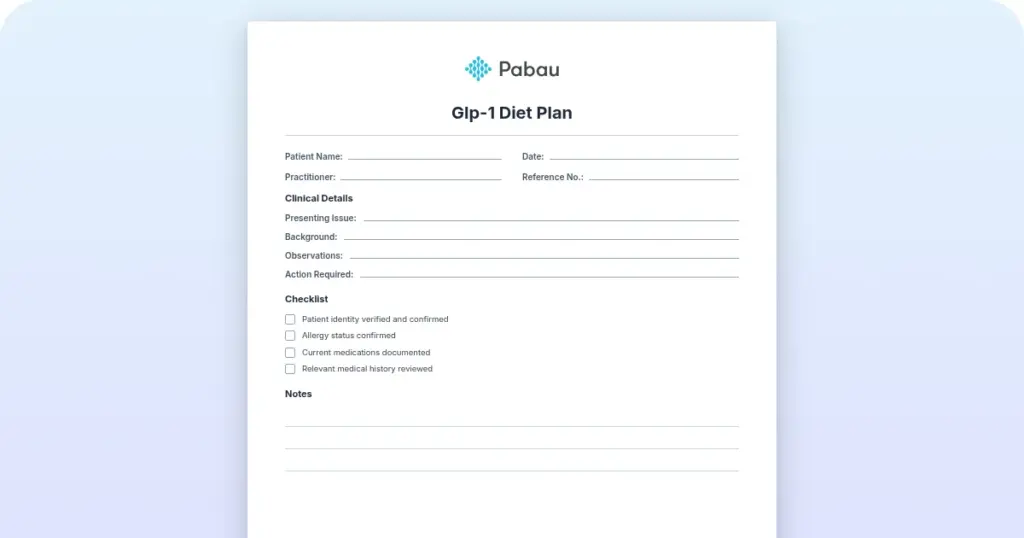
GLP-1 diet plan
A GLP-1 diet plan is a structured eating framework for patients taking semagluti...

2
Last Updated: Oct 13, 2026

An acute kidney injury (AKI) nursing care plan is a structured clinical tool that guides assessment, diagnosis, planning, intervention, and evaluation using the ADPIE nursing process.
Priority nursing concepts for AKI include fluid and electrolyte balance, elimination, and perfusion, monitored through lab work (serum creatinine, BUN, GFR) and vital signs.
Key nursing interventions include fluid intake/output monitoring, positioning, medication management, electrolyte replacement, and patient education on low-sodium diet and medication adherence.
Pabau’s digital forms and automated workflows streamline AKI care documentation and ensure consistent, evidence-based assessment protocols across your clinical team.
A comprehensive, ready-to-use nursing care plan template covering patient assessment, KDIGO-aligned AKI staging, nursing diagnoses, fluid and electrolyte management, medication safety, and post-discharge follow-up planning for acute kidney injury patients in inpatient and outpatient settings.
Download templateAn acute kidney injury (AKI) nursing care plan is a structured clinical tool that turns assessment findings into targeted interventions and measurable patient outcomes. AKI develops in an estimated 2 to 5% of hospitalized patients and in up to 67% of those admitted to intensive care, according to NCBI StatPearls. Systematic care planning is what catches deterioration early and helps prevent lasting kidney damage.
This guide walks your nursing team through building and using an AKI nursing care plan, from the first assessment through discharge, grounded in KDIGO clinical practice guidelines and the ADPIE nursing process. Across acute, critical, and outpatient settings.
An acute kidney injury nursing care plan is a documentation framework that guides nurses through five steps: assessment, diagnosis, planning, intervention, and evaluation. These make up the ADPIE nursing process. AKI is defined by KDIGO as a rise in serum creatinine of ≥0.3 mg/dL within 48 hours, or to ≥1.5× baseline within 7 days, or urine output below 0.5 mL/kg/h for at least 6 hours.
The care plan works as both a clinical tool and a legal record. It establishes the baseline clinical picture, identifies nursing diagnoses such as fluid volume excess, impaired kidney perfusion, or knowledge deficit, and sets out measurable goals and interventions. Left untreated, AKI can progress to chronic kidney disease and raises mortality risk in hospitalized patients.
If you landed here searching for an acute renal failure nursing care plan, an ARF nursing diagnosis, or an NCP for acute renal failure, you’re in the right place. “Acute renal failure” is the older clinical term for the same condition now standardized as acute kidney injury under the KDIGO 2012 guidelines.
The nursing process doesn’t change with the name: the same ADPIE steps, KDIGO staging, and NANDA-I diagnoses in this guide apply whether your facility’s documentation still says “ARF” or has switched to “AKI.” Use the acute kidney injury care plan and NCP template above for either term — the assessment parameters, interventions, and evaluation criteria are identical.
Building an AKI nursing care plan follows five operational steps grounded in clinical assessment and evidence-based practice:
KDIGO staging drives the intensity of your plan. Stage the patient on whichever criterion, serum creatinine or urine output, puts them in the higher stage:
| Stage | Serum creatinine | Urine output |
|---|---|---|
| Stage 1 | 1.5 to 1.9× baseline, or a rise of ≥0.3 mg/dL (≥26.5 µmol/L) | <0.5 mL/kg/h for 6 to 12 hours |
| Stage 2 | 2.0 to 2.9× baseline | <0.5 mL/kg/h for ≥12 hours |
| Stage 3 | 3.0× baseline, a rise to ≥4.0 mg/dL, or the start of renal replacement therapy | <0.3 mL/kg/h for ≥24 hours, or anuria for ≥12 hours |
An AKI nursing care plan supports multiple settings and roles:
Compliance and legal protection: Standardized documentation shows that your facility follows Joint Commission standards and KDIGO guidelines, which reduces liability in adverse outcome reviews.
Workflow efficiency: A structured template cuts the time spent writing repetitive assessment notes and makes sure no clinical parameter is missed.
Documentation clarity: Clear, organized care plans improve handoff communication during shift changes and interdisciplinary rounds, supporting safer transitions of care.
Patient safety and outcomes: Systematic monitoring of fluid balance, electrolytes, and renal perfusion catches complications such as hyperkalemia, fluid overload, and oliguria early, reducing progression to chronic kidney disease or dialysis-dependent renal failure.
An AKI nursing diagnosis is drawn from the same NANDA-I taxonomy used across nursing practice. The five diagnoses most commonly identified in AKI patients are:
Nursing assessment for AKI focuses on five key areas:
Nursing interventions for AKI center on fluid and electrolyte balance, medication safety, and patient education, each paired with its clinical rationale:
Here is one priority diagnosis worked through the full ADPIE process for a patient in the oliguric phase of AKI. Use it as a model for the other diagnoses in your plan.
| ADPIE step | Worked entry |
|---|---|
| Assessment | 2.5 kg weight gain over 24 hours, bilateral pitting edema, bibasilar crackles, BP 168/94 mmHg, urine output 0.3 mL/kg/h, serum creatinine 2.8 mg/dL (about 2× baseline). |
| Diagnosis | Fluid volume excess related to impaired kidney filtration, as evidenced by edema, weight gain, and hypertension. |
| Planning (goal) | Fluid balance moves toward baseline within 72 hours: daily weight trending down, lungs clear on auscultation, and BP below 140/90 mmHg. |
| Intervention | Hourly intake and output; daily weight at the same time and scale; furosemide per order; sodium below 2 g/day with prescribed fluid restriction; semi-Fowler’s positioning; check serum potassium before each ACE inhibitor dose. |
| Evaluation | By day 3: weight down 2 kg, lungs clear, BP 138/86 mmHg, urine output 0.6 mL/kg/h. Goal partially met, so continue the plan and reassess daily. |
Education helps prevent AKI recurrence and slows progression to CKD. Key teaching topics include:
A structured AKI nursing care plan standardizes assessment, diagnosis, and intervention planning across your team. Use the free downloadable template above so every patient with acute kidney injury gets the same systematic, evidence-based care. Facilities managing tracheostomy patients can apply the same structured approach with a tracheostomy nursing care plan template.
Want to see how structured, HIPAA-compliant care plans work across your team? Book a demo to see how Pabau’s digital forms and clinical workflows cut documentation time while keeping AKI assessment and intervention notes consistent.
Acute kidney injury (AKI) and acute renal failure are the same condition. “AKI” is the current standard term, adopted by KDIGO in 2012. Both describe a rapid loss of kidney function over hours to days that is often reversible with treatment.
The priority nursing diagnosis is usually fluid volume excess, because impaired filtration lets fluid and sodium build up, which can lead to pulmonary edema and hypertension. Risk for electrolyte imbalance, especially hyperkalemia, is the close second, since it carries a risk of cardiac dysrhythmia.
Target urine output is at least 0.5 mL/kg/hour. For an 80 kg patient, that is 40 mL/hour, or 960 mL/day. Oliguria (below 0.5 mL/kg/h) is a Stage 1 AKI criterion, so track cumulative daily output and compare it to recent baseline.
Indications include serum creatinine above 4 mg/dL with a rising trend, severe hyperkalemia (K⁺ above 6.5 mEq/L), pulmonary edema unresponsive to diuretics, severe metabolic acidosis (pH below 7.15), or uremia (BUN above 100 mg/dL with neurologic symptoms). Consult nephrology for timing and modality.
Secure, structured documentation protects patient privacy, keeps data consistent across shifts, and creates an auditable record for Joint Commission inspections and quality improvement reviews.
AKI is often reversible when treated promptly. Severe or prolonged AKI can cause permanent scarring and progress to chronic kidney disease, so early recognition and intervention improve the likelihood of full renal recovery.
Not as its own label. The NANDA-I diagnosis that covers this is Risk for Ineffective Renal Perfusion (NANDA-I 00203), which addresses risk factors, such as sepsis, nephrotoxic medications, or reduced cardiac output, that can progress to acute kidney injury if perfusion isn’t restored. Document it under that official label even if your team refers to it informally as an AKI risk diagnosis.
Acute kidney injury develops over hours to days and is often reversible with prompt treatment. Chronic kidney disease is a progressive, usually irreversible decline in kidney function over months or years. Unresolved or repeated AKI episodes raise a patient’s long-term risk of developing CKD, which is why post-discharge follow-up labs are part of this care plan’s evaluation step.