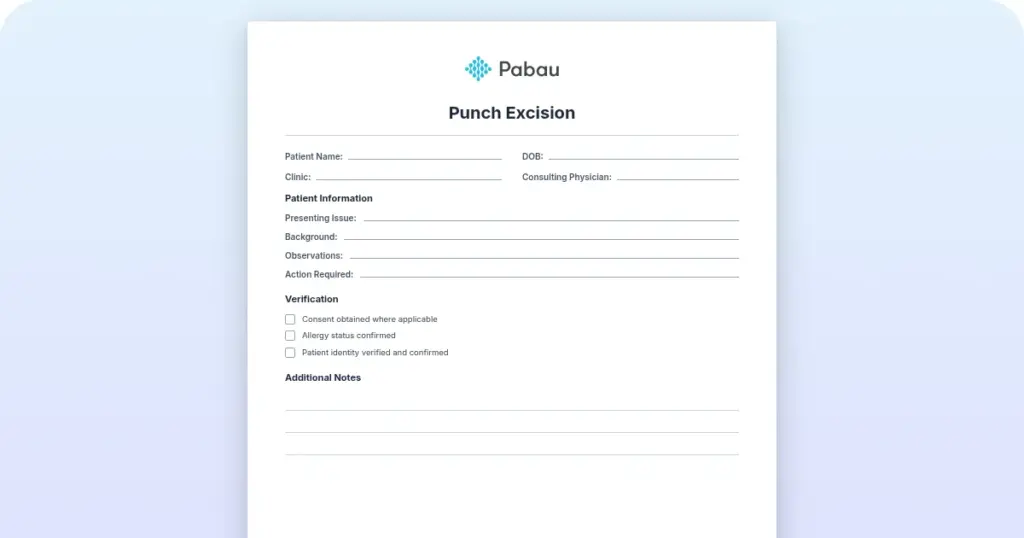
Punch excision aftercare instructions template
Punch excision is a minor procedure that removes a small cylinder of skin with a...

5
Last Updated: Oct 15, 2026

Isotretinoin causes prolonged skin dryness and sensitivity. Good aftercare protects the results of treatment and prevents complications.
Patients must continue strict sun protection (SPF 30+) and avoid waxing, lasers, and cosmetic procedures for at least 6 months post-treatment due to skin fragility.
Female patients of childbearing age must continue contraception for one month after stopping isotretinoin to comply with iPLEDGE (US) and the NHS Pregnancy Prevention Programme (UK).
A practice-branded aftercare handout keeps patient messaging consistent across every clinician on your dermatology team.
A ready-to-use aftercare instruction sheet for patients completing isotretinoin treatment, covering skincare, sun protection, contraception, and warning signs to monitor for complications.
Download templatePatients who finish an isotretinoin course often assume their acne is resolved and that their care responsibility ends at the final appointment. Without written aftercare guidance, that assumption leads to avoidable problems: acne rebound, sunburn from unprotected skin, or a lapse in the contraception window that iPLEDGE and the NHS Pregnancy Prevention Programme both require. Software built for med spas keeps the clinical record and the appointment history against one client.
This guide covers what the downloadable Accutane aftercare instructions sheet contains, how to use it at the end-of-course appointment, and why handing patients a written copy matters more than a verbal recap. It also shows how practice management software like Pabau lets your team send, sign, and store the handout digitally.
Accutane aftercare instructions are guidance sheets that dermatology practices give patients immediately after their final isotretinoin dose. Isotretinoin’s effects on skin and contraception requirements persist well past the last pill, so patients need clear, written direction rather than a verbal recap on their way out the door.
The template covers three clinical pillars:
The handout is a plain-language instruction sheet rather than a structured form. It ends with a single line for the patient to confirm they have read and understood the information and had the chance to ask questions.
A practice-branded version.
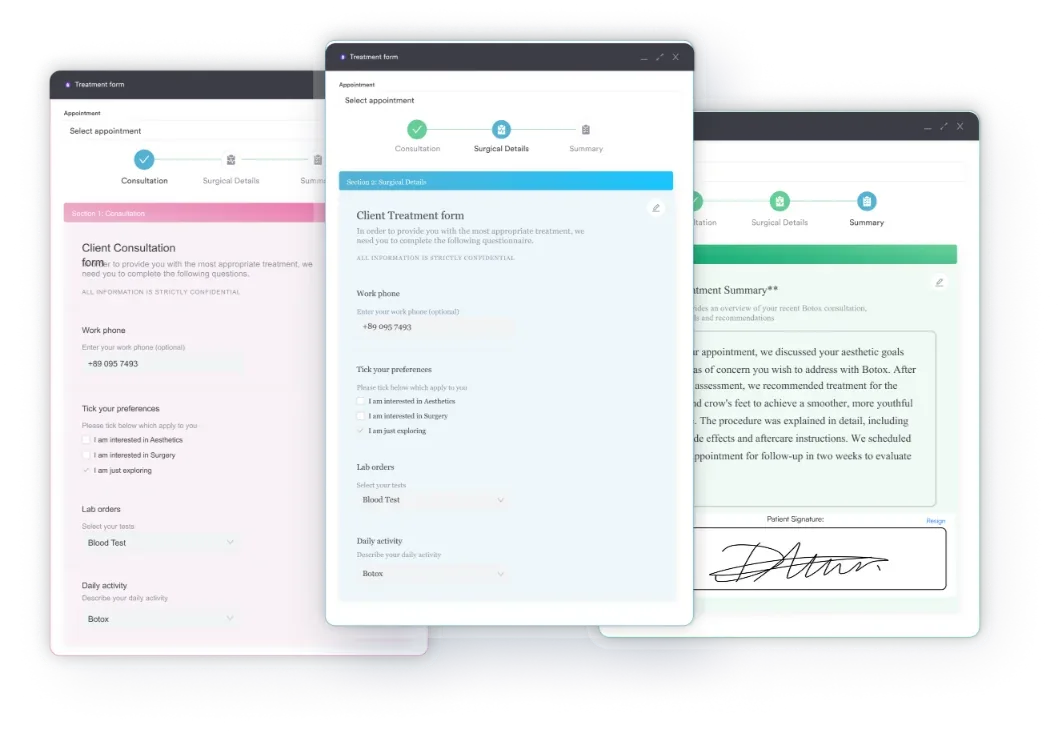
Distribute the sheet as a printed handout at the final isotretinoin appointment. Practices already running on dermatology practice management software can build this handout directly into that workflow. Five steps help practice teams work it into the end-of-course visit:
Distribute this template at the final isotretinoin appointment, immediately after the last dose. Do not delay – patients often assume the appointment ends their care responsibility, and a verbal reminder to “keep your skin moisturized” does not carry the same weight as a signed, practice-branded aftercare document (the same principle applies to other post-procedure handouts.
The sheet serves practices in three scenarios:
Timing sensitivity: Isotretinoin side effects like dryness, lip peeling, and eye irritation can persist for several weeks after the final dose. Give patients the sheet before they leave on treatment-completion day, so they start the aftercare routine right away rather than waiting and developing preventable dryness or irritation.
The post-Accutane skincare window (Weeks 1-4) prioritizes barrier repair over active treatment. Isotretinoin suppresses the sebaceous glands during treatment, and oil production returns only gradually over the following months, so the skin stays dry and prone to irritation from products the patient previously tolerated. The sheet recommends:
This is the highest regulatory priority. Isotretinoin is a potent teratogen, and pregnancy during or shortly after treatment causes severe birth defects. The iPLEDGE program (US FDA) and the NHS Pregnancy Prevention Programme (UK, administered by MHRA) both require female patients of childbearing age to continue contraception for one month after the final isotretinoin dose.
The aftercare sheet states this requirement in plain language, but it does not include a dedicated contraception checkbox or signature section – the single confirmation line at the end covers the whole document.
If your practice needs a signature-level record of contraception method and start date, capture that separately through your consent or intake paperwork rather than relying on the aftercare handout itself.
Store that separate contraception documentation in your regulatory compliance files. During CQC inspections (UK) or internal compliance reviews (US), these records demonstrate that your practice provided evidence-based post-treatment safety guidance to female patients.
If you are new to digital tooling, start with what practice management software does before digitizing forms like this.
The sheet lists five warning signs that should prompt patients to contact the practice urgently post-treatment:
Add your practice’s own contact protocols alongside the template: a phone number for routine questions, an email for non-urgent aftercare queries, and an emergency contact (on-call dermatologist, after-hours line) so patients know their escalation options rather than waiting for the next scheduled follow-up.
Structured post-treatment follow-up appointments prevent complications and demonstrate clinical diligence. The aftercare sheet itself does not include appointment-date fields, so use your practice’s own intake and scheduling system to book these visits at the final treatment appointment, at intervals aligned with isotretinoin safety guidance:
Pre-book these visits before the patient leaves the final treatment appointment to reduce friction and improve attendance. Use your practice’s online booking system to send automated appointment reminders one week before each follow-up. This improves compliance and reduces no-shows during the critical post-treatment window.
A practice-branded, paperless aftercare documentation process provides measurable advantages:
Store the signed handout using clinical documentation software and a secure HIPAA-compliant patient data management system, so your team can retrieve it for audits and print copies on demand without digging through paper files.
Book a demo to see how Pabau’s digital forms and patient portal streamline aftercare documentation delivery and compliance tracking for dermatology practices.
Patients completing isotretinoin have invested months in treatment. Inadequate aftercare guidance can undo those gains through acne recurrence, procedural injuries from premature waxing or laser treatment, or a lapse in contraception shortly after stopping the medication.
Give every patient a practice-branded aftercare instructions sheet and build it into your standard end-of-course workflow. Patients retain written guidance far better than verbal counseling, and the signed document gives your practice a record that supports liability protection and regulatory inspections.

Documenting cellulitis cases on paper charts? Cellulitis nursing care plan template covers assessment findings, diagnosis language, and intervention rationales in one record.
Weighing facial devices for your practice? HydraFacial vs Geneo vs DiamondGlow comparison compares three facial devices to help you pick the best fit for your practice.
Want fewer patients lost between visits? Dermatology practice marketing guide covers how online reputation and follow-up affect patient retention and growth.
Accutane aftercare instructions are guidance sheets that dermatology practices provide to patients after completing isotretinoin treatment. They cover post-treatment skincare routines, sun protection requirements, contraception continuation for female patients, and warning signs of complications.
Female patients of childbearing age must continue contraception for one month after the final isotretinoin dose, as mandated by iPLEDGE (US FDA) and NHS Pregnancy Prevention Programme (UK, MHRA). This window exists because isotretinoin is a potent teratogen and poses a severe birth defect risk.
Most dermatologists recommend waiting 6-8 weeks post-treatment before reintroducing retinoids, AHAs, BHAs, or vitamin C serums. However, timing varies by individual – patients should consult their dermatologist at the Week 2 or Week 4 follow-up appointment to confirm when their specific skin tolerance permits active ingredients.
Isotretinoin increases skin photosensitivity, and this sensitivity persists for weeks to months after stopping the medication. SPF 30-50 daily, applied and reapplied every 2 hours if outdoors, prevents sun damage, hyperpigmentation, and further barrier compromise on already-vulnerable post-treatment skin.
No. Patients should avoid waxing, laser hair removal, chemical peels, and cosmetic procedures for at least 6 months after completing isotretinoin due to prolonged skin fragility. Isotretinoin dries the skin and slows wound healing, which leaves it more prone to injury, scarring, and delayed recovery.
Pabau’s downloadable template is a plain-language instructional handout rather than a fillable form. It covers what to do during treatment (hydration, gentle skincare, sun protection), what to expect in the first few weeks, contraception and monitoring requirements for the duration of treatment, aftercare once the course ends, common side effects, and a checklist of symptoms that should prompt patients to contact their doctor immediately. It closes with a single line for the patient to confirm they have read and understood the instructions.