Obagi Blue Peel Radiance: Consent form and aftercare guide
An Obagi Blue Peel Radiance consent form records that your patient understood a ...

4
Last Updated: Sep 29, 2026

CryoPen freezes benign skin lesions with pharmaceutical-grade nitrous oxide, usually in 5 to 30 seconds.
Written consent has to record the lesion, the screening questions asked, the risks explained, and the patient’s signature.
Cold-triggered conditions, recent isotretinoin use, and any suspicious lesion rule the treatment out.
Your treatment note should capture freeze time, cycle count, and applicator size, so the four-week review has something to compare against.
Practice management software like Pabau keeps consent, treatment notes, and aftercare in one client record.
The template covers patient and lesion details, contraindication screening, the informed consent declaration, a treatment protocol checklist, and take-home aftercare instructions. Print it as it comes, or rebuild the fields inside your own digital forms.
Download templateClinical guidance tells you what consent to obtain before a CryoPen treatment. It says much less about which fields to record, or where the signed form should sit afterward. This template covers both.
Most cryotherapy consent forms stop at a signature. This one screens for the conditions that make freezing unsafe, records what was actually delivered, and hands the patient aftercare they can follow at home.
It suits med spas, dermatology practices, and skin clinics offering lesion removal. Every field is built to drop into a digital patient record, so nothing ends up in a folder behind reception.
CryoPen is a handheld cryosurgical device that destroys benign skin lesions with pharmaceutical-grade nitrous oxide. A fine, high-pressure jet freezes the target tissue with millimeter accuracy. The cold destroys the cells inside the lesion while the skin around it is largely spared.
Most lesions take 5 to 30 seconds and no anesthetic is needed. The operator applies the tip and freezes the tissue to a set depth. A thaw of roughly 30 to 60 seconds follows, then a second freeze in most protocols.
CryoPen is CE marked in the European Union and the UK, and FDA cleared in the US. It is a regulated medical device, so your practice has to hold the paperwork that proves it is registered. Registration sits with the MHRA in the UK, the FDA in the US, and the DHA in Dubai.
The procedure runs in six documented steps. You assess the patient, mark the lesion, calculate the freeze time, freeze, watch the thaw, then review. Each step produces something worth capturing in your digital consent forms and treatment notes.
The device handles a range of benign lesions across aesthetic and dermatology settings.
Record the lesion type, its location, and its size in millimeters on the form. For dermatology practices, a written record of lesion morphology backs up the treatment decision if the diagnosis is ever questioned.
Screen every patient for absolute and relative contraindications before the first freeze. Missing one of them is how a routine lesion removal turns into a complication and a complaint.
Your consent form needs a medical history section that asks these questions directly. A history and physical form is a useful starting point if you are building the screening questions from scratch.
Record every answer, including the negatives. If a patient later reports a cold-sensitivity reaction, that form is what shows you asked. Practices handling US patient data should keep those answers in a system built for HIPAA compliance.
Consent is a legal requirement before any treatment, and a signature on its own does not prove it. The form has to show that the patient understood the procedure and the risks. If you already run a microblading consent form, the structure below will look familiar.
Store every signed copy in the patient’s digital record rather than a filing cabinet. A GDPR request or a regulator’s inspection asks to see the form on demand, and a scanned pile is slow to search.
Healing takes two to four weeks, and almost all of it happens at home. Give the patient written instructions to take away, and keep a clinician-facing protocol for your own notes.
Send the sheet before the patient leaves, then let the system chase the follow-up. Automated email and SMS reminders can carry both the aftercare instructions and the four-week review booking.
No single qualification covers this device worldwide, so the requirement depends on where you practice. What every regulator wants to see is evidence that the operator was trained before they treated anyone.
In the UK, the CQC expects practices to hold training records for everyone performing aesthetic procedures. Training should cover the device, indications and contraindications, the treatment protocol, consent, and how to manage complications.
In the US, FDA clearance sets no training standard, and the rules vary by state. Some states limit cryotherapy to physicians, while others allow nurses and estheticians to treat. Check your state medical board before you delegate.
In Dubai, the DHA asks practices to hold training documentation and operator qualifications on file. Elsewhere in the UAE the equivalent sits with the DOH in Abu Dhabi and MOHAP in the northern emirates.
Record the completion date and the certifying body for every operator. Keep it where the rest of your compliance paperwork sits, not in a separate training spreadsheet nobody opens.
Digital records win here for one reason. The four-week review has to compare the result against what was delivered, and that comparison is impossible if the freeze time was never written down.
Capture patient demographics, lesion type, location and size, the medical history screening, the contraindication checklist, and the signature. Save it straight into the patient’s client record with a timestamp.
Record the operator, the date and time, the freeze time in seconds, the number of cycles, the applicator used, and how the lesion responded. Photograph the site. Clinical progress notes are far easier to defend when they carry the numbers, not just a description.
Generate the take-home sheet and attach a copy to the record. Log which patients received it, so a question three weeks later has an answer you can point at.
Book the four-week review before the patient leaves the room. Send a reminder by text or email closer to the date. Write what you find at that review into the same treatment record.
Most practices offering this treatment keep the paperwork in three places. Consent sits in a paper folder, the treatment note lives in a word processor, and the aftercare sheet is an email someone retypes each time. None of it connects.
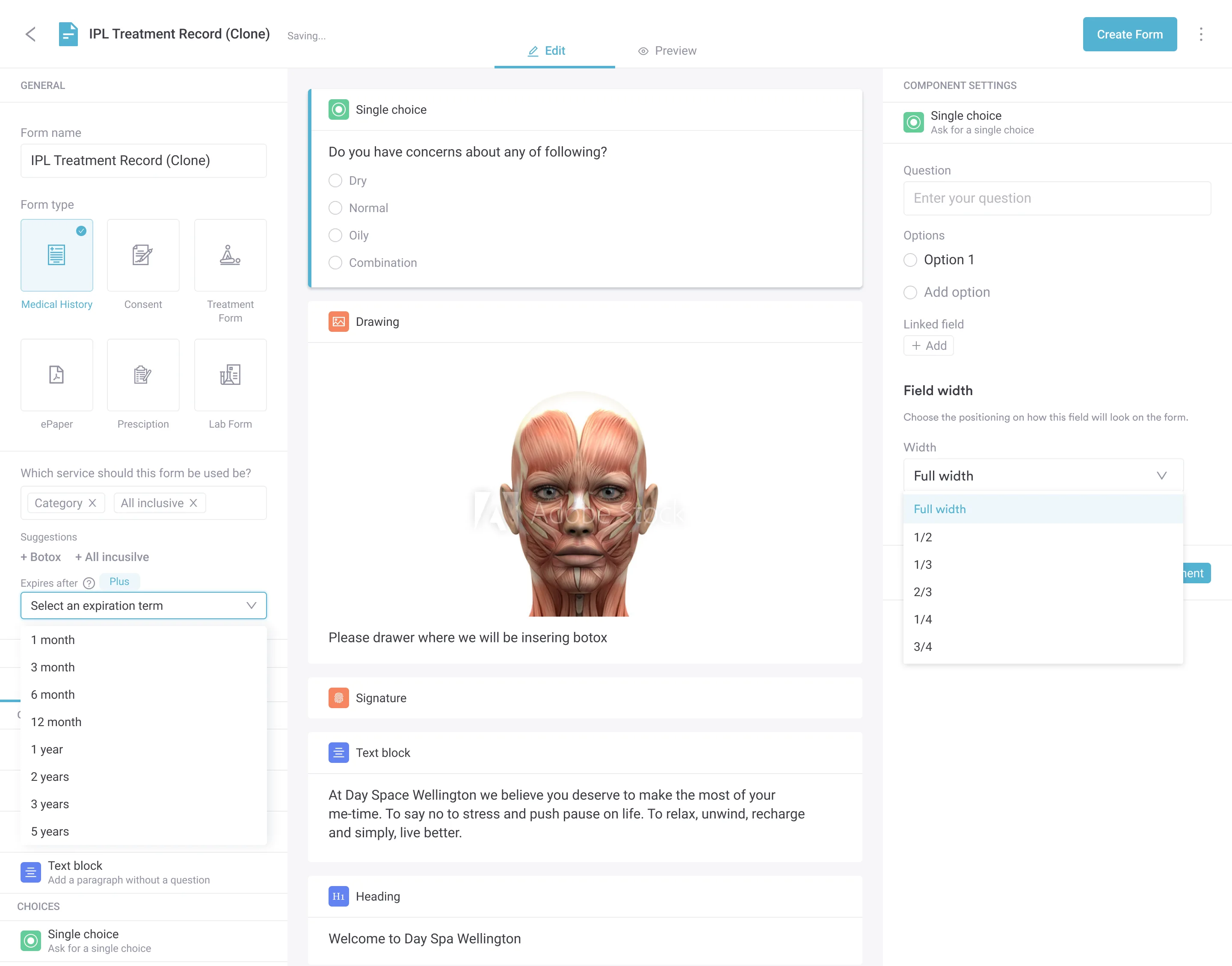
Practice management software like Pabau puts all three in the client record. The consent form is built from your own fields, signed on a tablet at the appointment, and filed against the patient automatically. The treatment note sits beside it with the photographs.
The follow-up then runs itself. The aftercare sheet goes out by email or text, the four-week review lands on the calendar, and every action carries a timestamp. Going paperless takes the filing job away from your front desk.
When an inspector asks for the consent behind a treatment from eight months ago, you search the patient, not the cabinet. That is the whole difference, and it takes about a minute.

Pabau’s digital forms, client records, and automated reminders hold CryoPen consent, treatment notes, and aftercare together. Your team stops chasing paperwork and the audit trail builds itself.

The freezing part of a CryoPen treatment is over in half a minute. The record it leaves behind is what decides whether a lesion still there at week four counts as a failure or an expected second session.
So download the template, then settle one question before you treat the next patient. Where does the signed copy live? A form scanned into a shared drive is only slightly better than the paper it came from.
Get that right and compliance stops being a weekly job. Book a demo to see how Pabau holds CryoPen consent, treatment notes, and aftercare in a single client record.

Offering skin needling treatments too? Skin needling consent form covers the treatment process, risks, benefits, and aftercare requirements before microneedling.
Documenting a different device treatment? Harmony XL Pro template covers the treatment record and consent wording for laser and IPL sessions.
Need a consent form for dermatology procedures? Dermatology consent form covers what patients must understand about risks, alternatives, and the procedure itself.
Running a dermatology practice in Canada? Dermatology software for Canada compares 7 platforms on billing, PIPEDA compliance, and clinical photography workflows.
CryoPen destroys benign skin lesions with controlled nitrous oxide freezing. Common targets are warts, skin tags, age spots, cherry angiomas, seborrheic keratoses, and benign moles. Any suspicious lesion has to be assessed by a dermatologist first.
Most patients feel a brief sting or a cold burning sensation during the freeze, and little afterward. No anesthetic is needed. Over-the-counter pain relief covers any soreness later in the day.
Each lesion is treated in 5 to 30 seconds. The full appointment runs 15 to 30 minutes once assessment and the aftercare conversation are included.
Absolute contraindications are Raynaud’s disease, cold urticaria, cryoglobulinemia, recent isotretinoin use, and any suspicious lesion. Relative ones include darker skin types, active infection, anticoagulant use, and a compromised immune system. Screen for all of them on the consent form.
Most benign lesions clear in one to three sessions. Warts often need two or three, while skin tags usually go in one. Book the review at four weeks to check progress.
Keep the area clean and dry for three days, leave blisters alone, and avoid direct sun for a week. Use antibiotic ointment only if it was prescribed. Return at four weeks so the practice can confirm healing.
Benign moles only. A mole with an irregular border, uneven color, recent growth, or bleeding needs a dermatologist’s assessment, and often a biopsy, before freezing is considered.
Yes, with a caveat. Fitzpatrick types IV to VI carry a higher risk of hypopigmentation, which is sometimes permanent. Use conservative freeze times and spell the risk out in the consent form.
Yes. Operators have to show competence even where no qualification is legally mandated. Training should cover the device, indications, contraindications, technique, consent, and complications. UK practices need those records on file for the CQC.
You need written informed consent recording the lesion, the medical history screening, the treatment explanation, expected outcomes, risks, and the aftercare given. It has to be signed and dated. Store it digitally so it can be produced during an audit.