CPT code 93503: Swan-Ganz catheter billing and modifiers
CPT code 93503: Official descriptor and procedure overview In the AMA CPT code s...

Last Updated: Oct 23, 2026

CPT code 21013 covers excision of a subfascial soft tissue tumor of the face or scalp measuring less than 2 cm.
Two facts have to be confirmed before you code. The tumor must sit below the fascia and measure under 2 cm.
Two errors dominate. Coders upcode to 21014 for a tumor of 2 cm or larger, or reach for 21011 when the dissection stayed above the fascia.
Non-facility Medicare pays roughly $500 to $700 for this code, and the 90-day global period bundles routine post-operative visits.
Practice management software like Pabau captures depth and size in the operative note, so the claim goes out with the detail payers ask for.
CPT code 21013 covers the excision of a subfascial soft tissue tumor of the face or scalp measuring less than 2 cm. The AMA descriptor reads: Excision, tumor, soft tissue of face and scalp, subfascial (eg, subgaleal, intramuscular); less than 2 cm. Every word in it is a coding criterion.
Depth decides this code. A palpable scalp mass sitting above the galea aponeurotica is subcutaneous, so it belongs to 21011 or 21012. Only a documented dissection through or below the fascial layer makes 21013 correct.
Practices using clinical notes software can build structured operative templates for this family of codes. The template prompts for depth confirmation before the surgeon finalizes the note.
The 21011-21016 range covers every soft tissue tumor excision of the face and scalp. Two variables separate the codes, and both have to be right. Depth splits subcutaneous from subfascial, and size splits under 2 cm from 2 cm or larger.
A surgeon excising a 1.5 cm intramuscular scalp mass codes 21013. The same procedure on a 2.5 cm mass codes 21014. Skin lesions sit in a different family altogether. A subfascial neck or anterior thorax mass codes to CPT 21556 instead, where the size split falls at 5 cm.
21015 and 21016 are radical resections for malignant tumors. A malignant skin lesion removed without radical resection falls to the 11600 series.
Billing teams in plastic surgery practices should map the whole range into their procedure templates. Size and depth then get captured while the note is being written, rather than reconstructed at the billing stage.
Every claim for this code needs a supporting ICD-10-CM diagnosis that establishes medical necessity. The usual pairings are benign neoplasms and soft tissue disorders of the head and face. An unsupported or mismatched diagnosis is a fast route to a medical necessity denial.
D21.0 is the most common pairing in routine practice. Check the diagnosis against the pathology report once it lands, because a post-operative diagnosis often differs from the pre-operative working diagnosis on the first claim.
Where the specimen turns out to be a retained foreign body rather than a neoplasm, M79.5 is the accurate diagnosis. AAPC Codify carries crosswalk data for confirming valid pairings.
Thin documentation is the leading reason these claims are denied or downcoded. The operative report has to carry four specific elements before a coder can assign 21013 with confidence.
Practices using digital clinical forms can set these four elements as mandatory fields. A note then cannot be finalized without depth and size on it. A standard SOAP progress notes format keeps that structure consistent across every surgeon.
A retrospective audit of incomplete records finds the same problem months later, once the denials have already landed.

Audit your last 20 claims for this code. Check each operative note for the word ‘subfascial,’ ‘subgaleal,’ or ‘intramuscular.’ If fewer than 80% carry explicit depth language, update your operative note template now. Payers flag operative notes amended after a denial, and that can escalate into a compliance review.
In software built for sports medicine, fracture care and joint procedures sit alongside rehab milestones.
Modifiers tell the payer something the code alone cannot, and they move reimbursement, claim acceptance, and audit risk. Five come up regularly on this code.
Modifier applicability varies by payer. Verify against the current CMS Physician Fee Schedule and the NCCI edit tables before appending anything. The NCCI governs which procedures can be billed alongside 21013 on the same date of service.
Wound closure is the most common companion claim. Practices with high surgical volumes benefit from claims management software that flags modifier rules at the billing stage.

Medicare reimbursement for this code is set annually through the CMS Physician Fee Schedule. Rates move with geographic locality and with setting, meaning non-facility versus facility. The figures below are 2026 national values. Use FastRVU’s RVU lookup for locality-specific calculations.
MD Clarity puts the national Medicare range for this code at roughly $500 to $700. At the 2026 conversion factor of $33.40, a non-facility total of 16.90 RVUs pays about $564 before geographic adjustment. The facility total of 11.10 RVUs pays about $371.
Two lines in that table decide more than the headline figure does. The practice expense component more than doubles in the office setting, so an in-office excision reimburses roughly $190 above the same excision in an ASC.
The second line is the global period. 21013 carries 90 days, so routine post-operative visits are already paid for and cannot be billed on their own. An unrelated visit inside that window needs modifier -24 to be paid.
Verify these values against the official 2026 Physician Fee Schedule final rule for your locality. The non-facility rate applies in an office or outpatient setting. The facility rate, with its lower practice expense component, applies in an ASC or hospital. Private payer reimbursement is negotiated separately from Medicare rates.
Soft tissue tumor excision codes draw a disproportionate share of claim edits and post-payment audits. Depth and size are both easy to miscapture at the documentation stage. These are the errors billing teams meet most often on this code.
Anatomical site redirects a claim the same way depth does. A subfascial tumor of the back or flank codes to CPT 21933 once it measures 5 cm or greater.
Practices tracking denial patterns can use reporting and analytics to see which CPT codes generate the most edits each quarter. That shows where coder education and template updates will pay off first.
Dermatology and plastic surgery teams handling high excision volumes should also review their medical office compliance practices, so documentation workflows stay audit-ready.
The operative note is written hours or days before anyone opens the claim. That makes the note the earliest place a 21013 denial can be prevented, and the cheapest.
Practice management software like Pabau connects clinical documentation straight to the billing workflow. Surgeons using Pabau Scribe, our AI scribe, get a structured operative note with required fields for depth, location, and measured size. The same structure carries into dermatology EMR workflows, where excision coding comes up most weeks. A clean claim rate below the practice benchmark usually points at one recurring coding or eligibility error. Eligibility, referral status and time thresholds all sit inside the Medicare Benefits Schedule descriptor rather than the code itself.
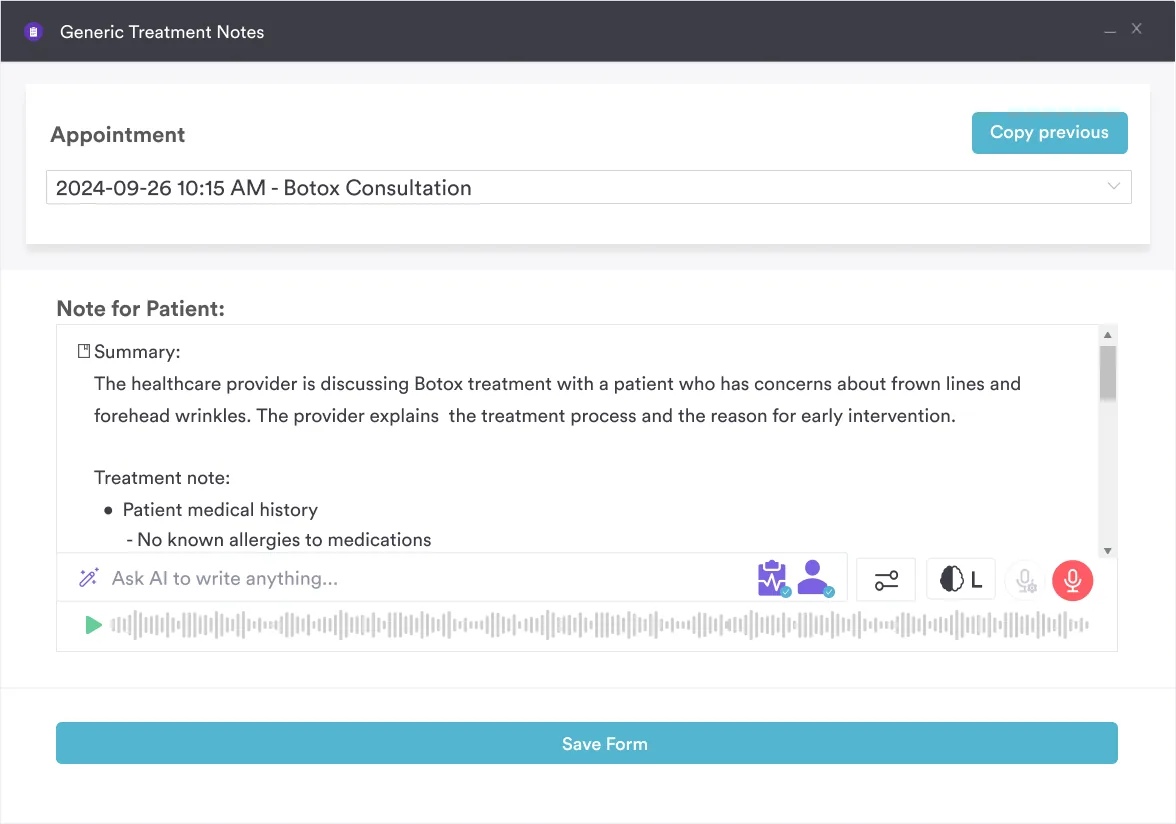
On the claims side, billing teams track submission status, flag denials, and resubmit with corrected documentation. Denial patterns broken out by CPT code show whether a documentation problem sits with one surgeon or across the practice.
From there.

Pabau captures the depth, size, and modifier detail that surgical excision codes depend on, at the point the operative note is written. Your billing team submits complete claims the first time, instead of chasing amendments after a denial.

Two checks decide whether a 21013 claim survives. Confirm the tumor sat below the fascia, and confirm the specimen measured under 2 cm. The diagnosis code, the modifiers, and the fee all follow from those two facts.
Fix the operative note template once and the same denials stop arriving. Adding depth language after a denial is slower and riskier, because payers flag amended operative notes.
Worth remembering on the money side: the office setting pays roughly $190 more than the ASC, and the 90-day global period already covers routine follow-up. Book a demo to see how Pabau keeps depth, size, and modifier detail in the record before a claim goes out.

Coding a benign lesion on the face instead? CPT code 11443 covers facial excisions where the dissection never reaches the fascia.
Removing a malignant lesion? CPT code 11624 sets out the size tiers and the margin documentation payers expect.
Operating on the maxilla? CPT code 21048 handles benign tumor and cyst excision in that region.
Excising on the trunk or limbs? CPT code 11400 shows how the size tiers work outside the head and neck.
Closing a larger wound after the excision? CPT code 12006 explains how repair length is measured and reported.
CPT code 21013 is a surgical billing code. It covers excision of a subfascial soft tissue tumor of the face or scalp measuring less than 2 cm. It sits in the musculoskeletal system section of the CPT code set maintained by the American Medical Association. The record must show the tumor was below the fascial layer, so either subgaleal or intramuscular.
Use CPT code 21013 when the tumor is subfascial and less than 2 cm. Use 21011 when the tumor is subcutaneous, meaning above the fascia, and less than 2 cm. Use 21014 when the tumor is subfascial but 2 cm or larger. Depth separates 21013 from 21011, and size separates it from 21014.
Modifier -22 covers increased procedural complexity, and -51 covers multiple procedures in one session. Modifier -59 applies to a distinct service at a separate anatomical site. Laterality modifiers -LT and -RT also apply on paired structures. Modifier -50 fits only when identical procedures are done on both sides in one session. Verify against current NCCI edits and payer policy first.
The 2026 national Medicare range for CPT code 21013 runs from roughly $500 to $700 in the non-facility setting. That reflects a non-facility total of 16.90 RVUs, including a malpractice RVU of 0.950, times the 2026 conversion factor. Facility rates are lower, because the practice expense component drops from 10.67 to 4.87. Check the CMS Physician Fee Schedule lookup for your locality code.
Yes. CPT code 21013 carries a 90-day global period, which classifies it as major surgery. Routine post-operative care in those 90 days is included in the payment and cannot be billed separately. An unrelated visit inside the window needs modifier -24, and a return to the operating room needs -78 or -79.
The operative note must document four elements. The first is tumor size under 2 cm, measured from the specimen. The second is the anatomical location on the face or scalp. The third is explicit depth language confirming dissection below the fascia. The fourth is submission of the specimen to pathology. Missing any one of them is enough for a payer to downcode or deny the claim.
Three pairings come up most. D21.0 covers a benign neoplasm of connective and soft tissue of the head, face and neck. D48.1 covers a neoplasm of uncertain behavior. M79.89 covers other specified soft tissue disorders. The diagnosis has to support medical necessity for a subfascial excision. A skin-only code from the L category does not establish that.