



HCPCS code E0198: Water pressure pad billing guide
HCPCS code E0198 is a water pad for a standard mattress HCPCS code E0198 is the ...

Last Updated: Oct 13, 2026
CPT code 43282 is the procedure code for laparoscopic surgical repair of a paraesophageal hernia with implantation of mesh, including fundoplasty when performed. Mesh is the only thing separating it from CPT 43281, which describes the same laparoscopic repair without mesh.
This reference covers the official descriptor, the modifiers that apply, and how Medicare pays the code by place of service. It also lists the ICD-10 codes that support medical necessity and the billing steps that keep the claim clean.

CPT 43282 describes laparoscopic paraesophageal hernia repair with mesh. Use CPT 43281 when no mesh is placed.
Modifier -22 applies when the procedure is substantially more complex than typical. Document the added time and complexity in the operative note.
Medicare pays 43282 at different rates in facility and non-facility settings, and geographic adjusters apply on top.
ICD-10 codes K44.0, K44.1, and K44.9 are the primary medical necessity codes for this procedure.
Practice management software like Pabau flags ICD-10 mismatches and modifier issues before the claim reaches the clearinghouse.
CPT code 43282 describes laparoscopy, surgical, repair of paraesophageal hernia, includes fundoplasty, when performed; with implantation of mesh. The American Medical Association maintains this descriptor within the Digestive System surgery section of the CPT code set. It is a Category I code, so it represents a procedure that is widely performed and backed by substantial clinical evidence.
The surgeon accesses the abdominal cavity laparoscopically and reduces the herniated stomach or other viscera back through the diaphragmatic hiatus. Mesh is then secured over the hiatus to reinforce the repair and lower the recurrence risk. Fundoplasty wraps the gastric fundus around the lower esophagus to address reflux. It is included in the code when performed, but 43282 applies whether or not it was done.
Three conditions must all hold before 43282 applies. The approach is laparoscopic, the hernia is paraesophageal rather than a simple sliding hiatal hernia, and mesh is implanted during the same operative session. A conversion to open surgery moves the claim to a different code family, and a repair without mesh is 43281.
When the operative note is ambiguous, work the three checks below in order and stop at the first one that fails.
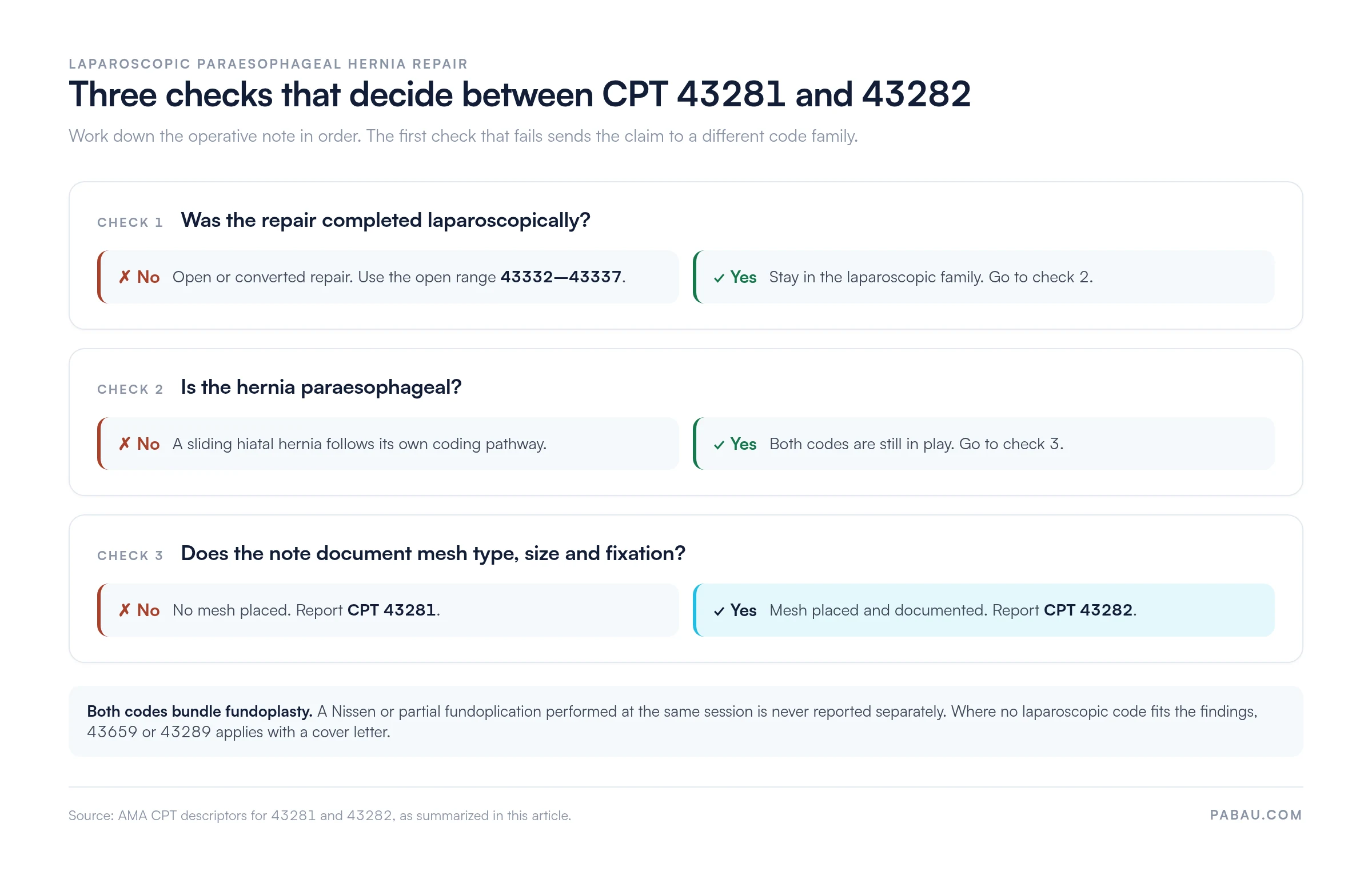
The only procedural difference between CPT 43281 and CPT 43282 is mesh. Both codes describe laparoscopic paraesophageal hernia repair. 43281 is reported when no mesh is implanted, and 43282 when mesh is. The common error is defaulting to 43281, which under-bills the procedure whenever the operative report documents mesh.
When reviewing the operative report, treat phrases such as “biosynthetic mesh,” “permanent polypropylene mesh,” or “biologic mesh secured with tacks” as the trigger for 43282. The AAPC’s CPT code lookup confirms mesh is the sole differentiator between the two codes.
Modifier selection for CPT 43282 depends on surgical complexity, setting, and whether additional procedures were performed. Incorrect modifier use is one of the top reasons this code is flagged in payer audits.
Modifier -22 is the most frequently misused. Payers want documentation that goes beyond checking a box. The operative note has to quantify the additional work, such as the time added, the extent of adhesions, or the prior repair anatomy encountered. Without that, the claim is reprocessed at standard rates or denied outright.
Medicare pays CPT 43282 under the Medicare Physician Fee Schedule (MPFS), and the rate differs by place of service. The CMS Physician Fee Schedule lookup tool is the authoritative source for current national and locality-adjusted payment amounts.
The facility rate applies when the procedure is performed in a hospital or ambulatory surgery center (ASC). The non-facility rate applies in a physician office setting, though this repair is rarely performed outside a facility. The non-facility rate is typically higher, because it accounts for the practice expense of maintaining procedure-room equipment.
Exact dollar values vary by geographic payment locality and change with each annual CMS update. Verify current rates against the CMS fee schedule lookup rather than a third-party rate table, which may lag by a year. The FastRVU 2026 RVU lookup calculates work, practice expense, and malpractice RVU values with locality adjusters applied.
Run a locality-specific fee schedule check before you sign with a new payer. Commercial payers often set their rate as a percentage of Medicare, so the Medicare benchmark for 43282 tells you whether the offer is reasonable. Check the facility and non-facility figures separately, because the two move independently.
Pairing CPT 43282 with the correct ICD-10-CM diagnosis code is what establishes medical necessity. A claim without a supporting diagnosis from the K44 diaphragmatic hernia category is denied or sent back for documentation. Check the pairing against your payer’s local coverage determination (LCD) first, since an LCD may restrict coverage to specific K44 subcategories.
K44.9 is the most common pairing for an elective laparoscopic paraesophageal hernia repair. K44.0 and K44.1 apply in acute or emergent settings where obstruction or vascular compromise is documented. K44 covers diaphragmatic hernias as a category, which is why paraesophageal hernias sit inside it. Pabau’s ICD-10-CM code library carries the wider K40–K46 hernia range, worth a look when the operative findings describe mixed hernia types.
A handful of billing patterns cause most denials on CPT 43282, and accurate documentation plus a pre-submission review prevents nearly all of them. A clean claim here means the right code, the correct modifier, a supporting ICD-10, and complete operative documentation before transmission.
Two payer policies come up repeatedly in the coding community around 43282. BridgeSpan Health publishes a reimbursement policy on hiatal hernia repair and gastropexy that sets out coverage criteria for mesh-reinforced repairs. EmblemHealth publishes a bariatric surgery denial policy that governs how hernia codes are processed alongside bariatric procedure codes. Read both provider policy libraries before submitting 43282 with any concurrent upper GI or bariatric code.
The denials that recur in practice trace back to four causes.
Routing 43282 denials by reason code shows a billing team which of the four causes is driving its rejections. That is what makes it possible to fix the cause instead of reworking each claim.
43282 sits within a family of laparoscopic upper GI procedure codes. Knowing how they relate helps a coder land on the right one when the operative findings are complex.
A code lookup ends at the descriptor. The claim still has to carry the right ICD-10 pairing, the correct modifier, and operative documentation that supports both. Practice management software like Pabau checks all three when the claim is created, rather than after the denial arrives.
Software that validates claims before submission does four jobs on a surgical claim like 43282.
Pabau integrates with the Claim.MD clearinghouse, processing claims across thousands of US payers and returning ERA data for payment reconciliation. A practice billing CPT 43282 can submit, track, and reconcile the claim in one place. That same system holds the patient record and the operative note the claim depends on.
Build a 43282 checklist into your pre-submission review. Confirm the mesh documentation is in the operative note, and verify the K44 ICD-10 code. Check for concurrent bariatric codes and the prior auth status on each. Review NCCI edits whenever a secondary procedure is on the claim. A few minutes at submission saves an appeal later.

Pabau flags ICD-10 mismatches, missing modifier documentation, and bundling conflicts before a claim reaches your clearinghouse. See how practices reduce surgical billing denials with a connected workflow.

CPT code 43282 pays or denies on the strength of one paragraph in the operative report. Mesh is what separates it from 43281, so the note has to name the product, its size, and how it was fixed.
Agree that standard with your surgeons before the next case, rather than reconstructing it during an appeal months later. Book a demo to see how Pabau checks a surgical claim’s codes, modifiers, and documentation before it goes out.

Need to understand how clearinghouse submissions work for surgical claims? Claim.MD clearinghouse guide explains how electronic claims reach payers and return ERA data for reconciliation.
Want to reduce claim denials across your surgical billing workflow? Denial codes in medical billing covers the most common CARC codes and how to respond to each.
Looking for guidance on revenue cycle management for your practice? What is revenue cycle management walks through the end-to-end billing cycle from eligibility to payment posting.
CPT code 43282 reports laparoscopic surgical repair of a paraesophageal hernia with implantation of mesh, including fundoplasty when performed. It applies when the approach is minimally invasive, the hernia is paraesophageal, and mesh is placed during the same operative session.
The difference is mesh. CPT 43281 covers laparoscopic paraesophageal hernia repair without mesh, and CPT 43282 covers the same procedure with mesh implantation. Both codes include fundoplasty when performed. Select 43282 only when the operative note documents mesh type, size, and fixation method.
In this repair, the surgeon reduces the stomach or other organs that have herniated through the diaphragmatic hiatus beside the esophagus. The hiatus is then reinforced with prosthetic or biologic mesh to prevent recurrence. The laparoscopic version of the repair is described by CPT 43282.
Three ICD-10-CM codes support CPT 43282. K44.9 covers diaphragmatic hernia without obstruction or gangrene, K44.0 adds obstruction, and K44.1 adds gangrene. K44.9 applies in most elective repairs, while K44.0 and K44.1 are used in acute presentations. Verify the pairing against your payer’s LCD before submitting.
It may be, but co-billing 43282 with bariatric codes such as 43775 or 43644 triggers denial review at some payers, including EmblemHealth. Prior authorization requirements also vary. Check the individual payer’s medical policy and obtain authorization before the procedure date when both codes will be submitted together.
The facility rate applies when 43282 is performed in a hospital or ASC. The non-facility rate applies in a physician office setting, and it is typically higher because it includes practice expense for office-based procedures. Exact rates depend on locality and the current CMS fee schedule. Use the CMS Physician Fee Schedule lookup tool for your locality.



