

CCSD code G5100: Bypass of duodenum billing guide
CCSD code G5100 bills a bypass that leaves the duodenum in place CCSD code G5100...

Last Updated: Oct 16, 2026
V5257 is the HCPCS Level II code for a hearing aid, digital, monaural, BTE. It describes one digital behind-the-ear device fitted to a single ear.
The code covers the device only. Audiology CPT codes report the fitting appointment, and the monaural dispensing fee is reported with V5241. The nearest neighbors are V5247, the digitally programmable analog BTE, and V5261, the digital binaural pair.
Let Pabau's smart automation suggest the right codes, reduce claim denials, and keep your practice compliant—effortlessly.
Automate repetitive tasks and focus on what matters most—your patients.
Reduce coding errors and ensure compliance with the latest regulations.
Clean claims, fewer denials, and faster reimbursements.
Powerful insights and reporting to help your practice thrive.
HIPAA compliant SOC 2 certified GDPR-compliant Trusted by 4,000+ clinics worldwide

HCPCS code V5257 describes a single-ear, digital, behind-the-ear hearing aid. It does not cover binaural fittings, analog aids, or accessories.
Traditional Medicare Part B excludes hearing aids under SSA §1862(a)(7). Verify Medicare Advantage or supplemental coverage before you bill.
Apply LT or RT modifiers when billing V5257 for a specific ear. Payer policy decides whether that means two line items or two units.
V5247 is the closest neighbor to V5257. It describes a digitally programmable analog aid rather than a digital one.
Practice management software like Pabau tracks V5257 claim status, flags missing documentation, and surfaces denials before the filing deadline.
HCPCS code V5257 covers a digital, monaural, behind-the-ear hearing aid. It is a permanent Level II code maintained by the Centers for Medicare and Medicaid Services (CMS). Specifically, the code sits inside the V5120-V5267 hearing aid range. In full, its official long descriptor is Hearing aid, digital, monaural, BTE.
Each term in the descriptor carries billing significance. Digital means the aid uses digital signal processing, so analog and digitally programmable analog aids fall under different V-codes. In turn, monaural means one ear only. Finally, BTE identifies the physical style, with the body of the device behind the ear and a tube or receiver routed into the canal.
V5257 covers a complete digital monaural BTE hearing aid dispensed and fitted by a qualified provider. In other words, the code represents the device itself, meaning the physical hearing aid unit delivered to the patient.
Several adjacent codes trip up billers who are not careful about the descriptor boundaries. Because of that, confirm each attribute before coding:
An analog pair fitted in both canals falls outside V5257 on technology, fitting, and style, so it is reported with V5249.
Supplies are billed separately from the device, so a replacement battery is reported with V5266 and not bundled into V5257.
The monaural codes line up on two axes, technology down the side and physical style across the top. As a result, reading them as a grid makes the neighbors of V5257 obvious.
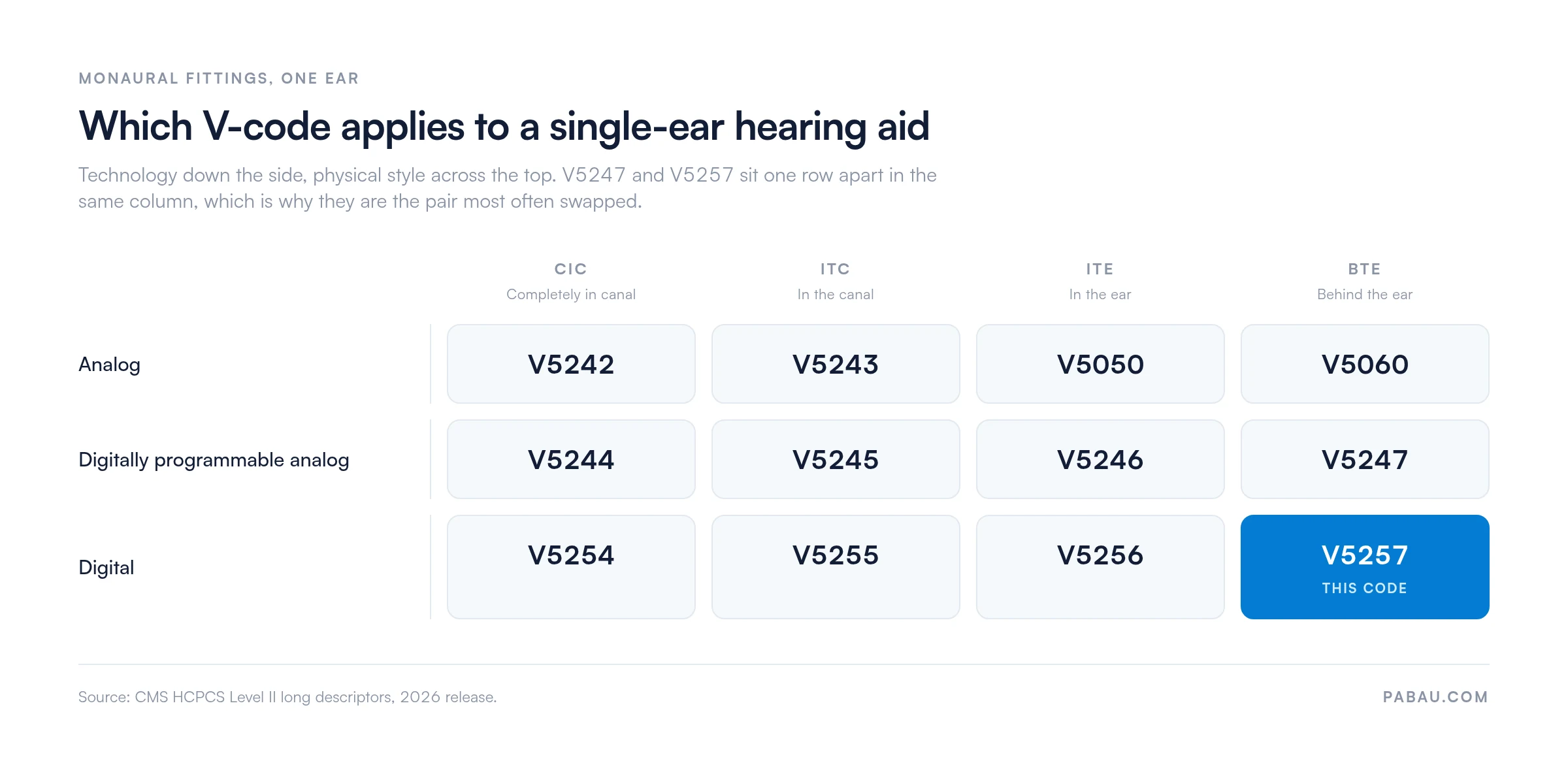
V5261 is the binaural counterpart to V5257. Specifically, it describes a hearing aid, digital, binaural, BTE, covering a matched pair fitted to both ears in a single dispense. Choosing between V5257 and V5261 is the most common coding question on this range, and the answer has payer-specific billing consequences.
Some commercial payers and Medicaid managed care plans prefer the binaural code when both aids are dispensed at the same encounter. In contrast, others require two V5257 claims with LT and RT modifiers. Either way, verify the payer’s hearing aid billing policy before submitting.
When billing V5257 for a bilateral fitting, LT (left side) and RT (right side) modifiers identify which ear each unit applies to. However, modifier application for hearing aid codes is payer-specific, and no universal rule covers every plan.
Pull the payer’s hearing aid billing guide or call provider relations to confirm the preferred approach before the first V5257 claim. Afterward, document the payer’s verbal confirmation in the patient account in case of a future audit.
A V5257 claim requires documentation that establishes medical necessity, provider qualification, and proof of dispensing. Missing one element is the most common trigger for non-clinical denials, so aim for a clean claim the first time.
Required documentation typically includes:
The claim also needs a diagnosis that supports the fitting, using the ICD-10 codes for conductive, sensorineural, and mixed hearing loss in the H90 and H91 categories. The audiogram on file has to support the degree of loss you report.
Who may bill V5257 depends on state licensure and payer credentialing. Audiologists can bill wherever they’re licensed to dispense hearing aids, and hearing instrument specialists can bill where state law permits independent dispensing.
Payer contracts may impose credentialing requirements beyond state licensure, so verify both the state and payer rule for every provider before the first claim.
Place of service (POS) codes should reflect where the fitting happened. Audiology offices typically bill POS 11, though some dispensing happens in hospital outpatient settings (POS 22) or the patient’s home. Payer rules on covered POS codes vary, so check before billing a non-standard location.
Prior authorization (PA) requirements for V5257 are payer-specific and change annually. For that reason, running insurance eligibility verification before the fitting appointment is the most reliable way to avoid a PA denial after the device is dispensed.
A PA request for V5257 usually needs three items. Specifically, those are the audiogram, the ordering provider’s documentation of medical necessity, and the device make and model. Turnaround at a commercial insurer commonly runs 5 to 14 business days, though it varies by plan. Either way, never dispense the device before the authorization is confirmed in writing.
Traditional Medicare Part B does not cover hearing aids. Specifically, the exclusion is statutory under Social Security Act §1862(a)(7), which lists hearing aids among the benefit categories excluded from Medicare coverage. As a result, no documentation, appeal, or medical necessity argument overrides that exclusion for fee-for-service Medicare.
Check the coverage before billing V5257 for any patient with Medicare as primary. In particular, confirm whether they carry Medicare Advantage, supplemental coverage, or secondary insurance that covers hearing aids. Otherwise, billing Part B without that check produces a predictable non-covered denial.
Traditional Medicare publishes no fee schedule rate for V5257, because the code sits outside the Medicare benefit. Instead, reimbursement comes from state Medicaid fee schedules and commercial payer contracts, and both vary widely.
For Medicaid, rates are set by each state program and updated on that state’s own schedule, often annually. Some states reimburse at acquisition cost plus a dispensing fee. In contrast, others use a fixed allowable amount regardless of device cost. State Medicaid portals publish their current hearing aid fee schedules, so check the relevant state agency website for the applicable year.
For commercial payers, reimbursement follows the practice’s contracted rate. Hearing aid rates are often set as a percentage of retail, or as a fixed allowable. In fact, they are negotiated separately from medical and surgical fee schedules.
V5257 has no Medicare Physician Fee Schedule entry, so no national benchmark exists to test a payer’s rate against. Instead, your contracts, the state Medicaid schedule, and the remittance advice on processed claims are the only reference points here.
Run a V5257 payment analysis in your practice management system before you renegotiate payer contracts. Filter remittance data by code for the prior 12 months and calculate the average allowed amount per payer. Your reimbursement baseline is that number rather than a published fee schedule.
V5257 denial patterns are predictable, and most fall into a small number of categories. Front-end process controls prevent more of them than back-end appeals do, so categorize every denial reason code for 90 days to find your practice’s root cause.
Tracking denials by reason code shows the pattern, such as one Medicaid MCO denying consistently for missing prior authorization while other payers pay without comment. Claims software for audiologists separates denials by code and reason, surfacing that pattern without a manual log review.
V5257 sits within a structured set of hearing aid HCPCS codes organized by technology, fitting, and physical style. The table below carries the codes most often confused with V5257, plus the dispensing and accessory codes around them; for the full range, use the AAPC HCPCS code lookup.
V5247 and V5257 are the pair most often swapped, since both describe a monaural BTE aid and only the technology word in the descriptor separates them.
V5247 is digitally programmable analog and V5257 is digital, so the manufacturer’s spec sheet decides the code; verify it against the NLM HCPCS Level II API before you commit.
A patient with profound loss in one ear needs a contralateral routing fitting, which no code in this table covers. CMS coded the in-the-ear BICROS version as V5210 until it deleted that code in 2019. The behind-the-ear BICROS aid sat under V5220, which CMS deleted on the same date in January 2019.
Assistive listening devices have their own codes just past this range, so a television caption decoder is reported with V5271.
In a hearing aid practice the code is chosen when the device is chosen, not when the claim is built, which puts coding accuracy in the audiologist’s hands as much as the biller’s. Treat the device selection note as a billing document.
Most audiology practices keep hearing aid claims in a spreadsheet beside the patient record. The audiogram sits in the chart, the authorization number sits in an email, and the serial number sits on a dispensing note. As a result, nobody sees all three together until a denial arrives.
Pabau keeps the patient record and the claim in one system. In practice, the audiogram, the order, the fitting note, and the device serial number attach to the same patient file the claim is built from. As a result, your biller can confirm the file is complete before a V5257 claim leaves the practice.
Claims are then submitted and tracked from the same screen, and every remittance posts back against the code it paid. As a result, that gives you a running view of what each payer allows for V5257, and which plans deny it most often. In turn, your team works the denials that matter instead of rebuilding the history by hand.

Pabau’s claims management tools help audiology practices track hearing aid claim status, flag missing documentation before submission, and resolve denials faster. See how it works for your practice.

V5257 is a simple code with an unusual problem. In practice, the payer, not the clinical picture, decides whether it is payable at all. Confirm the benefit before the fitting appointment and most of the denial risk goes away.
The trade-off worth remembering is timing. In practice, verifying coverage, getting authorization in writing, and confirming the payer’s bilateral billing format all happen before the device is ordered. If you skip that work, the same effort moves to an appeal instead, where the money is already at risk.
Make the verification step a hard requirement in your scheduling workflow and the rest of the V5257 process follows it. Book a demo to see how Pabau tracks hearing aid claims from the fitting appointment through to the posted payment.

Need to understand how HCPCS claims move through the clearinghouse? Medical claims clearinghouse overview explains how electronic claims are validated, corrected, and transmitted to payers.
Seeing repeated denials across multiple codes? Superbill documentation guide covers how to structure charge capture so coding accuracy is built into the clinical workflow.
Want to understand revenue leakage in audiology billing? Medical billing workflows explained covers the end-to-end process from charge entry to payment posting.
HCPCS code V5257 is the Level II code for a hearing aid, digital, monaural, BTE. It covers a single-ear digital behind-the-ear device dispensed to a patient. Audiologists and hearing instrument specialists bill it within the V5120-V5267 hearing aid range.
Yes, though modifier handling is payer-specific. Most commercial payers want two separate line items, V5257-LT and V5257-RT, each with one unit. Some accept two units on a single line without laterality modifiers. Check the payer’s hearing aid billing guide before submitting.
No. Traditional Medicare Part B excludes hearing aids under SSA §1862(a)(7), so Part B claims are denied as non-covered. Medicare Advantage plans vary, and many include a hearing aid benefit with their own coverage rules and authorization requirements. Verify the patient’s plan before dispensing.
You need a current audiogram, a signed physician or audiologist order, a dispensing note proving the fitting, and the device serial number. Some payers also want a certificate of medical necessity or an acquisition cost invoice. Review each payer’s hearing aid coverage policy before billing.
Most V5257 denials come from a handful of causes. A non-covered benefit, a missing prior authorization, and modifier or units errors on bilateral claims lead the list. A missing or expired audiogram, late filing, and coordination of benefits sequencing follow. Front-end eligibility checks prevent most of them.



