CPT code 93503: Swan-Ganz catheter billing and modifiers
CPT code 93503: Official descriptor and procedure overview In the AMA CPT code s...

Last Updated: Oct 23, 2026
Billable Code
V2610 is the HCPCS Level II code for single lens spectacle mounted low vision aids. It covers a device with one lens element, fitted in a spectacle frame and prescribed for vision loss that standard glasses can't correct.
V2610 sits in the V2600 to V2615 low vision aid range. Hand-held and other non-spectacle-mounted aids go under V2600, and telescopic and compound systems (V2615) have their own code. Traditional Medicare denies V2610 as noncovered, so most claims go to Medicaid, Medicare Advantage or commercial plans.
Let Pabau's smart automation suggest the right codes, reduce claim denials, and keep your practice compliant—effortlessly.
Automate repetitive tasks and focus on what matters most—your patients.
Reduce coding errors and ensure compliance with the latest regulations.
Clean claims, fewer denials, and faster reimbursements.
Powerful insights and reporting to help your practice thrive.
HIPAA compliant SOC 2 certified GDPR-compliant Trusted by 4,000+ clinics worldwide

HCPCS code V2610 covers a single lens spectacle mounted low vision aid, distinct from hand-held aids (V2600) and telescopic or compound systems (V2615).
Traditional Medicare denies V2610 as noncovered, so claims typically go to Medicare Advantage vision plans, Medicaid, or commercial insurers.
Documentation must include a low vision evaluation report with best-corrected visual acuity measurement, a written prescription, and a qualifying ICD-10 H54 series diagnosis code.
An eligibility check before dispensing and a claim-detail check before submission stop most avoidable V2610 denials, and Pabau’s claims management software runs both.
HCPCS code V2610 is defined by the Centers for Medicare and Medicaid Services as “single lens spectacle mounted low vision aids.” Every word in that descriptor carries a billing implication.
“Single lens” rules out binocular or bilateral systems. “Spectacle mounted” rules out hand-held magnifiers, stand-mounted devices, and telescope systems billed under other codes. “Low vision aid” confirms the clinical classification: the device must be prescribed to address a low vision condition, not simply to correct ordinary refractive error.
V2610 is a supply code under HCPCS Level II, maintained by CMS alongside all other V-series vision codes. It is billed by the supplier or dispensing provider, not by the prescribing clinician.
That two-provider distinction matters. The optometrist or ophthalmologist who conducts the low vision evaluation and writes the prescription bills separately using the appropriate evaluation CPT code. V2610 covers only the device itself.
A device qualifies under V2610 when it meets all three criteria at once. It uses a single optical lens element, and it is mounted in a spectacle frame worn on the face. It is also prescribed as a low vision aid for vision loss that standard spectacles cannot adequately correct.
Devices that meet two of the three criteria but not the third belong under a different code.
Covered under V2610:
Not covered under V2610:
A telescopic or compound device billed as V2610 is a wrong-code denial waiting to happen. Review the dispensing record and prescription before submitting.
The V2600 to V2615 range covers low and near vision aids as a group. The table below shows the key codes in this range and the differentiators that drive code selection. According to the AAPC HCPCS code reference, each code in this range reflects a specific combination of lens count, mounting type, and optical design.
The V2610 row is highlighted because it is the code most often confused with V2615. The difference is the optics. V2610 uses a single lens element with no compound or telescopic design. If the device uses two or more lens elements in a telescopic or compound arrangement, V2615 applies instead, whether or not it is frame-mounted.
Medical necessity for V2610 is established through an ICD-10 diagnosis code from the H54 series, which covers visual impairment including blindness and low vision.
The payers that cover low vision aids set their own clinical threshold for best-corrected visual acuity (BCVA). It is typically 20/70 or worse in the better eye with standard spectacles, but the exact cutoff varies by payer.
Always verify the applicable LCD or payer policy for the jurisdiction before submitting.
Commonly accepted ICD-10 codes that support V2610 claims include:
A V2610 claim that carries only the underlying diagnosis, with no H54 code, leaves the low vision classification unstated. Payers need it explicit on the claim. Sound medical billing compliance means confirming the H54 code is there before submission, not after a denial arrives.
Traditional Medicare Part B excludes most spectacle and eyeglass supplies under the statutory eyeglass exclusion (42 U.S.C. § 1395y(a)(7)). The DME MAC Refractive Lenses policy article (A52499, tied to LCD L33793) names V2610 among the low vision aids it denies as noncovered. Medicare’s prosthetic lens benefit only reaches patients with a congenitally absent or surgically removed lens.
So a V2610 claim sent to traditional Medicare comes back as a noncovered benefit, not a coding error. Knowing this before you submit saves a wasted claim cycle and lets you set the patient’s cost expectations at the fitting.
Coverage pathways that do apply include:
Fee schedule reimbursement rates for V2610 are published annually in the CMS DMEPOS fee schedule files, available through the CMS HCPCS code sets page. Rates are jurisdiction-specific and updated each January. For 2026 rates, check the current CMS DMEPOS fee schedule file for your Medicare administrative contractor (MAC) jurisdiction. Third-party fee schedule tools may lag CMS publication dates.
A dependable revenue cycle management workflow for V2610 starts with payer verification before the device is dispensed.
Every element below must be on file before a V2610 claim is submitted. Low vision aids carry statutory coverage limits, so the payers that do cover them tend to review the file closely.
Capturing the evaluation, the prescription, and the patient’s acknowledgment of receipt on digital forms at the point of care keeps the file complete. It also leaves an audit trail ready for the day a payer requests records.
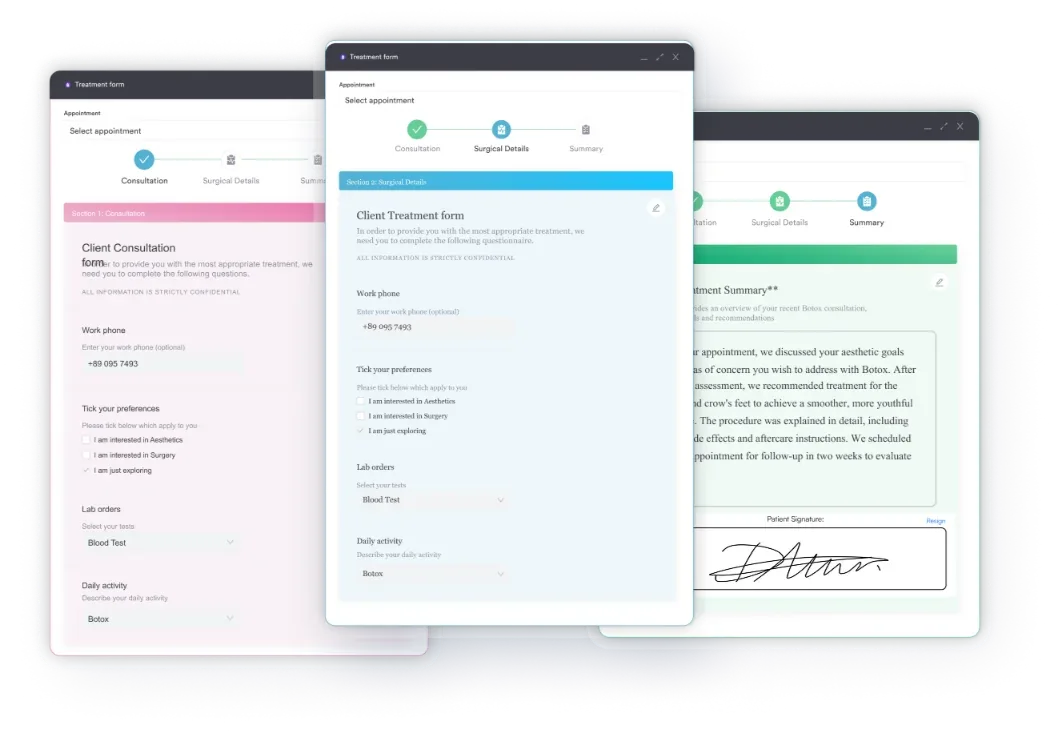
Run a five-point check on every V2610 claim before submission. Confirm the low vision evaluation date, the BCVA measurement, the H54 diagnosis code, the product description, and the supplier’s NPI status.
Traditional Medicare fee-for-service does not require prior authorization (PA) for V2610 because Part B treats the code as noncovered. PA becomes relevant when a Medicare Advantage plan, Medicaid managed care organization, or commercial insurer covers the benefit.
Payer-specific PA requirements vary widely. Medicare Advantage plans with vision riders typically require PA before dispensing. The prescribing provider or the supplier submits the request, depending on the plan’s rules. Medicaid managed care organizations follow state-specific protocols, and some require PA from the Medicaid agency rather than the managed care plan itself.
Keep a PA tracking log tied to the patient record. It timestamps when authorization was requested and approved, which is the record an auditor will ask to see.
V2610 denials follow a predictable pattern, and the six reasons below cover most of them. Denial management in healthcare starts with knowing which denials to expect and adding workflow steps that prevent them upstream. Our guide to denial codes for billers lists the claim adjustment reason codes (CARCs) used in remittance advice.
A clean claim for V2610 resolves every row in the denial table above before submission. Claims management software can run part of that review for you, checking required claim details before the claim goes out.
Code selection errors within the V2600 to V2615 range are a frequent cause of V2610 denials. The comparison below sets V2610 against its two neighbors.
Review the dispensing record against the device description to confirm the correct code before billing. The same logic runs through medical billing for every HCPCS supply category. The code must match the device supplied, not the closest approximation.
The classic wrong-code scenario: A prescriber writes “spectacle low vision aid” and the supplier bills V2610. If the device dispensed is a bioptic or telescopic system, V2615 is correct. Verify the code against the product invoice and lab order, not the prescription language alone. Two questions about the device settle the choice.
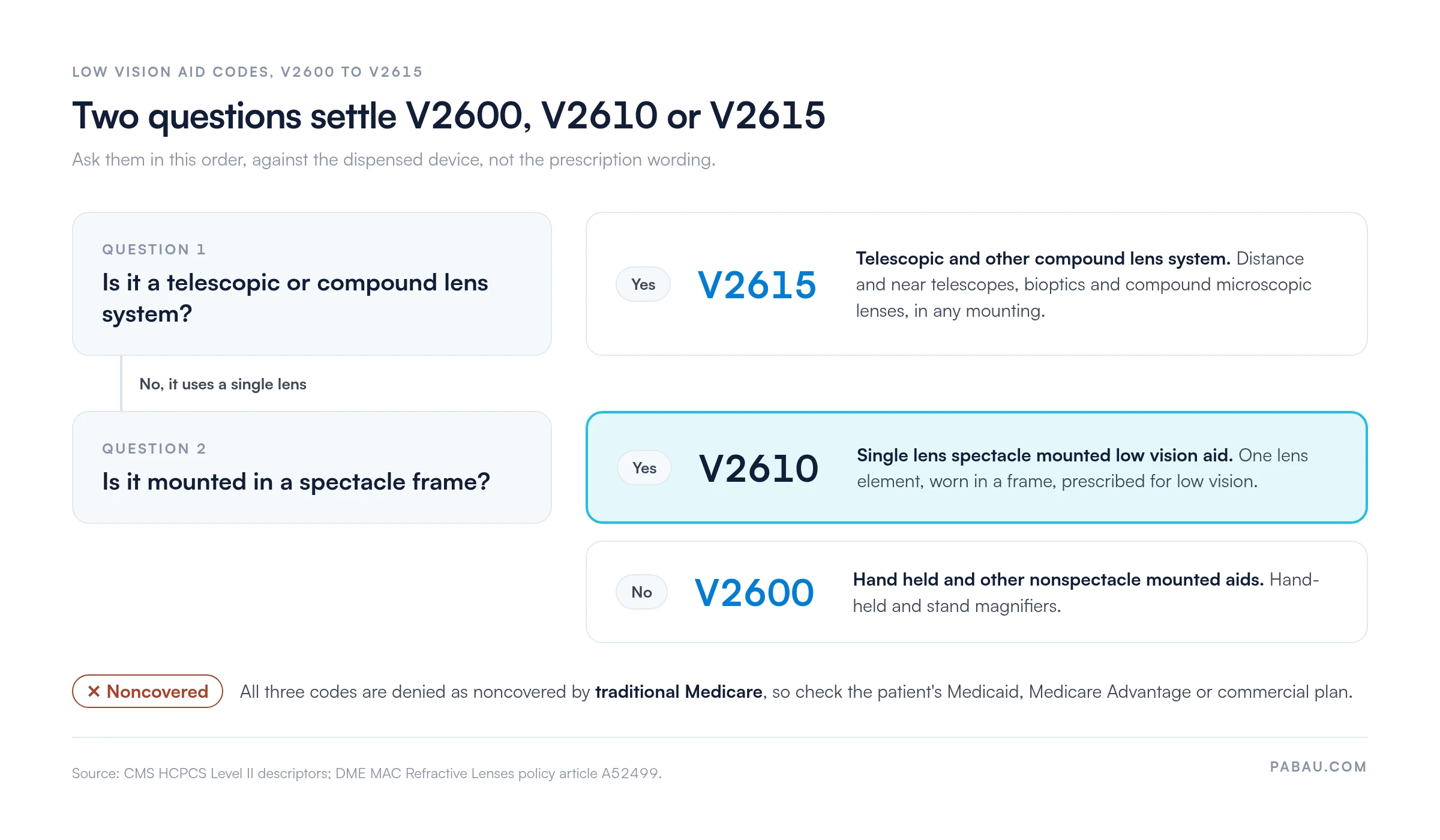
Run them against the dispensed device every time, since a frame-mounted telescope still takes V2615.
V2610 is a supply code billed by the dispensing supplier. The eye exam or evaluation is billed separately by the evaluating clinician on a different claim. Typical codes are 92002/92004 for new patients and 92012/92014 for established patients.
These two billing streams do not bundle under standard NCCI edits because they involve different billing entities. The clinician bills the evaluation, and the supplier bills the device.
Where bundling risk does arise is when a single practice both evaluates and supplies the device. In that case, the evaluation CPT code and the V2610 supply code may appear on claims from the same NPI.
National Correct Coding Initiative (NCCI) edits are updated quarterly by CMS. Verify current NCCI edits for the CPT code paired with V2610 before submitting both on the same claim or date of service.
When in doubt, submit the evaluation CPT code and the V2610 supply code on separate claims from their respective billing entities.
The PGM Billing HCPCS lookup tool provides current code pairing and bundling flags that practitioners can cross-reference against the NCCI quarterly updates. For practices managing multi-provider billing, superbill documentation that clearly separates evaluation services from device supply prevents inadvertent bundling issues during claims submission.
When the same practice both conducts the low vision evaluation and dispenses the V2610 device, assign separate billing responsibilities with distinct NPIs where possible. Submit the evaluation CPT code and the V2610 supply code on separate claims. Document the device receipt signed by the patient on the supply claim file. This separation keeps NCCI review straightforward.
Without a connected system, a V2610 file lives in three places. The evaluation sits in the exam notes, the prescription in a scanned folder, and the coverage check in a phone log. The claim only shows what someone remembered to copy across.
Pabau, the practice management platform we build, keeps those records on the patient file and sends the claim from the same system. In the US it connects to the Claim.MD clearinghouse. Your team can run a real-time eligibility check before the aid is ordered, then submit the claim electronically.
Before a claim goes out, Pabau checks that required details such as membership numbers and authorization codes are filled in. The Send button stays disabled until they are. Each claim then carries a live status from pending to paid, and ERA remittances post against the right invoice.

Pabau’s claims management software checks eligibility, validates claim details before submission, and tracks every claim’s status in one dashboard.

Picking V2610 is the easy part. If the aid is a single lens in a spectacle frame, prescribed for low vision, it is V2610. If not, it belongs under V2600 or V2615.
The decision that saves the most rework comes before dispensing: Confirm who will pay. Traditional Medicare denies V2610 as noncovered, so route the claim to the patient’s Medicaid, Medicare Advantage or commercial plan. Get prior authorization wherever that plan asks for it.
If your practice both evaluates and dispenses, keep the exam code and the V2610 supply code on separate claims unless NCCI edits allow them together. Book a demo to see how Pabau checks eligibility and claim details before your low vision aid claims go out.

Need a structured framework for managing claim denials? Denial management in healthcare covers the workflow steps and CARC code patterns that reduce denial rates across HCPCS supply categories.
Want to understand the full claim lifecycle from submission to payment? What is revenue cycle management explains the end-to-end process that connects V2610 submissions to collected revenue.
Looking for HCPCS billing compliance guidance? Medical billing compliance outlines the documentation and audit-readiness standards that apply to DMEPOS supply codes.
Coding the diagnosis behind a low vision aid claim? ICD-10 code H54.3 covers unqualified visual loss in both eyes and when it applies.
HCPCS code V2610 covers a single lens spectacle mounted low vision aid. That is an optical device with one lens element, fitted into a spectacle frame and prescribed for a qualifying low vision condition. It does not cover binocular devices, telescopic systems, or hand-held magnifiers, which fall under separate codes in the V2600 to V2615 range.
Traditional Medicare Part B generally does not cover V2610 due to the statutory eyeglass exclusion that applies to most spectacle supplies. Coverage is available through Medicare Advantage plans that include a vision rider, through state Medicaid programs, and through commercial insurance plans with low vision benefits. Always verify the specific plan’s coverage before dispensing the device.
V2610 is a single lens low vision aid mounted in a spectacle frame. V2615 is a telescopic or compound lens system, such as a bioptic telescope or a compound microscopic lens. If the device uses more than one lens element in a telescopic or compound design, bill V2615.
Required documentation includes a low vision evaluation report with documented best-corrected visual acuity and a signed written prescription from a qualified provider. The file also needs a qualifying ICD-10 H54 diagnosis code, a detailed description of the device dispensed, and proof of the supplier’s current DMEPOS enrollment. All five elements must be on file before the claim is submitted.
Two common denial reasons are a claim sent to traditional Medicare Part B, which excludes the benefit, and a missing or outdated evaluation report. Others include a diagnosis with no qualifying H54 code, the wrong code for a binocular or telescopic device, and a supplier not enrolled for DMEPOS. Fixing those issues before submission prevents most V2610 denials.
Yes, but typically on separate claims from different billing entities. The evaluating clinician bills the low vision evaluation CPT code, and the dispensing supplier bills V2610 for the device. When a single practice provides both services under one NPI, check current NCCI edits before pairing the codes on the same claim.