

CPT Code 30801: Superficial turbinate ablation billing guide
CPT Code 30801: Official descriptor and procedure overview The American Medical ...

Last Updated: Nov 27, 2026
T2044 is the HCPCS Level II code for hospice inpatient respite care, billed per diem. It covers a short inpatient stay that gives a hospice patient's family caregiver temporary relief, with one unit for each day.
T2044 sits in the T-code series, so Medicare does not recognize it. Confusion between Medicare and Medicaid hospice billing is a frequent documentation mistake for this code. Claims are also denied for a missing hospice election statement, days beyond the authorized limit, or the wrong modifier for the state plan.
Let Pabau's smart automation suggest the right codes, reduce claim denials, and keep your practice compliant—effortlessly.
Automate repetitive tasks and focus on what matters most—your patients.
Reduce coding errors and ensure compliance with the latest regulations.
Clean claims, fewer denials, and faster reimbursements.
Powerful insights and reporting to help your practice thrive.
HIPAA compliant SOC 2 certified GDPR-compliant Trusted by 4,000+ clinics worldwide

T2044 is the HCPCS code for hospice inpatient respite care, billed per diem to state Medicaid programs, and Medicare does not pay it.
One billing unit equals one day, and Medicare limits inpatient respite to five consecutive days at a time, while state Medicaid limits vary.
Missing hospice election statements, stays beyond the authorized day limit, and absent prior authorization are leading triggers of T2044 denials.
Claims management software such as Pabau keeps per-diem units, authorization details, and denied claims on one record.
HCPCS Code T2044 is the HCPCS Level II code for hospice inpatient respite care, billed per diem to state Medicaid programs.
CMS’s January 2027 HCPCS file lists it as “Hospice inpatient respite care; per diem” and marks it as not payable by Medicare. It belongs to the T-code series, T1000 to T9999, which the Centers for Medicare and Medicaid Services (CMS) maintains for state Medicaid agencies.
A T2044 claim sent to a Medicare contractor is rejected outright.
The official descriptor for T2044 is: Hospice inpatient respite care; per diem. Each part of that descriptor affects billing. “Inpatient” distinguishes it from home-based or outpatient respite. “Respite care” specifies that the admission purpose is caregiver relief, not a clinical deterioration. “Per diem” sets the billing unit at one day regardless of hours of care delivered within that day.
T2044 covers short-term inpatient respite care for a hospice patient in a licensed facility. It lets the primary family caregiver rest or attend to other responsibilities. The caregiver’s need for temporary relief drives the admission. When the patient’s symptoms need inpatient management instead, the stay bills as general inpatient care under T2045.
Several scenarios fall outside T2044’s scope and are common sources of overbilling errors. Knowing these boundaries prevents denials before the claim goes out.
T2044 per diem billing assigns one billing unit per calendar day of respite care. A five-day stay generates five units billed on a single claim line or on separate lines depending on state Medicaid claim submission rules. Using claims management software that tracks per-diem billing windows reduces the risk of day-count errors across multi-day stays.
The five steps below take a T2044 claim from the eligibility check to submission.
Place of service (POS) codes vary by setting. Inpatient hospice units typically use POS 34, hospitals use POS 21, and SNFs use POS 31. Confirm the correct POS with the applicable state Medicaid billing manual before submission.
Audit your T2044 claims monthly against the authorization window. Per-diem codes are easy to over-bill when a stay extends by one or two days beyond the approved period. Build an alert into your billing workflow that flags claims where the number of units exceeds the authorized days.
Modifier requirements for T2044 vary by state Medicaid plan and by managed care organization. No single modifier is universally required, but several appear frequently and their absence triggers denials.
Always confirm modifier requirements against the specific state Medicaid billing manual or managed care organization contract. Blanket application of a modifier that the payer has not requested is itself a denial trigger.
Documentation gaps are a leading cause of T2044 denials. The medical record must support both the hospice benefit election and the purpose of the admission as caregiver relief. Sound medical billing compliance practices assemble this documentation before the claim goes out, so nobody has to retrieve it after a denial.
Prior authorization requirements for T2044 are payer-specific. Fee-for-service Medicaid in some states does not require prior authorization for inpatient respite within the standard day limit. Medicaid managed care organizations (MCOs) are more likely to require it, and the authorization window often mirrors the allowed stay duration.
Contact the state Medicaid plan or MCO before the admission. Confirm whether prior authorization is required, the day limit, and the documentation needed to support the request.
T2044 and S9125 are both HCPCS Level II codes used for respite care, but they describe different service structures and are not interchangeable. Miscoding between them is a frequent audit finding. Use the AAPC HCPCS code lookup to verify current descriptors before making a code selection.
T2044 is for inpatient, facility-based respite under Medicaid, and S9125 describes home-based respite. Revenue code 0655 belongs to Medicare hospice billing. Submitting T2044 to Medicare or using S9125 for an inpatient stay both cause denials, and the diagram below shows the order of the decision.
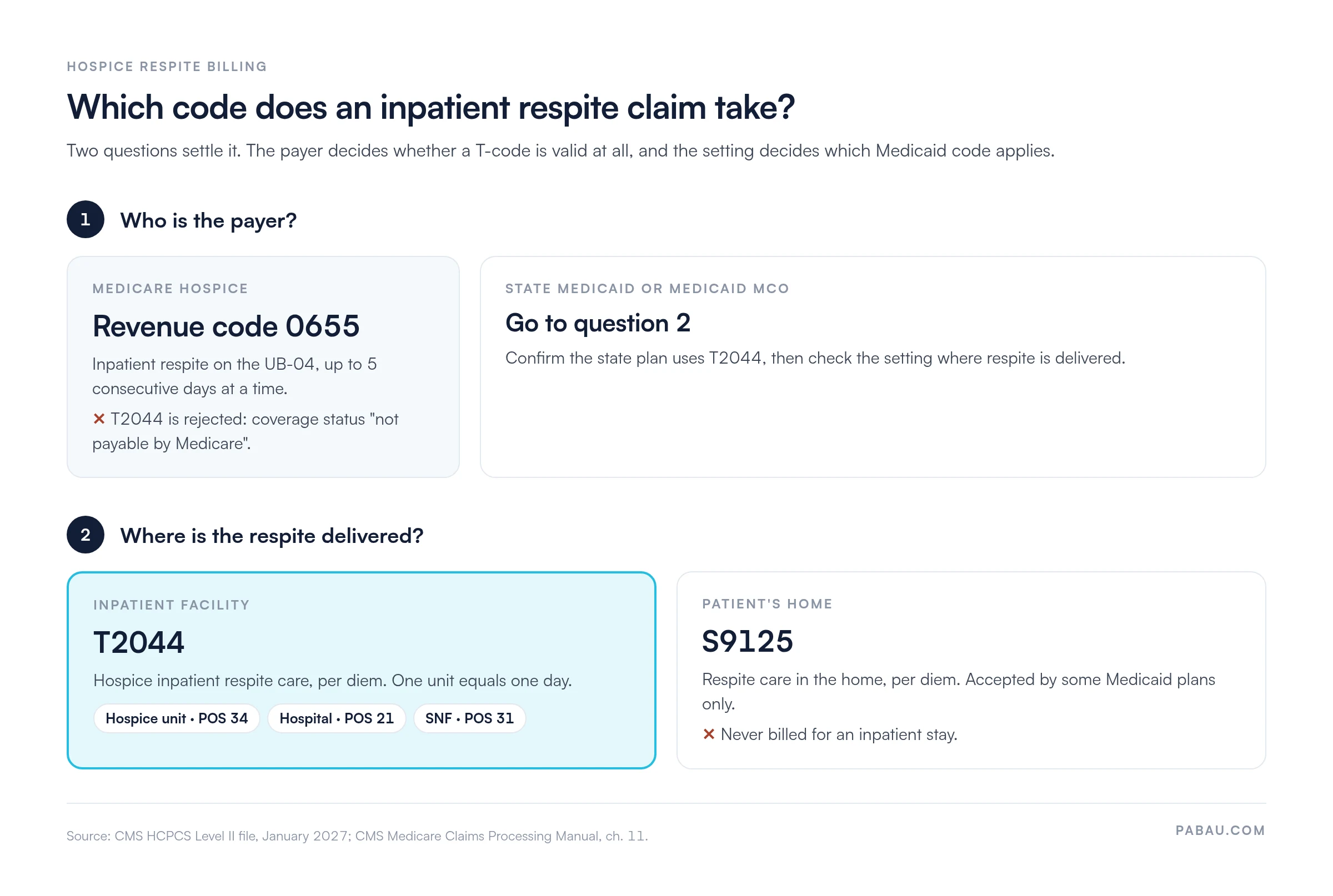
T2044 also sits beside the other hospice level-of-care codes. Routine home days bill under T2042, so the day a patient returns home from respite moves back to that code. Medicare follows the same rule and pays the discharge day at the routine home care rate.
T2044 claims fail for predictable reasons. The table below maps the most frequent denial triggers to their root causes and the corrective action needed. Tracking denial patterns against denial codes in medical billing helps identify whether a problem is systematic or case-specific.
T-codes are adopted at state discretion, so T2044 billing rules depend on the state. Not every state Medicaid program uses T2044. Among those that do, coverage rules, reimbursement rates, day limits, and authorization requirements differ materially.
Several practical realities follow from this variation:
The CMS HCPCS overview explains the structure of the T-code series and CMS’s role in maintaining HCPCS Level II. For state-specific rates and coverage rules, go to the state Medicaid agency’s billing manual or fee schedule. Each state publishes both on its Medicaid program website. For quick code verification, the PGM Billing HCPCS lookup provides free access to CMS-sourced code data.
Before billing T2044 in a new state, download the state Medicaid billing manual. Check whether T2044 is an active code, the current reimbursement rate, and the authorization rules. Build a one-page state-specific billing reference sheet and update it annually when fee schedules refresh.
Hospice billing teams often track T2044 authorizations in a spreadsheet beside the claim system. The day count, the authorization number, and the election statement sit in different places. A stay that runs one day long then surfaces only as a denial.
Pabau’s claims management software keeps the patient’s documents, the authorization details, and the claim on one record. Billers can check the units on a T2044 claim against the approved days before it goes out. Denied claims sit in one queue for follow-up.
The outcome is fewer per-diem denials and less time spent rebuilding paperwork for appeals.

Pabau’s claims management tools track per-diem billing, authorization windows, and denial queues in one place so your billing team spends less time chasing paperwork.

Treat T2044 as a payer-and-setting decision first and a per-diem code second. Before the patient is admitted, confirm that the state plan uses the code, the stay is inpatient, and the hospice election is on file.
The day count needs the same care. Match the units to the authorization, and check how the state bills the day the patient returns home.
Book a demo to see how Pabau keeps hospice authorizations, documents, and per-diem claims on one record.

Need a foundation in Medicaid claim submissions? Medical billing fundamentals explains how claims move from service to payment across payer types.
Getting systematic denials across your hospice billing? Denial management in healthcare covers root-cause analysis and appeal workflows for common denial patterns.
Want to understand the codes that appear on remittance advice? Electronic remittance advice explains ERA formats and how to read CARC and RARC codes that accompany T2044 denials.
HCPCS Code T2044 is a Medicaid-specific billing code for hospice inpatient respite care, billed on a per-diem (per day) basis. It belongs to the HCPCS Level II T-code series and is not recognized by Medicare. The code is used when a hospice patient is admitted to an inpatient facility so the primary caregiver can receive temporary relief.
T2044 is billed per diem, meaning one billing unit equals one calendar day of inpatient respite care. A five-day respite stay generates five units. Some state Medicaid billing manuals allow all days to appear on a single claim line; others require separate lines per day.
T2044 covers inpatient facility-based hospice respite care; S9125 covers home-based respite care. Both are per-diem codes used by some Medicaid programs, but their settings are mutually exclusive. Using S9125 for an inpatient stay or T2044 for a home-based service is a miscoding error that causes a denial.
Prior authorization requirements vary by state Medicaid plan and managed care organization. Fee-for-service Medicaid may not require pre-authorization within the standard day limit, while MCOs typically do. Always confirm authorization requirements with the specific payer before the patient is admitted to avoid a retrospective denial.
Common modifiers include the state-specific U-series (U1 through U9 and UA through UD). TF marks intermediate care levels, and TG marks complex or high-tech care. Modifier requirements are payer-specific; check the applicable state Medicaid billing manual or MCO contract to confirm which modifiers are required for each claim.
The most frequent denial reasons are missing prior authorization, billing beyond the authorized day limit, and a missing hospice election statement. An incorrect modifier, the wrong place of service code, or a payer that does not recognize T-codes, including Medicare, also causes denials. Check each element before submission rather than after a denial.




