HCPCS Code T2042: Hospice routine home care billing guide
HCPCS Code T2042: Official descriptor and coverage definition HCPCS Code T2042 i...

Last Updated: Nov 2, 2026
T2045 is the HCPCS Level II code for hospice general inpatient care, billed per diem. It covers one calendar day of inpatient hospice care for pain or acute symptoms that cannot be managed in any other setting.
The hospice bills T2045 on a UB-04 with revenue code 0656 and one unit per day. Medicaid managed care and commercial plans use the code, while Medicare fee-for-service pays GIP without it.
Let Pabau's smart automation suggest the right codes, reduce claim denials, and keep your practice compliant—effortlessly.
Automate repetitive tasks and focus on what matters most—your patients.
Reduce coding errors and ensure compliance with the latest regulations.
Clean claims, fewer denials, and faster reimbursements.
Powerful insights and reporting to help your practice thrive.
HIPAA compliant SOC 2 certified GDPR-compliant Trusted by 4,000+ clinics worldwide

HCPCS code T2045 bills one calendar day of hospice general inpatient care (GIP), and the hospice submits the claim rather than the facility.
A patient qualifies for GIP only when pain or acute symptoms cannot be managed in any other setting, per 42 CFR §418.108.
T2045 is mainly a Medicaid managed care and commercial payer code. Medicare fee-for-service pays GIP at its own per diem rate instead.
On the UB-04, a T2045 line carries revenue code 0656, bill type 081X and one unit per calendar day.
Most denials come from billing respite care (T2044) in place of T2045, or from a missing Notice of Election (NOE).
HCPCS code T2045 is the HCPCS Level II code a hospice uses to bill one day of general inpatient care (GIP). Its official descriptor reads “Hospice general inpatient care; per diem.” GIP is short-term inpatient care for pain or symptoms that no other setting can manage.
T2045 sits in the T-code series, which covers state Medicaid agency and managed care services that CPT and other HCPCS sections leave out. That is why Medicaid managed care and commercial plans ask for it, while Medicare fee-for-service does not.
CMS maintains the series and updates it every year through the CMS HCPCS Level II code system. Our searchable HCPCS code library lists the other T-codes next to T2045.
T2045 is active for 2026 with no changes to its descriptor or status from the prior year. The table below places it within the T2042-T2046 hospice family and shows each code’s billing unit.
T2045 reimburses one calendar day of general inpatient hospice care. That day covers the full scope of GIP services the hospice interdisciplinary group (IDG) delivers in an inpatient setting.
Covered under T2045:
Not covered by T2045:
The distinction between T2044 and T2045 is the most common source of wrong-code denials. Respite care (T2044) is time-limited relief for the primary caregiver. General inpatient care (T2045) is for acute medical crisis management the patient cannot receive at home. The clinical reason for admission determines which code applies.
A patient qualifies for GIP when pain or acute symptom management requires inpatient-level care that cannot be provided in the home or any other setting. This threshold is set by federal regulation at 42 CFR §418.108 and must be documented before every GIP admission.
The hospice IDG must determine that GIP is necessary and the plan of care must reflect that determination. CMS audits routinely look for the following documentation elements to support GIP necessity.
GIP is intended as short-term. Extended stays are subject to clinical review by the payer. Some managed care plans impose internal day limits on GIP authorization, so check payer-specific hospice clinical policies before admitting patients for extended GIP stays.
T2045 is billed per diem, so one unit equals one calendar day of GIP care. The hospice provider submits the claim, not the hospital or SNF where care is delivered. When a patient receives GIP in a hospital, the hospital bills its facility costs separately and the hospice bills T2045 for its own services.
Claims go on the UB-04 (CMS-1450) institutional claim form. If institutional claims are new to your team, start with these medical billing fundamentals. The table below summarizes the key UB-04 fields for T2045 claims, based on CMS hospice claim requirements.
A Notice of Election (NOE) must be filed with the payer before any hospice claim, including T2045, can be reimbursed. Without a timely NOE, the hospice cannot receive payment for any level of care. Billing teams that track NOE status in denial-reducing claims software can confirm it before a GIP claim goes out.
Before submitting T2045, run a four-point pre-claim check. Confirm the NOE was filed and accepted, the revenue code is 0656, and the billing NPI belongs to the hospice. Then check that units count individual calendar days rather than one lump total. Catching these at submission takes minutes, while catching them at denial takes weeks.
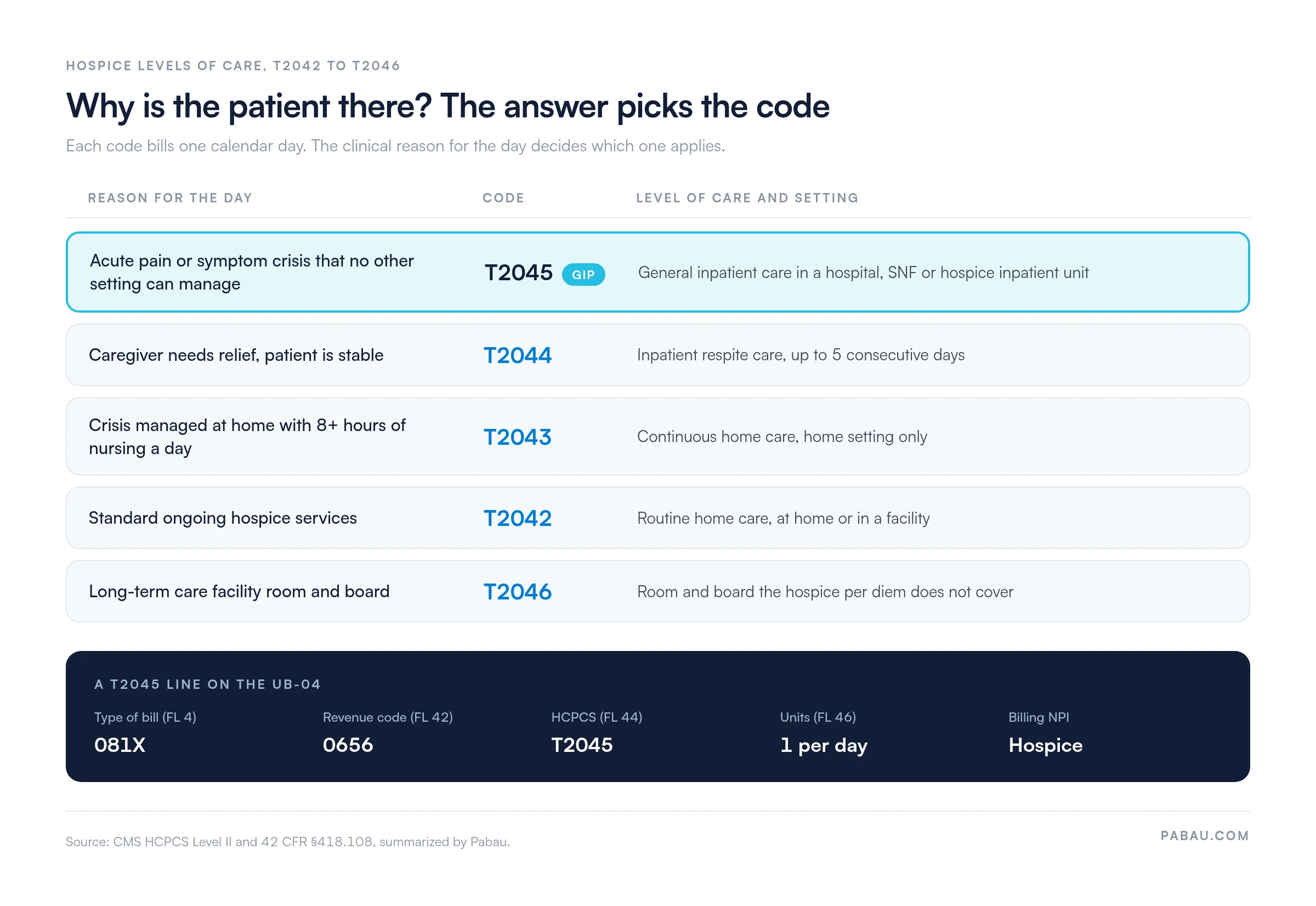
The T2042-T2046 range covers all four Medicare-defined hospice levels of care, plus long-term care room and board. Knowing which code maps to which clinical level prevents the most common wrong-code denials. Crisis care delivered at home is billed under T2043, and facility room and board falls under T2046.
Choosing between T2044 and T2045 turns on why the patient is in the inpatient facility. A stay for caregiver relief is T2044, and a stay for an acute symptom crisis is T2045. Payer reviewers apply exactly that test, so document the clinical reason for every admission.
The chart below starts from that reason and ends at the UB-04 line a GIP day needs.
T2045 claims are among the most documentation-intensive in hospice billing. CMS and managed care payers require a complete clinical record that supports GIP necessity for each admitted day, not just the admission date. Sound medical billing compliance practices reduce that audit exposure.
The mandatory documentation set for T2045 includes all of the following.
Keep all documentation in a single accessible record. When a payer requests supporting documentation for a T2045 claim, the response window is typically short. Records scattered across several systems are a common reason practices lose appeals they could have won.
Whether a payer accepts T2045 depends on the payer type. Confusing Medicare fee-for-service with Medicaid managed care is the costliest mistake in hospice HCPCS billing.
Medicare fee-for-service: Medicare does not reimburse GIP using T2045 directly. Under the Medicare hospice benefit, CMS pays the hospice a GIP per diem rate adjusted by the hospice wage index. The hospice bills Medicare on the UB-04 with revenue code 0656, and CMS applies the GIP rate without requiring T2045 in FL 44.
The current GIP base rate is set in the annual CMS Hospice Wage Index Final Rule, which CMS posts on its hospice payment page.
Medicaid managed care and commercial plans: T2045 is the active code for these payers. Managed care organizations typically require the HCPCS code on the claim alongside the revenue code. Prior authorization rules vary, since some plans require it for GIP admissions and others do not.
Always check the payer’s hospice clinical policy before admission. A denial for missing prior authorization usually cannot be fixed after the fact.
For Medicare fee-for-service, the GIP per diem rate is set annually through the CMS Hospice Wage Index Final Rule. The 2026 base rates are adjusted by each hospice provider’s geographic wage index. CMS publishes the final figures in the Federal Register and on CMS.gov.
The table below shows the approximate 2026 Medicare GIP rate structure by setting. Because rates carry a wage index multiplier, the amount paid differs by location. Confirm the current year’s rates in the final rule before you use them for budgets or contract negotiations.
Medicaid rates for T2045 are state-determined and not published in a single federal source. Contact your state Medicaid agency or review your managed care organization contracts for the applicable rate. Verify annually, as Medicaid T2045 rates are subject to state budget cycles independent of the CMS federal rule cycle.
T2045 denial rates in hospice billing are driven by a short list of recurring errors. Most are preventable with pre-submission checks. Effective denial management workflows catch these before the claim leaves the billing team.
T2045 appeals are winnable when the clinical record is complete. The appeal packet should include these four documents.
Most managed care plans allow 60-180 days from the denial date to file an appeal. The AAPC HCPCS code reference helps you confirm code requirements as you build the appeal narrative.
Run a weekly audit that compares GIP admission days with T2045 claim days. Any day that appears in one list but not the other needs fixing before the filing window closes. Many T2045 denials surface at payment posting, after the deadline for a clean resubmission has passed. Reconciling at admission keeps your team ahead of the clock.
Many hospice billing teams keep the GIP clinical record in one system and build the claim in another. Each handoff between them is a chance to lose an attestation or bill the wrong level of care.
Pabau keeps the clinical record and the outgoing claim in one place. Its digital forms hold plan of care templates, IDG notes and physician attestations. Each GIP day then has its documentation attached before the claim is built.
Claim status tracking lets billing managers follow T2045 submissions by patient. They can clear outstanding items before timely filing windows close, rather than finding them at payment posting.
Practices that bill hospice alongside other specialties get the same superbill preparation and denial tracking on every billing line. A team juggling T-codes, E/M visits and procedure billing across payers then works from one view of its denials.

Pabau keeps GIP documentation, claim status and denial follow-up in one system. Your T2045 claims go out complete, with the paperwork payers ask for already attached.

T2045 pays only when the chart proves the crisis. Before you bill a GIP day, check that the nursing notes and IDG determination show why no other setting could manage the patient. If they do not, the day belongs under a different level of care.
The payer decides the rest. Medicaid managed care and commercial plans want T2045 on the claim, often with prior authorization, while Medicare fee-for-service pays GIP through revenue code 0656 alone. Settle which rules apply at admission, and appeals become rare rather than routine.
Pabau links each GIP day’s documentation to its claim, so your team spends less time rebuilding records for appeals. Book a demo to see how it keeps T2045 claims clean from admission through payment.

Want to understand how medical billing works end to end? Revenue cycle management fundamentals explains the full claim lifecycle from patient intake through payment posting.
HCPCS code T2045 covers one calendar day of hospice general inpatient care (GIP). That day includes 24-hour skilled nursing, room and board in an approved inpatient setting, symptom management and interdisciplinary team support. It does not cover routine home care, respite care, or physician professional services, which are billed separately.
T2042 covers routine home care, the standard daily hospice benefit delivered in the patient’s home or a long-term care facility under routine conditions. T2045 covers general inpatient care, a higher-intensity level triggered by an acute pain or symptom crisis that cannot be managed in the home setting. The two codes represent different clinical levels of care and are not interchangeable.
Revenue code 0656, the general inpatient care code, accompanies T2045 on UB-04 claims. Codes 0651 (routine home care) and 0655 (inpatient respite care) are not used for GIP. Use bill type 081X for hospice claims, and confirm any payer-specific billing rules before the first submission.
Prior authorization requirements for T2045 vary by payer. Medicare fee-for-service does not require prior authorization for GIP admissions, but Medicaid managed care plans and commercial payers often do. Check the specific payer’s hospice clinical policy before every GIP admission. Retroactive authorization is rarely granted after a denial based on missing prior authorization.
There is no hard federal cap on consecutive GIP days billed under T2045, but GIP is intended as short-term acute care. Extended GIP stays are subject to clinical review by the payer, and some managed care plans impose their own authorization limits on GIP duration. Continue billing T2045 only as long as the clinical documentation supports GIP-level necessity on each calendar day.
Yes. Attending physician professional services are billed separately under Medicare Part B using the appropriate E/M or other professional service codes. The hospice provider bills T2045 for the facility-level GIP services. The attending physician’s NPI should appear on the hospice claim. The professional fee itself goes on a separate claim from the physician’s practice.