HCPCS Code T4529: Pediatric disposable briefs billing guide
HCPCS Code T4529: Definition and official descriptor HCPCS Code T4529 is the Lev...

Last Updated: Nov 2, 2026
T2042 is the HCPCS Level II code for hospice routine home care, billed per diem. State Medicaid programs and their managed care plans use it to pay a hospice for each day of home care without crisis-level nursing.
It is the first of five hospice level-of-care codes, T2042 to T2046. Medicare Part A does not use T2042. Medicare hospice claims report routine home care with revenue code 0651 instead.
Let Pabau's smart automation suggest the right codes, reduce claim denials, and keep your practice compliant—effortlessly.
Automate repetitive tasks and focus on what matters most—your patients.
Reduce coding errors and ensure compliance with the latest regulations.
Clean claims, fewer denials, and faster reimbursements.
Powerful insights and reporting to help your practice thrive.
HIPAA compliant SOC 2 certified GDPR-compliant Trusted by 4,000+ clinics worldwide

HCPCS Code T2042 pays a hospice for one day of routine home care under state Medicaid or a Medicaid managed care plan.
Medicare Part A hospice claims never carry T2042. They report routine home care with revenue code 0651 instead.
T2042 is one of five level-of-care codes, T2042 to T2046, and the clinical record decides which code each day gets.
Bill one unit per calendar day, however many disciplines visited, and check the state’s rules on span dates and same-day level changes.
Claims management software with claim validation, such as Pabau’s, catches unit and code errors before the claim reaches the payer.
HCPCS Code T2042 is a T-series code among the HCPCS Level II codes, with the official descriptor Hospice routine home care; per diem. The Centers for Medicare and Medicaid Services (CMS) maintains HCPCS Level II. It reserves the T-series for state Medicaid agencies, covering services that have no permanent national code.
Routine home care is the most frequently billed hospice level of care. It applies on any day a hospice patient receives care at home and needs neither continuous nursing nor an inpatient bed. The per diem rate covers an entire calendar day, not a specific visit duration.
Key definitional facts about HCPCS Code T2042:
Each state Medicaid agency sets its own T2042 per diem rate, so there is no single national fee schedule. CMS publishes annual hospice payment rates that states use as a baseline. What a hospice receives for HCPCS Code T2042 then depends on the state and on any Medicaid managed care contract in place.
T-codes are not paid by Medicare, so the Medicare Physician Fee Schedule carries no T2042 rate. Look up the current rate in your state Medicaid fee schedule or provider manual. The table below shows how each hospice code is paid, and the rate itself always comes from the state.
Rates typically follow CMS’s annual hospice wage-index updates. Verify the current rate for your state by consulting the relevant Medicaid provider bulletin before the start of each fiscal year. Billing a stale rate from a prior-year fee schedule is a common and avoidable source of underpayment.
Choosing the wrong code from the T2042-T2046 range is a frequent cause of hospice Medicaid denials. Each code maps to a distinct level of care, and the clinical record must support the code billed on each day. The diagram below walks one hospice day through both decisions: the payer first, then the level of care.
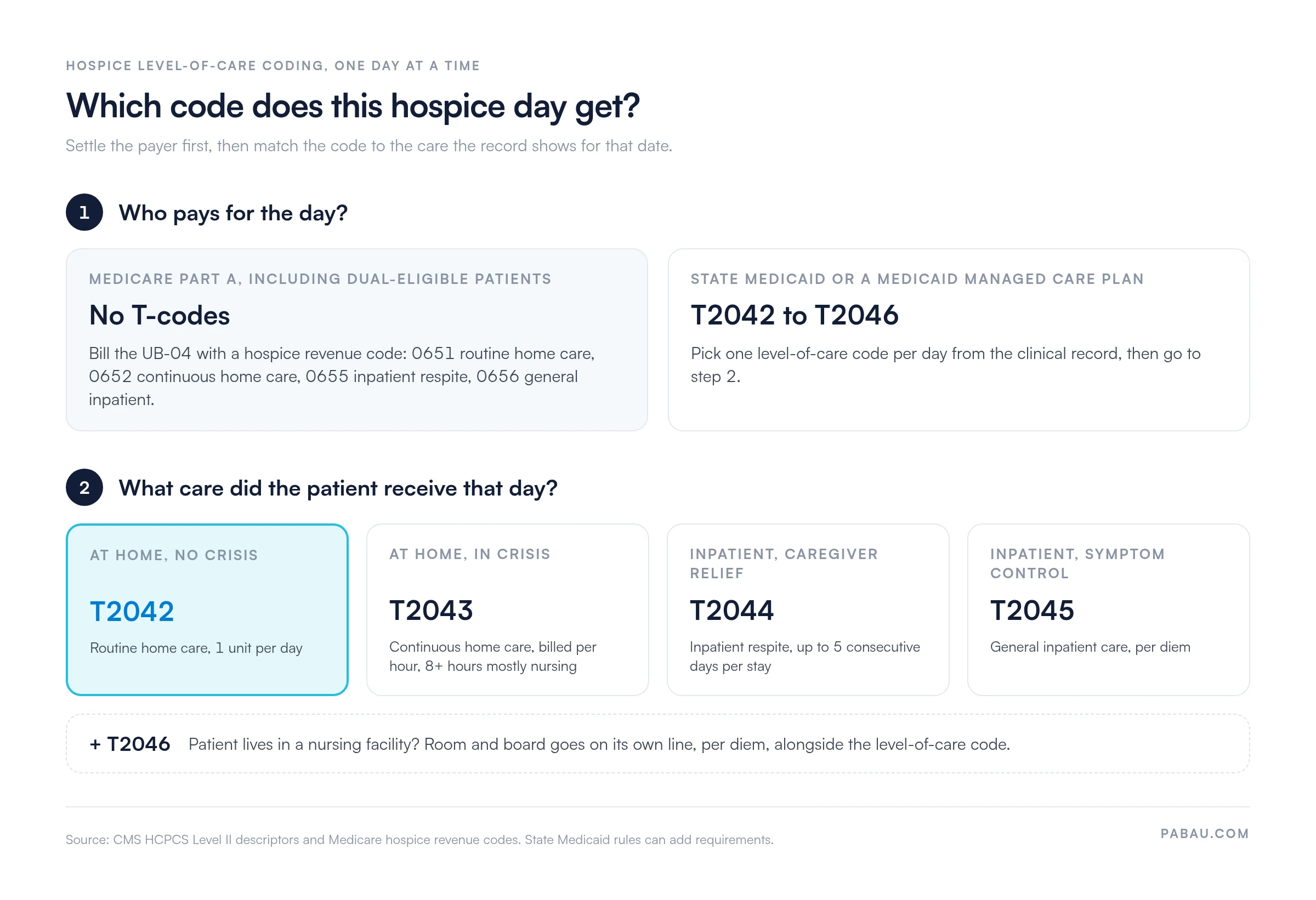
The table adds the mix-up each code is most prone to.
Some days cross levels, such as routine care in the morning and continuous care from the afternoon. The rule for same-day changes is payer-specific, so check the state Medicaid or managed care policy before submitting.
Crisis days follow the hourly unit rules covered under T2043. Nursing facility residents also need a room and board line, explained under T2046.
HCPCS Code T2042 is a Medicaid-specific code. It does not appear on Medicare Part A hospice claims. Sending it to Medicare gets the claim rejected, and billers often misread that rejection as a coding error when the payer is the problem.
Medicare Part A hospice claims report the level of care with UB-04 revenue codes 0651, 0652, 0655 and 0656 instead of HCPCS T-codes. T2042 lets state Medicaid agencies and their managed care plans pay each hospice level of care per diem, inside their own payment systems.
Before billing T2042, confirm that the patient has elected the hospice benefit. A valid election statement must be on file for the billing period.
Every T2042 claim needs a clinical record that shows the patient’s hospice eligibility and the level of care given on the billed date. Missing or incomplete documentation is among the top reasons for medical billing compliance failures during post-payment audits.
Required documentation for each T2042 claim date:
Document the attending clinician’s name and discipline on the daily service log for every billed date. Auditors often flag T2042 claims whose log shows a single aide visit with no note of nursing oversight. That happens even when the plan of care supports routine home care. A brief supervisory note from the RN case manager on the same date removes that ambiguity.
The T2042 per diem rate is an all-inclusive payment. Services rendered on a routine home care day are bundled into a single daily rate and must not be billed separately. Unbundling is an OIG audit trigger and a direct route to overpayment recoupment.
A non-hospice provider who treats a hospice patient for an unrelated condition may bill that service outside the hospice benefit. The hospice agency is not responsible for those claims. Document the distinction clearly in the medical record.
Modifier requirements for HCPCS Code T2042 vary by payer. The modifiers below are widely recognized on Medicaid and managed care hospice claims. Always confirm them against the state Medicaid provider manual or MCO contract. Incorrect modifier use generates denials that are often not correctable on resubmission.
Billing unit rule: Bill exactly 1 unit of T2042 per calendar day, regardless of how many disciplines visited the patient on that date. The per diem pays for the full day of routine home care. A claim with more than one unit per day denies, and the only fix is to void and resubmit it.
Hospice Medicaid claims using HCPCS Code T2042 are typically submitted on the UB-04 claim form. The steps below reflect standard practice, though specific field requirements can vary by state Medicaid system or MCO. Refer to the AAPC hospice code range for the current descriptors before submitting an unfamiliar claim setup.
T2042 claim denials cluster around a predictable set of billing errors. The table below maps each denial trigger to its root cause and the specific fix to apply on resubmission or, better, before initial submission.
Building a denial management workflow that tracks T2042 denial CARC codes by root cause shows which errors repeat. If three or more claims in a rolling month share a denial trigger, fix the step that produces it before resubmitting.
Set a calendar reminder 10 days before each hospice benefit period renewal date for every active patient. The physician certification must be completed before the next period begins. A missed renewal date means T2042 claims for that period will deny on eligibility, and retroactive certification is not always accepted by Medicaid payers.
Many hospice billers still check each T2042 claim date by hand. They match the payer, the level of care and the unit count against the election statement, the certification and the daily log.
Pabau, the practice management platform we build, raises each claim from the patient’s invoice. Its claims management software validates the claim for missing or invalid details before it reaches your clearinghouse. An eligibility check before the visit confirms coverage, too.
The election statement, plan of care and visit notes sit in the same patient record, so an auditor’s request takes minutes. Every claim’s status shows on one dashboard, with rejected claims marked Needs action for your team to fix.
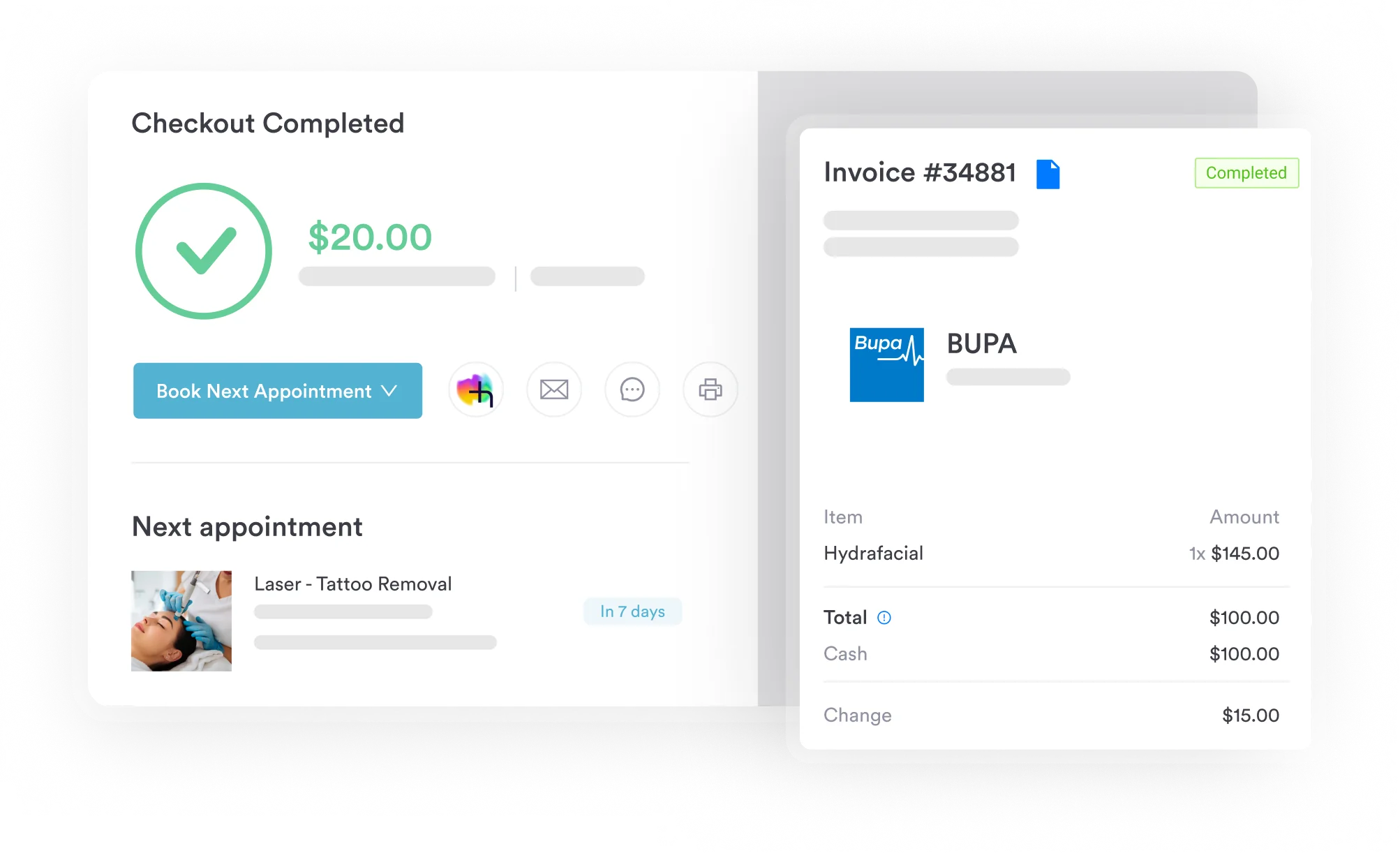

Pabau validates each hospice claim for missing or invalid details before it reaches your clearinghouse, so your team spends less time reworking denials.

Getting paid for T2042 comes down to three checks per claim date. The payer must take T-codes, the record must support routine home care, and the election and certification must cover the date.
Build those checks into claim preparation rather than the denial queue. A hospice that runs them on every date bills one clean unit a day and has its audit file ready before anyone asks.
To see how Pabau runs those checks before each T2042 claim goes out, book a demo.

Looking to tighten up your claims submission process? Submitting a clean claim explains the field-level requirements that prevent front-end rejections before a claim reaches adjudication.
HCPCS Code T2042 covers one full calendar day of hospice routine home care, paid per diem. The rate bundles nursing visits, aide services, counseling, medications and DME related to the terminal condition. It is a Medicaid code and does not apply to Medicare Part A claims.
T2042 is a Medicaid code. Medicare hospice billing uses UB-04 revenue codes 0651, 0652, 0655 and 0656 instead of HCPCS T-codes. A T2042 line on a Medicare claim is rejected. For dual-eligible patients, Medicare Part A pays first. T2042 then covers only Medicaid-covered services or cost-sharing amounts.
T2042 is for routine home care days, when the patient receives standard hospice services at home without crisis-level nursing. T2043 is for continuous home care during a pain or symptom crisis: at least 8 hours in a 24-hour day, mostly nursing. T2043 is billed per hour rather than per day, and the record must show the hours.
T2042 is billed once per calendar day (1 unit per date of service) for each day a hospice patient receives routine home care. Several discipline visits on one day still make one unit. Billing more than 1 unit per day triggers a denial from Medicaid payers.
The most common denial reasons are a lapsed hospice benefit period, the wrong level-of-care code, and claims sent to Medicare Part A instead of Medicaid. Missing certifications, missing modifiers and more than 1 unit per day also cause denials. A pre-submission check tied to each claim date prevents most of them.
You need a signed physician certification of terminal illness and the patient’s hospice election statement. You also need an individualized plan of care covering the claim period and a daily service log for the billed date. The certification is renewed at the start of each new benefit period.