HCPCS Code E0272: Foam rubber mattress billing guide
HCPCS Code E0272: official descriptor and code overview HCPCS Code E0272 is the ...

Last Updated: Nov 6, 2026
T2011 is the HCPCS Level II code for a preadmission screening and resident review (PASRR) Level II evaluation, billed per evaluation. It covers the full assessment of a nursing facility applicant or resident whose Level I screen flags a serious mental illness or intellectual disability.
T2011 is a T-code for state Medicaid agencies, and Medicare does not pay it. The Level I screen bills separately under T2010. Each state sets who may perform the evaluation, how often it can be billed and what it pays.
Let Pabau's smart automation suggest the right codes, reduce claim denials, and keep your practice compliant—effortlessly.
Automate repetitive tasks and focus on what matters most—your patients.
Reduce coding errors and ensure compliance with the latest regulations.
Clean claims, fewer denials, and faster reimbursements.
Powerful insights and reporting to help your practice thrive.
HIPAA compliant SOC 2 certified GDPR-compliant Trusted by 4,000+ clinics worldwide

HCPCS code T2011 bills a preadmission screening and resident review (PASRR) Level II evaluation, one unit per evaluation.
The Level II evaluation follows a positive Level I screen. It decides whether the person needs nursing facility care and specialized services.
T2011 is a Medicaid T-code that Medicare does not pay, and the Level I screen bills separately under T2010.
The evaluator must be independent of the nursing facility, and each state decides who may bill T2011 and how often.
A signed written report that meets 42 CFR 483.128 is the record that keeps a T2011 claim payable.
HCPCS code T2011 bills a preadmission screening and resident review (PASRR) Level II evaluation, per evaluation. It assesses a nursing facility applicant or resident whose Level I screen points to a serious mental illness, intellectual disability or related condition.
T2011 sits in the HCPCS Level II T-code range, T1000-T5999, which CMS reserves for state Medicaid agencies. Medicare does not pay it. Together with T2010, the Level I screen, it makes up the two-code PASRR group.
PASRR is a federal requirement for every person entering a Medicaid-certified nursing facility, whatever pays for the stay. The billing rules, however, belong to each state. Your state’s PASRR program decides whether T2011 goes on a claim at all.
A T2011 evaluation answers two questions about one person. Does the person need the level of care a nursing facility provides? And do they need specialized services for their mental illness or intellectual disability?
To answer them, the evaluator gathers and reviews:
Federal rules let evaluators use existing records that are valid and current. Where those records fall short, the evaluator collects new data. The full criteria are in 42 CFR 483.128.
T2011 pays for one comprehensive evaluation and its report. Several nearby services bill elsewhere or not at all.
Level I is a short screen for everyone entering a Medicaid-certified nursing facility. Level II is the full evaluation for the people that screen flags. The billing unit is the same for both, but the work and the evaluator differ.
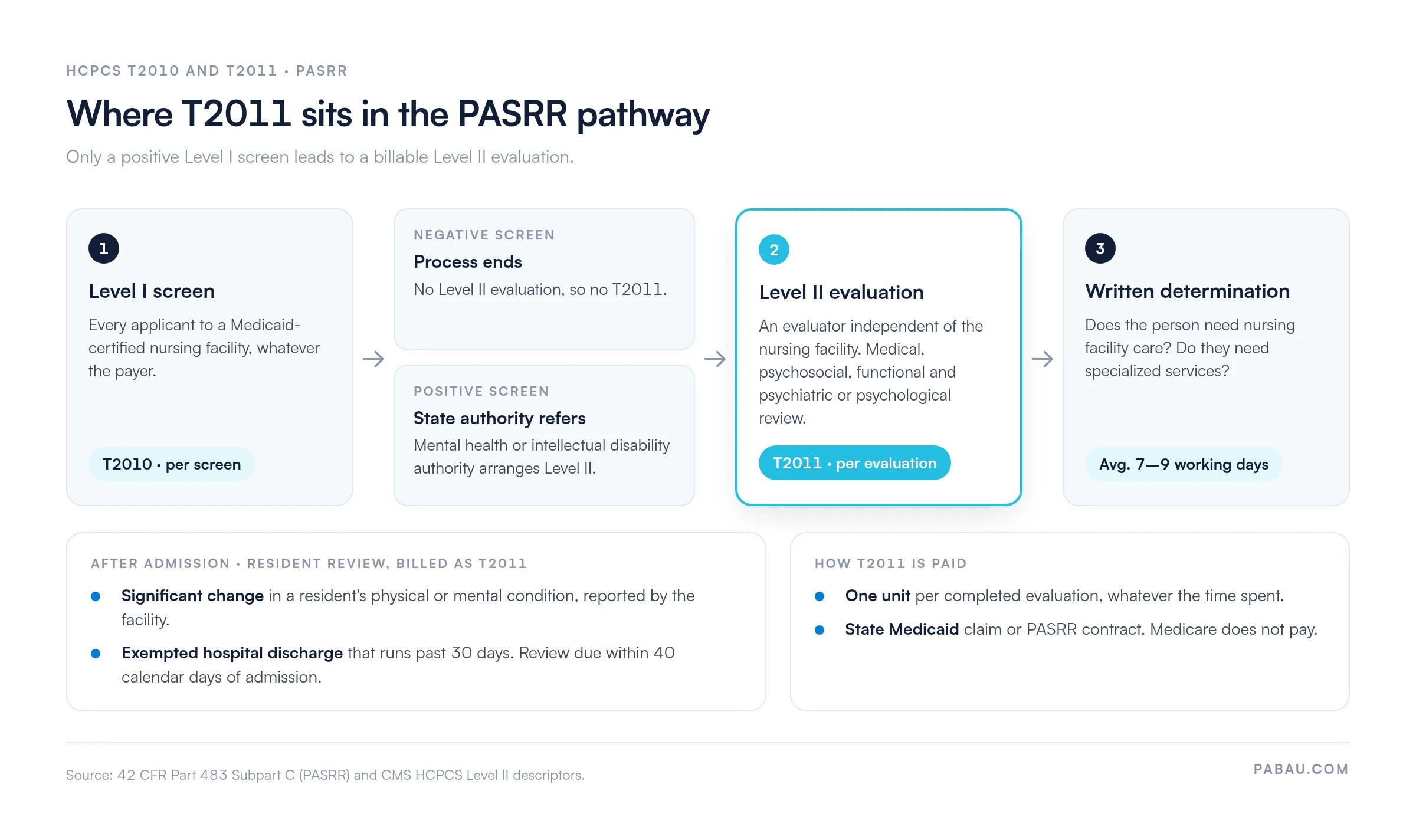
A negative Level I screen ends the process, so no T2011 follows. A positive screen goes to the state authority, which arranges the Level II evaluation before admission. The pathway below also shows the resident reviews that bill T2011 after admission.
Two state authorities own PASRR Level II: the state mental health authority and the state intellectual disability authority. Under 42 CFR 483.106, they can delegate the work to another entity, but never to a nursing facility.
States then set the credentials. Oregon’s PASRR instructions, for example, require a Qualified Mental Health Professional and a Licensed Medical Practitioner to complete each Level II evaluation.
Only the contracted or approved evaluator bills T2011. A practice outside the state’s PASRR network cannot bill it, even for an equally thorough assessment.
A Level II evaluation is required before admission whenever the Level I screen is positive. It can also be needed later, while the person lives in the facility.
The state must issue its written determination within an annual average of 7 to 9 working days of referral. Evaluators therefore work to tight turnarounds, and the report date matters on the claim.
Bill one unit of T2011 for each completed Level II evaluation. Time spent does not change the unit count, so a long evaluation is still one unit.
Where your state pays T2011 on a claim, it goes out on the standard CMS-1500 or 837P format, with one unit in Box 24G. Many states instead pay PASRR evaluators through a contract, so no claim line is involved. Check the state PASRR program before your first evaluation.
Pabau, the practice software we build for healthcare teams, supports both claim formats in its claims management workflow. The evaluation date, unit and diagnosis codes are pulled from the patient record, so nobody retypes them.
Log the Level II report date against the person’s record as soon as it is signed. A frequency limit, such as Oregon’s one evaluation per 12 months, counts from that date.
CMS sets no modifier requirement for T2011, so any modifier comes from the state program. Some states append a program modifier, such as HE for a mental health program. Others use none, so check the current state manual before you add one.
T2011 rarely needs prior authorization in the usual sense. Instead, the state referral after a positive Level I screen authorizes the evaluation.
Federal rules also let states claim a 75 percent federal match for PASRR activities. That match is one reason many states fund Level II evaluations as administrative contracts rather than fee-for-service claims.
The Level II report is the documentation for T2011. Under 42 CFR 483.128, an individualized report must include:
The report also goes to the person, their legal representative, the admitting or retaining facility, the attending physician and any discharging hospital. Keep the Level I referral, signatures and distribution record with it. A clean file supports medical billing compliance if the state audits the claim.
There is no federal fee for T2011, because Medicare does not pay it. Each state sets the rate, either in its Medicaid fee schedule or in the evaluator’s contract.
Rates vary widely between states and contracts, and many are not published. Ask the state PASRR program for the current rate before you quote one, rather than relying on an old fee schedule.
Most T2011 denials trace back to the payer, the evaluation count or a missing referral. A steady denial management workflow helps your team work each remittance quickly.
Payer, unit and coding errors can usually be corrected and resubmitted. By contrast, missing referrals and late filing tend to need an appeal. Knowing the common claim denial codes shortens both routes.
A T2011 claim rests on several records: the Level I referral, each part of the evaluation, the signed report and its distribution. When they sit in separate files, the claim can go out without proof of the referral or the evaluation date.
Pabau keeps those records on one patient file. Digital forms capture the psychosocial, functional and psychiatric sections, and the calendar books the evaluation with the right team member.
When the claim is ready, Pabau sends it through its Claim.MD clearinghouse integration, with eligibility checks and electronic remittance advice. Pabau does not choose codes or units for you, so your team still applies the state PASRR rules above.

Pabau keeps the referral, the Level II report and the appointment on one patient record. Claims then go out through Claim.MD from that data.

T2011 is a single-unit evaluation code, and most errors start when it is treated as a time-based service or confused with the Level I screen. Before the first evaluation, confirm whether your state pays T2011 by claim or by contract.
Then build each claim from the signed Level II report and its referral, not from memory. Book a demo to see how Pabau keeps PASRR reports, referrals and claims on one record.

Want a grounding in the claim cycle? What is medical billing explains how codes, claims and payments fit together.
Want a broader view of the billing process? Revenue cycle management explains how authorization, claims submission and payment posting connect.
Sending T-code claims electronically? The 837 file explained walks through the electronic claim format that carries your T2011 line to the payer.
HCPCS code T2011 covers a preadmission screening and resident review (PASRR) Level II evaluation, billed per evaluation. It assesses a nursing facility applicant or resident flagged by a Level I screen.
T2010 bills the PASRR Level I identification screen, per screen, for every nursing facility applicant. T2011 bills the full Level II evaluation that follows a positive Level I screen.
No, T2011 is a PASRR evaluation code. Personal care aide services bill under T1019, per 15 minutes.
No, Medicare does not pay T2011. It is a T-code for state Medicaid agencies, and each state decides how it pays for Level II evaluations.
An evaluator approved by the state mental health or intellectual disability authority, and never a nursing facility or an entity affiliated with one. States set the credentials.
Bill one unit per completed evaluation, whatever the time spent. States can also cap evaluations per person, such as Oregon’s one per 12 months.
Common reasons are a claim sent to Medicare, a frequency limit, more than one unit, a missing state referral or late filing.