CPT code 93567: Supravalvular aortography billing guide
CPT code 93567 covers aortography above the aortic valve CPT code 93567 reports ...

Last Updated: Nov 20, 2026
T2010 is the HCPCS Level II code for a preadmission screening and resident review (PASRR) Level I identification screening, billed per screen. It identifies nursing facility applicants who may have a serious mental illness, intellectual disability or related condition.
T2010 is a T-code for state Medicaid agencies, and Medicare does not pay it. A positive screen leads to a Level II evaluation, billed under T2011. Each state sets who may screen and whether the screen is paid by claim or by contract.
Let Pabau's smart automation suggest the right codes, reduce claim denials, and keep your practice compliant—effortlessly.
Automate repetitive tasks and focus on what matters most—your patients.
Reduce coding errors and ensure compliance with the latest regulations.
Clean claims, fewer denials, and faster reimbursements.
Powerful insights and reporting to help your practice thrive.
HIPAA compliant SOC 2 certified GDPR-compliant Trusted by 4,000+ clinics worldwide

HCPCS code T2010 bills a preadmission screening and resident review (PASRR) Level I identification screening, one unit per screen.
Federal rules require a Level I screen for every applicant to a Medicaid-certified nursing facility, whatever pays for the stay.
T2010 is a Medicaid T-code that Medicare does not pay, and the Level II evaluation bills separately under T2011.
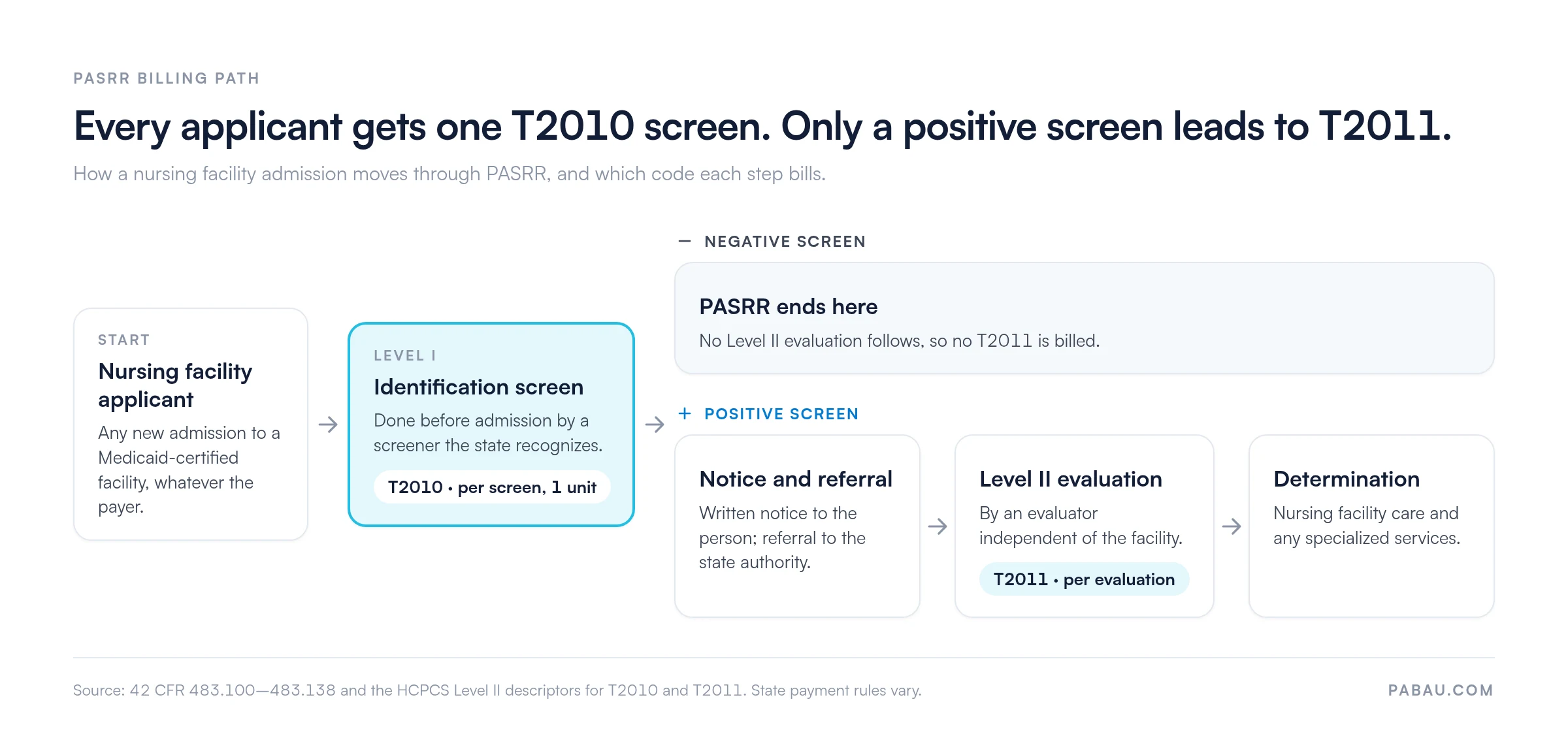
A positive screen triggers a written notice and a referral for Level II, while a negative screen ends the PASRR process.
HCPCS code T2010 bills a preadmission screening and resident review (PASRR) Level I identification screening, per screen. Oregon’s Medicaid program, for example, names T2010 as its Level I code in the Oregon Health Authority PASRR instructions. The screen checks whether a nursing facility applicant may have a serious mental illness, intellectual disability or related condition.
T2010 sits in the HCPCS Level II T-code range, which CMS reserves for state Medicaid agencies. Medicare does not pay it. Together with T2011, the Level II evaluation, it makes up the two-code PASRR group. The same range carries waiver service codes too, such as T2032 for monthly residential care.
PASRR is a federal requirement under 42 CFR 483.100 to 483.138. The billing rules, however, belong to each state. Your state’s PASRR program decides whether T2010 goes on a claim at all.
A Level I screen answers one question: could this person have a serious mental illness, an intellectual disability or a related condition? It does not diagnose, and it does not decide placement.
Most state Level I forms collect:
Federal rules call this identification step Level I. The definitions it screens against are in 42 CFR 483.102, and each state publishes its own form.
T2010 pays for one identification screen. Several nearby services bill elsewhere or not at all.
T2010 is the short screen for everyone. T2011 is the full evaluation for the people that screen flags. Each code bills a different service, so a payer can deny a claim that swaps them.
A negative screen ends the process, so no T2011 follows. A positive screen goes to the state mental health or intellectual disability authority, which arranges the Level II evaluation before admission. The diagram below traces both routes and the code each step bills.
The state Medicaid agency is responsible for the PASRR program and its Level I screens. Federal rules let the state delegate the screen, as long as it keeps final responsibility.
Only a screener the state recognizes can bill T2010, and only where the state pays per screen. In many states, Level I is unpaid administrative work for the referring hospital.
A Level I screen is required before any new admission to a Medicaid-certified nursing facility. The payer for the stay makes no difference.
A screen that is late or missing blocks the admission, not just the claim. Facilities therefore expect the Level I result before the patient arrives.
Bill one unit of T2010 for each completed Level I screen. Time spent does not change the unit count, so a long screen is still one unit.
Where your state pays T2010 on a claim, it goes out on the standard CMS-1500 or 837P format, with one unit in Box 24G. Many states fund Level I through contracts instead, so no claim line is involved.
Pabau, the practice software we build for healthcare teams, supports both claim formats in its claims management workflow. The screen date, unit and diagnosis codes come from the patient record, so nobody retypes them.
Check your state PASRR manual before the first screen. It tells you whether Level I is paid per screen under T2010, paid by contract or not paid at all.
CMS sets no modifier requirement for T2010, so any modifier comes from the state program. Some states append a program modifier, and others use none. Check the current state manual before you add one.
The completed Level I form is the documentation for T2010. Keep these records with it:
Under 42 CFR 483.128, a first positive screen requires written notice to the person and their legal representative. A clean file supports medical billing compliance if the state audits the claim.
There is no federal fee for T2010, because Medicare does not pay it. Each state sets the rate, either in its Medicaid fee schedule or in a screener contract.
States can claim a 75 percent federal match for PASRR activities. That match is one reason many states fund Level I as administrative work rather than fee-for-service claims. Ask the state PASRR program for the current rate before you quote one.
Most T2010 denials trace back to the payer, the unit count or the wrong PASRR level. A steady denial management workflow helps your team work each remittance quickly.
Payer, unit and coding errors can usually be corrected and resubmitted. Late filing tends to need an appeal. Knowing the common claim denial codes shortens both routes.
A T2010 claim rests on a few records: the Level I form, the screener’s signature, the screen date and any referral. When they sit in separate files, the claim can go out without proof the screen came before admission.
Pabau keeps those records on one patient file. Digital forms capture the Level I questions and signature, and a positive result can be followed up from the same record.
When the claim is ready, Pabau sends it through its Claim.MD clearinghouse integration, with eligibility checks and electronic remittance advice. Pabau does not choose codes or units for you, so your team still applies the state PASRR rules above.

Pabau keeps the Level I form, the screen date and any referral on one patient record. Claims then go out through Claim.MD from that data.

T2010 is a single-unit screening code, and most errors start when it is mistaken for the Level II evaluation or billed by time. Before the first screen, confirm whether your state pays T2010 by claim, by contract or not at all.
Then build each claim from the signed Level I form and its date, not from memory. Book a demo to see how Pabau keeps PASRR screens, referrals and claims on one record.

Billing the next PASRR step? HCPCS code T2011 covers the Level II evaluation that follows a positive screen.
Want a grounding in the claim cycle? What is medical billing explains how codes, claims and payments fit together.
Sending T-code claims electronically? The 837 file explained walks through the electronic claim format that carries your T2010 line to the payer.
HCPCS code T2010 covers a preadmission screening and resident review (PASRR) Level I identification screening, billed per screen. It checks whether a nursing facility applicant may have a serious mental illness or intellectual disability.
T2010 bills the PASRR Level I identification screen, per screen, for every nursing facility applicant. T2011 bills the full Level II evaluation that follows a positive Level I screen.
No, T2010 is a PASRR screening code. Home health aide visits bill under T1021, per visit, or S9122, per hour.
No, Medicare does not pay T2010. It is a T-code for state Medicaid agencies, and each state decides how it pays for Level I screens.
Every applicant to a Medicaid-certified nursing facility needs one before admission, whatever pays for the stay.
Bill one unit per completed screen, whatever the time spent. A positive or negative result counts as one screen.
Common reasons are a claim sent to Medicare, more than one unit, a Level II evaluation coded as T2010, or late filing.