CPT Code 98981: RTM Treatment Management Billing Guide
CPT code 98981: Definition and official descriptor CPT code 98981 is an add-on c...

Last Updated: Nov 9, 2026
T1021 is the HCPCS Level II code for home health aide or certified nurse assistant, per visit. It covers non-skilled help with bathing, dressing, transfers and other activities of daily living in the patient's home.
T1021 belongs to the T-code series (T1000-T5999), which CMS designates for state Medicaid agencies. Medicare fee-for-service rejects it outright, and some state Medicaid programs convert the per-visit unit into 15-minute units.
Let Pabau's smart automation suggest the right codes, reduce claim denials, and keep your practice compliant—effortlessly.
Automate repetitive tasks and focus on what matters most—your patients.
Reduce coding errors and ensure compliance with the latest regulations.
Clean claims, fewer denials, and faster reimbursements.
Powerful insights and reporting to help your practice thrive.
HIPAA compliant SOC 2 certified GDPR-compliant Trusted by 4,000+ clinics worldwide

HCPCS Code T1021 applies to home health aide and certified nurse assistant services under Medicaid, not Medicare fee-for-service.
T1021 is billed per visit on the CMS-1500 with Place of Service 12 (home), though some state Medicaid programs convert it to 15-minute units.
Most state Medicaid programs require prior authorization before services begin, and billing without it results in automatic denial.
Missing or incomplete documentation, including the signed plan of care and aide visit notes, is a leading cause of T1021 audit denials.
Pabau’s claims management software carries each prior authorization code from booking to claim and validates the claim before it is submitted.
HCPCS Code T1021 is the Medicaid procedure code for home health aide (HHA) or certified nurse assistant (CNA) services in the home, billed per visit. Some state Medicaid programs convert it to 15-minute units, so check your state fee schedule before you bill.
The code sits within the T-code range that CMS designates exclusively for Medicaid programs. It therefore carries no Medicare fee schedule rate and no Part A or Part B benefit assignment.
These are the attributes you enter or check on a typical T1021 claim.
The official HCPCS descriptor is: Home health aide or certified nurse assistant, per visit. The code covers only non-skilled, supportive care that helps a beneficiary with activities of daily living (ADLs) and basic health maintenance.
Covered services include:
Explicit exclusions (services that require a different code or a licensed clinician):
T1021 may only be billed by providers enrolled in their state Medicaid program. Individual aides do not bill directly. The home health agency (HHA) or personal care agency supervising the aide submits the claim.
Eligible service providers under T1021:
All services must be authorized in a physician-signed plan of care (CMS-485 or state-equivalent form). An aide performing services without a valid, current plan of care on file creates an unbillable encounter regardless of the service quality.
T1021 is billed per visit at the national level. The CMS long descriptor ends in “per visit”, so one completed aide visit is one unit on the claim. A contracted home health agency paid a daily rate bills HCPCS code T1022 instead, at one unit per day.
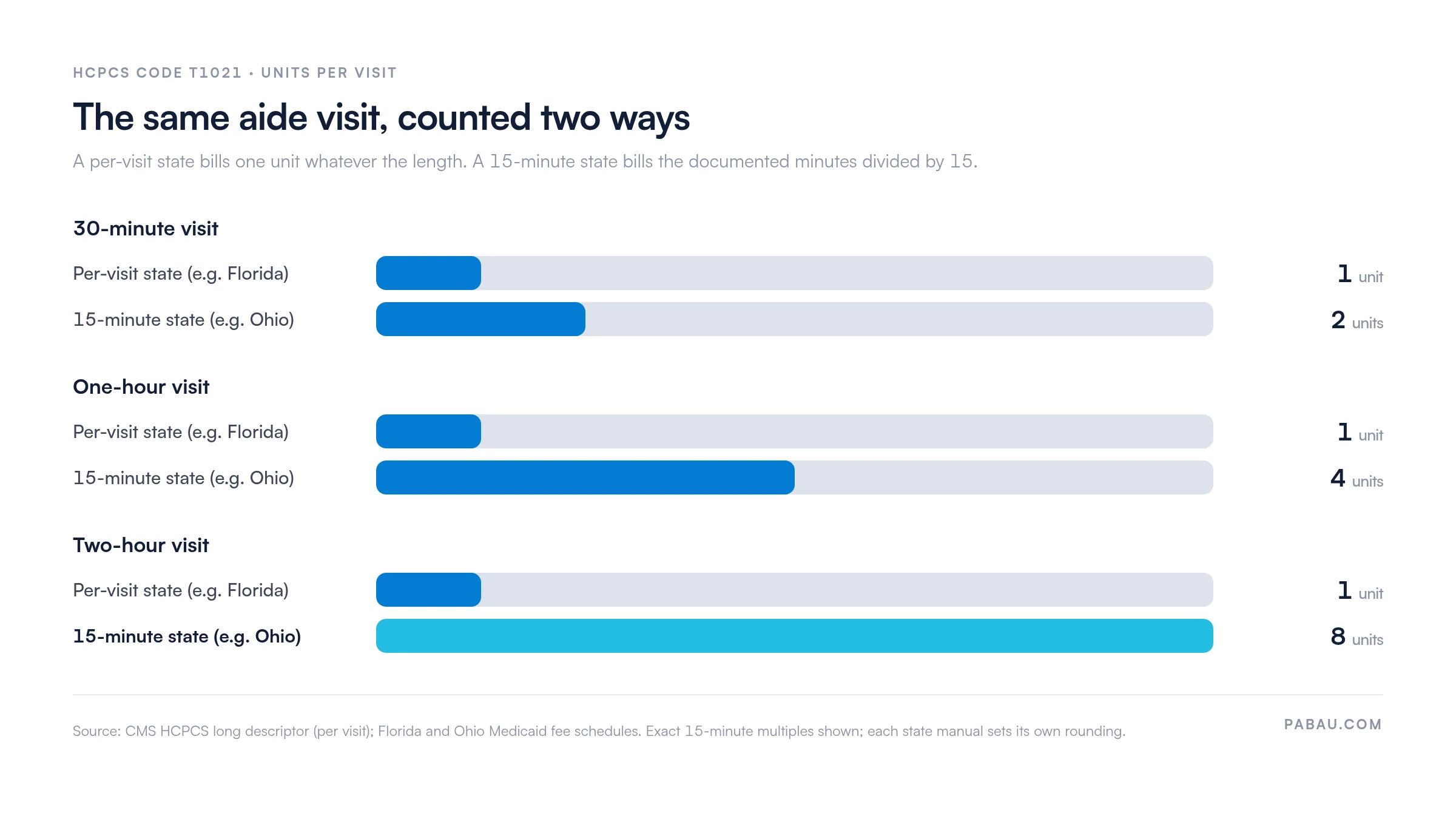
State Medicaid programs set their own unit basis, though, and several convert T1021 to time. The Iowa HCBS waiver fee schedule pays a 15-minute rate capped per day, and Ohio pays home health aide services in 15-minute units. Florida pays T1021 per visit, at $18.04 in its 2024 Home Health Visit Services Fee Schedule.
That split matters at claim time. The same two-hour visit is one unit in Florida and eight units in a 15-minute state. A 30-minute visit is two units there, and a one-hour visit is four.
The Medicare 8-minute rule does not apply to T1021. That rule governs timed CPT therapy codes, and T-codes are Medicaid-only. Where a state converts T1021 to 15-minute units, its own billing manual sets the rounding policy.
Enter the unit count in Box 24G of the CMS-1500. Confirm the unit basis in your state fee schedule before the first claim, and recheck it each fiscal year. Daily and weekly caps also vary by state and waiver, so never bill past your authorization ceiling without an amended prior authorization.
T1021 modifier requirements are set by each state Medicaid program. There is no universal modifier that applies to all payers, but the table below reflects common patterns documented in state Medicaid billing manuals. Always verify with your specific payer before appending a modifier.
A missing or wrong modifier is one of the most common reasons a T1021 claim is denied. Confirm your state’s requirements each year, because Medicaid billing manuals are updated every fiscal year.
Place of Service (POS) 12, designated as “Home” by CMS, is the standard code for T1021 claims. Some states accept alternate POS codes depending on the care setting, as shown below.
On the CMS-1500, complete Box 24B with the applicable POS code. Box 24D carries the T1021 procedure code and any modifier. Box 24G captures the unit count. The billing provider’s NPI goes in Box 33a. The ordering physician’s NPI goes in Box 17b.
Three other HCPCS codes describe overlapping home health aide services. Using the wrong one is a direct cause of denial or audit recoupment. The AAPC HCPCS code lookup is useful for confirming descriptors before claim submission.
The closest Medicaid neighbor is T1019, which bills personal care in 15-minute units. Its own descriptor bars it from home health aide or certified nurse assistant services. A certified HHA visit therefore always goes on T1021.
No. Medicare fee-for-service does not recognize T-codes, so a Medicare claim carrying T1021 is rejected outright. For Medicare beneficiaries receiving home health aide services, the correct code is G0156.
Medicare Advantage (Part C) plans vary by contract and may accept T-codes in limited circumstances, so verify with the specific plan before billing.
Most state Medicaid programs require prior authorization (PA) before any T1021 services begin. Billing without an active, matching authorization results in automatic denial in most states. Insurance eligibility verification should include confirming both the beneficiary’s active Medicaid enrollment and the status of any existing prior authorization.
A typical PA request for T1021 must include:
PA requirements and approval timelines vary by state and by Medicaid managed care organization (MCO). Always check your state Medicaid billing manual for the specific authorization pathway.
Incomplete documentation is a leading cause of T1021 claim denials on Medicaid audit, and state billing manuals return to it again and again. Medical billing compliance for home health aide services depends on a complete record written at each visit. Notes reconstructed after the fact do not hold up on audit.
Required documentation at the time of billing:
Time-in/time-out documentation is non-negotiable. A visit note recording only “1 hour of care” without explicit start and end times will fail audit in virtually every state Medicaid program. To submit a clean claim, every billed unit must trace back to a timestamped visit record.
Audit your aide visit note template quarterly. The most common documentation failure is an incomplete note. It records the tasks performed but omits the time-out, or logs total hours without timestamped start and end times. A single missing time-out can void an otherwise valid claim on audit.
The eight denial patterns below recur across state Medicaid billing manuals, and each comes with a fix you can build into your workflow. Log which ones hit your agency most often, because denial management in healthcare starts with that tally.
T1021 reimbursement rates are set by each state Medicaid program individually. No federal fee schedule rate applies because T-codes are outside the CMS Physician Fee Schedule. Rates vary substantially by state, by program type (fee-for-service vs. managed care vs. HCBS waiver), and by service tier.
Illustrative state examples show how far the unit basis and rate can differ. Verify current figures on each state’s Medicaid fee schedule before billing.
Rates change every year and sometimes mid-year. Take payment figures from your state Medicaid agency’s fee schedule portal, never from last year’s remittances.
Most T1021 denials trace back to an authorization or a claim field that nobody checked before submission. Pabau’s claims management software builds those checks into the billing workflow, so each claim reaches the payer matched to its prior authorization.
Where Pabau cuts T1021 denial risk:
Track two metrics for T1021: first-pass acceptance rate and days in accounts receivable (AR) by denial reason. Together they show where your claims process breaks down and what each denial pattern above costs you.

Pabau stores each Medicaid prior authorization as a case and shows how many approved visits you have used. It validates every CMS-1500 claim before it reaches your clearinghouse.

T1021 is a simple code with one trap: its unit basis changes from state to state. Agencies that confirm per-visit or 15-minute billing up front, and keep authorizations and visit notes current, see few denials. The claims that fail on audit usually fail on a missing time-out, an expired PA number, or a wrong POS code.
Settle the unit basis for each payer before the first claim, then let the authorization drive every bill after it. Pabau carries each authorization code from booking to claim and flags a missing one before submission. Book a demo to see T1021 claims matched to their authorizations before they reach Medicaid.

Need to understand how claims move through the clearinghouse? Medical claims clearinghouse guide explains how claims are scrubbed and routed before reaching the payer.
Looking for the denial code that came back on a T1021 rejection? Denial codes in medical billing maps common CARC and RARC codes to their corrective actions.
Billing personal care by the day instead? HCPCS code T1020 covers per diem personal care services under Medicaid.
HCPCS Code T1021 covers home health aide or certified nurse assistant services provided in a home setting, billed per visit under Medicaid. Covered tasks include ADL assistance (bathing, dressing, grooming), ambulation, meal preparation, and light housekeeping directly related to the patient’s care. Skilled nursing tasks and therapy services are excluded.
T1021 is billed per visit under the national CMS descriptor. Some state Medicaid programs convert it to 15-minute units, such as Iowa’s HCBS waiver and Ohio, while Florida pays a flat rate per visit. Check your state fee schedule before you count units. The Medicare 8-minute rule does not apply to T1021.
T1021 is a Medicaid-only code, and G0156 is the Medicare equivalent for home health aide services. Never put T1021 on a Medicare fee-for-service claim. Medicare does not recognize T-codes, so the claim will reject. Use G0156 for Medicare beneficiaries and T1021 for Medicaid beneficiaries.
Yes, in most state Medicaid programs. Prior authorization is required before T1021 services begin, and billing without an active PA number results in automatic denial in most states. Authorization requirements and timelines vary by state and by Medicaid managed care plan, so confirm with your specific payer.
Place of Service 12 (Home) is the standard code for T1021 claims. Some states accept alternate POS codes for custodial care facilities or adult family homes. POS 12 still applies in the large majority of T1021 encounters. Enter the POS in Box 24B of the CMS-1500.
Yes, in some states, but only when distinct services are performed by different aides with separate documentation. T1021 covers certified HHA services, while T1019 covers personal care aide (PCA) services. Billing both for the same beneficiary on the same date requires clear documentation showing which aide delivered which service type and at what times.