

HCPCS Code E0272: Foam rubber mattress billing guide
HCPCS Code E0272: official descriptor and code overview HCPCS Code E0272 is the ...

Last Updated: Nov 6, 2026
T1002 is the HCPCS Level II code for RN services, up to 15 minutes. It covers skilled nursing by a registered nurse in the patient's home or a community setting, billed in 15-minute units to Medicaid.
CMS maintains T-codes like T1002 for state Medicaid agencies, and Medicare fee-for-service does not pay them. The two most common billing errors are sending the claim to Medicare instead of Medicaid, and confusing T1002 with T1003, the LPN code.
Let Pabau's smart automation suggest the right codes, reduce claim denials, and keep your practice compliant—effortlessly.
Automate repetitive tasks and focus on what matters most—your patients.
Reduce coding errors and ensure compliance with the latest regulations.
Clean claims, fewer denials, and faster reimbursements.
Powerful insights and reporting to help your practice thrive.
HIPAA compliant SOC 2 certified GDPR-compliant Trusted by 4,000+ clinics worldwide

HCPCS code T1002 covers registered nurse home health services billed per 15-minute unit under Medicaid, not Medicare.
T1002 is a Medicaid code only. Medicare uses G0299 for direct skilled RN nursing visits in home health.
Bill T1003 instead when an LPN or LVN performed the visit, whoever is assigned to the case.
Most Medicaid programs and managed care organizations require prior authorization before T1002 services begin.
Pabau, the practice management platform we build, ties each visit note to the claim, from eligibility checks to remittance posting.
HCPCS code T1002 is the billing code for registered nurse (RN) services in a home health setting, paid by Medicaid per 15-minute unit. The official CMS descriptor reads: RN services, up to 15 minutes. It sits in the T-code series of HCPCS Level II, national codes that CMS maintains for state Medicaid agencies. T-codes are not part of the Medicare fee schedule. A T1002 claim sent to Medicare Part A or Part B is a coding error and gets denied.
T1002 billing unit structure uses a 15-minute increment as one unit of service. A 60-minute RN home visit therefore generates 4 units billed on a single claim line. Most state Medicaid programs expect time documented to the minute, with time-in and time-out entries. A partial unit under 8 minutes is typically not paid as a full unit. Check your state Medicaid billing manual for the rounding threshold, because some managed Medicaid plans apply a different rule.
T1002 covers skilled nursing services performed by a credentialed RN in the patient’s home or in a home-and-community-based services setting. The key word is “skilled.” The clinical task must require RN-level training and judgment, so companion care, homemaking, and basic assistance do not qualify.
Covered services:
Not covered under T1002:
T1002 covers RN services, while T1003 covers LPN and LVN services. The two are not interchangeable, and billing T1002 for an LPN visit is upcoding that triggers audits. The clinical distinction matters. An RN can independently assess, plan, and delegate skilled care. An LPN works under RN or physician supervision and cannot independently perform assessment or care planning. If an LPN performed the visit, bill T1003 even when an RN is also assigned to the case.
HCPCS code T1002 belongs to a family of Medicaid nursing codes that run from T1000 to T1005. Coders who work across several home health programs meet these codes together, and cross-code errors within the family are common. The table below maps the full series.
T1002 is a Medicaid code, and G0299 is the Medicare code for direct skilled RN nursing in home health or hospice. Both bill in 15-minute units, so the payer decides which one goes on the claim. For dual-eligible patients, the correct code depends on which program is the primary payer for that claim. When Medicare is primary, bill G0299 through the home health benefit. When Medicaid is primary (or for HCBS waiver services that fall outside the Medicare home health benefit), bill T1002.
Verify which program holds primary responsibility for the specific service before you submit. Your state Medicaid program can confirm how HCBS waiver services interact with the Medicare home health benefit. The diagram below runs the payer, task, and credential checks in the order a coder should ask them.
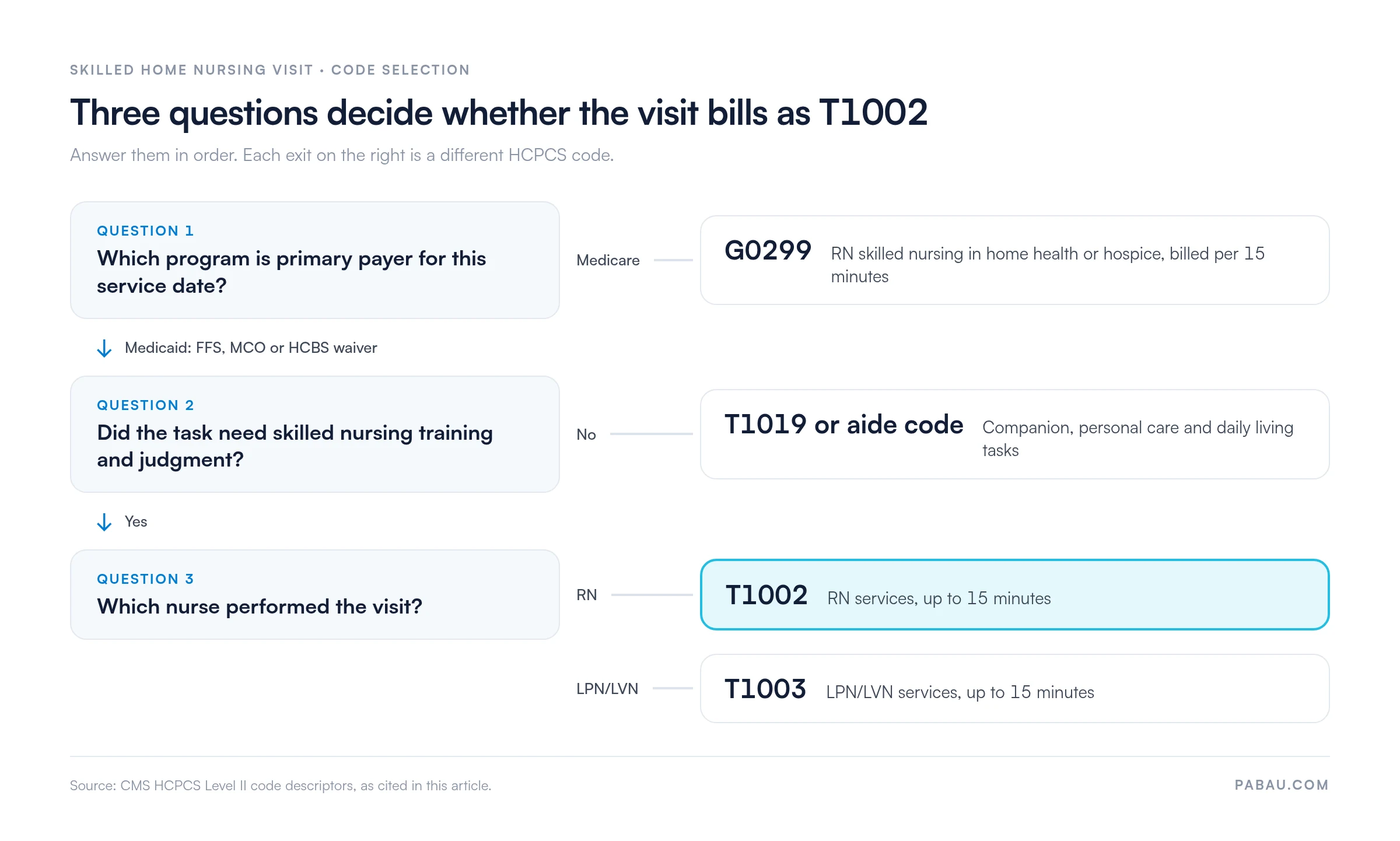
Before billing T1002 for a dual-eligible patient, run an eligibility check. Confirm that Medicaid, not Medicare, is primary payer for that service date and program. A single-payer assumption on a dual-eligible case is a common cause of T1002 denials.
HCPCS code T1002 is accepted by Medicaid programs, not by Medicare fee-for-service. The three main program types that use T1002 are listed below.
Because each state runs its own Medicaid program, coverage rules, rate schedules, and authorization requirements differ from state to state. Always verify T1002 policy in your state’s Medicaid provider manual before billing.
Documentation for T1002 must demonstrate that a credentialed RN performed a medically necessary skilled service under a valid physician order and plan of care. Missing or incomplete documentation is a frequent audit finding for home health T-code claims. The same visit notes decide whether a Medicaid audit passes and whether a denied claim wins on appeal.
Required documentation elements for each T1002 claim:
Documentation must map directly to the units billed. If 4 units are billed (60 minutes), the visit note must clearly account for 60 minutes of skilled RN activity. Notes that describe clinical tasks but omit time stamps routinely trigger denials on post-payment audit.
Modifiers for T1002 vary by state Medicaid program and MCO contract. The table below covers the most commonly required modifier types. Always confirm which modifiers your specific payer requires before submitting.
T1002 claim denials follow predictable patterns. Most originate from one of six root causes. Identifying the specific Claim Adjustment Reason Code (CARC) on the remittance advice is the fastest way to pinpoint the problem and correct the claim. Linking visit documentation directly to billing catches most of these errors before submission.
For what each CARC and RARC on a remittance file means, see our guide to denial codes in medical billing.
Accurate T1002 billing requires a sequential workflow that begins before the first visit. A lapsed eligibility check or a missing PA rarely surfaces until the claim is denied weeks later. Working through these steps in order prevents most of the denial patterns above.
Pabau’s claims management software carries each of these stages, from eligibility verification through remittance posting.
T1002 reimbursement rates are set state by state. The CMS HCPCS overview describes the Level II code set, and T-codes carry no national Medicare fee schedule. Each state Medicaid agency publishes its own rate, which typically changes annually. Rates also vary between state FFS programs and managed Medicaid MCOs, which negotiate their own fee schedules independently of the state FFS rate.
To find your state’s current T1002 rate:
The AAPC HCPCS code lookup is a useful reference for descriptors and categories. Reimbursement amounts still come from state Medicaid fee schedules. The CMS Physician Fee Schedule search tool covers Medicare rates but not T-code Medicaid rates.
Run a T1002 rate reconciliation every January and July. Many home health agencies discover they are billing at a lapsed rate after a state Medicaid update. Six months at an outdated rate means lost revenue if the rate went up, or overpayment liability if it went down.
In many home health agencies the RN writes the visit note in one system and a biller rebuilds the claim in another. Time stamps, the nurse’s credential, and the PA unit balance all get retyped. Each retyped field is a chance to bill T1002 for an LPN visit or to run past the authorized units.
In Pabau, the visit note, the clinician’s credential, and the authorization live on the same patient record as the claim. Units come from the documented time-in and time-out. The claim carries the code that matches the nurse who signed the note.
The outcome is a T1002 claim your documentation already supports when an auditor asks for it. Billing staff work fewer denials and spend less time reconciling remittances by hand.

Pabau links RN visit notes, time stamps, and prior authorizations to the claim. Billing staff submit units the record supports and spend less time on denials.

T1002 rarely fails on the descriptor. It fails on the facts around the visit: which program pays that day, which nurse walked in, and how many authorized units remain. Settle those three before the first visit, and the claim mostly codes itself.
The trade-off is front-loaded work. Eligibility checks, PA tracking, and minute-level notes take time each week, but they cost less than reworking denied claims. Book a demo to see how Pabau links RN visit notes to Medicaid claims in one record.

Billing the LPN visits too? HCPCS code T1003 covers the LPN and LVN counterpart to T1002, with its own unit and documentation rules.
Working a dual-eligible case? HCPCS code G0299 explains the Medicare code for skilled RN visits in home health and hospice.
Need a refresher on how medical billing works end to end? What is medical billing covers the full revenue cycle from patient registration through claim adjudication.
Want to understand denial codes on your remittance advice? Denial codes in medical billing breaks down CARC and RARC codes used across payer 835 files.
Handling the Medicare side of home health? Medicare billing walks through claims, coverage rules, and submission for Medicare patients.
HCPCS code T1002 covers registered nurse home health services billed per 15-minute increment under Medicaid. Covered services include RN clinical assessment, wound care, medication administration, IV management, and care plan oversight performed in the patient’s home or an HCBS setting. Non-skilled tasks such as companion care or personal assistance do not qualify under T1002.
T1002 covers registered nurse (RN) services, and T1003 covers licensed practical nurse (LPN) or licensed vocational nurse (LVN) services. Both are billed per 15-minute unit under Medicaid. Bill the code that matches the credential of the nurse who performed the visit. Billing T1002 when an LPN provided the service is an upcoding error.
Most Medicaid programs and managed Medicaid MCOs require prior authorization before T1002 services begin, though requirements vary by state and payer. Submit a PA request with supporting clinical documentation before the first visit. Failing to obtain prior authorization is one of the most common denial causes for T1002 claims.
T1002 is billed per 15-minute unit of service, not per visit. A 60-minute nursing visit generates 4 units on the claim line. Document time-in and time-out for every visit. Then apply your state Medicaid program’s rounding rule to any partial increment.
T1002 is accepted by state Medicaid fee-for-service programs, Medicaid managed care organizations, and HCBS waiver programs. Medicare fee-for-service does not cover T1002. Medicare uses G0299 for equivalent direct skilled nursing visits in home health.
T1002 is a Medicaid code billed per 15-minute unit. G0299 is a Medicare code billed per 15-minute unit for direct skilled nursing in the home health or hospice setting. The unit is the same, so the payer decides the code. For dual-eligible patients, use T1002 when Medicaid is primary and G0299 when Medicare is primary.




