

HCPCS code E0198: Water pressure pad billing guide
HCPCS code E0198 is a water pad for a standard mattress HCPCS code E0198 is the ...

Last Updated: Oct 13, 2026
G0156 is the HCPCS Level II code for services of home health/hospice aide in home health or hospice settings, each 15 minutes.
Let Pabau's smart automation suggest the right codes, reduce claim denials, and keep your practice compliant—effortlessly.
Automate repetitive tasks and focus on what matters most—your patients.
Reduce coding errors and ensure compliance with the latest regulations.
Clean claims, fewer denials, and faster reimbursements.
Powerful insights and reporting to help your practice thrive.
HIPAA compliant SOC 2 certified GDPR-compliant Trusted by 4,000+ clinics worldwide

HCPCS Code G0156 covers services of a home health aide or hospice aide in home health or hospice settings, billed per 15-minute increment.
Revenue code 0571 pairs with G0156 on UB-04 claims in both settings. Missing that pairing is a common reason agencies receive claim rejections.
G0156 needs no modifier in routine billing. Modifier PM applies only to a post-mortem aide visit, and GP, GO, GV, and GW never apply.
G0156 has no standalone Medicare rate. The aide visit is bundled into the 30-day period payment under HH PPS and PDGM, or into the hospice per-diem rate.
Pabau’s claims management software helps home health agencies track G0156 units and pair them with the right revenue code. Clean UB-04 claims then go out without manual rework.
HCPCS Code G0156 covers services of a home health aide or hospice aide, billed in 15-minute units.
It is the primary Medicare billing code for aide visits under both the home health and the hospice benefit. On a UB-04 claim it pairs with revenue code 0571 and carries no modifier in routine use.
G0156 is classified as a temporary G-code under HCPCS Level II, maintained by the Centers for Medicare and Medicaid Services (CMS). Its status is active, and it remains the standard aide-services code for Medicare home health and hospice billing.
G0156 is not a CPT code. It is a HCPCS Level II G-code, which places it outside the AMA’s CPT code set and under the direct maintenance of CMS. Coders searching for “g0156 cpt code” or “cpt code g0156” are looking for this same code under a different label. The function is identical either way, but the classification matters for billing systems that distinguish between CPT and HCPCS code types.
G0156 covers personal care and supportive aide services delivered by a home health aide (HHA) or hospice aide. These are paraprofessional services, distinct from the skilled nursing or therapy services billed under other G-codes in the same series.
Medicare covers aide services under the home health benefit only when a physician-certified plan of care includes them. The patient must also qualify for at least one skilled service. That means skilled nursing, physical therapy, speech-language pathology, or continued occupational therapy. Aide services alone do not trigger the home health benefit.
Covered aide tasks under G0156 typically include:
G0156 applies in both home health and hospice settings, but the billing and documentation context differs. In hospice, aide services fall under the Medicare Hospice Benefit (Part A) as part of routine home care or continuous home care. The same 15-minute unit structure applies. Hospice claims do carry different condition codes and occurrence codes on the UB-04 than home health claims. Neither setting requires a modifier on the aide line, as the next section explains.
G0156 is billed in 15-minute increments. Each unit represents exactly 15 minutes of aide services delivered to the patient. A 60-minute aide visit generates four units. Agencies should document the time spent in the visit record, because Medicare contractors audit unit counts against aide visit logs during post-payment reviews.
Unit counts are one of four fields that decide whether an aide line goes out as a clean claim. The revenue code, the HCPCS code itself, and the modifier field are the other three.
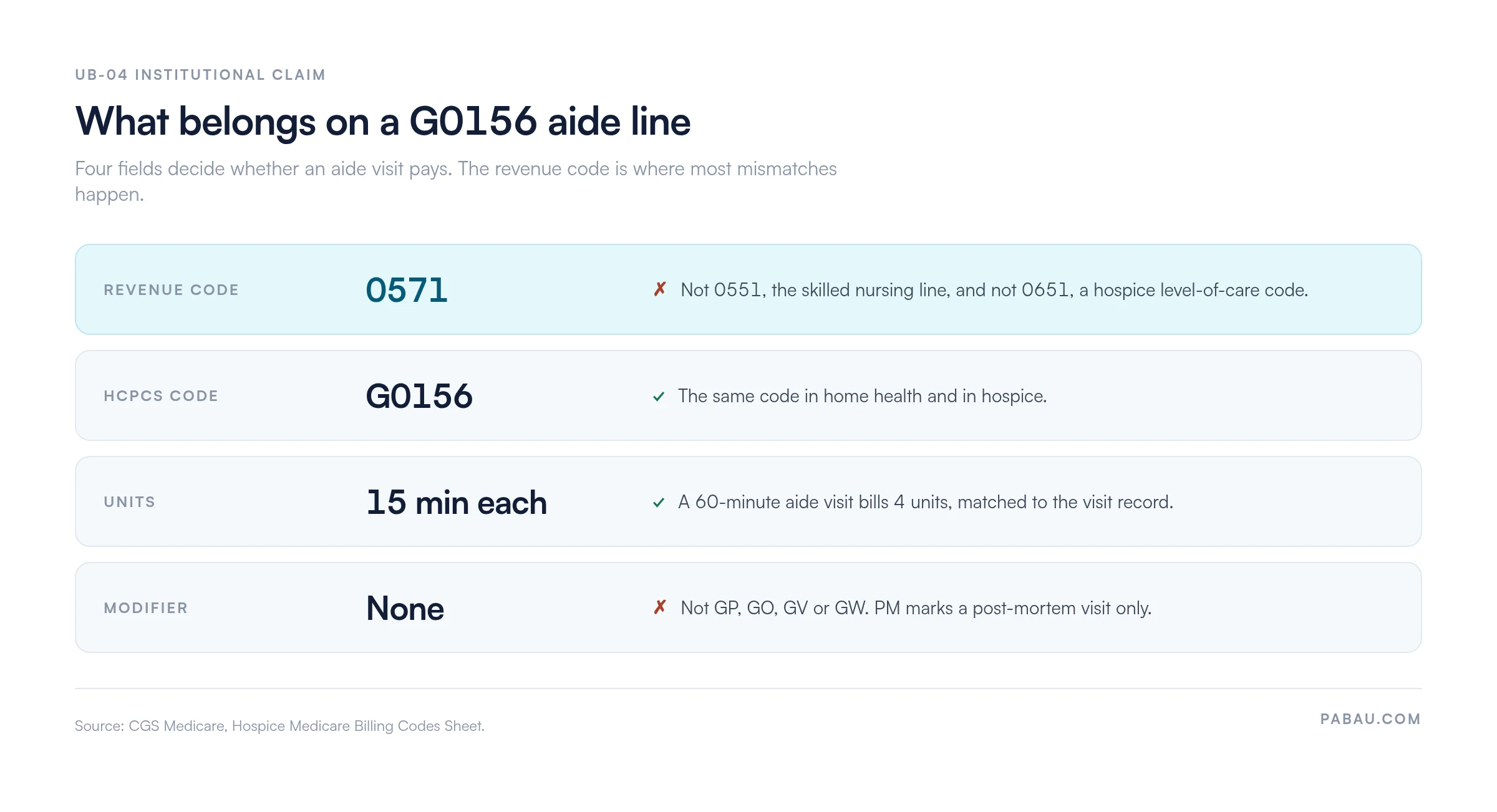
G0156 takes no modifier in normal use. CGS Medicare’s hospice billing codes sheet lists PM, for a post-mortem visit, as the only modifier tied to the aide line. Coders often assume GP, GO, GV, or GW applies instead. None of those four belongs on a G0156 line, and the table below explains why.
Two points follow from that table. A G0156 line with no modifier is correct, and no MAC edit rejects it on that basis. The automatic-rejection edit coders associate with GP and GO covers the always-therapy code list, which excludes G0156, G0151, G0152, and G0153.
The second point concerns hospice. A hospice flags a service as unrelated to the terminal condition with Condition Code 07 on the UB-04. That is a claim-level condition code, not a line-level modifier on the aide service. A hospice aide visit is related to the terminal condition by definition, so the question rarely comes up on a G0156 line at all.
On UB-04 institutional claims, G0156 pairs with revenue code 0571, the home health aide revenue code. CGS Medicare maps the same 0571 line to hospice aide visits. Revenue code 0571 identifies the service type at the revenue line level, and G0156 goes in the HCPCS field on that same line.
Two neighboring codes cause most of the mismatches. Revenue code 0551 is the skilled nursing line, which paired with the now-deleted G0154. Revenue code 0651 identifies hospice routine home care, a level of care rather than a discipline. Neither one belongs on an aide line in either setting.
Build a UB-04 claim template in your billing system that pre-populates revenue code 0571 whenever G0156 is selected. This single workflow step removes the most common revenue code mismatch and cuts manual review time on every aide claim.
G0156 has no standalone Medicare payment rate. Medicare does not pay a per-unit amount for the code, and no locality-adjusted fee schedule figure exists to look up. Under the Home Health Prospective Payment System and the Patient-Driven Groupings Model (PDGM), an aide visit is bundled into the agency’s 30-day period payment. In hospice, it is bundled into the level-of-care per diem, most often routine home care.
G0156 also does not appear on the CMS Physician Fee Schedule. That schedule prices physician and practitioner services through the resource-based relative value scale. Home health aide and hospice aide visits are institutional services billed by the agency on a UB-04, so they sit outside it entirely. A per-unit dollar figure for G0156 on a third-party lookup site is almost always a commercial payer’s negotiated average, not a Medicare rate.
The one published Medicare dollar figure tied to aide visits is the HH PPS per-visit amount. It applies when a 30-day period ends below its PDGM low-utilization payment adjustment (LUPA) threshold. Medicare then pays the period visit by visit instead of paying the full case-mix-adjusted amount. The CMS CY2026 HH PPS rate update sets the national per-visit amount for aide services at $80.12. A wage index adjustment then applies by locality. That figure covers a whole aide visit, and it is not a rate for each 15-minute unit.
Unit accuracy still has a financial consequence, just not through a line-item payment. Reported visits and units feed the case-mix and LUPA logic that sets the period payment. They are also the first thing a MAC compares against aide visit records on post-payment review. Treat G0156 as reporting data rather than as a billable rate.
Medicare does not publish a hard daily unit cap for G0156. Frequency has to be supported by the physician-certified plan of care and by documented medical necessity. Claiming more units than the plan of care authorizes is a compliance risk, not just an administrative error. Remittance adjustment codes on G0156 rejections often reveal when unit counts exceed what the MAC will process without extra documentation.
CMS Conditions of Participation (CoPs) require home health agencies to maintain specific documentation for every G0156 claim. Compliance audits for home health focus heavily on aide services. Aide claims are high-volume and high-frequency, which makes them straightforward to audit against visit records.
Required documentation elements include:
Incomplete documentation is the primary driver of G0156 post-payment audit recoupments. Confirming benefit eligibility at the start of each episode also protects against billing aide services after a patient’s home health coverage has lapsed or changed.
Every G0156 claim requires at least one ICD-10-CM diagnosis code that supports medical necessity for aide services. The diagnosis must reflect the patient’s documented condition. Selecting a code solely to establish medical necessity, without a clinical basis, is a fraudulent billing practice.
The diagnosis code must appear on the CMS-485 plan of care and align with the OASIS assessment findings. MAC post-payment reviews regularly flag claims where the ICD-10 code does not clearly support aide-level services as medically necessary.
G0156 is one code in a series of home health and hospice G-codes that cover different disciplines. Selecting the wrong code from this series is a common error that triggers compliance reviews. The series covers every discipline that delivers home health services under Medicare.
G0154 still appears in older billing guidance, but it is not valid for visits on or after January 1, 2016. Skilled nursing now splits between G0299 for an RN and G0300 for an LPN or LVN. A claim system that still carries G0154 on a service list will reject the line.
The G prefix also spans codes that carry no payment at all. HCPCS code G8918 belongs to the G8000-series quality reporting range and marks a measure outcome, not a billable visit.
G0156 and G0299 are the two most commonly confused codes in the home health G-code series. The distinction is the credential of the person delivering the service, not the task itself. Bathing assistance performed by a home health aide is G0156. An RN conducting a medication assessment during the same visit bills G0299.
Billing G0299 for services actually delivered by an aide is upcoding, a serious compliance violation. The reverse error is billing G0156 when an RN delivered a skilled nursing service. That misstates the discipline on the claim and can distort the case-mix and LUPA data behind the period payment. Train billing staff to verify the credential of the treating clinician before assigning a code from this series. AAPC’s HCPCS code database carries the full descriptions for cross-referencing when credential-to-code alignment is unclear.
Post-payment audits of home health aide claims surface the same error patterns again and again. Catching them before submission costs far less than working through a denial backlog afterwards.
Review the denial codes your MAC returns on the remittance advice when a G0156 claim rejects. The adjustment reason code usually points straight at which of these errors occurred.
Run a monthly G0156 internal audit. Pull all aide claims for the prior 30 days, cross-reference unit counts against visit records, then confirm the revenue code matches the benefit type. Catching errors before a MAC audit saves significant recoupment risk and staff time.
Accurate G0156 billing depends on visit records matching claim data, revenue codes loading correctly by setting, and documentation keeping pace with every aide visit. When those three jobs live in separate systems, errors accumulate between the clinical record and the claim.
Pabau is practice management software for healthcare providers, and its claims software for agencies connects clinical documentation to claim submission in one workflow. Agencies configure G0156 once, with revenue code 0571 attached and no stray modifiers. Coders then stop making that decision from memory on every claim.
Aides complete visit records on a mobile device at the point of care. The time stamps then line up with the units submitted on the UB-04. Billing staff see the status of every submitted claim in one view.
Some agencies run both home health and hospice lines of service. Pabau’s multi-setting configuration keeps claim settings separate for each benefit type. That removes the cross-setting errors that otherwise surface only in manual review.

Pabau helps agencies track G0156 units, pair them with revenue code 0571, and submit clean UB-04 claims.

HCPCS Code G0156 is simple in concept and exact in execution. Revenue code 0571, unit counts that match the visit record, and a current plan of care are what decide whether an aide line pays.
Set those three defaults once in your billing system and the code stops generating rework. Leave them to memory and every coder re-decides them on every claim, which is where the mismatches come from. To see how Pabau handles home health and hospice billing workflows, book a demo.

Need a framework for reducing claim rejections across your billing team? Clean claim submission guide covers the documentation and coding checks that prevent denials before they happen.
Want to understand how remittance codes tell you what went wrong on a claim? Electronic remittance advice (ERA) explained breaks down how to read adjustment reason codes and act on them.
Managing billing compliance across a home health or hospice agency? Medical billing compliance guide outlines the documentation standards and audit triggers that affect aide service claims.
HCPCS Code G0156 reports services provided by a home health aide or hospice aide. Each unit represents 15 minutes of aide care in a home health or hospice setting. It is a Medicare billing code used by certified home health agencies and hospice providers submitting UB-04 institutional claims.
G0156 is a HCPCS Level II G-code, not a CPT code. It is maintained by CMS rather than the AMA. Many coders search for it using “CPT code G0156” or “G0156 CPT,” but the correct classification is a temporary G-code under HCPCS Level II.
Medicare pays no separate amount for G0156. The aide visit is bundled into the agency’s 30-day period payment under HH PPS and PDGM, or into the hospice level-of-care per diem. The code does not appear on the CMS Physician Fee Schedule, so there is no per-unit Medicare rate to look up. Units are reported for visit detail, case-mix, and audit purposes rather than for line-item payment.
Medicare does not set a hard daily unit cap for G0156. The number of units billed must match the time documented in the aide visit record. It must also stay within the frequency authorized in the physician-certified plan of care. Billing units beyond what the plan of care supports is a compliance risk regardless of how much time the aide spent.
None, in normal use. G0156 does not require a modifier on a home health or hospice aide line. The one exception is PM, which marks a post-mortem visit. GP, GO, GV, and GW do not apply to this code. A hospice service unrelated to the terminal condition is flagged with Condition Code 07 on the UB-04, not a modifier.
Revenue code 0571 pairs with G0156 on UB-04 claims. The same revenue code applies to home health aide visits and to hospice aide visits. Revenue code 0551 is the skilled nursing line and 0651 identifies hospice routine home care, so neither belongs on an aide line.
G0156 covers services delivered by a home health aide or hospice aide (a paraprofessional), while G0299 covers services delivered by a registered nurse (RN). Both are billed per 15-minute unit, but using G0299 for aide-delivered services constitutes upcoding and is a compliance violation. The credential of the person providing the service determines which code applies.



