HCPCS code C1731: Catheter billing, OPPS reimbursement, and denial guide
HCPCS code C1731: Official descriptor and code series context HCPCS code C1731 i...

Last Updated: Oct 8, 2026
V2020 is the HCPCS Level II code for frames, purchases. It reports the spectacle frame dispensed with a prescription eyeglass order, while each lens is billed on its own line with a separate V-code.
Medicare Part B excludes routine eyeglasses. It pays for V2020 only as part of one pair of eyeglasses after each cataract surgery with an intraocular lens (IOL) implant. Other payers cover frames through vision plans or state Medicaid benefits, each with its own frequency limits.
Let Pabau's smart automation suggest the right codes, reduce claim denials, and keep your practice compliant—effortlessly.
Automate repetitive tasks and focus on what matters most—your patients.
Reduce coding errors and ensure compliance with the latest regulations.
Clean claims, fewer denials, and faster reimbursements.
Powerful insights and reporting to help your practice thrive.
HIPAA compliant SOC 2 certified GDPR-compliant Trusted by 4,000+ clinics worldwide

HCPCS code V2020 reports the spectacle frame only, and each lens is billed on its own line with a separate V-code.
Medicare Part B excludes routine eyeglasses but covers one pair of eyeglasses after each cataract surgery with IOL implantation. Frames are paid up to the Medicare allowance.
Many payers require modifier NU (new equipment), while LT, RT and RR do not apply to spectacle frames.
Upgraded frames are billed on V2025, and a signed ABN covers the non-covered upgrade amount.
Pabau, the practice management platform we build, checks claims for missing insurer details before submission and tracks each one through to payment.
HCPCS code V2020 is the HCPCS Level II code for spectacle frames. The Centers for Medicare and Medicaid Services (CMS) lists it under the official descriptor “Frames, purchases” in the HCPCS code set. V2020 reports the frame dispensed with a prescription eyeglass order. Lenses are never part of it, and each one is billed on a separate claim line.
V2020 is a supply code that reports the physical frame dispensed to the patient. The provider’s exam and refraction are billed separately, so V2020 carries only the materials cost on the claim.
V2020 covers the spectacle frame only. It applies to any frame style dispensed with prescription lenses as part of a complete eyeglass order. Lens costs are always reported on their own lines.
A common billing error is combining the frame and lens costs on a single line. V2020 and each lens code must appear on separate lines of the CMS-1500. Payers edit for this, and a bundled submission typically triggers a CO-97 denial.
V2020 usually appears with a lens code on the same claim. Frame-only claims are valid for replacement frames when the payer allows it. Knowing which lens codes pair with V2020 prevents a missing lens line, and it stops V2020 being billed when only lenses were dispensed.
Each lens is billed on its own line. A single-vision pair usually means V2020 on line one and V2100 or another V21xx code on lines two and three, one per eye. Bifocal lenses use the V2200-series codes.
Progressive lenses take the base lens code plus the add-on V2781, which reports a progressive lens, per lens. Check lens code selection against the prescription before you submit, because payers audit lens type against refraction data in the record.
Medicare Part B does not cover routine eyeglasses or spectacle frames. The exclusion is statutory, under Social Security Act Section 1862(a)(7). Billing V2020 to Medicare for routine vision correction results in a CO-96 denial.
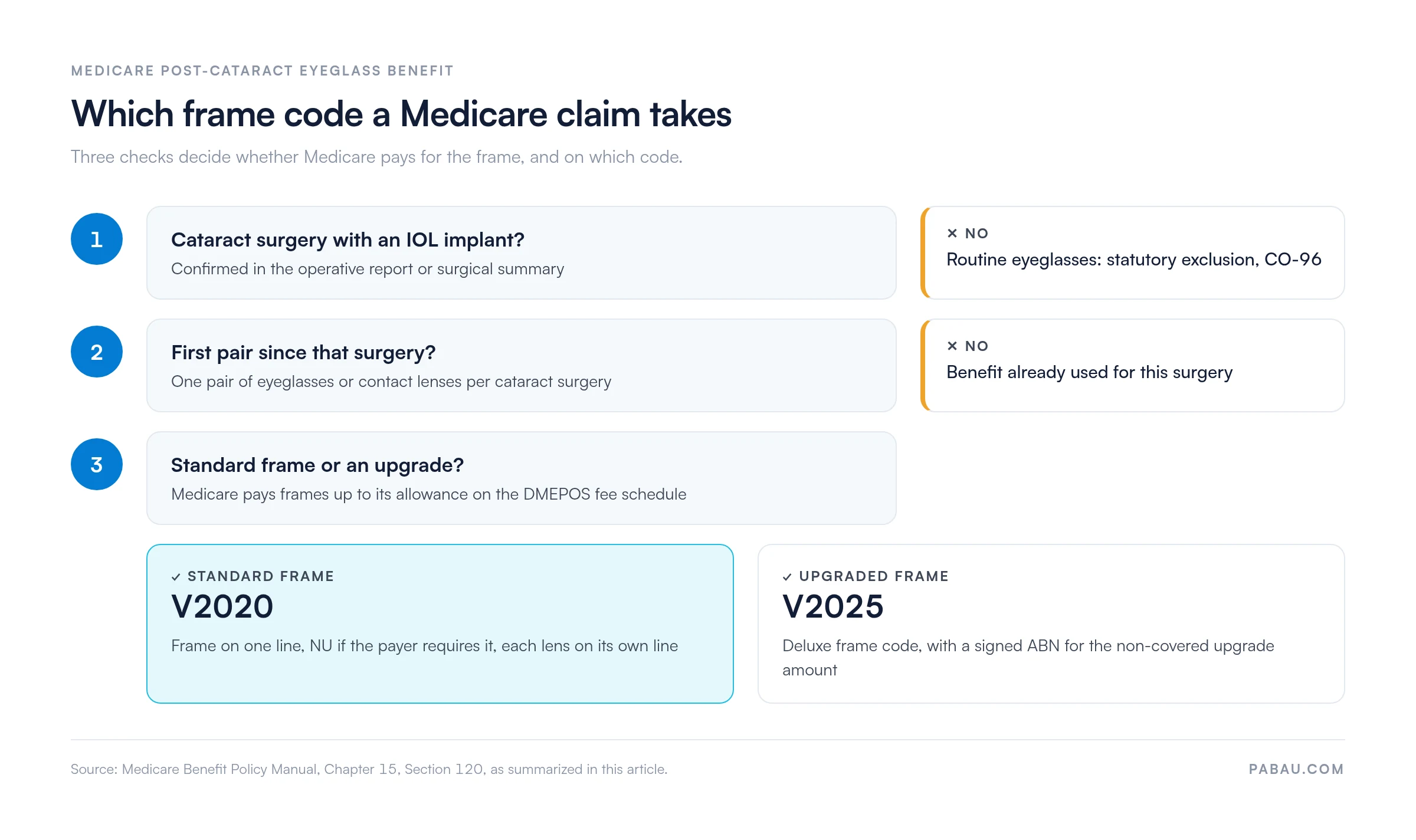
The exception is narrow. Medicare covers one pair of eyeglasses or contact lenses after each cataract surgery in which an intraocular lens (IOL) is implanted. The rule sits in Social Security Act Section 1861(s)(8) and Medicare Benefit Policy Manual Chapter 15, Section 120. The surgery itself is usually billed on 66984.
Three checks decide whether Medicare pays for the frame at all, and whether the claim takes V2020 or V2025.
Medicare Advantage plans may extend coverage beyond the statutory exception. Each plan sets its own optical benefit, including frame allowances, covered frequencies, and in-network dispensers. Verify the member’s plan benefit before you submit a V2020 claim under Medicare Advantage.
Before you submit any V2020 claim for a Medicare patient, confirm the cataract surgery date and IOL implantation in the operative note. Payers audit this retroactively. A copy of the surgical report or a summary note from the operating surgeon, kept in the dispensing record, satisfies most post-payment review requests.
Medicaid optical benefits vary significantly by state. Some state Medicaid programs cover annual frame replacements for adults, while others limit coverage to children under a set age or to medically necessary replacements. There is no national Medicaid rule for V2020 beyond what CMS mandates for mandatory benefit populations.
V2020 claims are supply-based, so the documentation must show that a frame was physically dispensed. A prescription in the record is necessary but not sufficient on its own.
Keep the itemized dispensing receipt and delivery confirmation in the patient chart. These are the two documents most often requested during post-payment audits of V2020 claims. Missing either can lead to full recoupment of the allowed amount.
Modifier selection for V2020 is often misunderstood. Frames are not side-specific and are never rented, so the most common modifiers in other HCPCS categories do not apply here.
The NU modifier is the one billing staff most often omit. Several Medicare Administrative Contractors and vision payers require NU on all DMEPOS supply codes to confirm the item is newly dispensed. Check the applicable Local Coverage Determination (LCD) or payer billing guide before you default to no modifier.
The billing sequence for V2020 follows a set path on a CMS-1500 or 837P electronic claim. Each step matters, because payers run automated edits on optical claims before any human reviewer sees them.
For a clean claim, check that no field is missing or invalid before you send it. The usual clean-claim failures on V2020 are a wrong date of service, a missing NPI, and a missing modifier the payer’s LCD requires.
V2020 denials cluster around four root causes, which are coverage exclusions, duplicate submissions, missing modifiers, and frequency violations. The denial code on the Explanation of Benefits shows which issue triggered the edit. Sorting denials by category with structured denial management shortens the resolution cycle.
OA-18 (duplicate claim) deserves special attention. It appears when a claim is resubmitted too soon after the original. If the first submission is still pending, wait for the remittance before acting. A second identical claim sent during processing is denied as OA-18 and can flag the account for payment integrity review.
Build a V2020 denial tracker in your practice management system. Log each denial by CARC code, note the root cause, and review the log monthly. Recurring denials usually trace back to a handful of causes, and each one can often be fixed with a single change before claim submission.
Most V2020 denials start in the dispensing record. When the frame order, the insurer details and the claim live in separate systems, billing staff re-key the dispensing date, NPI and modifiers by hand.
Pabau’s medical claims management keeps the claim in the same system as the patient record and the invoice. Insurer and policy details sit on the patient record, so each invoice routes to the right payer without re-keying.
Your billing team still selects V2020 and the lens codes. Pabau makes sure the claim carrying them is complete, so fewer frame claims come back for missing information.

Pabau’s claims management checks insurer details before submission, tracks every claim’s status, and posts remittances against the invoice. Fewer V2020 claims come back for missing information.

V2020 itself rarely causes a denial. The claims that fail usually miss a payer rule around it. The usual culprits are the Medicare post-cataract exception, the NU modifier, and a frame upgrade that belongs on V2025.
Build those rules into dispensing, not billing. Confirm the IOL surgery and the remaining benefit before the frame is ordered, and record the delivery date as the date of service. The claim then leaves the practice complete, and nobody has to rebuild it from a denial.
The cost is a few extra checks at the dispensing desk, and the return is frame claims that get paid the first time. Book a demo to see how Pabau checks V2020 claims for missing details before they reach the payer.

Billing bifocal lenses alongside the frame? HCPCS code V2200 covers the bifocal lens code that pairs with V2020 on multifocal orders.
Checking optical benefits before the frame is ordered? Insurance eligibility verification walks through confirming coverage and remaining benefit before the visit.
Dealing with recurring HCPCS claim denials? Denial management in healthcare walks through how to categorize, track, and systematically reduce denial rates.
Want to reduce claim errors before submission? Submitting a clean claim outlines the field-level requirements that keep optical claims out of the denial queue.
Need to understand the full revenue cycle? What is revenue cycle management covers the end-to-end process from patient intake to collected payment.
HCPCS code V2020 covers spectacle frames of any style dispensed as part of a prescription eyeglass order. It covers the frame only. Each lens is billed separately on its own claim line with the matching V-code.
Medicare Part B does not cover routine eyeglasses or spectacle frames. The exception is cataract surgery with intraocular lens (IOL) implantation. Medicare then covers one pair of eyeglasses or contact lenses after each surgery, with frames paid up to the Medicare allowance for that benefit.
V2020 covers the spectacle frame itself, and V2100 covers a single-vision sphere lens from plano to +/-4.00 diopters, per lens. Both codes appear on the same claim when a complete pair of eyeglasses is dispensed, each on its own line.
Modifier NU (new equipment) is required by many payers, including Medicare, for DMEPOS supply codes like V2020. Modifier RA may be required for replacement frames under certain Medicaid and DME policies. LT, RT and RR do not apply, because spectacle frames cover both eyes and are never rented.
Yes, in some cases. V2020 usually appears with a lens code, but frame-only claims are valid for replacement frames when the payer allows it. For a new pair of eyeglasses, bill the lens codes on separate lines next to V2020.
The most common denials are CO-96 (routine vision excluded by Medicare), OA-18 (duplicate claim) and CO-97 (frame and lens bundled on one line). CO-4 (missing NU modifier) and CO-119 (frequency limit exceeded) are also frequent. Each maps to a fix, such as coverage verification, splitting frame and lens lines, adding the modifier, or checking eligibility before dispensing.
Medicaid optical coverage for spectacle frames varies by state. Check the state Medicaid optical fee schedule and confirm whether prior authorization is required before dispensing. Children are typically covered under EPSDT vision benefits, and adult coverage depends on the state plan. Enter V2020 with the modifier your state requires, and document the dispensing event.