

HCPCS Code Q4175: Billing, coverage, and documentation guide
HCPCS Code Q4175: Code Description and Product Identity HCPCS Code Q4175 is the ...

Last Updated: Nov 20, 2026
Q4151 is the HCPCS Level II code for AmnioBand or Guardian, per square centimeter. It reports these skin substitute products applied to chronic wounds such as diabetic foot ulcers and venous leg ulcers, one unit per sq cm applied.
From January 1, 2026, Medicare pays non-BLA skin substitutes like AmnioBand as incident-to supplies at one flat national rate, $127.14 per sq cm. That rate applies in the office, hospital outpatient department and ASC alike. Each claim also needs a separate application code, a documented conservative care trial and units that match the product applied.
Let Pabau's smart automation suggest the right codes, reduce claim denials, and keep your practice compliant—effortlessly.
Automate repetitive tasks and focus on what matters most—your patients.
Reduce coding errors and ensure compliance with the latest regulations.
Clean claims, fewer denials, and faster reimbursements.
Powerful insights and reporting to help your practice thrive.
HIPAA compliant SOC 2 certified GDPR-compliant Trusted by 4,000+ clinics worldwide

HCPCS code Q4151 reports AmnioBand or Guardian, billed per square centimeter of product applied to chronic wounds.
From January 1, 2026, Medicare pays non-BLA skin substitutes like AmnioBand as incident-to supplies at one flat national rate per sq cm.
CMS set that category rate at $127.14 per sq cm, so confirm the Q4151 figure in the current CMS payment files.
Each Q4151 claim needs an application code on the same date, CPT 15271-15278 for a sheet product, and no JW or JZ modifier.
WISeR prior authorization includes skin substitutes only in the states with an active skin-substitute LCD (New Jersey, Ohio, Oklahoma, Texas).
HCPCS code Q4151 reports AmnioBand or Guardian, per square centimeter, applied to chronic wounds.
From January 1, 2026, Medicare pays these non-BLA skin substitutes as incident-to supplies. CMS fixed one national rate of $127.14 per sq cm in the corrected CY 2026 fee schedule rule. Older guides that still price the product from quarterly sales data are out of date.
Each Q4xxx code maps to one or more named commercial products. Q4151 covers AmnioBand and Guardian, so the product on the invoice must match the code on the claim. A different brand needs its own Q-code, even when the tissue type looks similar. Particulate AmnioBand, measured in 1 mg units, takes its own code Q4168 rather than Q4151.
CMS can add, delete or reassign Q4xxx codes in its quarterly updates. Check the current product assignment in the CMS HCPCS Level II code set before each billing cycle. Our HCPCS Level II codes reference lets you compare neighboring Q-codes side by side. Billing a code after it changes is a compliance risk.
Coverage for Q4151 is limited to chronic, non-healing wounds where standard wound care has failed. MAC policies typically restrict coverage to the following wound types.
Document the exclusions just as carefully. Q4151 is not covered for acute surgical incisions, superficial partial-thickness burns, or wounds that haven’t completed the conservative care trial. Applying the product before the wound meets chronicity thresholds is a leading cause of CO-50 (not medically necessary) denials.
Medicare Administrative Contractors (MACs) set skin substitute coverage through LCDs and their billing articles. In December 2025 CMS withdrew the new skin-substitute LCDs that were due on January 1, 2026. Policies already in effect remain, so check which LCD or article your MAC currently has in force.
The criteria below are the ones most MACs share.
A clean Q4151 claim comes from six checks before it leaves the practice. Missing any one of them can trigger a denial.
The diagnosis codes below are the most common pairings for Q4151 claims. The code must reflect the wound type, laterality and severity documented in the chart. With E11.621, E11.622 or an I87.31- code, add an L97 code for the ulcer’s site and depth.
The modifier picture changed in 2026, and older billing guides haven’t caught up. Here’s what applies to Q4151 now.
In a hospital outpatient department or ASC, the facility reports Q4151 on its own claim and the clinician bills only the application. Agree with the facility upfront who bought the product, so it isn’t billed twice or not at all.
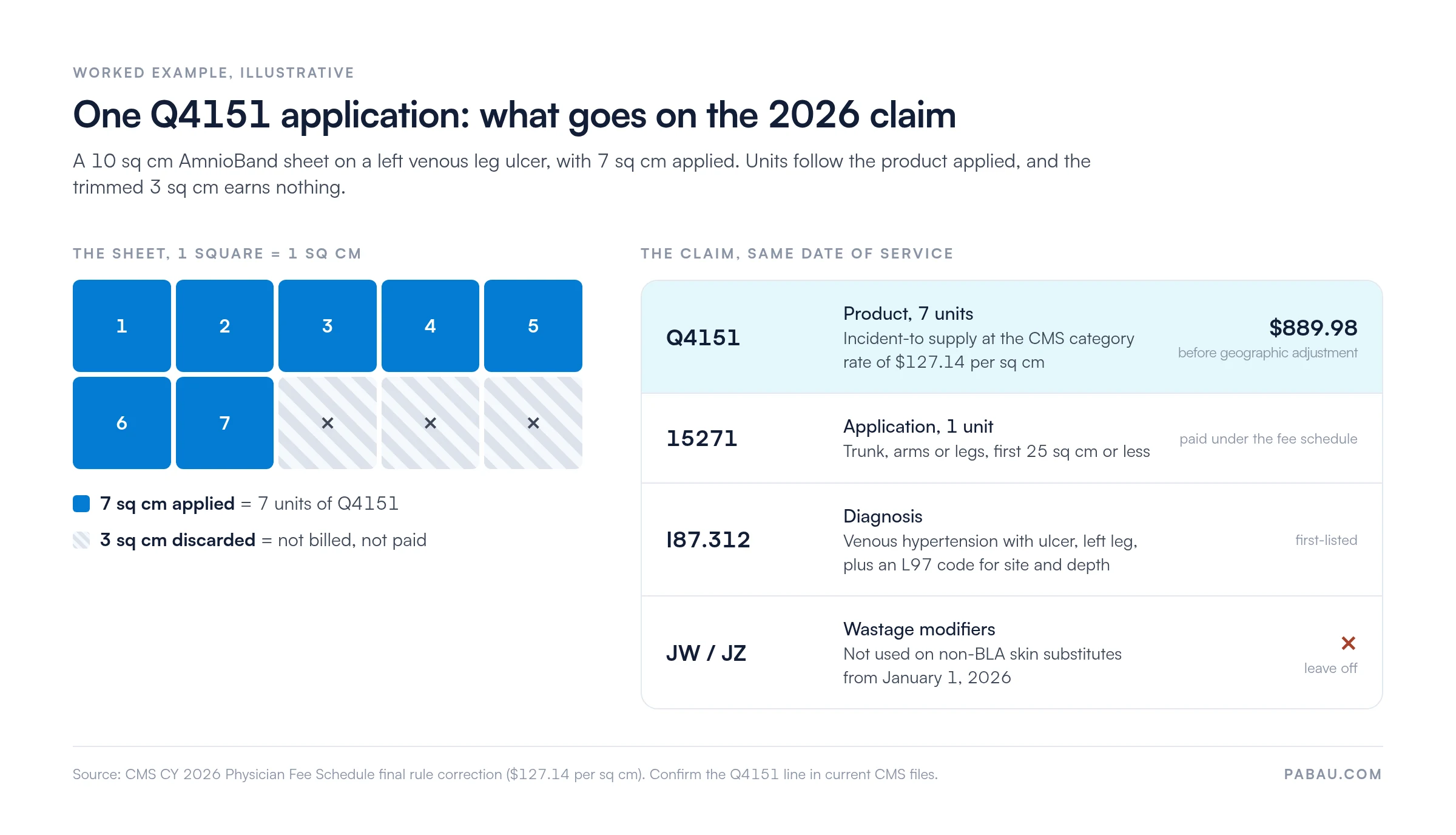
Take a venous leg ulcer on the left lower leg that hasn’t closed after four weeks of compression and moist dressings. The clinician opens a 10 sq cm AmnioBand sheet and trims it to the wound. That leaves 7 sq cm applied and 3 sq cm discarded.
The claim carries 7 units of Q4151 and one unit of 15271, since the wound sits on the leg and measures under 25 sq cm. The first-listed diagnosis is I87.312, with an L97 code for the ulcer’s site and depth. JW and JZ stay off the line.
At the $127.14 category rate, the 7 units come to $889.98 before geographic adjustment. Medicare pays for none of the discarded 3 sq cm, so picking the sheet size closest to the wound protects your margin.
Traditional Medicare has no general MAC prior authorization list for skin substitutes. What changed in 2026 is the CMS WISeR model, which runs from January 1, 2026. Its selected services include skin and tissue substitutes in the states with an active skin-substitute LCD (New Jersey, Ohio, Oklahoma, Texas).
WISeR runs in six states (Arizona, New Jersey, Ohio, Oklahoma, Texas, Washington). Skin substitutes are reviewed only where an active skin-substitute LCD exists, which currently means New Jersey, Ohio, Oklahoma and Texas. Arizona and Washington are in the model but not for skin substitutes. Confirm against the current CMS WISeR Operational Guide.
Medicare Advantage and commercial plans set their own authorization rules wherever you bill. Before the first application, confirm these four points with the payer.
Where a payer does require authorization, a missing approval leads to a CO-197 denial. A missing or invalid authorization number on the claim leads to CO-15. Treat the authorization check as a pre-service step, not a post-denial fix.
For dates of service from January 1, 2026, Medicare pays non-BLA skin substitutes as incident-to supplies. These are products regulated as 361 HCT/Ps or 510(k) devices, such as AmnioBand. CMS set one national category rate of about $127.14 per sq cm, first printed as $127.28 before a correction.
That figure is the CMS rate for this category of products, and CMS doesn’t publish it as a Q4151-specific line. Confirm the payment for Q4151 in the current CMS Physician Fee Schedule and OPPS files before you rely on it. Your MAC also applies geographic adjustments.
The Q4100 series holds dozens of product-specific skin substitute codes. Picking the wrong one is a simple but costly error, because the code must match the product on the invoice.
If the invoice names DermaPure, the claim needs Q4152. Dermavest or Plurivest needs Q4153.
Reserve Q4100 for a product with no Q-code of its own. Use the AAPC HCPCS code lookup or PGM Billing’s HCPCS search tool to cross-check any Q4xxx code against its current product before you submit.
Q4151 claims usually fail on audit because the chart can’t show why the product was needed. The record must tell a complete, dated story from wound onset to the decision to apply the skin substitute.
Practices using claims management software keep that record next to the claim, so a missing measurement shows up before filing rather than at recoupment.
Build a pre-service documentation review into the wound care workflow. The chart is then complete before the product is opened, instead of being pieced together during a post-payment audit.
Scan the product label and invoice to the patient’s encounter on the day of application. If an audit request arrives 18 months later, the paperwork is ready on the payer’s timeline. Wound care practices often lose audit money over records they can’t produce, even when the care was sound.
Run these checks on every Q4151 claim before it goes out. Each one heads off a denial code in the next section.
Skin substitute billing draws close payer scrutiny, and the Office of Inspector General has flagged it as a fraud and abuse risk. These are the denial patterns Q4151 claims run into most often.
Most of these come from protocols written before the 2026 payment change.
Wound care practices billing Q4151 often juggle claims, eligibility checks and authorizations across separate tools. That’s where details slip, such as an expired approval or a payer response nobody posted.
Pabau, a practice management platform with built-in claims tools, keeps that work together. In the US, its claims management submits claims through Claim.MD, runs eligibility checks and brings in ERA remittances. Prior authorizations are tracked on the patient’s case, and Pabau warns your team when an authorization is missing.
The result is fewer surprises after submission. Your team sees a missing authorization before the application, and remittances land against the claim they belong to.

Pabau submits US claims through Claim.MD, runs eligibility checks and posts ERA remittances. Authorizations sit on the patient’s case, with a warning when one is missing.

Q4151 is now simpler to price and less forgiving to bill. One national rate per sq cm replaces the quarterly pricing checks, but wastage is no longer paid and every claim needs a matching application code.
Rewrite your skin substitute protocol around those two changes first, then confirm the current Q4151 figure in the CMS files. If you bill in New Jersey, Ohio, Oklahoma or Texas, add the WISeR decision to your pre-service checks. Those steps head off most of the denials this code attracts.
Book a demo to see how Pabau keeps each Q4151 claim, eligibility check and authorization on one patient record.

Need a full framework for clean claim submission? Claims management software features explains how Pabau structures the submission workflow from charge capture through ERA posting.
Trying to understand how clearinghouse edits catch code errors? What makes a clean claim walks through the edit layers that Q4151 claims must pass before reaching the payer.
Building a denial management process for your wound care practice? Denial codes in medical billing covers the most common CARC codes and how to build a systematic response workflow.
Applying a skin substitute to the feet, hands or face? CPT code 15277 covers the application code for those sites when the wound is 100 sq cm or larger.
Billing Dermavest or Plurivest instead? HCPCS code Q4153 sets out the units, coverage and billing rules for that product.
Q4151 is the HCPCS Level II code for AmnioBand or Guardian skin substitute, billed per square centimeter applied. It’s used on chronic wounds such as diabetic foot ulcers and venous leg ulcers, alongside a separate application code.
CMS set one national rate of $127.14 per sq cm for non-BLA skin substitutes, including AmnioBand. Seven units would come to $889.98 before geographic adjustment. Confirm the Q4151 line in the current CMS payment files.
Yes. Q codes are temporary national HCPCS Level II codes that CMS assigns to items without a permanent code. Q4151 stays valid until CMS deletes or replaces it, so check the quarterly HCPCS update before each billing cycle.
Not under general Medicare MAC rules. The CMS WISeR model includes skin and tissue substitutes in the states with an active skin-substitute LCD (New Jersey, Ohio, Oklahoma, Texas). Medicare Advantage and commercial plans set their own rules.
Not automatically. Medicare Advantage and commercial plans pay under their own contracts and coverage policies, and many keep their own authorization lists. Check each plan’s fee schedule and policy before the first application.
Generally no. MAC policies cover Q4151 on chronic wounds that haven’t healed after at least four weeks of standard care. A non-healing surgical wound can qualify once it meets your MAC’s chronicity criteria.





