Pabau Engage inbox

Pabau Engage is here: every patient conversation in one inbox.

Learn more
HCPCS Code

HCPCS code P9059 – Fresh frozen plasma, frozen 8-24 hours after collection


Code Definition

P9059 is the HCPCS Level II code for fresh frozen plasma between 8-24 hours of collection, each unit.

Blood banks often label this product PF24. The freeze time on the label decides the code. Plasma frozen within 8 hours is P9017, and a unit released after a donor retest is P9060. Medical necessity rests on a clotting problem, such as a raised INR, bleeding on warfarin or a factor deficiency.

Level
Level II
Category
P9010-P9100 Blood and blood products, with associated procedures
Status
Active (2026 HCPCS Level II code set)
Billable
No
Code also known as
PF24, plasma frozen within 24 hours after phlebotomy, FP24
Save time. Improve accuracy. Get paid faster.
Automate coding with Pabau

Let Pabau's smart automation suggest the right codes, reduce claim denials, and keep your practice compliant—effortlessly.

  • AI-powered code suggestions
  • Real-time compliance checks
  • Faster claims, fewer denials
Why practices choose Pabau
Save hours every week

Automate repetitive tasks and focus on what matters most—your patients.

Improve accuracy

Reduce coding errors and ensure compliance with the latest regulations.

Get paid faster

Clean claims, fewer denials, and faster reimbursements.

Grow with confidence

Powerful insights and reporting to help your practice thrive.

HIPAA compliant SOC 2 certified GDPR-compliant Trusted by 4,000+ clinics worldwide

Key takeaways

Key takeaways

HCPCS Code P9059 bills one unit of fresh frozen plasma that was frozen between 8 and 24 hours after collection.

The freeze time on the blood bank label decides the code: plasma frozen within 8 hours is P9017, and donor-retested plasma is P9060.

Medical necessity rests on coagulopathy, such as a raised INR or PT, a factor deficiency, massive transfusion or warfarin reversal.

P9059 bills the plasma only, so pair it with a transfusion code such as CPT 36430 and revenue code 0383 on the UB-04.

HCPCS Code P9059: Official descriptor and code details

HCPCS Code P9059 is the Level II code for a unit of fresh frozen plasma frozen between 8 and 24 hours after collection.

It sits in the P9010 to P9100 range for blood and blood products, part of the P-series permanent national codes for pathology and laboratory services. The Centers for Medicare and Medicaid Services maintains the code set. The official descriptor is: Fresh frozen plasma between 8-24 hours of collection, each unit.

Blood banks usually label this product as plasma frozen within 24 hours after phlebotomy, or PF24. The freeze window is the one detail that separates it from standard fresh frozen plasma under P9017.

FieldValue
HCPCS CodeP9059
Official descriptorFresh frozen plasma between 8-24 hours of collection, each unit
Code seriesHCPCS Level II permanent national codes, P9010-P9100 Blood and Blood Products, with Associated Procedures
Product typePlasma frozen within 24 hours after phlebotomy (PF24)
Billing basisPer unit (bag) supplied, not per transfusion procedure
Code statusActive in the 2026 HCPCS Level II code set (verify against each annual CMS release)
Medicare outpatient paymentRecognized as a blood product under OPPS and paid separately

CMS updates the HCPCS file every year. Check the descriptor against the current-year file before you build it into a charge master or billing workflow.

What P9059 covers and what it excludes

P9059 covers the supply of single-donor plasma that was frozen more than 8 hours, but no more than 24 hours, after collection. Levels of the labile clotting factors V and VIII run slightly lower than in plasma frozen within 8 hours. Transfusion services generally treat PF24 as interchangeable with standard fresh frozen plasma for the same indications.

Covered under P9059:

  • Single-donor plasma labeled as frozen between 8 and 24 hours after collection, such as PF24
  • Plasma issued for coagulopathy, a massive transfusion protocol, warfarin reversal or a documented factor deficiency
  • Each bag issued and transfused, reported as one unit

Not covered under P9059 (use a different code):

  • Plasma frozen within 8 hours of collection (use P9017)
  • Fresh frozen plasma released after the donor was retested (use P9060)
  • Pooled, solvent/detergent-treated plasma (use P9023)
  • Pathogen-reduced plasma (use P9070 for pooled units or P9071 for single-donor units)
  • Cryoprecipitate (use P9012) and cryoprecipitate-reduced plasma (use P9044)
  • Red cell, platelet and albumin products, which each carry their own P-codes
  • The transfusion itself, which goes on a separate line under an administration code such as CPT 36430

When the issue record does not state the freeze window, do not guess between P9017 and P9059. Ask the blood bank for the product label before the claim goes out.

P9059 vs P9017, P9060 and other plasma codes

Several P-codes describe frozen plasma, and the differences sit in how the unit was processed. Freeze time, donor retesting, pooling and pathogen reduction each move a unit to a different code. A unit labeled PF24 still bills as P9059, even when the order simply asks for plasma.

CodeOfficial descriptorKey distinction
P9059Fresh frozen plasma between 8-24 hours of collection, each unitSingle-donor plasma frozen after the 8-hour window but within 24 hours
P9017Fresh frozen plasma (single donor), frozen within 8 hours of collection, each unitStandard FFP, frozen within 8 hours
P9060Fresh frozen plasma, donor retested, each unitHeld in quarantine and released only after the donor tested negative again
P9023Plasma, pooled multiple donor, solvent/detergent treated, frozen, each unitPooled from many donors and treated to inactivate enveloped viruses
P9070Plasma, pooled multiple donor, pathogen reduced, frozen, each unitPooled plasma with pathogen reduction applied
P9071Plasma (single donor), pathogen reduced, frozen, each unitSingle-donor plasma with pathogen reduction applied
P9012Cryoprecipitate, each unitFibrinogen-rich fraction made from plasma, not plasma itself

The freeze window and the retest status both come from the blood bank, not from the clinical team. Work through the questions below in order, and stop at the first yes. The ladder after the list lays out the same checks against the freeze clock.
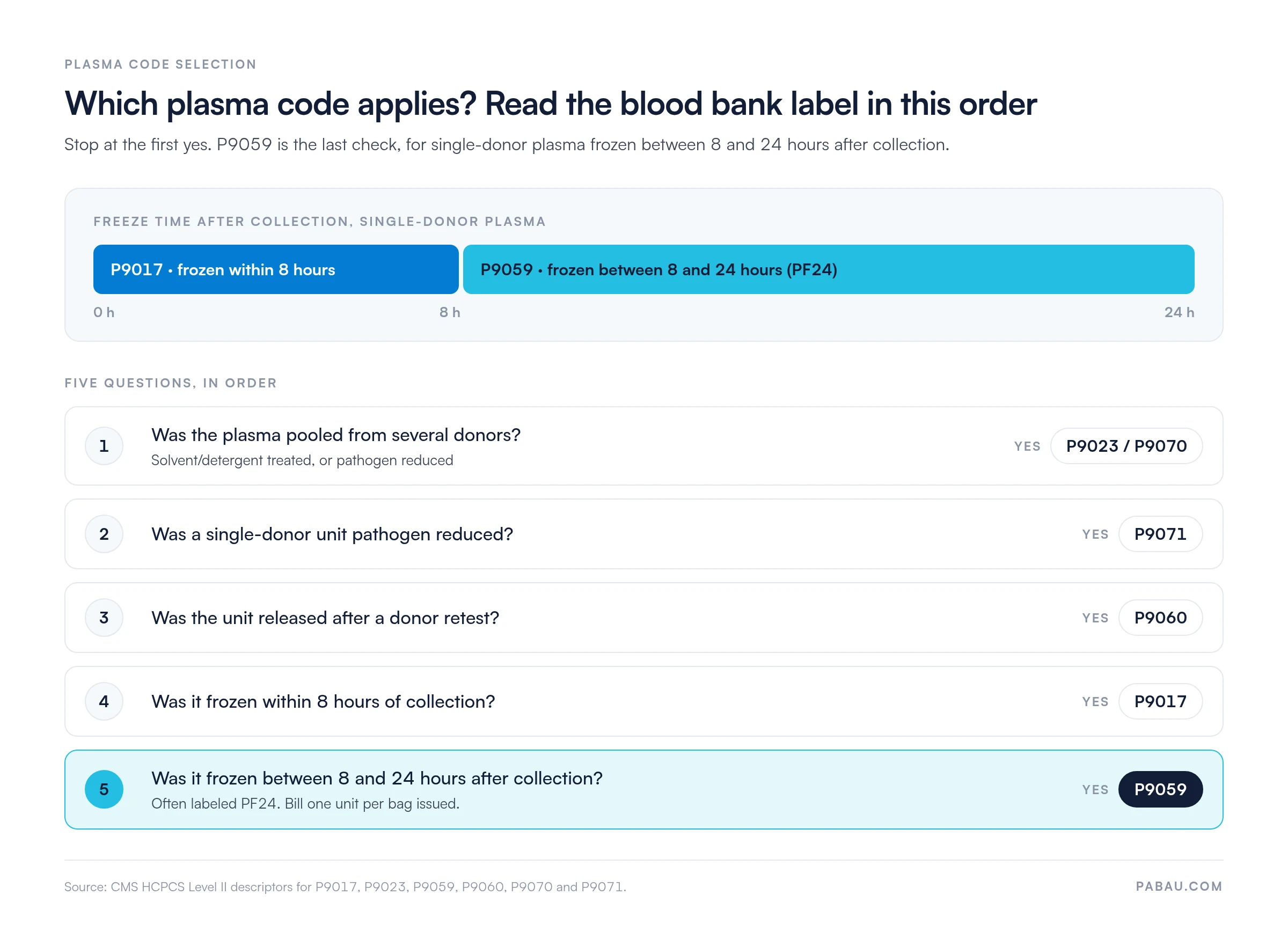
  • Was the plasma pooled from several donors? Use P9023 for solvent/detergent-treated plasma or P9070 for pathogen-reduced plasma.
  • Was a single-donor unit pathogen reduced? Use P9071.
  • Was the unit released after a donor retest? Use P9060.
  • Was it frozen within 8 hours of collection? Use P9017.
  • Was it frozen between 8 and 24 hours after collection? Use P9059.
Decision ladder for plasma HCPCS codes: freeze time 0 to 8 hours is P9017, 8 to 24 hours is P9059 (PF24). Five questions in order: pooled plasma is P9023 or P9070, single-donor pathogen reduced is P9071, donor retested is P9060, frozen within 8 hours is P9017, frozen between 8 and 24 hours is P9059
The freeze clock only decides between P9017 and P9059 once pooling, pathogen reduction and donor retesting are ruled out. Codes follow the CMS HCPCS Level II descriptors.

How to bill P9059: Units, revenue codes and claim forms

P9059 follows a per-bag model. Each bag of PF24 the blood bank issues counts as one unit. A patient who receives four bags during a massive transfusion protocol shows P9059 with a quantity of 4.

Billing elementGuidance
Units fieldOne unit per bag supplied; confirm the count against the blood bank issue record
Revenue code (UB-04)0383 (plasma, in the 038X blood and blood components series) on the P9059 line
Transfusion lineCPT 36430, usually reported under revenue code 0391 (blood administration); check your payer’s manual
Claim formUB-04 for hospital claims, since the facility supplies the plasma
Type of bill13X for hospital outpatient claims and 11X for inpatient stays
ModifiersNone required on P9059 by default; follow any payer-specific modifier rules for blood products

Build each P9059 claim line in this order:

  1. Read the product name and freeze window on the blood bank issue record.
  2. Confirm the unit is single-donor plasma frozen between 8 and 24 hours after collection.
  3. Enter P9059 with a quantity equal to the number of bags issued and transfused.
  4. Add revenue code 0383 to the line, and add the transfusion on its own line with CPT 36430.
  5. Attach the ICD-10-CM code for the coagulopathy, bleeding or anticoagulant effect that drove the order.

P9059 is a supply code. It bills the plasma itself, and the transfusion goes on its own line under an administration code such as CPT 36430. Clean claim submission depends on both lines being present with matching dates and units.

Medical necessity and ICD-10 codes paired with P9059

Plasma is transfused to replace clotting factors, so medical necessity for P9059 rests on a coagulation problem. Hemoglobin and anemia do not support a plasma claim. Payers look for one of these indications in the record:

  • Coagulopathy with bleeding or before a procedure: A prolonged PT or raised INR, often above 1.5 in institutional guidelines. It comes with active bleeding or a planned invasive procedure.
  • Massive transfusion: Plasma given with red cells and platelets under a massive transfusion protocol after trauma or major hemorrhage.
  • Warfarin reversal: Urgent reversal for serious bleeding or emergency surgery, usually when prothrombin complex concentrate is unavailable.
  • Factor deficiency: A congenital or acquired deficiency with no specific factor concentrate available, such as factor V deficiency.
  • Disseminated intravascular coagulation or liver failure: Consumption or failed production of clotting factors with bleeding or a procedure planned.
ICD-10-CM CodeDescriptionClinical context
D65Disseminated intravascular coagulation [defibrination syndrome]Clotting factors are used up faster than the body replaces them
D68.32Hemorrhagic disorder due to extrinsic circulating anticoagulantsBleeding on warfarin where urgent reversal is needed
D68.4Acquired coagulation factor deficiencyFactor loss from liver disease, vitamin K deficiency or dilution
D68.2Hereditary deficiency of other clotting factorsIncludes factor V deficiency, which has no specific concentrate
K72.00Acute and subacute hepatic failure without comaLiver failure reduces clotting factor production
T79.4XXATraumatic shock, initial encounterMassive transfusion protocol context; pair with the injury codes

Where no MAC-specific Local Coverage Determination exists for plasma, the claim relies on the diagnosis and the physician’s documentation. The note should tie the diagnosis and the lab values to the decision to transfuse. Of the pairings above, D65 gives the clearest case, because DIC uses up the clotting factors that plasma replaces.

Medicare and payer requirements for P9059

Medicare pays HCPCS Code P9059 under the Outpatient Prospective Payment System when it is furnished in a hospital outpatient department. CMS lists P9059 among the codes it recognizes as blood products, so it is paid separately from the transfusion. The rate is set each year in OPPS Addendum B, so never carry a prior-year rate forward.

  • Inpatient stays: Plasma given during a Medicare inpatient admission is paid within the DRG rather than as a separate line payment.
  • Blood deductible: Medicare’s three-pint blood deductible applies to whole blood and packed red cells, not to plasma.
  • Prior authorization: Medicare does not generally require prior authorization for plasma in a hospital setting. Medicare Advantage and commercial plans may, so check before elective transfusions.
  • Medicaid: Coverage and payment vary by state. Some states follow OPPS rates, while others set their own fee schedules for blood products.
  • Commercial payers: Most apply criteria close to Medicare’s. Some ask for an INR or PT result and a stated indication in the record before they pay.

Documentation requirements to support a P9059 claim

Payers auditing P9059 claims look for an unbroken chain of records from the physician order to the end of the transfusion. The medical record for a plasma encounter should capture each of these elements.

  • Physician order: The order names plasma as the product, the number of units and the clinical indication. It is authenticated before the unit is issued.
  • Coagulation results: A PT/INR, and where relevant an aPTT or fibrinogen level, dated close to the transfusion.
  • Clinical indication in the progress note: “Plasma requested” is not enough. “INR 2.8 on warfarin, active GI bleed, two units of plasma ordered” is.
  • Blood bank issue record: The unit number, product name, freeze window, ABO type and time of issue. The product name is what confirms P9059 rather than P9017.
  • Transfusion administration record: Start and stop times, vital signs, volume infused and any reaction. It supports CPT 36430 as well as P9059.
  • Consent: A signed transfusion consent where institutional policy or state law requires one.

Build blood bank records into the routine pre-billing audits of your medical billing compliance program. Waiting for a denial to surface the problem costs more rework.

Common P9059 claim denial reasons and how to resolve them

P9059 denials tend to come from missing coagulation evidence, the wrong plasma code, unit mismatches and payer packaging rules. The reason code on the remittance advice points to the fix. For other reason codes, see our guide to fixing each denial code.

Denial codeRoot causeResolution
CO-50Not medically necessary under the payer’s policyAppeal with the INR or PT result, the indication in the note and the supporting ICD-10-CM code
CO-11Diagnosis inconsistent with the procedure, such as an anemia code on a plasma lineCorrect the claim with the coagulopathy, bleeding or anticoagulant diagnosis
CO-16Claim lacks information, such as units or a revenue codeAdd the missing field and resubmit as a corrected claim
CO-97Payment included in another service billed on the same dayCheck whether the stay was inpatient or a commercial contract packages blood products before appealing
CO-18Duplicate claim or serviceConfirm the line was not already paid before you resubmit

A coding error, such as the wrong plasma code or unit count, goes back as a corrected claim. A medical necessity denial needs a formal appeal, and Medicare redeterminations must be filed within 120 days of the initial determination. Checking the freeze window and the diagnosis before release prevents both kinds of rework.

Pro Tip

Before you submit a P9059 claim, check the diagnosis on the line. An anemia code on a plasma line is a common reason for a CO-11 denial, because plasma treats clotting problems, not low hemoglobin.

How claims management software keeps P9059 claims clean

Most P9059 errors start with manual steps. Someone keys the unit count by hand, picks the plasma code from memory, then chases a missing diagnosis after the claim bounces.

Pabau, the practice management platform we build, removes most of that retyping with its claims software for billing teams. The claim form pre-fills from the patient record, and HCPCS and ICD-10 lookups sit inside the claim screen.
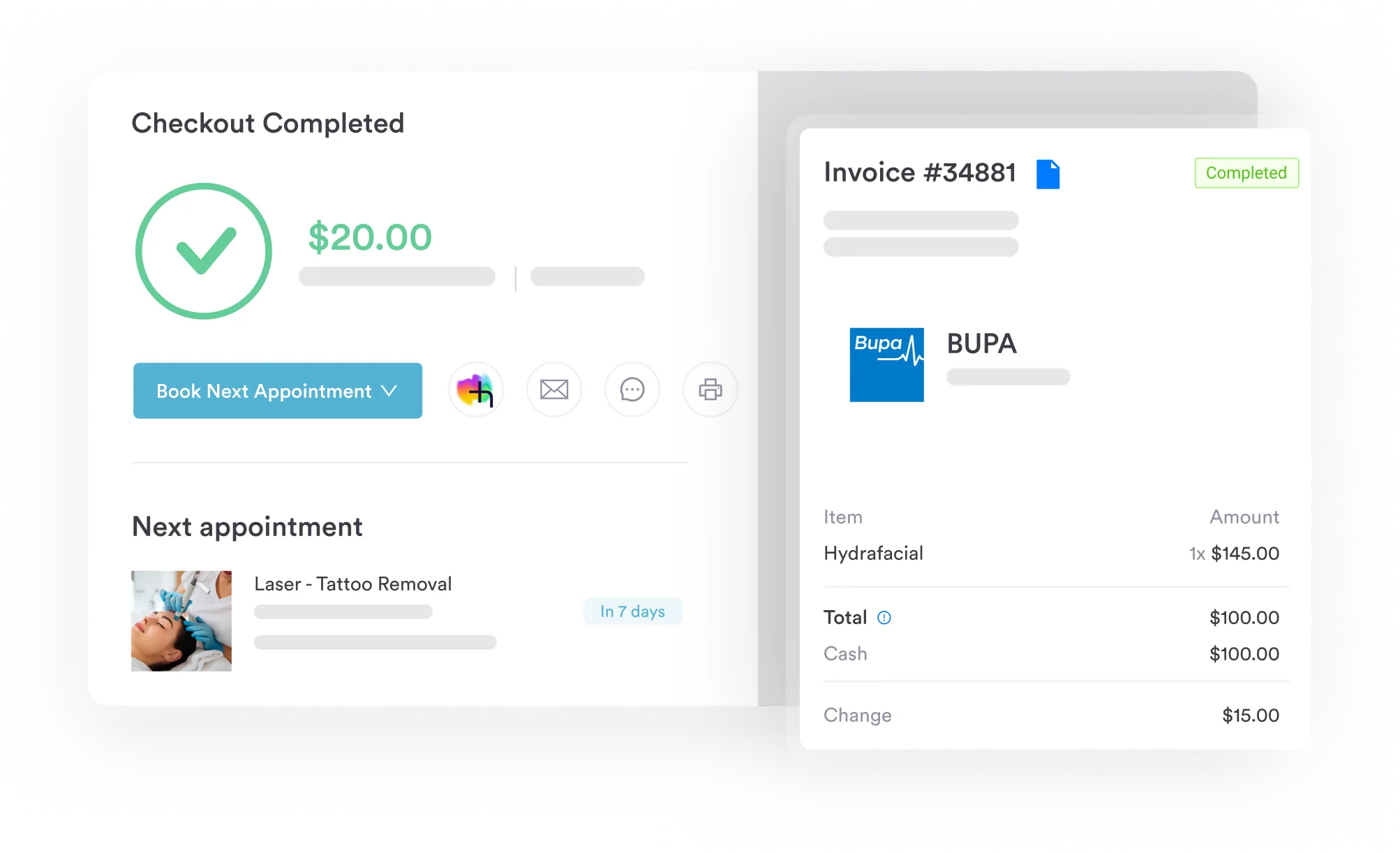
Pabau claims and billing screen
Pabau’s claims screen pre-fills codes from the patient record, so a P9059 line goes out with its diagnosis and units already in place.

Pabau also checks that required fields, such as membership and authorization numbers, are complete before you can send. Claims then go out electronically with status tracking, so your team spends less time chasing plasma payments.

Get plasma claims right the first time

Pabau pre-fills claims from the patient record and checks required fields before you send, so P9059 lines leave complete.

Pabau claims management dashboard

Conclusion

P9059 exists because a plasma unit frozen after the 8-hour mark is a different product on paper, even when it treats the same patient. Read the freeze window on the blood bank record before you code, and the choice between P9059 and P9017 makes itself.

The other half of a clean claim is the reason for the transfusion. A plasma line backed by an INR, a bleeding note or a factor deficiency holds up in an audit. One backed by an anemia code does not.

If your team still retypes codes and chases missing claim fields by hand, that work can move into the claim screen. Book a demo to see how Pabau prepares, sends and tracks blood product claims for your billing team.

Continue your research

Continue your research

Coding plasma frozen within 8 hours? HCPCS code P9017 covers standard single-donor fresh frozen plasma and the freeze window that separates it from P9059.

Was the donor retested before release? HCPCS code P9060 explains donor-retested fresh frozen plasma and when it applies.

Coding pooled plasma instead? HCPCS code P9023 explains solvent/detergent-treated pooled plasma and how it differs from single-donor units.

New to the claims lifecycle? What is medical billing explains the full process from charge capture through payment posting.

Was a single-donor unit pathogen reduced? HCPCS code P9071 covers pathogen-reduced single-donor plasma and when it replaces P9059.

Frequently asked questions

What is HCPCS Code P9059?

HCPCS Code P9059 is the Level II code for fresh frozen plasma frozen between 8 and 24 hours after collection, billed per unit. Blood banks often label this product PF24. The transfusion itself goes on a separate line, usually with CPT 36430.

How many units should be billed for P9059?

Bill one unit of P9059 for each bag of plasma supplied. A patient who received three bags in one encounter shows P9059 with a quantity of 3. The count must match the blood bank issue record.

What is the difference between P9059 and P9017?

Both codes cover single-donor plasma, and the freeze time separates them. P9017 is for plasma frozen within 8 hours of collection. P9059 is for plasma frozen between 8 and 24 hours after collection.

What is the difference between P9059 and P9060?

P9060 covers fresh frozen plasma from a donor who was retested before the unit was released from quarantine. P9059 covers plasma frozen 8 to 24 hours after collection with no retest release on file.

What diagnosis supports medical necessity for P9059?

The diagnosis must show a clotting problem, such as DIC (D65), bleeding from an anticoagulant (D68.32) or an acquired factor deficiency (D68.4). Payers also look for a recent INR or PT result. An anemia code does not support a plasma claim.

Does Medicare reimburse HCPCS Code P9059?

Yes, Medicare pays P9059 separately under the Outpatient Prospective Payment System in a hospital outpatient setting. The rate is updated each year in OPPS Addendum B. During an inpatient stay, plasma is paid within the DRG.

Which revenue code goes with P9059 on a hospital claim?

Hospitals report the plasma under revenue code 0383, part of the 038X blood and blood components series, on the P9059 line. The transfusion is a separate line, usually with CPT 36430.

Why would a P9059 claim be denied?

Common reasons are missing coagulation evidence (CO-50), a diagnosis that does not fit plasma (CO-11), missing claim details (CO-16) and payer packaging rules (CO-97). Coding P9017 for a unit frozen after 8 hours is another.
Tanja Lepcheska
Content Writer

Tanja is a Senior Content Writer who has a skill to turn complex med spa topics into easy, engaging reads that actually make sense. She loves helping clinic owners feel confident about growing their business. When she’s not writing, you’ll probably find her rewatching her favorite romantic movies, working on a new crochet project, or rearranging her home decor “just one more time.”
×