

HCPCS code E0198: Water pressure pad billing guide
HCPCS code E0198 is a water pad for a standard mattress HCPCS code E0198 is the ...

Last Updated: Oct 13, 2026
P9023 is the HCPCS Level II code for plasma, pooled multiple donor, solvent/detergent treated, frozen, each unit. It reports solvent/detergent (S/D) plasma such as Octaplas, which is pooled from many donors and treated to inactivate lipid-enveloped viruses.
P9023 sits in the P9010-P9100 blood products range. Its nearest plasma neighbors are P9017 for single-donor fresh frozen plasma, P9070 for pooled pathogen-reduced plasma, and P9071 for single-donor pathogen-reduced plasma. The processing line on the bag label decides which code applies.
Let Pabau's smart automation suggest the right codes, reduce claim denials, and keep your practice compliant—effortlessly.
Automate repetitive tasks and focus on what matters most—your patients.
Reduce coding errors and ensure compliance with the latest regulations.
Clean claims, fewer denials, and faster reimbursements.
Powerful insights and reporting to help your practice thrive.
HIPAA compliant SOC 2 certified GDPR-compliant Trusted by 4,000+ clinics worldwide

HCPCS code P9023 reports solvent/detergent treated plasma, pooled from multiple donors and frozen, billed per unit. Octaplas is the licensed US product.
P9023 is not a general fresh frozen plasma code. Single-donor FFP is P9017, and pathogen-reduced plasma is P9070 (pooled) or P9071 (single donor).
Hospital outpatient departments are paid for P9023 under OPPS with status indicator R. The Medicare blood deductible does not apply to plasma.
Pabau, the practice management platform we build, keeps clinical notes, charges, and claim status in one system. Each P9023 line then traces back to its documentation.
HCPCS code P9023 is the Level II code for plasma, pooled multiple donor, solvent/detergent treated, frozen, each unit. It sits in the P9010-P9100 blood and blood products range of the CMS HCPCS Level II system. CMS publishes its short descriptor as “Frozen plasma, pooled, sd”, and confirms the code as active in the current CMS HCPCS alpha-numeric file.
The billing unit is one bag of S/D plasma as issued by the blood bank. P9023 is billed by the hospital or facility that furnishes the product, so confirm setting-specific rules with your Medicare Administrative Contractor (MAC).
Solvent/detergent (S/D) plasma is plasma pooled from many donors of the same ABO blood group, then treated with a solvent and a detergent. The treatment inactivates lipid-enveloped viruses such as HIV, hepatitis B, and hepatitis C. Pooling also averages out donor-to-donor variation in clotting factor levels.
In the United States, the licensed S/D plasma product is Octaplas, made by Octapharma. The FDA licensed Octaplas in 2013 as a biologic. It arrives as a manufactured product, not as a unit collected by the local blood center.
According to its FDA labeling, Octaplas is indicated for two uses.
Hospitals that stock S/D plasma are mostly transplant centers, cardiac surgery programs, and apheresis services. Some choose it for patients who need large plasma volumes, because pooling and viral inactivation change the product’s risk profile.
P9023 covers one product: frozen plasma that is pooled from multiple donors and solvent/detergent treated. The code applies whenever that product is thawed and administered, whatever the clinical indication.
These related products fall outside P9023 and take their own codes.
Each step of the transfusion workflow produces a record that supports the P9023 line. A missing record is the easiest reason for a payer to question medical necessity.
Report one unit of service for each bag of S/D plasma administered. If three bags are transfused, P9023 carries three units. Bill the units administered according to your MAC’s instructions.
On the UB-04, hospitals report blood products with a revenue code from the blood (038X) or blood processing and storage (039X) series. The choice is set out in Medicare Claims Processing Manual, Chapter 4, section 231, and your MAC’s billing guide confirms which applies.
The JW and JZ drug-wastage modifiers apply to single-dose drugs and biologicals billed with drug codes, not to P9 blood-product codes. When a thawed bag is not transfused, follow your MAC or payer instructions and your hospital’s blood wastage policy.
Before billing multiple units of P9023, match each unit on the claim to a release in the blood bank record. Auditors routinely ask for these records. A claim for three units against a log that shows two releases will not survive review.
Under the Medicare hospital outpatient prospective payment system (OPPS), P9023 carries status indicator R, which means blood and blood products paid separately through an APC. Look up the current payment rate in the CMS OPPS Addendum B for the quarter of service.
For inpatient stays, the product is part of the hospital’s inpatient payment rather than a separately paid line. Neither the Physician Fee Schedule nor the clinical laboratory fee schedule sets a rate for P9023.
Medicare’s blood deductible covers the first three pints of blood a beneficiary receives each calendar year, under Part A and Part B combined. It applies only to whole blood and packed red cells, per Claims Processing Manual Chapter 4, section 231.
Plasma, including S/D plasma billed with P9023, is not subject to the blood deductible. The standard Part B deductible and coinsurance apply to an outpatient P9023 line instead.
Commercial coverage and prior authorization rules vary. Some payers route outpatient blood products through a separate infusion benefit. Confirm the payer’s policy before a scheduled transfusion, such as planned plasma exchange, and record any authorization number on the claim.
Every P9023 claim needs a diagnosis that establishes medical necessity. The attending physician owns the diagnosis, and the billing team checks that the claim matches the documented indication.
The table below is illustrative, built around the FDA-labeled uses of S/D plasma. It is not a coverage list, so check your MAC and payer policies for the codes they accept.
Unspecified codes are acceptable when a specific diagnosis is not yet confirmed, but payers expect the most specific code the record supports. If the chart documents a confirmed diagnosis, code it.
Among the Level II HCPCS codes, the plasma codes in the P9 range split on two questions. Is the product pooled from many donors or collected from one? And was it solvent/detergent treated, pathogen reduced, or neither? The chart below walks through both, starting with processing.
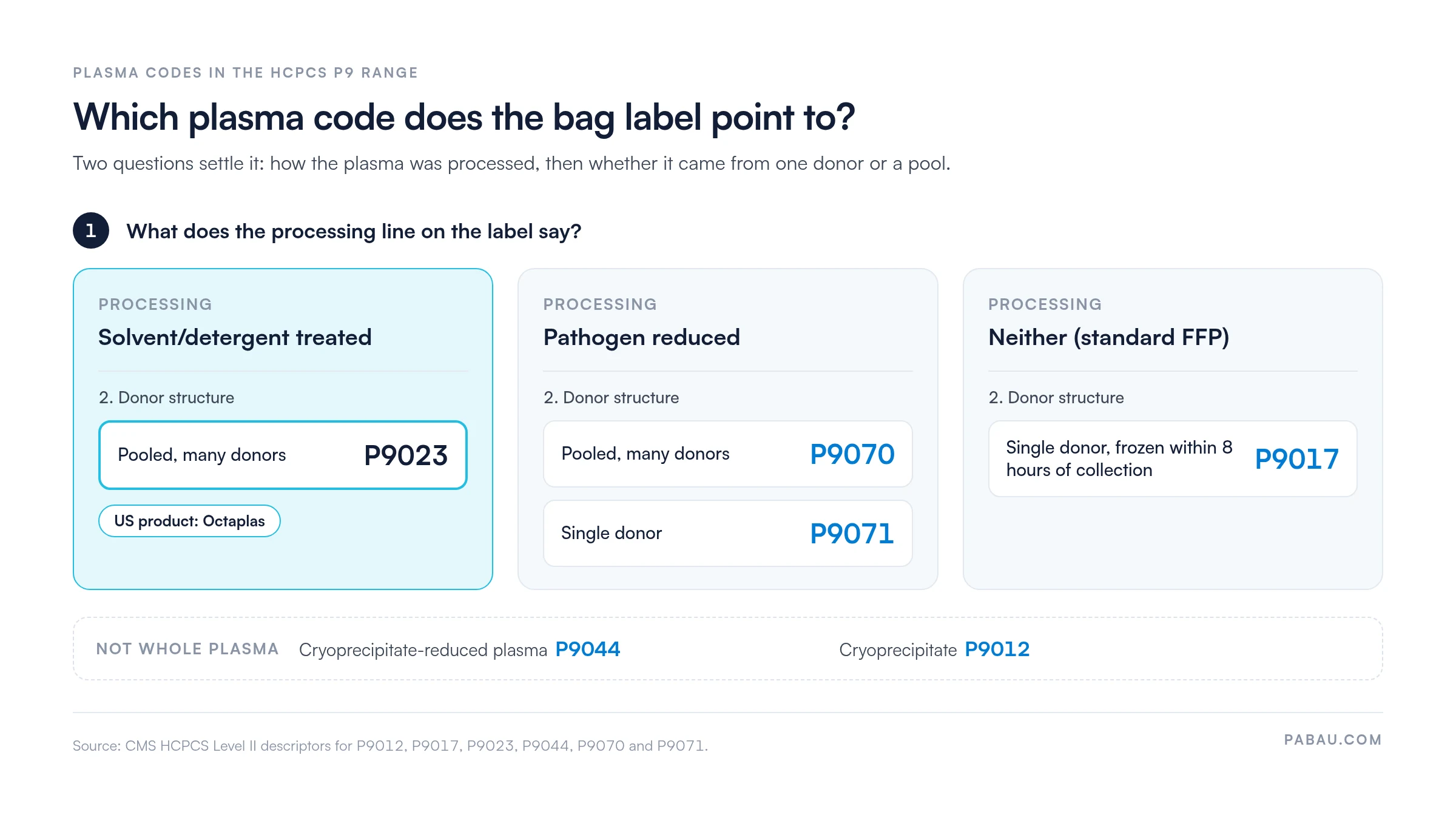
One frequent miscoding on this code is using P9023 as a catch-all for fresh frozen plasma. Standard single-donor FFP belongs on P9017. A unit held in quarantine until the donor was retested belongs on P9060. Another is confusing P9023 with P9070, because both are pooled. The processing line on the bag label decides between them.
P9023 denials cluster around a few predictable errors. Our denial management process guide covers the general workflow: find the root cause, correct the record, and resubmit with support attached.
This checklist maps each record to the denial it prevents. Review it before submitting a P9023 claim, especially for scheduled outpatient transfusions. Good medical billing compliance starts with documentation, not with the remittance advice.
Run one check on every P9023 claim before it goes out. Pull the blood bank issue record, confirm the product code says solvent/detergent treated pooled plasma, and count the bags transfused. If either the product or the count disagrees with the claim, fix it first.
Most billing teams check a P9023 claim by opening three systems: the blood bank log, the nursing record, and the billing software. When a payer asks for support months later, someone rebuilds the trail by hand.
Pabau keeps clinical notes, charges, and invoices on one patient record. Its claims management software submits claims from that data and tracks their status through to payment or denial. Your team still confirms the code, units, and diagnosis, and Pabau keeps the notes and charges behind that decision on the same record.
The result is a shorter path from a payer’s records request to a complete response, because the documentation already sits next to the claim.

Pabau keeps clinical documentation, charges, and claim status in one system. Billing teams can trace each P9023 line back to the record that supports it, and spend less time rebuilding evidence for a payer review.

P9023 is a narrow code. It fits one product, solvent/detergent treated pooled plasma, and the bag label is the fastest way to prove it. Practices that confirm the product code before billing avoid the two product mix-ups this code invites. One is FFP billed as P9023, and the other is P9070 confused with P9023.
After the code, the claim rests on units that match the release log and a diagnosis that matches the order. Payment runs through OPPS, and the blood deductible stays out of it. To see how Pabau keeps that documentation and the claim in one place, book a demo.

Need a framework for reducing claim rejections across your practice? Clean claim submission covers the elements every claim needs to pass payer edits before adjudication.
New to the revenue cycle behind a claim like this? What is medical billing explains the end-to-end revenue cycle from charge capture to payment posting.
Billing a plasma derivative instead? HCPCS code P9043 covers plasma protein fraction, which takes its own P-code rather than P9023.
Got a denial back on a blood product line? Denial codes in medical billing explains what the common denial codes mean and how to respond to them.
HCPCS code P9023 covers plasma pooled from multiple donors, solvent/detergent treated and frozen, billed per unit administered. In the US that product is Octaplas. Single-donor fresh frozen plasma (P9017) and pathogen-reduced plasma (P9070, P9071) take their own codes.
Report one unit of service for each bag of S/D plasma administered, following your MAC’s billing instructions. Hospitals use a blood revenue code from the 038X or 039X series. JW and JZ do not apply to P9 blood-product codes, so follow MAC or payer and hospital policy for wastage.
Yes. Hospital outpatient departments are paid for P9023 under OPPS with status indicator R. CMS Addendum B lists the rate for each quarter. The Medicare blood deductible does not apply to it. That deductible covers only whole blood and packed red cells. The standard Part B deductible and coinsurance apply instead.
P9023 can share a claim with other blood products given in the same encounter, such as P9016 for leukocyte-reduced red cells or P9012 for cryoprecipitate. Each product is billed on its own line with its own unit count. The code on each line must match the exact product the blood bank issued.



