CPT Code 62284: Injection procedure for myelography
CPT Code 62284: official descriptor and procedure overview The American Medical ...

Last Updated: Oct 19, 2026
P9060 is the HCPCS Level II code for fresh frozen plasma, donor retested, each unit. It covers one bag of single-donor plasma held in quarantine until the same donor gave again and tested negative. That retest usually comes four to six months later.
That release record is the detail that matters most. Without it, the unit counts as standard fresh frozen plasma and takes a different code. For billers and coders, retest status decides both the code and whether the claim survives review. Below, you'll find how to confirm it, count units, pair the transfusion code and fix common denials.
Let Pabau's smart automation suggest the right codes, reduce claim denials, and keep your practice compliant—effortlessly.
Automate repetitive tasks and focus on what matters most—your patients.
Reduce coding errors and ensure compliance with the latest regulations.
Clean claims, fewer denials, and faster reimbursements.
Powerful insights and reporting to help your practice thrive.
HIPAA compliant SOC 2 certified GDPR-compliant Trusted by 4,000+ clinics worldwide

P9060 covers one bag of single-donor fresh frozen plasma released from quarantine after the donor tested negative again.
Bill one unit per bag transfused, and put multiple bags on one claim line using the quantity field.
Missing quarantine-release records and weak ICD-10 support are the two leading causes of P9060 denials.
P9060 is a supply code, so the claim also needs a transfusion administration code such as CPT 36430.
Claims management software like Pabau checks that required claim fields are complete before a claim is sent.
HCPCS code P9060 is the CMS code for “Fresh frozen plasma, donor retested, each unit.” It belongs to HCPCS Level II, the Healthcare Common Procedure Coding System set CMS keeps for supplies, drugs and services outside CPT.
Within Level II, P9060 sits among the pathology and laboratory P-codes, which run from P2028 to P9615. Its group is P9010 to P9100, the blood products codes. That puts it next to whole blood, red cells, platelets and the other plasma codes.
Each part of the descriptor changes how you bill it.
The HCPCS file changes every year. So check P9060’s current status in the AAPC HCPCS code lookup each January, because payment status can shift between years.
P9060 covers one unit of plasma separated from whole blood within 8 hours and frozen at -18°C or colder. The blood bank then holds it until the donor is retested, a quarantine window of four to six months. That retest step is what sets P9060 apart from every other plasma code.
These products fall outside P9060 and carry their own codes.
Blood banks often stock several plasma types at once. Before you assign P9060, confirm which product the patient received, not just what the inventory system shows.
Donor-retested FFP follows a set quarantine protocol. The blood bank holds the unit until the same donor comes back, usually four to six months later, and passes repeat infectious-disease screening. Until then, the unit stays in quarantine and can’t be billed as P9060.
That protocol leaves a paper trail, and your claim depends on it.
Billing a unit as retested without that release record misstates the product, and auditors can recoup the payment. When in doubt, bill the standard FFP code and note the reason in the record.
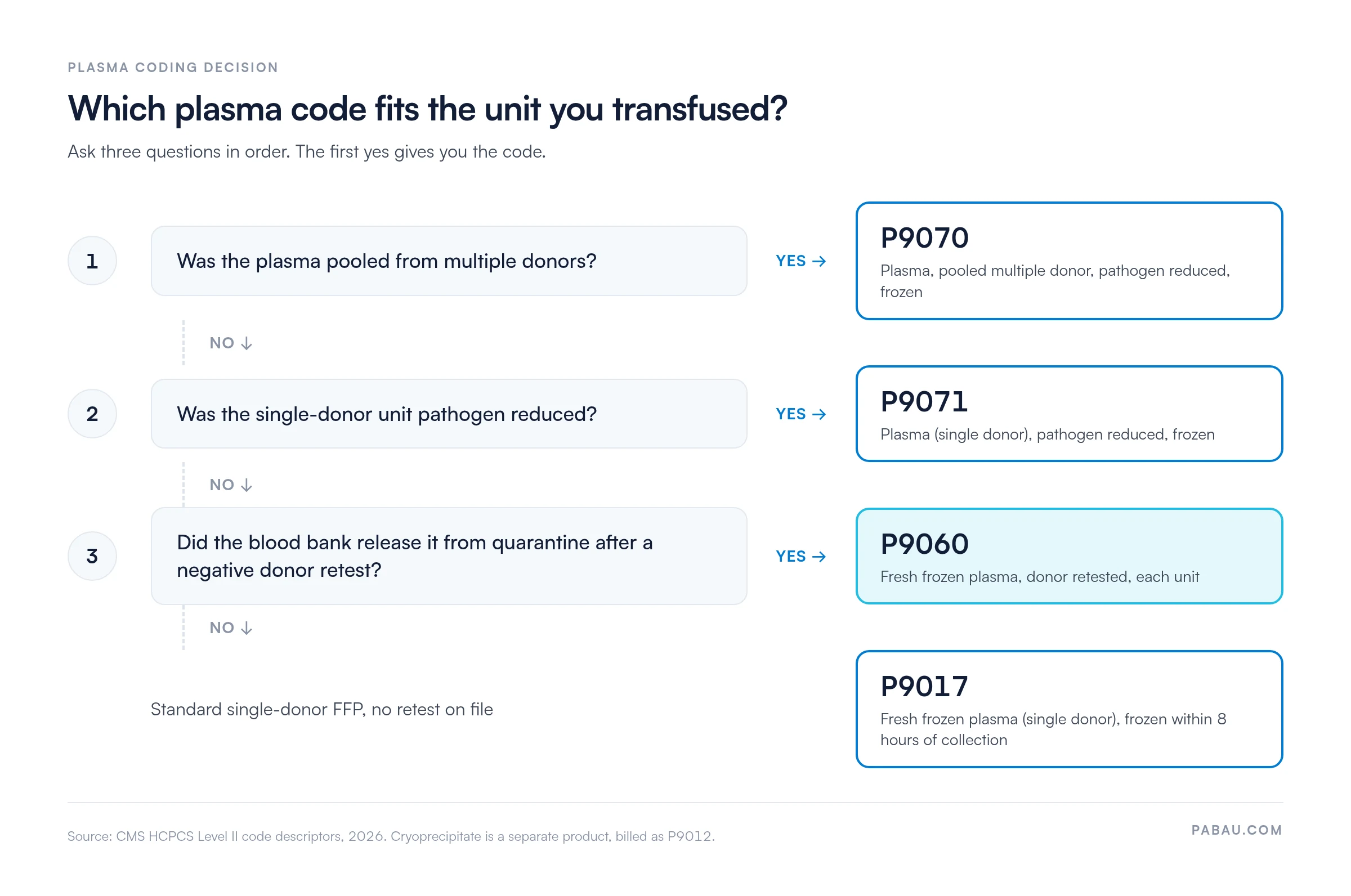
P9060 vs P9070 is the plasma pair coders mix up most. P9070 covers pathogen-reduced plasma pooled from multiple donors, with a different safety profile. Swapping one code for the other is a coding error, and payers deny it.
Solvent/detergent treated pooled plasma is a third transfusable product, and it bills under P9023. Read the unit label from the blood bank before you choose between the three codes.
The quick test comes down to one question. Did the blood bank release the unit after a confirmed donor retest? If the answer is no, the flow below points you to the right code.
P9060 is a supply code. It pays for the plasma, not for giving it, so the claim also needs a CPT code for the transfusion. Without that administration line, some payers deny P9060 because no service is attached to the supply.
These CPT codes commonly appear alongside P9060.
NCCI edits change every year, so check the current tables before you pair P9060 with these codes. Some payers also fold the transfusion into a broader surgical or critical-care code. In that case, P9060 may be the only line paid separately.
In hospital outpatient settings, Medicare pays P9060 under the Hospital Outpatient Prospective Payment System (OPPS). Blood products carry Ambulatory Payment Classification (APC) assignments, and CMS posts updated rates each quarter in OPPS Addendum B.
Four facts shape what you’ll collect.
Review your remittance advice after each batch of P9060 claims. A run of $0.00 payments with a bundling remark code usually means the payer counts the plasma inside the administration payment.
Run a monthly P9060 payment report segmented by payer. Blood product reimbursement rates shift quarterly under OPPS and annually for commercial contracts. A payer paying 100% in Q1 may begin bundling P9060 into the administration APC in Q3 without advance notice. Catching this early prevents months of under-billing.
After a missing release record, weak medical necessity support is the most common reason P9060 claims fail. The chart has to show why the patient needed plasma. Check that it holds these five items before the claim goes out.
When a payer requests records for an audit, send only what the request needs. HIPAA’s minimum-necessary standard applies to blood bank documents too.
Code the specific underlying condition whenever the chart documents it. “Coagulation defect, unspecified” is a valid fallback, but many LCDs expect a more specific primary diagnosis. Check your MAC’s local coverage determination before you code from this table alone.
P9060 has no required modifier. A few may still apply depending on the case, and each payer treats them differently. Confirm with your MAC or commercial plan before you use any of them routinely.
JW is the one to watch. CMS guidance for JW covers single-dose drugs and biologicals, and MACs differ on whether blood products count. Get written guidance from your MAC before you add JW to P9060.
Traditional Medicare generally doesn’t require prior authorization for emergent or urgent blood transfusions, P9060 included. Medical necessity gets reviewed when the claim arrives instead. So approval isn’t automatic, it just happens at adjudication rather than before the service.
Other plans can be stricter. Medicare Advantage, Medicaid managed care and commercial PPO or HMO plans may require authorization for elective FFP. For those patients, work through this list.
Here’s the path a P9060 claim follows in a hospital outpatient setting, step by step.
Trouble usually starts at step one or step three. A missing release record or a wrong bag count follows the claim all the way to the remittance.
P9060 denials follow a familiar pattern across payers. The table matches each common reason to the claim adjustment reason code (CARC) that usually appears on the remittance.
For what each code means, see our guide to medical billing denial codes.
Sort denials into two groups at intake. Product denials, such as missing release records or unit errors, go back to the blood bank for documents. Service denials, such as bundling or place of service, go to billing for claim correction. Mixing the two slows every fix down.
One unit of P9060 equals one bag of FFP. If a patient gets four bags in one encounter, bill one claim line with a quantity of 4. Four separate lines with a quantity of 1 trigger duplicate-claim edits, and most payers reject or merge them.
The most common slip is entering volume instead of bags. A bag holds roughly 200 to 250 mL, so typing “250” for one bag bills 250 units. Here’s a worked example for four bags.
A claim scrubber that flags unusual quantities on blood product codes catches the first error before the payer does.
Many P9060 errors come from manual steps. Someone keys the quantity by hand, retypes the diagnosis, then chases a missing authorization number after the claim bounces.
Practice management software like Pabau cuts out much of that retyping, with claims tools for billers built in. The claim form pre-fills from the patient record, and HCPCS and ICD-10 lookup libraries sit inside the claim screen.
Pabau also checks that required fields, such as membership and authorization numbers, are complete before you can send.
Claims then go out electronically. US teams also get eligibility checks through Claim.MD, remittance posting and claim-status tracking, so less time goes on chasing P9060 payments.
Confirming retest status stays with the blood bank, but the claim built around it leaves complete.
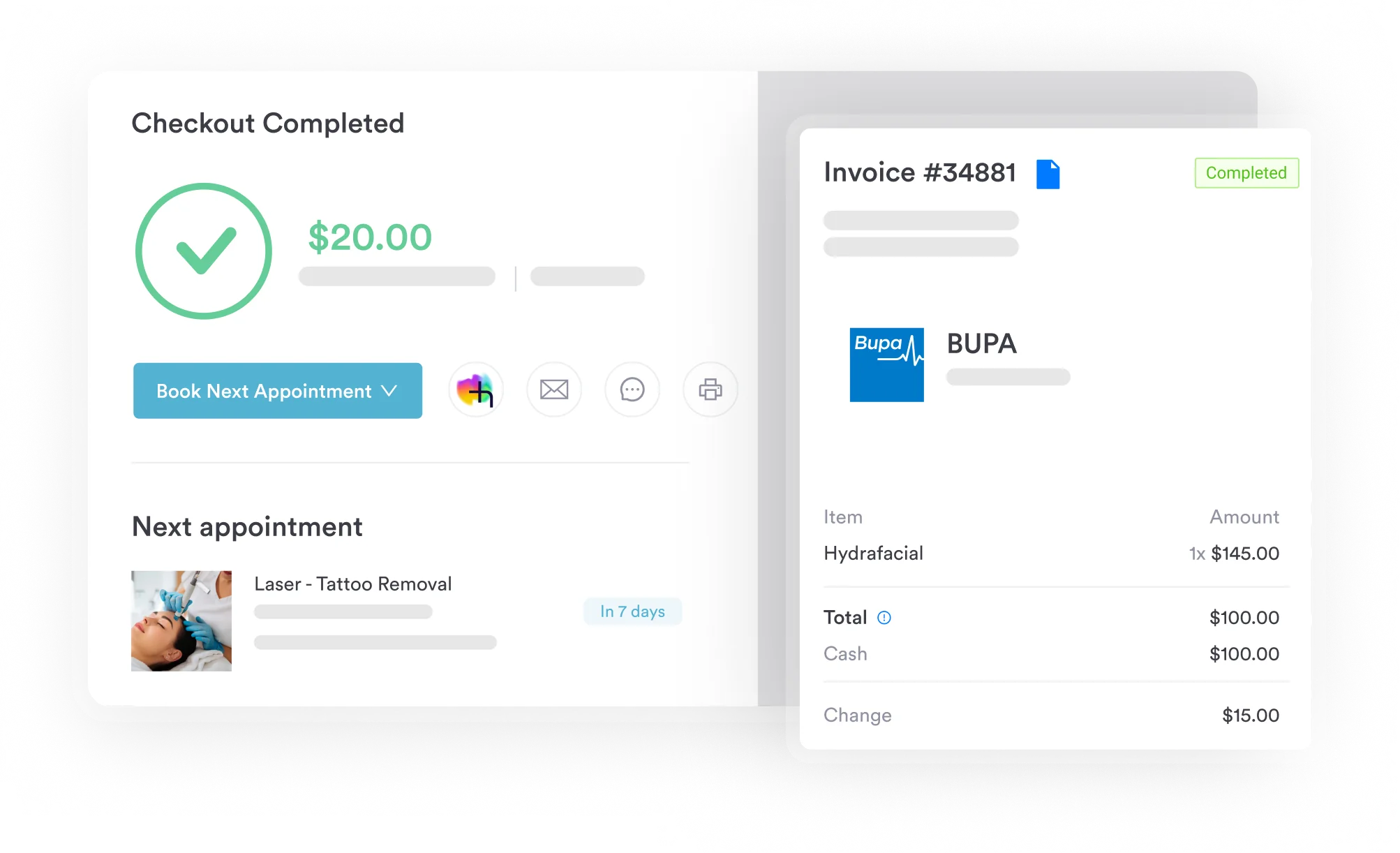

Pabau pre-fills claims from the patient record and checks required fields before you send. That means fewer rejected claims and less rework for your billing team.

P9060 rewards billers who treat the blood bank as part of the claim. Confirm the release record before you code, count bags instead of milliliters, and pair every unit with a transfusion code and a supporting diagnosis.
Do that every time and P9060 denials become rare. Skip the release check, though, and one audit can claw back payment on every unit billed that way.
If your team still retypes codes and chases missing claim fields by hand, that work doesn’t have to stay manual. Book a demo to see how Pabau prepares, sends and tracks claims for your billing team.

Billing pathogen-reduced plasma instead? HCPCS code P9071 covers single-donor pathogen-reduced plasma and how it differs from retested FFP.
Transfusing cryoprecipitate as well? HCPCS code P9012 explains how to count cryoprecipitate units on the same claim.
Working with whole blood? HCPCS code P9010 walks through billing whole blood per unit.
Want fewer denials to rework? Denial management in healthcare shows how to sort, route and resolve denied claims faster.
Building a cleaner submission process? What is a clean claim lists the checks that get claims paid on the first pass.
Hospitals usually report plasma under revenue code 0383, part of the 038X blood series, on the same line as P9060. Some payers set their own pairing rules, so check the billing manual.
No. Bill only the bags that went into the patient. A unit returned to the blood bank or discarded stays off the claim. The crossmatch testing may still be billable, but the plasma isn’t.
Yes. P9060 appears in the 2026 HCPCS Level II file as “Fresh frozen plasma, donor retested, each unit.” Codes can change each January, so recheck it at the start of every year.
Yes, if the patient received both products. Put each code on its own line with its own unit count. The blood bank records should support each product separately.
Ask the blood bank before you code. Only its release record can confirm donor-retested status. Without that confirmation, bill the standard FFP code instead of P9060.