HCPCS code P2031: Hair analysis (excluding arsenic)
HCPCS code P2031 covers hair analysis, minus arsenic HCPCS code P2031 is the Lev...

Last Updated: Oct 22, 2026
P9017 is the HCPCS Level II code for fresh frozen plasma (single donor), frozen within 8 hours of collection, each unit.
The freeze time on the blood bank label decides the code. Plasma frozen between 8 and 24 hours after collection is P9059, and a unit released after a donor retest is P9060. Bill one unit of P9017 per bag, alongside a transfusion code such as CPT 36430.
Let Pabau's smart automation suggest the right codes, reduce claim denials, and keep your practice compliant—effortlessly.
Automate repetitive tasks and focus on what matters most—your patients.
Reduce coding errors and ensure compliance with the latest regulations.
Clean claims, fewer denials, and faster reimbursements.
Powerful insights and reporting to help your practice thrive.
HIPAA compliant SOC 2 certified GDPR-compliant Trusted by 4,000+ clinics worldwide

HCPCS Code P9017 bills one unit of single-donor fresh frozen plasma that was frozen within 8 hours of collection.
The blood bank label decides the code: plasma frozen 8 to 24 hours after collection is P9059, and donor-retested FFP is P9060.
P9017 bills the plasma product only, so pair it with a transfusion code such as CPT 36430 and revenue code 0383 on the UB-04.
Medicare pays P9017 separately under the Outpatient Prospective Payment System, with rates updated each year in OPPS Addendum B.
HCPCS Code P9017 sits in the P9010 to P9100 range of Level II codes for blood and blood products. The Centers for Medicare and Medicaid Services maintains the code set. The official descriptor is: Fresh frozen plasma (single donor), frozen within 8 hours of collection, each unit.
Two details in that descriptor drive code selection. The plasma comes from one donor, and it was frozen no later than 8 hours after collection.
CMS updates the HCPCS file every year. Check the descriptor against the current-year HCPCS Level II file before you build it into a charge master or billing workflow.
P9017 covers the supply of plasma separated from a single donation and frozen within 8 hours of collection. The blood bank labels this product as fresh frozen plasma (FFP), and that label is what the code follows.
Covered under P9017:
Not covered under P9017 (use a different code):
When the issue record does not state the freeze window or the product name, do not assume P9017. Ask the blood bank for the product label before the claim goes out.
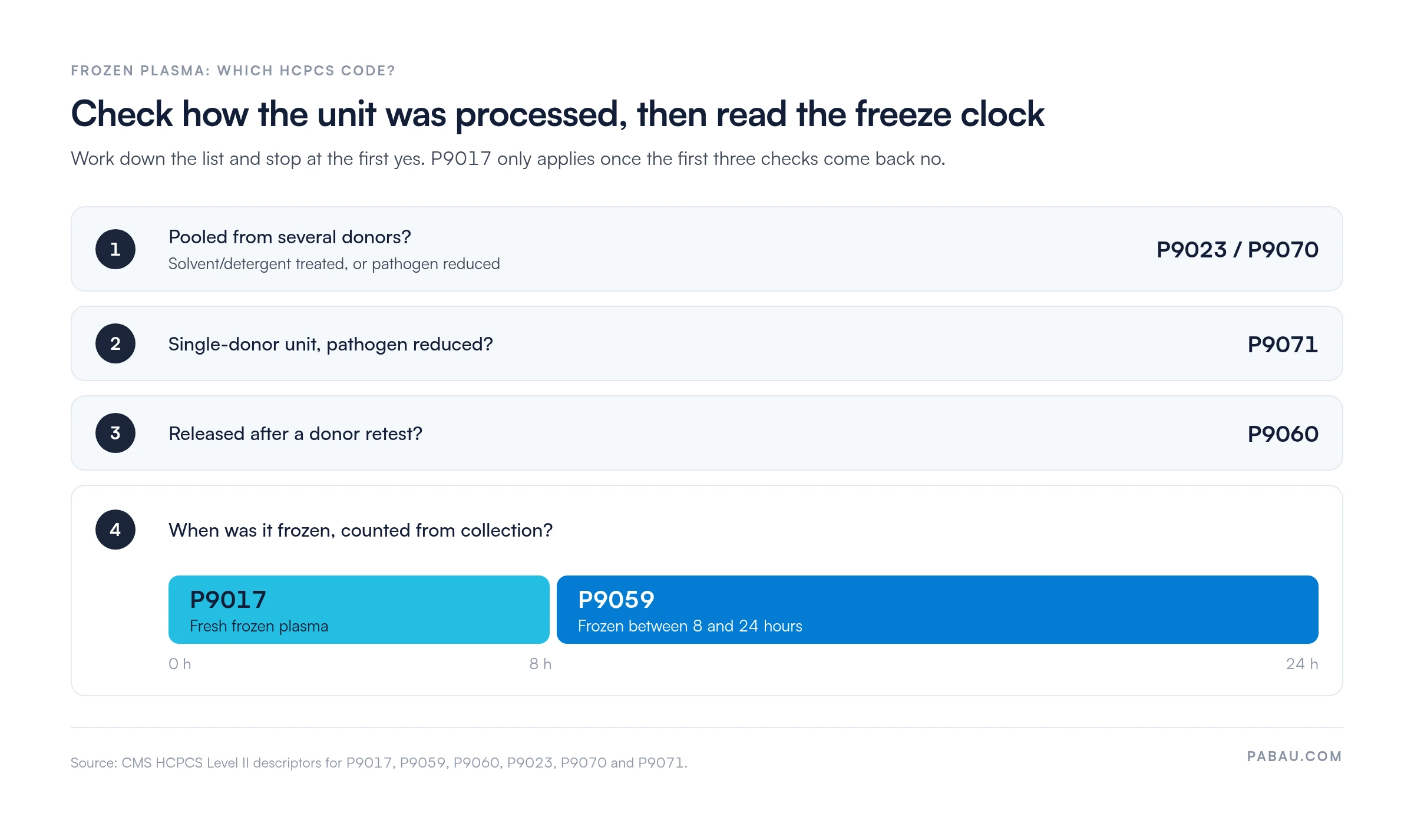
Several P-codes describe frozen plasma, and the differences sit in how the unit was processed. Freeze time, donor retesting, pooling and pathogen reduction each move a unit to a different code. A unit held in quarantine until its donor retests negative moves to P9060, even though it is still fresh frozen plasma.
The freeze window and the retest status both come from the blood bank, not from the clinical team. Work through the questions below in order, and stop at the first yes.
Unit reporting for HCPCS Code P9017 follows a per-bag model. Each bag of FFP the blood bank issues counts as one unit of P9017. A patient who receives four units during a massive transfusion protocol shows P9017 with a quantity of 4.
P9017 is a supply code. It bills the plasma itself, and the transfusion goes on its own line under an administration code such as CPT 36430. Both lines belong on the same claim for an outpatient transfusion encounter. Clean claim submission depends on both codes being present with matching dates and units.
Medical necessity for an FFP transfusion is established through a supporting ICD-10-CM diagnosis code. Payers use it to check that the clinical indication fits their coverage policy. Requirements vary by Medicare Administrative Contractor (MAC), so check any applicable Local Coverage Determination before billing.
Where no MAC-specific LCD exists for FFP, the claim relies on the diagnosis and the physician’s documentation. The order should link the ICD-10-CM diagnosis to the decision to transfuse, stated in the progress note rather than implied. Of the pairings above, D65 gives the clearest case, because DIC uses up the clotting factors that FFP replaces.
Medicare pays HCPCS Code P9017 under the Outpatient Prospective Payment System when it is furnished in a hospital outpatient department. Blood products carry OPPS status indicator R, so P9017 is paid separately from the transfusion. The rate is set each year in OPPS Addendum B, so never carry a prior-year rate forward.
Payers auditing P9017 claims look for an unbroken chain of records from the physician order through to the end of the transfusion. The medical record for a blood product encounter should capture each of these elements.
Build blood bank records into the routine pre-billing audits of your medical billing compliance program. Waiting for a denial to surface the problem costs more rework.
P9017 denials tend to come from four causes: missing medical necessity, unit count mismatches, wrong product codes and payer packaging rules. The denial code on the remittance advice points to the fix. For a broader reference, see denial codes in medical billing.
A unit count mismatch between the blood bank record and the billed quantity is the easiest denial to prevent. Add a reconciliation step so the P9017 units billed always equal the bags issued for that patient on that date. Effective denial management in healthcare starts before the claim leaves the facility.
Before you submit a P9017 claim, read the product name on the blood bank issue report. If it says plasma frozen within 24 hours rather than fresh frozen plasma, the line should be P9059, not P9017.
Blood product lines are easy to sample in an audit. Each unit on the claim maps to a numbered bag in the blood bank record. Reviewers compare the billed code and quantity with the issue record, so any mismatch shows up quickly.
Practices and facilities that bill P9017 at volume should build in these internal checkpoints:
Check HCPCS code selection against the current AAPC HCPCS Level II code lookup and PGM Billing’s HCPCS tool. Both confirm the descriptor for the active code year.
Many P9017 errors start with manual steps. Someone keys the unit count by hand, retypes the diagnosis, then chases a missing authorization number after the claim bounces.
Pabau’s practice management platform cuts most of that retyping with built-in claims software for billing teams. The claim form pre-fills from the patient record, and HCPCS and ICD-10 lookups sit inside the claim screen.
Pabau also checks that required fields, such as membership and authorization numbers, are complete before you can send. Claims then go out electronically, with claim-status tracking, so your team spends less time chasing P9017 payments.
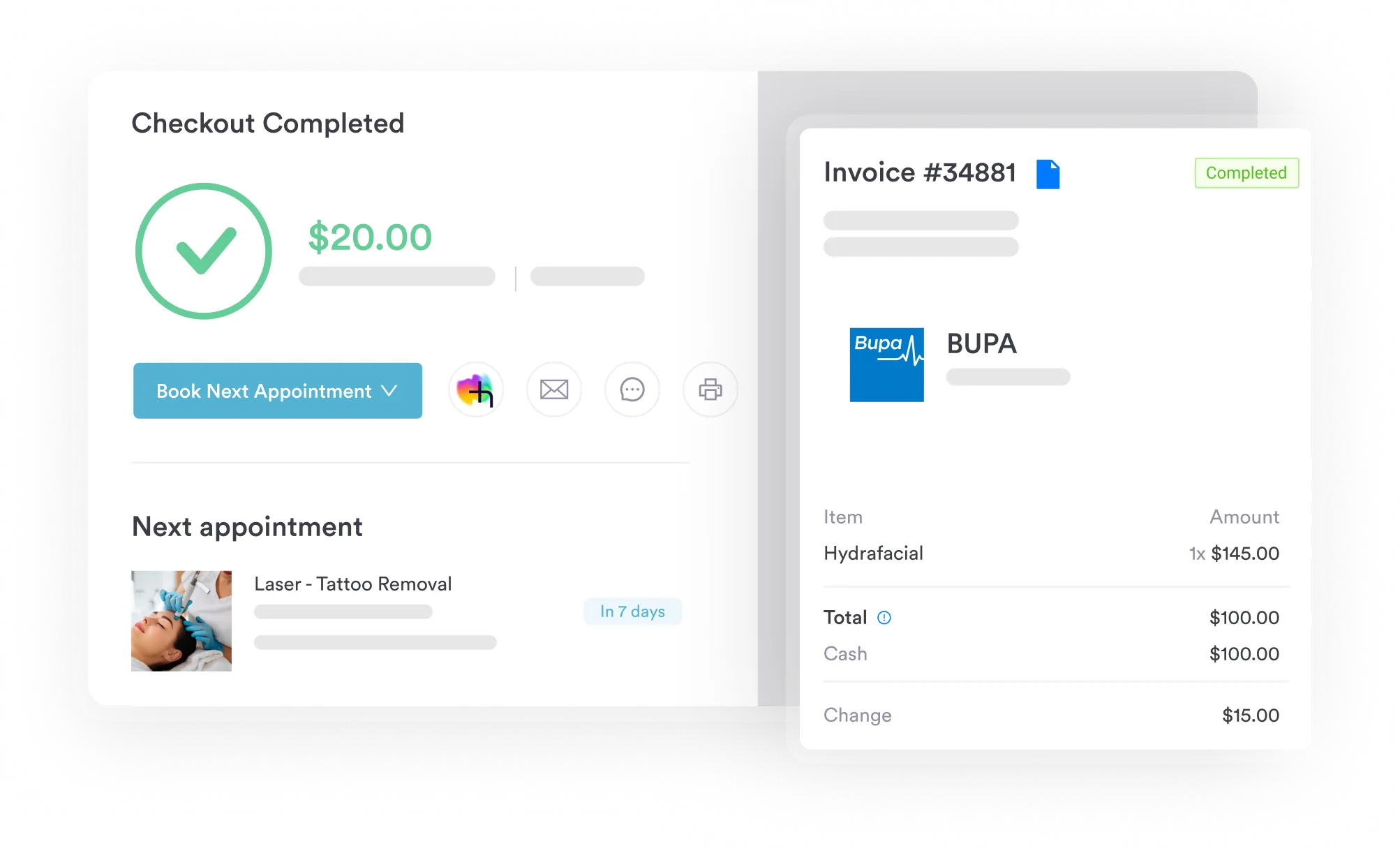

Pabau pre-fills claims from the patient record and checks required fields before you send, so P9017 lines leave complete and clear the first time.

P9017 is the default code for single-donor FFP, which is why it gets billed for units it does not describe. Read the product name and freeze window on the blood bank record before you code, and send retested or later-frozen units to P9060 or P9059.
Pair each bag with a transfusion code and a supporting diagnosis, and match the billed units to the issue record. Skip the label check, though, and one audit sample can unwind payment on every plasma line coded the same way.
If your team still retypes codes and chases missing claim fields by hand, that work can move into the claim screen. Book a demo to see how Pabau prepares, sends and tracks blood product claims for your billing team.

New to the claims lifecycle? What is medical billing explains the full claims lifecycle from charge capture through remittance posting.
Billing red cells on the same claim? HCPCS code P9016 covers leukocyte-reduced red blood cells, the product most often billed next to FFP.
Coding pooled plasma instead? HCPCS code P9023 explains solvent/detergent-treated pooled plasma and how it differs from single-donor FFP.
HCPCS Code P9017 is the Level II code for fresh frozen plasma from a single donor, frozen within 8 hours of collection, billed per unit. The transfusion itself goes on a separate line, usually with CPT 36430.
Bill one unit of P9017 for each bag of fresh frozen plasma supplied. A patient who received three bags in one encounter shows P9017 with a quantity of 3. The count must match the blood bank issue record.
Both codes cover single-donor fresh frozen plasma, and the freeze time separates them. P9017 is for plasma frozen within 8 hours of collection. P9059 is for plasma frozen between 8 and 24 hours after collection.
P9060 covers fresh frozen plasma from a donor who was retested before the unit was released from quarantine. P9017 covers standard FFP with no retest release on file. The blood bank record shows which applies.
Yes, Medicare pays P9017 separately under the Outpatient Prospective Payment System in a hospital outpatient setting. The rate is updated each year in OPPS Addendum B. Medicare Advantage and commercial plans may add prior authorization rules.
Hospitals report the plasma under revenue code 0383, part of the 038X blood and blood components series, on the P9017 line. The transfusion is a separate line, usually with CPT 36430.
No single ICD-10-CM code is mandated, but the diagnosis must support the need for FFP. Common choices include D65, D68.x coagulation defects, K72.x hepatic failure and trauma codes in massive transfusion. Check your MAC’s LCD.
Common reasons are missing medical necessity (CO-50), payer packaging rules (CO-97) and modifier problems on the paired CPT code (CO-4). Unit counts that differ from the blood bank record are another. Each needs a different fix before resubmission.