



CCSD code G5100: Bypass of duodenum billing guide
CCSD code G5100 bills a bypass that leaves the duodenum in place CCSD code G5100...

Last Updated: Oct 16, 2026

CPT Code 36430 covers transfusion of blood or blood components by intravenous infusion, including whole blood, pRBCs, FFP, platelets, and cryoprecipitate.
36430 covers the administration service only, so the blood product is billed separately using HCPCS P-codes such as P9010, P9016, and P9021.
Missing HCPCS product codes and unpaired ICD-10 diagnosis codes are the two most common denial triggers on transfusion claims.
Modifiers -26 and -TC never apply to 36430, because Medicare assigns the code a PC/TC status indicator of 5.
Practice management software like Pabau embeds CPT and HCPCS code libraries with modifier prompts and claim scrubbing to cut transfusion billing errors.
CPT Code 36430 is the billable code for transfusion of blood or blood components by intravenous infusion. It covers the administration service only. The blood product itself is reported separately on the same claim with a HCPCS Level II P-code.
The code applies to whole blood, packed red blood cells, fresh frozen plasma, platelets, and cryoprecipitate. It sits in the venous procedures subsection of the AMA surgery section. This guide covers the clinical indications, the 2026 fee schedule, modifiers, paired ICD-10 and HCPCS codes, and the documentation a payer expects.
According to the American Medical Association (AMA), CPT Code 36430 describes “transfusion, blood or blood components.” The code is component-agnostic. It applies to whole blood, packed red blood cells (pRBCs), fresh frozen plasma (FFP), platelets, and cryoprecipitate administered by intravenous infusion.
The code covers the administration service only. The blood product itself is billed separately using the appropriate HCPCS Level II P-code. Both codes are required on the same claim for proper reimbursement.
CPT Code 36430 applies whenever a patient receives a transfusion of blood or blood components by intravenous infusion. Medical necessity must be documented in the clinical record before billing.
Common clinical scenarios that support use of this code include:
Medical necessity criteria vary by payer. CMS Local Coverage Determinations (LCDs) define acceptable indications for Medicare patients. Always verify the payer’s specific LCD before submitting a claim.
Reimbursement for CPT Code 36430 varies by setting, geographic location, and payer. The CMS Physician Fee Schedule (PFS) lookup tool is the authoritative source for current Medicare rates. A 2026 RVU lookup will calculate the location-adjusted rate using the geographic practice cost index for your area.
Because CMS updates rates annually, verify the current-year fee schedule rather than relying on third-party figures. Reconcile each remittance against what was billed, so an underpayment on the product line is caught while it can still be appealed.
Submitting through a clearinghouse validates the claim against payer edits before it reaches the insurer. Pabau routes 36430 claims through eligibility verification and payer-specific scrubbing, so a rejection surfaces before the claim ever reaches the fee schedule stage.
Modifier selection for CPT Code 36430 turns on whether the transfusion was repeated and who performed it. The National Correct Coding Initiative (NCCI) governs which combinations are permissible, so check the current NCCI table before submitting.
Two modifiers that coders often reach for do not belong on this code at all. Medicare assigns 36430 a PC/TC status indicator of 5, which identifies it as an “incident to” code. The code has no professional or technical component split, so modifiers -26 and -TC never apply. Setting differences show up in the facility versus non-facility rate instead.
Modifier -76 or -77 is required when billing multiple units of CPT Code 36430 on the same date of service. Without one of them, a payer’s system will typically reject the second line as a duplicate. Check payer-specific policies, because some commercial insurers want documentation in the claim notes field rather than a modifier alone.
Every CPT Code 36430 claim needs a supporting ICD-10-CM diagnosis code that establishes medical necessity. The diagnosis must match the clinical documentation and link directly to the reason for transfusion. Accepted pairings differ by plan, so check the payer’s own coverage policy before submitting.
This list is illustrative, not exhaustive. Accepted ICD-10 pairings depend on each payer’s LCD. Submit the most specific diagnosis code the clinical documentation supports, rather than defaulting to an unspecified code such as D64.9.
CPT Code 36430 covers the transfusion administration service only. The blood product itself must be reported separately using the appropriate HCPCS Level II P-code. Both the CPT administration code and the HCPCS product code appear on the same claim.
The table above lists the products that come up most often. Leukocyte-reduced platelets collected by apheresis bill as P9035 on the same claim as 36430.
Payer coverage of individual P-codes varies significantly. Molina Healthcare, HMSA, and the major Blue Cross plans each maintain their own blood transfusion service policies.
Verify which P-codes the payer recognizes before billing. Some payers accept only certain leukocyte-reduced or irradiated product codes, and others require prior authorization for specific components.
The administration code, the product code, the diagnosis, and any repeat modifier all have to arrive on the same claim. The chart below shows what each line carries and what happens when one is missing.
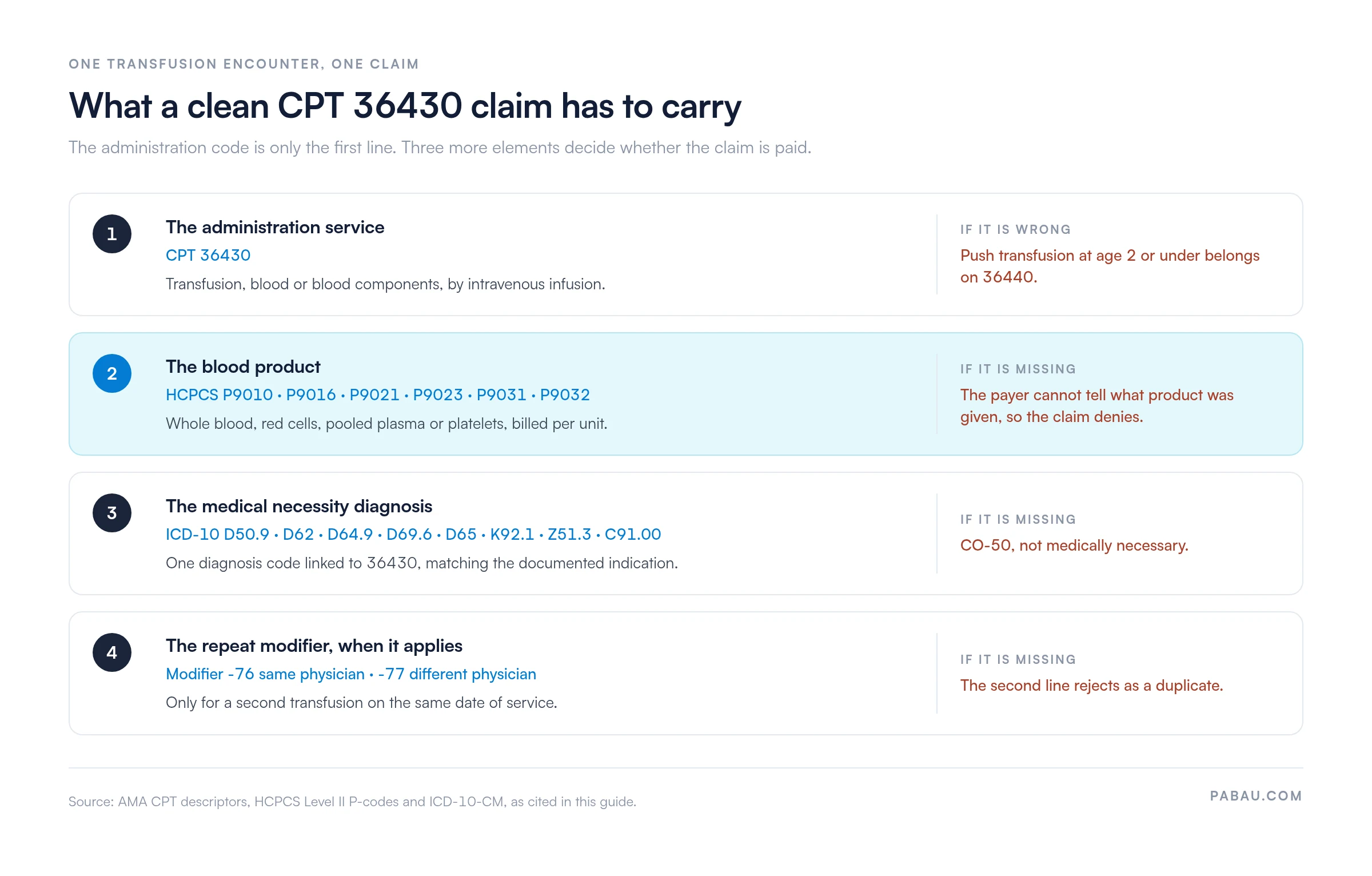
CPT Code 36430 is one of several transfusion codes in the venous procedures subsection. Code selection depends on the patient’s age, the type of transfusion, and the clinical indication. The AAPC Codify CPT lookup compares descriptors across the full range.
The most common coding error in this family is using 36430 for a push transfusion in an infant when 36440 is correct. Age and administration method are the distinguishing factors.
Insufficient documentation is one of the leading causes of denial for transfusion claims. Thorough records give Medicare and commercial payers the evidence they ask for during an audit. The superbill should capture each of the following elements before the claim is submitted.
For Medicare claims, check whether a local LCD governs transfusion billing in the MAC jurisdiction. Some MACs require specific pre-transfusion lab values as a condition of coverage. The electronic claim file must carry the ICD-10 diagnosis code that matches the documented clinical indication.
Each element above comes from the encounter record or the lab. Documentation for HCPCS code L1844 sits with the fabricator instead, because the record has to justify a custom-fabricated brace over a prefabricated one.
Run a pre-submission documentation checklist on every transfusion claim. Confirm the physician order, the T&C result, the component and units, the start and stop times, and the pre-transfusion lab values. A five-minute chart review at the point of billing significantly reduces documentation-related denials.
Most denials for CPT Code 36430 fall into a small number of recurring patterns. Work out which of them your practice generates, then put a targeted pre-submission check on each one. Peripheral IV access carries its own code, 36000, so check the NCCI bundling edits before adding it to a transfusion claim.
Reading the reason code on a rejected claim tells you which error category applies. CO-4 (inconsistent modifier), CO-97 (bundled service), and CO-50 (not medically necessary) are the three that show up most often on 36430. Our guide to denial codes sets out what each one asks you to correct.
A transfusion claim carries more moving parts than a typical outpatient visit code. Each encounter needs the CPT administration code, one or more HCPCS product codes, and an ICD-10 diagnosis pairing.
Repeat transfusions add modifier logic on top. Assembling those lines by hand, from four separate reference sources, is where most 36430 errors start.
Practice management software with integrated billing removes that assembly step. Pabau’s claims management software embeds CPT and HCPCS code libraries inside the clinical workflow. The correct P-code surfaces alongside 36430 at the point of documentation, rather than during a separate billing session later in the week.
Modifier prompts fire on same-day service rules, and claim scrubbing checks NCCI edits and missing diagnosis codes before the claim reaches the clearinghouse. The coder sees the problem while the chart is still open.
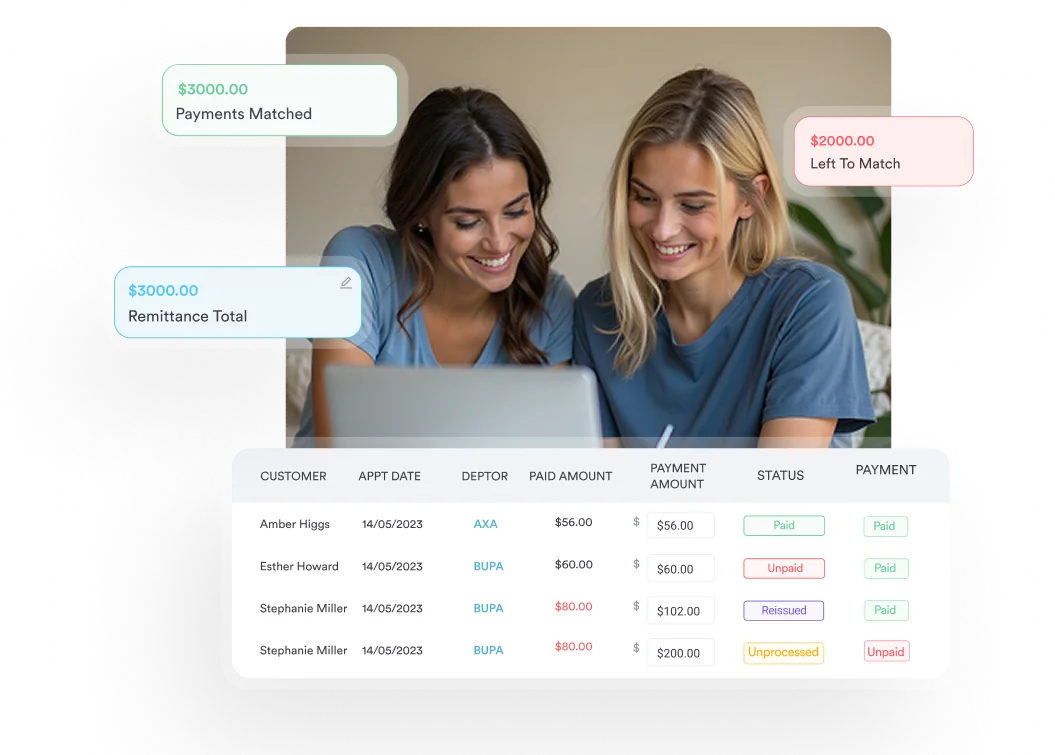
The effect on the revenue cycle shows up in the numbers. Fewer claims fail on first pass, payment arrives sooner, and less of the billing team’s week goes to rework. For oncology infusion centers, hematology practices, and hospital outpatient departments, that saving compounds across every billing cycle.

Pabau’s claims management software puts CPT and HCPCS code libraries, modifier prompts, and pre-submission claim scrubbing into the coding workflow. Your team catches 36430 errors before the claim leaves the practice.

Choosing CPT Code 36430 is rarely the hard part of a transfusion claim. The lines that travel with it decide whether it gets paid. That means the P-code for the product, the ICD-10 code for medical necessity, and a repeat modifier where a second transfusion applies.
The practical fix is to move the check to the moment of coding rather than the moment of appeal. A billing system that prompts for the companion P-code and the linked diagnosis will stop most 36430 denials before submission. Book a demo to see how Pabau handles transfusion and infusion billing end to end.

Looking to understand the full claim submission process? How a medical claims clearinghouse works walks through the electronic submission workflow from claim creation to ERA receipt.
Want to benchmark your billing compliance posture? Medical billing compliance covers the documentation and audit-readiness standards practices should meet.
Want to see the file the payer actually receives? The 837 electronic claim file explains how each code line reaches the insurer.
New to the billing cycle end to end? What is medical billing walks through every step from patient encounter to posted payment.
CPT Code 36430 is the administration code for transfusion, blood or blood components. It covers the intravenous transfusion service for whole blood, packed red blood cells (pRBCs), fresh frozen plasma (FFP), platelets, and cryoprecipitate. The code does not cover the blood product cost, which is billed separately using HCPCS P-codes such as P9010, P9016, or P9021.
The 2026 Medicare rate for CPT Code 36430 varies by geographic location and billing setting. Verify the current rate with the CMS Physician Fee Schedule lookup tool. CMS updates rates annually, so third-party figures may not reflect the current payment year.
CPT Code 36430 is generally billed per encounter, meaning per transfusion session, not per unit of blood product transfused. When more than one transfusion is given on the same date of service, append modifier -76 or -77 to the subsequent lines. Use -76 for the same physician and -77 for a different physician, so the line is not denied as a duplicate.
No. Medicare assigns CPT Code 36430 a PC/TC status indicator of 5, which identifies it as an incident to code. It has no professional or technical component split, so neither modifier -26 nor modifier -TC belongs on the claim. Differences between settings are reflected in the facility and non-facility rates instead.
CPT 36440 covers a push transfusion, meaning manual syringe administration, in patients aged 2 years or younger. CPT 36430 covers standard gravity or pump-driven transfusions in all age groups, including infants. Age and administration method are the two deciding factors between these codes.
P9010 covers whole blood, P9016 leukocyte-reduced red cells, and P9021 red blood cells. P9023 covers pooled plasma, P9031 leukocyte-reduced platelets, and P9032 irradiated platelets. Payer coverage of individual P-codes varies, so verify the payer’s blood transfusion policy before billing.
Yes. CPT Code 36430 can be billed in an outpatient hospital setting under Medicare Part B and most commercial plans. The physician bills 36430 at the facility rate, and the hospital separately bills its facility fee under the Outpatient Prospective Payment System (OPPS). For inpatient Part A encounters, 36430 is typically bundled into the DRG payment and not separately billable.



