

HCPCS Code E0272: Foam rubber mattress billing guide
HCPCS Code E0272: official descriptor and code overview HCPCS Code E0272 is the ...

Last Updated: Nov 6, 2026
M1009 is the HCPCS Level II code for discharge/discontinuation of the episode of care documented in the medical record.
It is a quality data code, active since January 1, 2020. It reports that an episode of care ended by discharge or discontinuation, as the medical record shows. It describes no service and carries no separate Part B payment. In MIPS Quality ID #478, an episode counts toward the measure only when M1009 documents its discharge.
Let Pabau's smart automation suggest the right codes, reduce claim denials, and keep your practice compliant—effortlessly.
Automate repetitive tasks and focus on what matters most—your patients.
Reduce coding errors and ensure compliance with the latest regulations.
Clean claims, fewer denials, and faster reimbursements.
Powerful insights and reporting to help your practice thrive.
HIPAA compliant SOC 2 certified GDPR-compliant Trusted by 4,000+ clinics worldwide

HCPCS Code M1009 reports that an episode of care was discharged or discontinued, and that the medical record documents it.
The code has been active since January 1, 2020, and Medicare Part B does not price it separately.
In MIPS Quality ID #478, an episode without M1009 never enters the denominator, so its outcome is never scored.
Report M1009 only when the record holds a dated discharge or discontinuation note that gives the reason.
Modifier use and the reporting route follow the quality program or payer specification, not a fixed rule for the code.
HCPCS Code M1009 is a Level II quality data code. It reports the discharge or discontinuation of an episode of care, as documented in the medical record. CMS added it to the HCPCS Level II code set on January 1, 2020, and it remains active in 2026.
The official long descriptor reads Discharge/discontinuation of the episode of care documented in the medical record. The short descriptor is Dc eoc doc med rec. The code describes no clinical service of its own. It tells a quality program that an episode ended, and that the record proves it.
Other Level II codes are covered in the HCPCS code library.
M1009 reports one fact. The episode of care has ended by discharge or discontinuation, and the medical record documents it. The code does not describe a procedure, and it does not replace any CPT or HCPCS service code.
Keep these limits in mind before you report it:
The clearest current use of M1009 is MIPS Quality ID #478, Functional Status Change for Patients with Neck Impairments. In CMS’s 2026 specification, M1009 is a denominator criterion rather than a numerator code.
A treatment episode starts at an initial evaluation for a neck deficit and ends at discharge. An episode counts only when M1009 documents that discharge. An episode that never gets one drops out of the measure, however good the patient’s outcome was.
Interruptions follow the same logic. If the patient is hospitalized or has surgery, the specification requires a discharge from the current episode. Care that resumes later starts a new episode. The flow below shows where M1009 sits and which code closes the scoring.
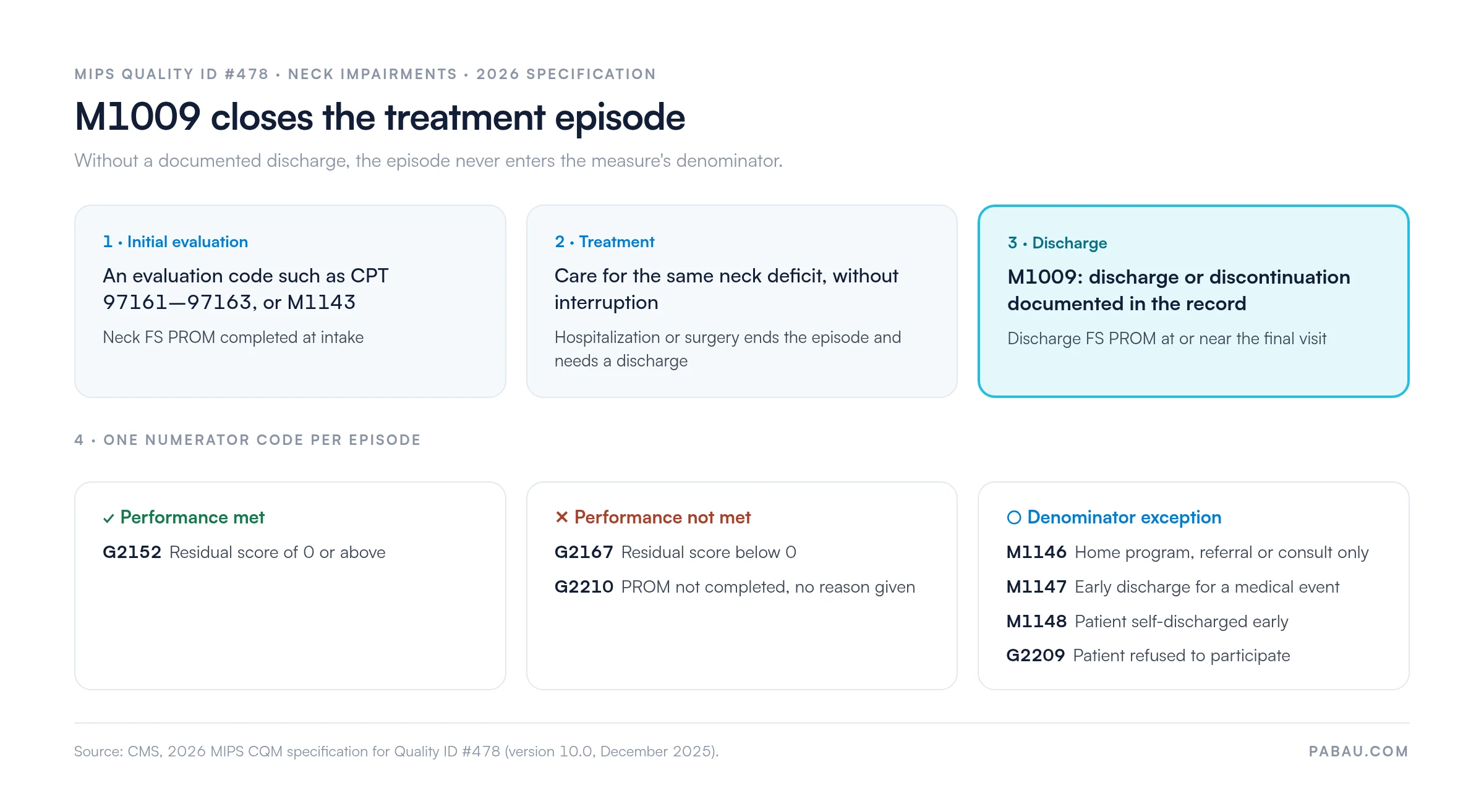
The initial evaluation can be a physical therapy evaluation such as 97161, another evaluation code on the measure’s list, or the status code M1143. The patient completes the neck functional status questionnaire at intake and again at or near discharge.
Quality ID #478 is collected as a MIPS clinical quality measure. Its data goes to CMS through a registry or another qualified submitter, not on the claim.
Medicare does not pay for M1009. Part B does not price the code separately, and reporting it adds no amount to the visit. Its value is the quality score it makes possible.
Quality is a scored MIPS performance category. Episodes that never close leave a clinician’s measure built on fewer cases than the clinician treated. Medicaid programs and commercial insurers set their own M-code policies, so Medicare’s approach does not carry over.
Accurate medical billing compliance for M1009 starts with the discharge note, not the claim or the registry file. The record has to show that the episode ended, when it ended, and why.
Check each M1009 report against this list. Add any measure-specific requirement from the current program specification or payer policy.
Before you report M1009, open the discharge note and confirm three items: the date, the reason, and the condition it closes. If one is missing, fix the note first. An M1009 report the record cannot support will not survive an audit.
M1009 sits among HCPCS M-codes that report quality data. Coders sometimes reach for a neighboring M-code, a quality G-code, or a CPT Category II code where M1009 belongs, and the reverse. The comparison below covers the usual mix-ups.
When you are unsure which code a program expects, read the measure specification first. Then compare descriptors side by side in the AAPC HCPCS code lookup.
The steps below take one episode from discharge to a clean M1009 report. The submission route depends on the program or payer you report to.
Most M1009 problems trace back to the discharge note or to a reporting rule borrowed from another code type. The table maps each error to its effect and the fix.
When a payer rejects an M1009 line, the guide to denial management in healthcare covers the end-to-end workflow. A clean claim process catches most of these errors before submission.
Set a payer-level flag in your billing system for payers that do not accept HCPCS M-codes. Claims to those payers then leave M1009 off automatically, without a manual check of every claim.
Most M1009 errors start in the chart. The discharge note lacks a date or a reason, or the episode never gets closed at all. Billing staff then find the problem weeks later, when registry or payer data is due.
Pabau, the practice management platform we build, keeps treatment notes, medical forms, and billing on one patient record. A discharge form built in Pabau can hold the date, the reason, and the condition in set fields. Your billers then report from the same record the clinician signed.
Pabau’s therapy practice claims software submits and tracks the claims behind each episode. When a payer asks for M1009 on a claim line, it goes out from the record that holds the discharge note.

Pabau keeps treatment notes, discharge forms, and claims on one patient record. Your team reports M1009 from documentation that already holds the date and the reason.

Treat M1009 as the last line of a discharge note, not as a billing task. The code only works when the record already proves the episode ended, on which date, and for what reason.
Get that right at the closing visit and the rest follows. Episodes reach the denominator, the right numerator code gets picked, and an audit finds nothing to question. Skip it, and treated patients drop out of your quality score.
Book a demo to see how Pabau keeps discharge notes, quality codes, and claims on one patient record.

Coding the evaluation that opens the episode? CPT code 97163 covers the high-complexity physical therapy evaluation.
Billing insurance as a therapy practice? Insurance billing for therapists walks through payer setup, claims, and follow-up.
Dealing with repeated claim denials across your practice? Denial management in healthcare covers root-cause analysis, appeal workflows, and denial prevention strategies.
Want to understand what makes a claim pass first-pass adjudication? Clean claim best practices outlines the data elements and edit checks that determine whether a claim clears the payer front-end.
Need a full picture of how medical billing works? What is medical billing explains the end-to-end revenue cycle, from charge capture to payment posting.
HCPCS Code M1009 reports the discharge or discontinuation of an episode of care, as documented in the medical record. It is a Level II quality data code, active since January 1, 2020. It describes no service and carries no separate payment.
Medicare does not pay for M1009. Part B does not price the code separately, and it adds nothing to the visit’s payment. Its purpose is quality reporting, such as closing an episode in MIPS Quality ID #478.
MIPS Quality ID #478, Functional Status Change for Patients with Neck Impairments, uses M1009 as a denominator criterion in its 2026 specification. Each treatment episode counts only when M1009 documents its discharge.
The record needs a note stating that the episode of care was discharged or discontinued. The note gives the date and the reason, and closes the condition the initial evaluation identified. The M1009 report must match that note.
The usual causes are a missing discharge note, a payer that does not accept M-codes, or a modifier the program never asked for. In Quality ID #478, a missing discharge questionnaire scores the episode as performance not met.
Medicare quality programs such as MIPS are the main home for M1009. Commercial insurers and state Medicaid programs set their own policies, and many do not accept M-codes. Check each payer’s billing guidelines before you report it.
Modifier use for M1009 depends only on the applicable quality program or payer specification. The 1P, 2P, and 3P performance modifiers belong to CPT Category II reporting, not to M1009. Add none unless the specification calls for one.




