Vasodilators medication list
A vasodilators medication list is a clinical reference that groups vasodilator d...

1
Last Updated: Oct 7, 2026

Insurance billing for therapists means submitting claims to payers for covered sessions using CPT codes, NPI numbers, and CMS-1500 forms.
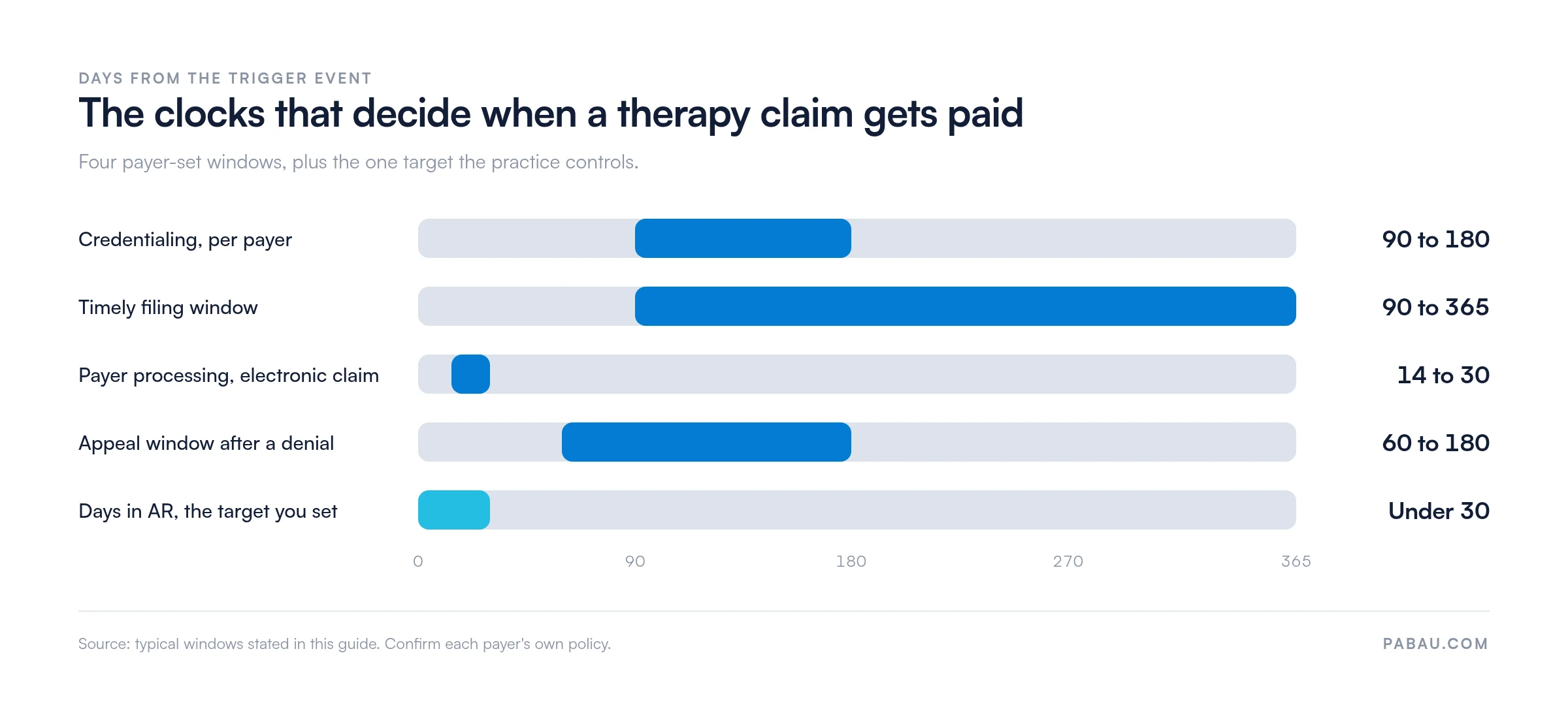
Credentialing with insurance panels is the prerequisite to in-network billing, and it typically takes 90 to 180 days per payer.
Most claim denials are preventable. They usually trace back to a missing prior authorization, a wrong CPT code, or a late filing.
Telehealth therapy bills with modifier 95 and place of service 02 or 10, for Medicare and commercial payers alike.
Pabau’s claims management software automates claim submission, ERA posting, and eligibility verification in one platform.
Insurance reimbursement accounts for most of the revenue in a typical therapy practice. Claims errors quietly drain thousands of dollars a year from that total, mostly through write-offs nobody chose to take. The Mental Health Parity and Addiction Equity Act requires most insurers to cover mental health services at the same level as medical benefits.
That parity rule widens the pool of clients whose therapy is reimbursable. The coverage only reaches your bank account when your billing is accurate, timely, and compliant. This guide walks through insurance billing for therapists stage by stage, from credentialing through denial management.
Insurance billing for therapists means submitting a claim to a health insurance payer after a covered session. You then collect the reimbursement on the client’s behalf. The workflow runs through six steps: credentialing, benefits verification, CPT code selection, claim submission, payment reconciliation, and denial management.
Every claim ties back to three identifiers your practice needs before billing a single session. Those are a National Provider Identifier (NPI), a Tax Identification Number (TIN), and an active payer contract. Miss one and the claim rejects before a human ever reviews it.
Credentialing is how insurers verify your qualifications before adding you to their provider network. Most major commercial payers use the CAQH Provider Data Portal, formerly CAQH ProView, as their central credentialing database. Completing that profile is the starting point.
From there you apply directly to each payer panel you want to join. Budget 90 to 180 days per payer, because timelines vary widely between them. A detailed walkthrough of getting credentialed covers the document checklist and the payer-specific quirks.
Before you apply, decide whether you want to work in-network or out-of-network. That choice shapes your billing workflow, your client mix, and your reimbursement rates.
In-network therapists accept payer-negotiated rates and bill the insurer directly. Out-of-network therapists set their own fees. They either collect from the client directly, or hand over a superbill the client submits for partial reimbursement. Neither model suits every practice, and the trade-offs run in opposite directions.
Benefits verification is the step that gets skipped when a schedule is full. A client’s insurance card confirms coverage exists. It does not confirm that therapy is covered, that you are in-network for their specific plan, or that their deductible has been met.
Running insurance eligibility verification before the first session prevents the billing surprises that damage a therapeutic relationship. Confirm these five points before every new client’s intake appointment:
Prior authorization requirements vary by payer and by plan. Some payers require pre-authorization before session one. Others allow a set number of visits before authorization kicks in. Submitting a claim without the required authorization is one of the fastest routes to a denial.
Mental health billing codes come from the AMA’s Current Procedural Terminology (CPT) codebook, which is updated annually. Using the wrong code, even by one digit, routes the claim to the wrong fee schedule or triggers an automatic denial.
The codes below cover most outpatient therapy: individual psychotherapy, diagnostic evaluations, and family sessions.
For a telehealth session, append modifier 95 to the same CPT code. Medicare and commercial payers both use modifier 95 now, paired with place of service 02 or 10. Payer policies still differ, so check before you bill a video session at the in-person rate.
Most insurance billing for therapists happens electronically through a clearinghouse, which routes your claim data to the payer in the required EDI 837P format. Some payers still accept a paper CMS-1500 form. Electronic submission is faster, produces fewer errors, and confirms receipt straight away.
Out-of-network clients get a superbill instead, which they submit to their own insurer. A ready-made superbill template saves you rebuilding the itemized fields for every client.
A clean claim carries the correct NPI, an accurate ICD-10-CM diagnosis code tied to the billed CPT code, the service date, and the provider’s signature. Getting those right before you submit cuts processing time sharply.
Timely filing deadlines vary by payer, and commonly run from 90 days to one year after the date of service. Miss the window and the claim cannot be resubmitted, however clinically accurate the original session was.
Track your timely filing deadlines in a spreadsheet by payer, and flag any claim older than 60 days with no ERA response. Most payers process an electronic claim in 14 to 30 days. Silence at 60 days usually means the claim was rejected rather than denied.
After a claim is processed, the payer sends payment information in two formats. The Electronic Remittance Advice (ERA) is the machine-readable 835 transaction your billing software uses to auto-post payments and adjustments. The Explanation of Benefits (EOB) is the human-readable version sent to you and to your client.
Read the ERA line by line and it tells you what the payer paid, what they adjusted off, and why. ERA data maps directly to your accounts receivable. When a payer pays less than the contracted rate, the ERA shows a CARC (Claim Adjustment Reason Code) explaining the reduction.
Two codes come up constantly. CO-45 means the charge exceeds the fee schedule. CO-97 means the service is bundled into another one already paid. Knowing them lets you spot the billing patterns that erode reimbursement over time.
Unworked denials are where a practice loses money it has already earned. Most mental health denials are preventable, and reversible with the right denial management workflows. Four reasons account for the bulk of them:
Appeals work best when they go out promptly with supporting documentation. Send the original claim, the denial explanation, the clinical note for that date of service, and a written appeal letter citing the denial reason code.
Most payers allow 60 to 180 days from the denial date to file. Track your denial rate as a share of total claims submitted. Anything above 5% points to a workflow problem worth fixing.
Telehealth billing uses the same CPT codes as in-person sessions, with a modifier and a place of service code flagging the virtual delivery. The payer landscape has settled since 2020, but policies still differ. Verify your payer contracts annually, because coverage that was expanded temporarily may now carry extra documentation requirements.
Some payers still require an originating site modifier, or restrict video-only visits without audio. Confirm the payer’s current telehealth policy before the session, not after.
Billing errors follow predictable patterns. Recognizing them early saves time, prevents denials, and keeps the practice clear of audit risk.
One more exposure is worth naming. The service in the clinical note and the service on the claim must describe the same session. Any discrepancy between the two will be read as a compliance problem.
Days in accounts receivable (days in AR) tells you how efficiently your billing converts sessions into cash. Benchmarks for outpatient therapy put the target under 30 days for in-network claims. Practices sitting at 45 days or more are usually losing revenue to late submissions, unworked denials, and missing ERA reconciliation.
That target sits alongside four deadlines the payer sets, and the windows are wildly different lengths. Seeing them on one scale shows which clock threatens your revenue first.
Three levers move days in AR for a therapy practice:
The software-versus-service decision depends on practice size, clinical capacity, and how much billing complexity you want to manage. A solo therapist seeing 25 clients a week faces different trade-offs than a group practice with 10 clinicians billing six payers.
Either way, the handoff between clinical documentation and claim submission is where data entry errors live. Software that holds both sides removes the handoff altogether.
Practice management software like Pabau closes the distance between the session and the claim. Pabau’s medical claims management connects each part of the therapy billing workflow in one place. Eligibility verification runs at booking, claims generate from completed appointment records, and ERA data posts back into the system holding the clinical note.
The insurance claims workflow now lives inside Pabau’s main interface. There is no separate billing screen to log into, and no export step between the note and the claim. Therapists and billing staff work the revenue cycle without switching platforms.
Pabau is built for multi-discipline practices, therapy and mental health among them. HIPAA-compliant clinical notes, digital intake forms, and automated appointment workflows sit alongside the billing engine. That matters for a therapist who bills insurance and also wants recalls, secure messaging, and client booking in one place.

Pabau combines claim submission, ERA reconciliation, and benefits verification in one platform, so billing runs alongside your clinical work instead of after it.

Therapy billing rarely fails on the clinical side. It fails on small administrative details repeated at scale. A missed modifier, a lapsed authorization, or an untracked filing window each writes off work you already did.
Pick the two habits that cost least and pay most. Submit claims the same day, and work denials weekly rather than monthly. Those two alone will pull days in AR back toward the 30-day mark.
If billing is eating the hours you would rather spend with clients, the fix is usually workflow rather than effort. Book a demo to see how Pabau runs eligibility checks, claims, and ERA posting alongside your session notes.

Need the fundamentals before the therapy specifics? What is medical billing? walks through the whole claim lifecycle for any specialty.
Want fewer rejections at the clearinghouse? What is a clean claim in medical billing? lists the fields a payer checks before a claim is accepted.
Unsure how to read a payer’s payment file? What is electronic remittance advice (ERA)? explains the 835 transaction and the codes inside it.
Billing out-of-network clients? What is a superbill? covers what belongs on one and how clients claim against it.
Looking at the whole revenue picture? What is revenue cycle management (RCM)? connects billing decisions to the money that reaches your account.
Insurance billing for therapists is the process of submitting claims to a health insurance payer for covered therapy sessions. Each claim carries CPT codes, ICD-10 diagnosis codes, and the provider’s NPI. The payer then pays the therapist directly when in-network, or reimburses the client when out-of-network.
You need an NPI, an active credentialing agreement with the payer, and a verified diagnosis and CPT code for every session. Submit claims electronically through a clearinghouse inside the payer’s timely filing window. That window commonly runs from 90 days to one year after the date of service.
The four most commonly billed mental health CPT codes are 90791, 90837, 90834, and 90847. They cover a psychiatric diagnostic evaluation, 60-minute individual psychotherapy, 45-minute individual psychotherapy, and family psychotherapy with the patient present. Check that the code matches the documented session length and clinical scenario.
A superbill is an itemized receipt carrying the provider’s NPI, the client’s diagnosis code, the CPT code for each service, and the fee charged. Out-of-network clients use it to file their own reimbursement claim. It guarantees nothing, because the payer still decides coverage from the client’s plan.
Prior authorization requirements depend on the payer and on the client’s specific plan. Some plans require pre-authorization before the first session. Others allow a set number of visits before authorization is needed. Verify the requirement during benefits verification, before the intake appointment.
Use the same CPT code as the in-person session and append modifier 95. Pair it with place of service 10 when the client is at home, or 02 when they are somewhere else. Medicare retired modifier GT for Part B in 2018, so modifier 95 now applies to Medicare and commercial payers alike.
An ERA (Electronic Remittance Advice) is the machine-readable 835 transaction your billing software uses to auto-post payments and read denial reason codes. An EOB (Explanation of Benefits) is the human-readable version sent to the provider and the client. Both carry the same payment data in different formats.