



HCPCS code E0198: Water pressure pad billing guide
HCPCS code E0198 is a water pad for a standard mattress HCPCS code E0198 is the ...

Last Updated: Oct 13, 2026

CPT code 97163 covers a high complexity physical therapy evaluation, and all three criteria must be met and documented.
The gates are 3 or more personal factors affecting the plan of care, and 4 or more body elements examined.
The third gate is high complexity clinical decision making, evidenced by a standardized assessment instrument or a functional outcome measure.
Medicare pays 97161, 97162 and 97163 at the same national rate, so billing 97163 adds audit exposure without adding revenue.
Practice management software like Pabau ties structured evaluation notes to the claim, so each complexity criterion is documented before submission.
CPT code 97163 is the billable code for a physical therapy evaluation of high complexity. It applies when the presentation, the examination, and the clinical decision making all reach the highest tier of the evaluation family.
The American Medical Association’s CPT code set requires three components, and all of them together. The typical time associated with the service is 45 minutes, compared with 30 for 97162 and 20 for 97161.
The tiered codes 97161, 97162 and 97163 replaced a single evaluation code after the American Physical Therapy Association (APTA) pushed for complexity-differentiated billing. The intent was to stop a straightforward presentation being billed the same as a complex comorbid one.
Medicare never carried that intent through to payment. All three tiers carry the same work relative value unit (RVU) of 1.54, so the fee schedule pays them alike. Choosing 97163 changes what you have to prove, not what you collect.
All three criteria below must be met and independently documented. Satisfying two out of three does not qualify for 97163. Each gate represents a distinct clinical threshold.
Component 1: Personal factors and comorbidities. The key phrase is “affect the plan of care.” Listing diagnoses is not enough, because the note must explain how each comorbidity changes the treatment approach. A patient with a lumbar strain, uncontrolled hypertension, stage 3 kidney disease and severe osteoporosis clears the bar. Each condition constrains exercise selection, intensity and progression.
Component 2: Examination of 4 or more body elements. The count must reach four from any combination of three domains, and each element needs an objective finding recorded.
Component 3: High complexity clinical decision making. APTA guidance specifies that clinical decision making (CDM) must use a standardized patient assessment instrument or a measurable assessment of functional outcome. A narrative paragraph alone does not satisfy this criterion. The note should name the instrument, report the score, and connect the findings to the plan of care.
Documentation failures drive most 97163 downcodes and denials. Payers reviewing a high-complexity evaluation claim look for explicit evidence of all three gates. A note that only implies complexity gets paid at 97162.
The tiered evaluation codes are a family. Knowing where 97163 sits relative to 97161 for low complexity and 97162 for moderate complexity is what lets you defend the level you picked.
The boundary between 97162 and 97163 is the one most commonly misapplied. Both require 3 or more personal factors or comorbidities. The differentiator is whether those comorbidities affect the plan of care, and whether decision making reaches high complexity with a standardized instrument. A patient with three documented comorbidities but a straightforward treatment plan is a 97162.
The grid below sets the three tiers side by side, and adds the row that changes how you should think about the choice.
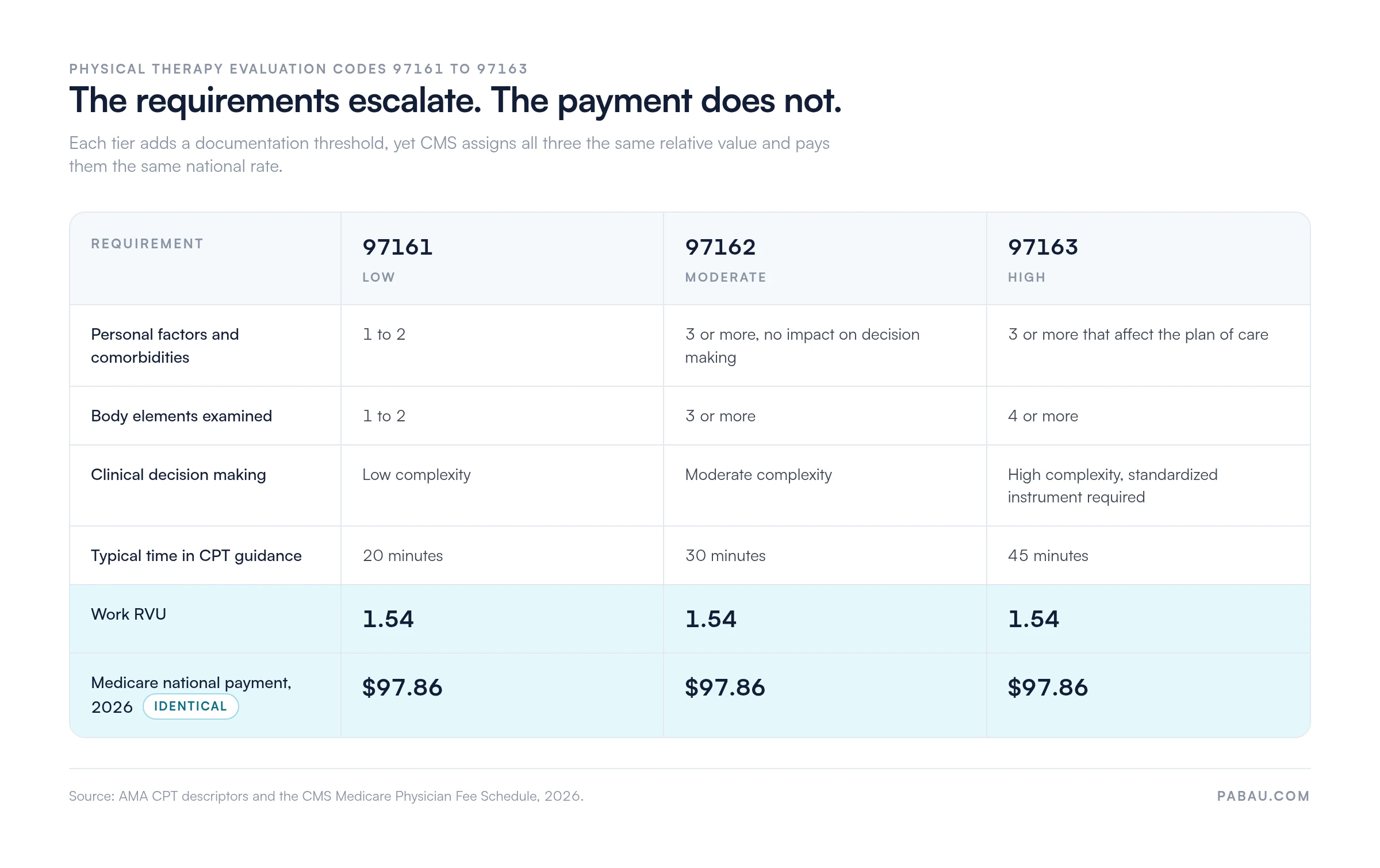
CPT code 97163 is appropriate when the evaluation genuinely satisfies all three required components. Knowing which presentations qualify lets therapists code defensibly at the time of service, rather than retroactively.
Presentations that commonly qualify for 97163:
Presentations that do not qualify for 97163:
An acute ankle sprain with two comorbidities falls short, and so does a simple rotator cuff strain with diabetes. So does any presentation where the comorbidities are documented but do not demonstrably alter the plan of care. Billing 97163 reflexively for every Medicare patient, or every 45-minute evaluation, is the pattern that triggers payer audits.
Run three checks before you submit a 97163 claim. Does the note name 3 or more comorbidities and say how each one changes the treatment plan? Does the examination section record 4 or more body elements with objective findings? Does the CDM section name an instrument, give the score, and tie it to the plan? Three yeses make the claim defensible. Anything unclear gets fixed before billing.
Medicare pays 97161, 97162 and 97163 at the same rate. Under the CMS Medicare Physician Fee Schedule, all three carry a work RVU of 1.54. The national payment was roughly $98 in 2025 and about $97.86 in 2026.
So the complexity tier you select changes the documentation you must hold, not the amount you collect. That makes 97163 a compliance decision. Auditors read a high 97163 share as a risk signal, and no payment upside offsets it.
The rows repeat because CMS assigned the three tiers the same relative value, and that is a documented compliance point rather than a rounding artifact.
Rates still vary by place of service and by locality. The figures above are national averages, so check the CMS fee schedule lookup tool for your own. The Geographic Practice Cost Indices (GPCIs) adjust each locality’s payment, and the fee schedule updates annually.
Private payer rates usually track Medicare, though a contract can depart from it in either direction. Medicaid rates are state-administered and often lower, so confirm with your state agency before assuming parity.
State Medicaid programs also decide which codes they recognize. HCPCS code H1011 carries no national rate, and states that never activated it deny claims outright.
CPT 97164 is the re-evaluation code in the same family, and it is not tiered by complexity. It applies when a patient already receiving PT services needs a re-evaluation, because of a significant clinical change or a new plan of care.
The Office of Inspector General (OIG) flags high-complexity evaluation codes across therapy disciplines. The 97163 audit pattern is predictable. Practices that bill it for a high share of evaluations, or that repeat the same documentation, draw scrutiny.
Knowing which denial codes follow a downcode helps you read the remittance advice and answer it properly.
Review your 97163 billing rate quarterly and compare it to your 97161 and 97162 volumes. If 97163 represents more than 30% to 35% of your initial evaluation claims, cross-check that your documentation supports every claim at that level. A spread across the three tiers reads as compliant billing. A heavy skew toward the highest tier is what triggers payer review.
Most PT practices know the 97163 criteria. The harder part is capturing the same clinical detail for every eligible patient, across every clinician. When the note lives in one system and the claim in another, the detail that justified the tier never reaches the payer.
Practice management software like Pabau puts the evaluation note and the claim on the same data layer. Pabau’s medical claims management reads from the structured note. A documented count of four body elements and a named CDM instrument carry through without re-entry.
Claims go out electronically through Claim.MD, our US clearinghouse partner. That connection supports real-time eligibility checks, CMS-1500 and 837P formats, and electronic remittance advice. Checking eligibility before the evaluation visit confirms coverage and any therapy threshold that affects how you bill.

Structured evaluation forms carry the consistency payers look for. Map the sections to the three criteria, so the form asks for a comorbidity narrative, a body element log, and a CDM instrument score. The note then ends up defensible by default rather than by memory.


Pabau’s physical therapy EMR gives your practice structured evaluation templates, digital forms, and integrated claims management. Every CPT 97163 claim goes out with the documentation it needs to stick.

The tier you choose on a PT evaluation is a documentation decision before it is a billing one. Medicare pays 97161, 97162 and 97163 the same, so 97163 buys you no extra revenue and a lot more to prove.
Code the complexity the patient presents. Where all three gates are met and written down, 97163 holds up. Where one is thin, 97162 is the safer answer and it pays the same.
The practices that stay out of trouble are the ones whose notes make the tier obvious to a stranger reading them a year later. Book a demo to see how Pabau’s structured evaluation notes and claims management keep high-complexity PT billing defensible.

Starting from the lowest tier? CPT code 97161 sets out the low complexity evaluation and where its thresholds sit.
Working a downcoded claim? Denial codes in medical billing decodes the CARC codes a payer returns and how to answer each one.
Losing revenue to reworked claims? Denial management in healthcare sets out the workflow for catching denials before they age.
Want the full billing picture? What is revenue cycle management explains how clinical documentation connects to payment end to end.
CPT code 97163 bills a physical therapy evaluation at the high complexity level. It applies when the patient has 3 or more personal factors or comorbidities affecting the plan of care. The examination must cover 4 or more body elements, and the clinical decision making must be high complexity.
The first is a clinical presentation with 3 or more personal factors or comorbidities that affect the plan of care. The second is an examination of 4 or more body elements, drawn from body structures and functions, activity limitations or participation restrictions. The third is high complexity clinical decision making, using a standardized assessment instrument or a measurable functional outcome. All three must be met and documented separately.
The three codes differ by complexity tier. CPT 97161 needs 1 to 2 personal factors, 1 to 2 body elements and low complexity decision making. CPT 97162 needs 3 or more personal factors, 3 or more body elements and moderate decision making. CPT 97163 needs 3 or more personal factors that affect the plan of care. It also needs 4 or more body elements and high complexity decision making with a standardized instrument. Medicare pays all three the same amount.
Medicare pays about $98 for CPT 97163 in 2025 and about $97.86 in 2026. It pays 97161 and 97162 the same, because all three carry a work RVU of 1.54. Your locality’s Geographic Practice Cost Indices adjust the figure, so check the CMS Physician Fee Schedule lookup tool.
CPT guidance associates 45 minutes with 97163, against 30 minutes for 97162 and 20 minutes for 97161. The code is not strictly time-based, so time alone never justifies the tier. Recording total evaluation time still corroborates the complexity you documented.
Generally yes. CPT 97163 can be billed with procedure codes such as 97110 for therapeutic exercise or 97140 for manual therapy. NCCI bundling edits still apply to specific combinations. Verify your combination with your Medicare Administrative Contractor or billing software, because same-day rules vary by payer.
Any comorbidity that changes how the plan of care is designed counts, provided 3 or more of them affect the plan. Diabetes with peripheral neuropathy affects exercise intensity, heart failure limits aerobic parameters, and severe osteoporosis constrains loading. Chronic pain alters goal-setting and cognitive impairment changes patient education. The test is whether the condition changes the treatment plan, not whether the diagnosis exists.



