HCPCS Code L0472: Hyperextension TLSO billing guide
HCPCS code L0472: Official descriptor and device definition HCPCS code L0472 des...

Last Updated: Nov 5, 2026
L2114 is the HCPCS Level II code for ankle foot orthosis, fracture orthosis, tibial fracture orthosis, semi-rigid, prefabricated, includes fitting and adjustment. It describes a ready-made, semi-rigid brace that stabilizes a healing tibia, fitted and adjusted by the supplier at delivery.
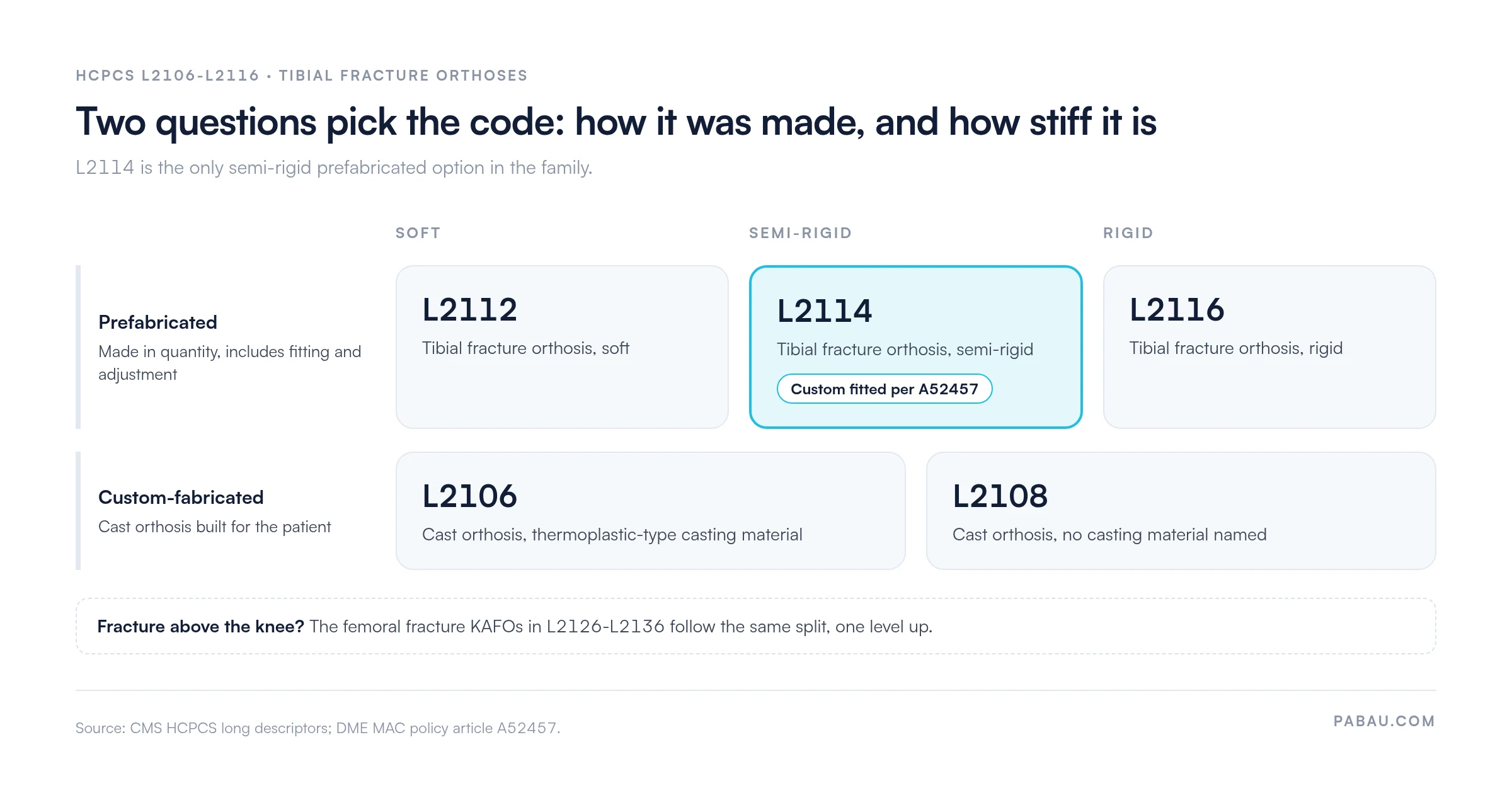
Its siblings differ by stiffness and fabrication. L2112 is the soft version and L2116 the rigid one, while L2106 and L2108 are custom-fabricated cast orthoses. Medicare covers L2114 under LCD L33686, and its policy article codes it as custom fitted, so the fitting notes must show more than minimal self-adjustment.
Let Pabau's smart automation suggest the right codes, reduce claim denials, and keep your practice compliant—effortlessly.
Automate repetitive tasks and focus on what matters most—your patients.
Reduce coding errors and ensure compliance with the latest regulations.
Clean claims, fewer denials, and faster reimbursements.
Powerful insights and reporting to help your practice thrive.
HIPAA compliant SOC 2 certified GDPR-compliant Trusted by 4,000+ clinics worldwide

HCPCS code L2114 is a prefabricated, semi-rigid tibial fracture orthosis, and its descriptor includes fitting and adjustment at delivery.
Its siblings differ by stiffness and fabrication. L2112 is soft, L2116 is rigid, and L2106 and L2108 are custom-fabricated cast orthoses.
Medicare’s policy article codes L2114 as custom fitted, so the supplier’s notes must describe modifications beyond minimal self-adjustment.
Policy article A52457 lists no diagnosis codes for L2114, so coverage rests on the functional criteria in LCD L33686.
Every claim line needs KX, GA or GZ plus RT or LT, and bilateral orthoses go on two lines of one unit each.
HCPCS code L2114 is the code for a prefabricated, semi-rigid tibial fracture orthosis, including the fitting and adjustment done at delivery. It is a ready-made ankle-foot orthosis (AFO) that stabilizes a healing tibia while the patient walks.
The Centers for Medicare and Medicaid Services (CMS) maintains it in the L-series of HCPCS Level II codes, the series for orthotic and prosthetic devices.
Two words in the descriptor decide the code. “Semi-rigid” places the device between the soft L2112 and the rigid L2116. “Prefabricated” means it was made in quantity rather than built from a cast of the patient’s leg, which would point to L2106 or L2108.
The CMS HCPCS file gives the long descriptor as: Ankle foot orthosis, fracture orthosis, tibial fracture orthosis, semi-rigid, prefabricated, includes fitting and adjustment. Each term narrows the device a little further.
The descriptor does not end in “each”, and no unit wording appears in it. In practice one unit equals one orthosis for one leg. Policy article A52457 asks for each side on its own claim line, with one unit of service.
Medicare splits prefabricated orthoses into off-the-shelf (OTS) and custom-fitted items. The difference is how much adjustment the device needs at delivery. Policy article A52457 lists L2114 among the codes for items that need more than minimal self-adjustment by a qualified practitioner.
L2114 has no OTS twin, so the supplier’s record has to show that a trained fitter did the work. Minimal self-adjustment means changes the patient or a caregiver could make, such as tightening straps or trimming for comfort. If the notes describe only that, Medicare denies the claim as incorrect coding.
L2114 covers the semi-rigid prefabricated tibial fracture orthosis and the fitting and adjustment provided when it is dispensed. It does not cover a custom-fabricated cast orthosis, a soft or rigid version of the same device, or a knee-ankle-foot orthosis.
The L2106-L2116 range covers AFO fracture orthoses for the tibia. The codes differ on two axes, stiffness and fabrication method. The femoral fracture orthoses in L2126-L2136 follow the same pattern one level up, as knee-ankle-foot orthoses (KAFOs).
When a device sits close to a boundary, check the current long descriptors in the CMS HCPCS quarterly file rather than a third-party lookup.
Record the stiffness and the fabrication method in the fitting note, in the same words the descriptor uses. A note that says semi-rigid and prefabricated answers the two questions a reviewer asks about an L2114 claim.
Medicare Part B covers L2114 as an orthotic device under LCD L33686, the Ankle-Foot/Knee-Ankle-Foot Orthosis LCD. The LCD lists L2114 among the AFOs covered for ambulatory patients with weakness or deformity of the foot and ankle.
If these basic criteria are not met, the LCD denies the orthosis as not reasonable and necessary. Medicare pays the enrolled DMEPOS supplier, and the patient owes the Part B deductible plus 20% coinsurance.
Payment comes from the DMEPOS fee schedule, which CMS updates each January with quarterly revisions. Look up the current L2114 amount for your state on the CMS DMEPOS fee schedule page before you quote a patient’s share.
Two documents govern L2114, and both come from the DME Medicare Administrative Contractors (MACs). LCD L33686 sets the medical necessity criteria. Policy article A52457 sets the coding rules, the modifier rules and the custom-fitted definitions.
The LCD also sets a higher bar for custom-fabricated AFOs. One qualifying reason is a healing fracture that lacks normal anatomical integrity or proportions. If the patient fits a prefabricated device, the record should say so, because that is what supports L2114 over L2106 or L2108.
Policy article A52457 lists covered diagnosis codes only for L4392, L4396, L4397 and L4631. For every other code in the policy, L2114 included, it states that diagnoses are not specified. Coverage therefore rests on the functional criteria above, not on a diagnosis list.
The claim still needs the diagnosis that explains the orthosis, and for L2114 that is usually a tibial fracture. The categories below are common examples from ICD-10-CM. They are not a CMS list.
S82 codes take a 7th character for the encounter. A, B and C mark initial care, D through J subsequent care, K, M and N nonunion, P, Q and R malunion, and S sequela. Code the encounter the record describes, at the most specific level it supports.
An L2114 claim is only as strong as the file behind it. Build that file before the orthosis is dispensed, not after a denial arrives. Good medical billing compliance from the start protects the practice in a later audit.
Traditional Medicare does not require prior authorization for L2114. The code is not on the CMS Required Prior Authorization List as updated on July 29, 2026. It is not on the probationary list for newly enrolled suppliers either. Medicare Advantage, Medicaid and commercial plans set their own rules. Insurance eligibility verification should include a check for orthotic prior authorization.
When a plan does require approval, send the order, the clinical notes on the fracture and function, the ICD-10 code and the device details. Sending all four in the first request avoids a round of follow-up questions.
L2114 claims fail for predictable reasons, and most of them are visible before submission. Sound denial management starts with coding accuracy and documentation discipline, not with appeals.
Policy article A52457 sets the modifier rules for AFO base codes, including L2114. Check the current version on the CMS coverage database before you submit.
Most L2114 denials trace back to paperwork held in different places. The order sits in an inbox, the fitting note is on paper, and the delivery record is a scanned form. When a reviewer asks for the file, someone has to rebuild it.
In Pabau, the practice software we build, that file lives on one patient record. Digital forms capture the fitting note and the patient’s signature at delivery, next to the order and the clinical notes. The fitting form can ask for stiffness, fabrication method and the modifications made, so every note answers a reviewer’s first questions.
Pabau’s claims management software then pre-fills the claim from the data already on that record and tracks its status after submission. The coding decisions stay with your team. The clean claim rests on a complete record, and Pabau keeps the record complete and easy to find.

Pabau keeps the order, fitting note and signed delivery record on one patient file, then pre-fills and tracks the claim from that data.

L2114 is a narrow code, and the claims that fail usually fail on that narrowness. The device has to be semi-rigid, prefabricated and fitted by someone qualified, and the record has to say all three. Get those right and the modifier and laterality rules are routine.
Before the next fitting, check that your note template asks for stiffness, fabrication method and the modifications made. That one change protects more claims than any appeal. Book a demo to see how Pabau keeps your orthotic records and claims in one place.

Need a cleaner claims workflow? Clean claim best practices covers the documentation and modifier standards that prevent first-submission denials across DMEPOS billing.
Handling claim denials after submission? Denial management in healthcare explains the appeals process and how to reduce denial rates systematically.
Want to verify eligibility before dispensing? Insurance eligibility verification outlines how to confirm coverage and prior authorization status before a device is supplied.
Is the device rigid rather than semi-rigid? HCPCS code L2116 covers the rigid prefabricated tibial fracture orthosis and how to document it.
Was the orthosis cast for the patient? HCPCS code L2106 explains the custom-fabricated thermoplastic cast orthosis and its extra coverage criteria.
HCPCS code L2114 describes a prefabricated, semi-rigid tibial fracture orthosis, including fitting and adjustment at delivery. It is an ankle-foot orthosis that stabilizes a healing tibia. Medicare covers it as an orthotic device under LCD L33686.
Yes, when LCD L33686 criteria are met. The patient must be ambulatory, have weakness or deformity of the foot and ankle, need stabilization and be able to benefit functionally. An enrolled DMEPOS supplier bills it with KX, GA or GZ and RT or LT.
The supplier needs a completed Standard Written Order before billing, the treating practitioner’s records, fitting notes and proof of delivery. The fitting notes must describe modifications beyond minimal self-adjustment.
All three are prefabricated tibial fracture orthoses, and they differ by stiffness. L2112 is soft, L2114 is semi-rigid and L2116 is rigid. Each includes fitting and adjustment at delivery.
L2114 is prefabricated, while L2106 is a tibial fracture cast orthosis custom-fabricated from thermoplastic casting material. L2108 is the other custom-fabricated cast orthosis. Medicare covers a custom-fabricated AFO only when the LCD’s extra criteria are met.
Traditional Medicare does not require prior authorization for L2114. The code is not on the CMS Required Prior Authorization List as updated on July 29, 2026. Medicare Advantage, Medicaid and commercial plans set their own rules, so check the plan first.
Policy article A52457 lists no covered diagnosis codes for L2114. Coverage rests on the LCD’s functional criteria. The claim still carries the diagnosis that explains the orthosis, usually a tibial fracture code from S82.1- to S82.3-, S82.5- or S82.87-.