

HCPCS code E0198: Water pressure pad billing guide
HCPCS code E0198 is a water pad for a standard mattress HCPCS code E0198 is the ...

Last Updated: Oct 13, 2026
L2106 is the HCPCS Level II code for ankle foot orthosis, fracture orthosis, tibial fracture cast orthosis, thermoplastic type casting material, custom fabricated.
Coders regularly confuse L2106 with the adjacent codes L2108, L2112, and L2114 because the descriptors share so much language. The differences that matter are the casting material and whether the orthosis was custom fabricated or supplied off the shelf. Getting either one wrong is a common cause of denied DME claims.
Let Pabau's smart automation suggest the right codes, reduce claim denials, and keep your practice compliant—effortlessly.
Automate repetitive tasks and focus on what matters most—your patients.
Reduce coding errors and ensure compliance with the latest regulations.
Clean claims, fewer denials, and faster reimbursements.
Powerful insights and reporting to help your practice thrive.
HIPAA compliant SOC 2 certified GDPR-compliant Trusted by 4,000+ clinics worldwide

HCPCS code L2106 describes a custom-fabricated ankle-foot fracture orthosis made from thermoplastic casting material over a patient-specific model.
L2112, L2114, and L2116 are the prefabricated tibial fracture orthoses. L2108 is custom fabricated but names no casting material.
Medicare Part B covers L2106 under the DME benefit when a valid written order and supporting ICD-10 diagnosis are on file before device delivery.
LT or RT modifiers are required on every L2106 claim; missing laterality modifiers are among the top denial triggers for this code.
Practice management software like Pabau helps DME suppliers track documentation checklists and modifier requirements to reduce L2106 denials before submission.
HCPCS code L2106 is the Level II billing code for a custom-fabricated tibial fracture cast orthosis. Specifically, the full descriptor reads: ankle foot orthosis, fracture orthosis, tibial fracture cast orthosis, thermoplastic type casting material, custom fabricated. Three parts of that wording decide whether the code is correct:
Custom fabrication is the part suppliers get wrong most often. A stock brace pulled from inventory and fitted to the patient belongs to a different code. Ultimately, deciding that at intake, rather than at the claim stage, is what keeps the L2106 line payable.
L2106 covers a narrow device category. Getting the inclusions and exclusions right before billing prevents the most common miscoding errors on ankle fracture claims.
The tibial fracture orthosis L-codes are where miscoding happens most often. Together, all five describe the same anatomical region. The table below shows what separates them, so suppliers can select the correct code before billing.
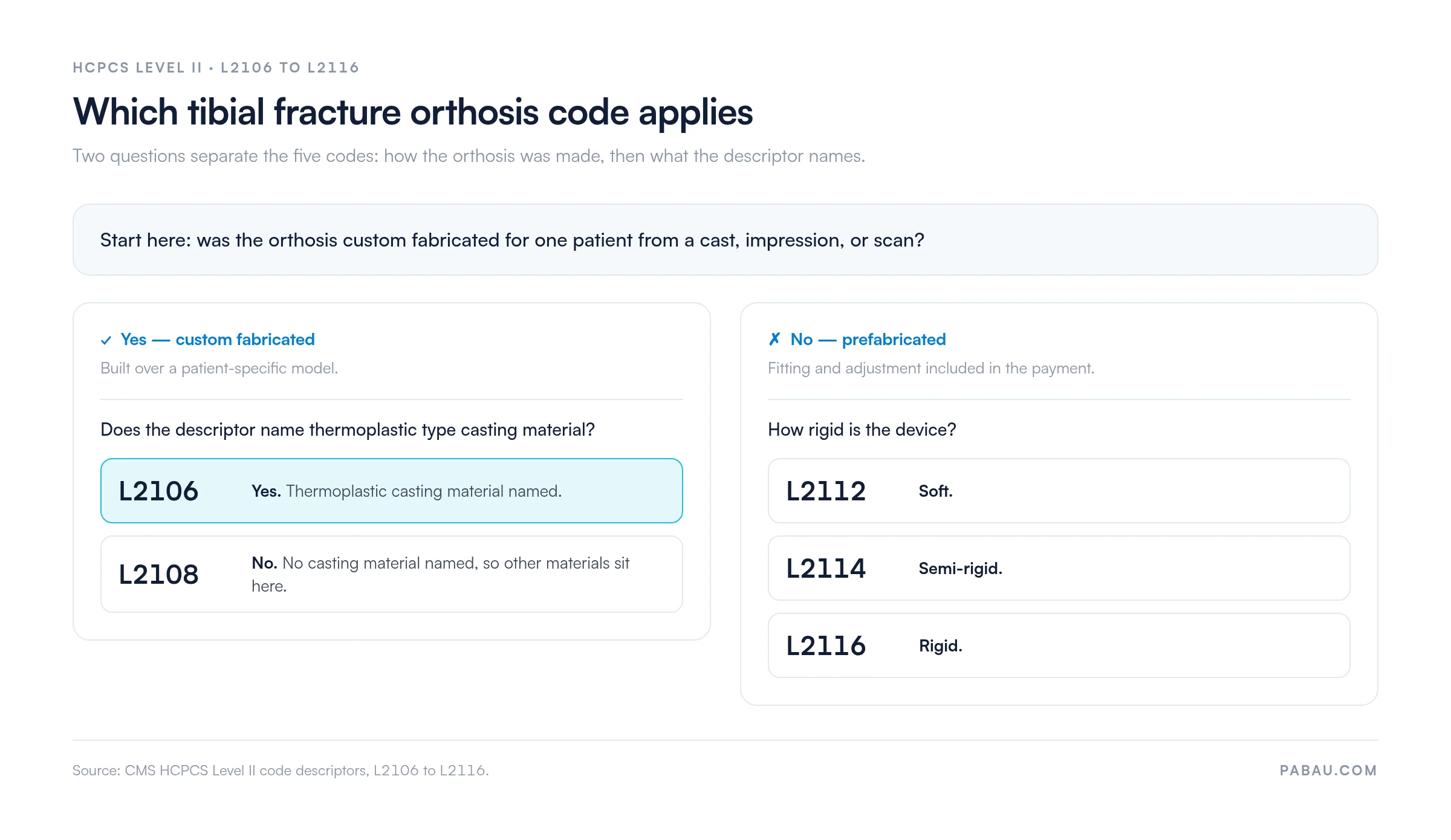
Two distinctions run through this family. The first is fabrication. Suppliers custom-fabricate L2106 and L2108, while L2112, L2114, and L2116 arrive prefabricated, with fitting and adjustment already included in the payment.
The second distinction is what separates the codes on each side of that line. L2106 names thermoplastic casting material and L2108 names none, so L2108 carries custom-fabricated devices built from other materials. Among the prefabricated codes, the choice turns on whether the orthosis is soft, semi-rigid, or rigid. The diagram below runs both questions in order.
In practice, billing L2106 for a stock brace taken off a shelf is a coding error that invites audit scrutiny. Verify the product’s PDAC coding verification or manufacturer documentation before assigning the code.
All five codes in the table above brace the tibia. A femoral fracture needs a knee-ankle-foot orthosis instead, and the semi-rigid prefabricated version of that brace bills under L2134.
Medicare and commercial payers require a supporting ICD-10-CM diagnosis code that establishes medical necessity for a fracture stabilization device. The following codes are the most commonly accepted pairings for HCPCS code L2106 claims.
Local Coverage Determinations (LCDs) from individual MAC contractors may expand or restrict this list. Confirm coverage rules against the applicable LCD before billing.
Practices ordering or coordinating orthotic devices should confirm the physician-assigned ICD-10 code before the supplier bills. That avoids a mismatch between the referring diagnosis and the submitted claim. Our ICD-10 reference for billers carries the full fracture code set. Diagnosis codes tied to non-fracture conditions, such as neurological foot drop, do not support L2106 and will trigger automatic denial.
Medicare Part B covers L2106 under the durable medical equipment benefit when two conditions hold. The claim must document medical necessity, and the billing supplier must hold Medicare DMEPOS enrollment.
Verifying the patient’s benefits before device delivery is the first checkpoint every DME supplier should build into their workflow. Key coverage conditions include:
Keep compliance records for every L2106 transaction, including the supplier enrollment certificate and the assignment documentation. MAC auditors ask for both.
Before delivering an L2106 device to a Medicare beneficiary, confirm two things. The supplier’s DMEPOS number must be active, and the fabrication records must show the orthosis was made for this patient. Delivering first and documenting afterwards is a leading cause of rejections that cannot be appealed on medical necessity grounds.
CMS requires a complete documentation trail before a supplier submits an L2106 claim. In short, missing any of these elements is grounds for denial. Suppliers cannot repair a delivery that preceded the written order.
Store these records somewhere access-controlled, so the documentation stays both clinically accurate and protected. Suppliers using a practice management platform with an integrated billing module can build pre-submission checklists that surface missing documentation before the claim goes out.
Modifier selection on L2106 claims is one of the most audited elements in orthosis billing. The table below covers every modifier a supplier may need, with the consequence of omitting each one.
For bilateral fractures, bill L2106 twice on separate claim lines, one with LT and one with RT. Do not use a single line with a quantity of 2, as most payers reject that format for orthosis codes.
The DMEPOS supplier submits L2106 claims on the CMS-1500 claim form (or the electronic 837P transaction). Physicians do not bill L2106; the supplier who provides the device holds the billing responsibility. A submission process that captures every required element up front reduces the back-and-forth with payers. Key submission points include:
Tracking the electronic remittance advice for each L2106 submission shows patterns in payer adjustments. Reading those codes after every remittance cycle surfaces widespread problems before they become a denial backlog.
Submitting a clean claim from the start is the most reliable way to get paid on the first pass. That means correct modifiers, a valid written order on file, and a matched ICD-10 code.
L2106 denials cluster around a short, predictable list of documentation failures, so a working denial management process pays off on orthosis codes.
From there, sorting denial patterns by code shows a billing team which root cause drives the most write-offs. Pabau’s claims software for suppliers lets DME teams build pre-submission checks that flag a missing modifier or unsigned order before the claim reaches the payer.
Run a monthly denial audit filtered by HCPCS code L2106 and sort by denial reason code. If laterality modifier denials appear in the top three, update your billing software claim template. Require LT or RT before the claim can be saved. One workflow change eliminates an entire denial category.
Most orthotics suppliers track L2106 evidence across three places. The written order sits in one system, the casting and delivery records sit in another, and staff key the claim into a third. An unsigned order at delivery then surfaces weeks later, on a remittance advice.
Practice management software like Pabau keeps the order, the clinical note, the delivery record, and the claim on one patient file. Billing staff can check that the practitioner signed the order before the delivery date without opening a second system.
Fewer L2106 claims then leave the practice with a missing modifier or an unsigned order behind them. When a denial does arrive, the supporting records are already attached to the patient it belongs to.

Pabau’s claims management software helps DME suppliers and orthotics practices track documentation requirements, apply correct modifiers, and submit cleaner claims. Fewer L2106 bills then come back denied.

Billing L2106 accurately comes down to three checks. First, the device must be a custom-fabricated thermoplastic tibial fracture orthosis. The documentation trail must be complete before delivery, and the correct modifiers must appear on every claim line.
The most avoidable denials are missing laterality modifiers, absent written orders, and non-covered diagnoses. Workflow controls stop all three before submission, which costs far less than appealing after the fact.
Pabau’s claims tools help orthotics and DME suppliers build those controls into the billing process. Errors then get caught before submission rather than after. To see how the platform handles documentation checklists and modifier validation, book a demo with the team.

Need help understanding HCPCS billing errors? Denial management in healthcare covers the full denial lifecycle and how to build an effective appeals workflow.
Want to improve first-pass claim acceptance? Submitting a clean claim explains every element a payer checks before processing a DME or orthotics claim.
Looking for a broader billing compliance framework? Medical billing compliance outlines the audit risk areas CMS and MAC contractors prioritize for DME suppliers.
HCPCS code L2106 covers a custom-fabricated ankle-foot orthosis for tibial fracture management. The orthosis is built for one patient from thermoplastic type casting material. It does not cover off-the-shelf braces, surgical boots, or AFOs used for neurological conditions rather than fractures.
L2106 is custom fabricated. The official HCPCS descriptor ends with the words custom fabricated, so a stock orthosis selected from inventory cannot be billed under this code. The prefabricated tibial fracture orthoses are L2112, L2114, and L2116.
LT (left) or RT (right) is required on every L2106 claim to indicate laterality. KX confirms LCD medical necessity criteria are met for Medicare claims. GA is used when an Advance Beneficiary Notice is on file, GY for non-covered items, and NU for new equipment purchased by the patient.
Yes, CMS requires a written order from the treating practitioner before the device is delivered to the patient. The order must be signed and dated before delivery. An order obtained after delivery, or one missing the practitioner’s signature, voids the claim and cannot be corrected retroactively.
The most frequent L2106 denial reasons are a missing or unsigned written order and an absent LT or RT laterality modifier. A non-covered ICD-10 diagnosis code, a missing KX modifier, and delivery before the order date also appear often. Most denials are preventable with a pre-delivery documentation checklist that verifies code assignment before submission.



