

HCPCS code E0198: Water pressure pad billing guide
HCPCS code E0198 is a water pad for a standard mattress HCPCS code E0198 is the ...

Last Updated: Oct 13, 2026
L2116 is the HCPCS Level II code for ankle foot orthosis, fracture orthosis, tibial fracture orthosis, rigid, prefabricated, includes fitting and adjustment. The descriptor covers the prefabricated device together with the fitting and adjustment performed at delivery.
The code sits in the L-code series that the Centers for Medicare and Medicaid Services (CMS) maintains for orthotics and prosthetics. Most denials trace back to three fixable errors. The physician order omits the fracture diagnosis, the proof of delivery is missing, or the device was never verified against the PDAC list.
Let Pabau's smart automation suggest the right codes, reduce claim denials, and keep your practice compliant—effortlessly.
Automate repetitive tasks and focus on what matters most—your patients.
Reduce coding errors and ensure compliance with the latest regulations.
Clean claims, fewer denials, and faster reimbursements.
Powerful insights and reporting to help your practice thrive.
HIPAA compliant SOC 2 certified GDPR-compliant Trusted by 4,000+ clinics worldwide

HCPCS Code L2116 covers a rigid, prefabricated tibial fracture orthosis, and its descriptor includes the fitting and adjustment done at delivery.
Medicare covers L2116 under the DME benefit when a compliant physician order, a fracture diagnosis, and proof of delivery are on file before submission.
L2116 is prefabricated, yet Medicare still classifies it as custom fitted rather than off-the-shelf, so PDAC verification and modifier accuracy both apply.
Practice management software like Pabau helps DME suppliers and orthotists track documentation checklists and submit clean claims across payers.
HCPCS Code L2116 describes a rigid, prefabricated ankle foot orthosis dispensed as a fracture orthosis for tibial fractures. The code pays for the device together with the fitting and adjustment the supplier performs at delivery. The table below captures the classification details billers and orthotists need before submitting a claim.
The word custom carries two meanings on this code, and confusing them is a common source of denials. The official descriptor calls L2116 prefabricated, so the device is manufactured in advance rather than built for one patient.
Medicare Policy Article A52457 still classifies L2112, L2114, and L2116 as custom fitted rather than off-the-shelf. Fitting them takes more than minimal self-adjustment by the patient. Confirm your device model against PDAC coding verification guidance before you bill. Coding a device at the wrong fabrication level is one of the most audited errors in orthotic billing.
L2116 applies when a patient presents with a tibial fracture that needs rigid lower-leg immobilization from an ankle foot orthosis. This is a fracture-specific code, and a general AFO dispensed for another condition belongs elsewhere in the L-code series.
The device covered by L2116 differs from a standard walking boot (CAM boot), and the difference changes the code. Walking boots have their own HCPCS codes, such as L4360, L4361, L4386, and L4387. Those codes split on whether the boot is pneumatic and how much fitting it needs.
L2116 describes a rigid tibial fracture orthosis that the supplier fits and adjusts for the patient. Billing a walking boot under L2116 is a miscoding error that drives denials.
Clinical scenarios that support L2116 billing include:
The prescribing physician’s order must explicitly name the fracture diagnosis and the device type. A generic order for “an AFO” will not satisfy Medicare documentation requirements for L2116. Practices involved in fracture rehabilitation should raise this with the referring provider at the point of referral.
Medicare covers L2116 under the DME benefit when the device is a rigid, prefabricated fracture AFO used for tibial fracture management. The documentation must also be complete. CMS Policy Article A52457 governs coverage of ankle-foot and knee-ankle-foot orthoses broadly. The device must be reasonable and necessary for the patient’s condition.
Included in the L2116 code:
Not included or separately coded:
Which KAFO code applies turns on the fracture site and the fabrication method. For a femoral fracture, the custom-fabricated cast orthosis is L2128. A prefabricated semi-rigid brace for the same fracture bills under L2134 instead.
Commercial payers may follow Medicare rules or apply their own coverage criteria, so verify with the specific payer before dispensing. Using claims management software that surfaces payer rules at claim creation stops a technically clean claim from going out against the wrong policy.
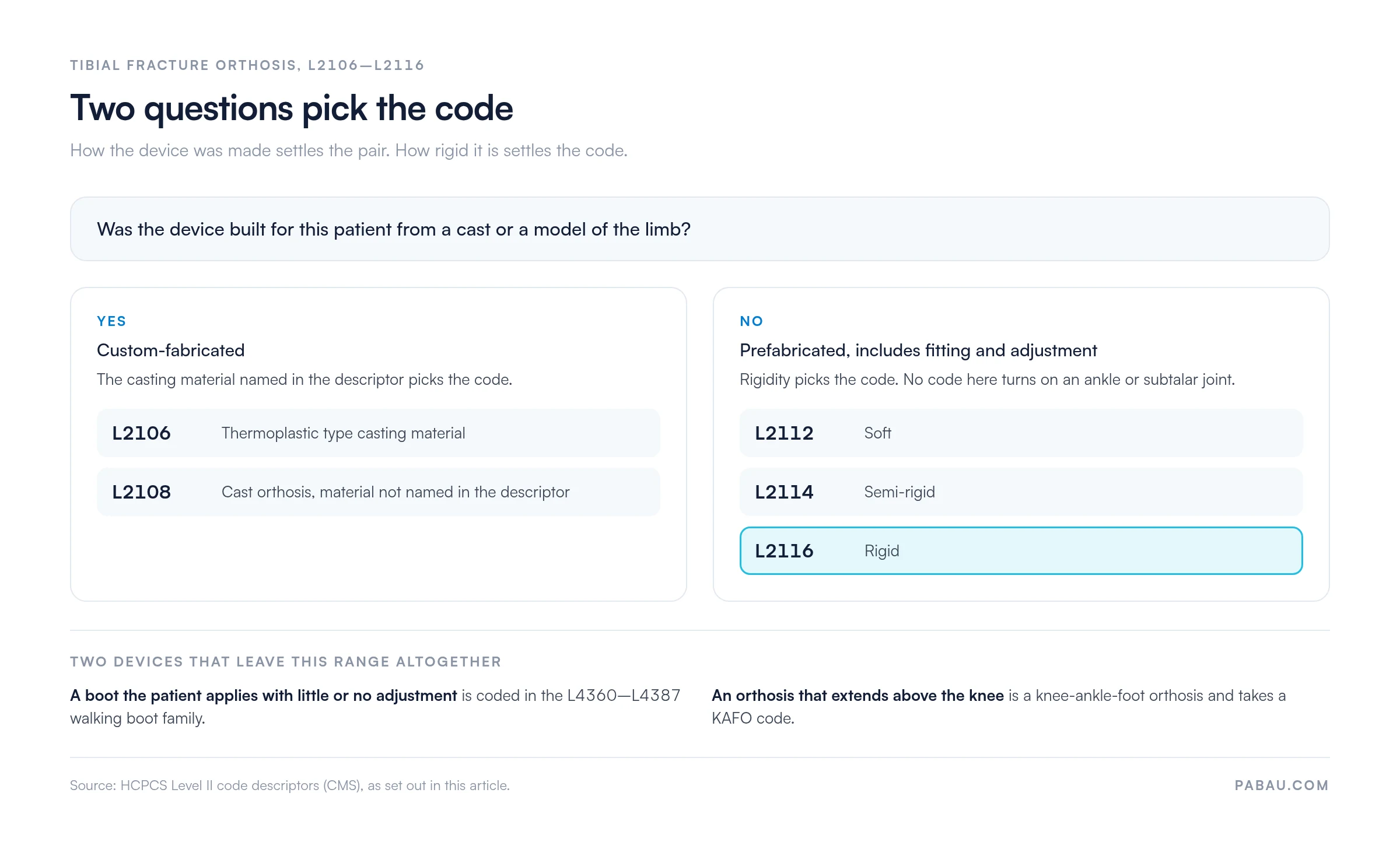
The L2106-L2116 range covers tibial fracture orthoses only. The fabrication method and the rigidity of the finished device separate the codes inside it. Selecting the wrong one is the most common coding error for tibial fracture orthotics, so the table below sets the official descriptors side by side.
L2106 and L2108 are the custom-fabricated codes, built for one patient from a cast or a model of the limb. L2112, L2114, and L2116 are prefabricated devices, separated only by rigidity. Soft is L2112, semi-rigid is L2114, and rigid is L2116.
No code in this family turns on whether the orthosis carries an ankle or subtalar joint, so never choose between them on that basis. Check the full descriptor text at the AAPC HCPCS code lookup before you select one. The chart below runs the same two questions in the order a coder asks them.
Medicare covers HCPCS Code L2116 under the Part B DME benefit. The claim is submitted by the orthotist or DME supplier, not the physician. Coverage requires that the device is medically necessary, documented by a compliant written order, and delivered to the patient before the claim date.
Key Medicare coverage requirements:
Noridian Medicare (DME MAC Jurisdiction D) has historically published specific policy on walking boots and AFOs. The Noridian article referenced in some online resources is marked retired, so always retrieve the current LCD from your MAC’s website.
Commercial payers follow their own coverage policies, which may diverge from Medicare. Verify payer-specific rules before each claim rather than once a year.
Medicare reimbursement for L2116 is set through the DMEPOS fee schedule, updated annually by CMS. Allowed amounts vary by geographic payment locality and are adjusted each January.
Because rates change each calendar year and vary by locality, this article does not publish specific dollar figures. A reimbursement amount that has since been updated creates compliance risk for anyone relying on the figure.
Verify the current allowed amount through the CMS DMEPOS fee schedule lookup tool. It searches by HCPCS code, year, and geographic locality.
Points to verify on the fee schedule lookup:
Run your L2116 claims through a fee schedule lookup before submitting each quarter. CMS publishes quarterly updates when rates change outside of the annual cycle. Tracking your expected allowed amount against posted remittances is the fastest way to catch underpayments before they age beyond the timely filing window.
Incomplete documentation is the top driver of L2116 denials. Every item below must be in the patient file before the claim is submitted, not gathered after a denial.
A pre-billing checklist keeps any claim from leaving the practice before every document is confirmed. A missing POD alone will cause Medicare to recover payment on audit, even if the device was legitimately prescribed and delivered. Treat each item as a gate the claim has to pass, rather than paperwork to assemble after the fact.

L2116 requires a tibial fracture diagnosis code to establish medical necessity. The correct ICD-10-CM code comes from the S82 category, fracture of lower leg including ankle. It must carry the correct laterality and the correct 7th character.
Always use the most specific code the documentation supports. Submitting an unspecified code when the chart documents laterality and fracture location is an overcoding risk. The 7th character for initial encounter (A) is appropriate when the orthosis is dispensed during active fracture treatment; subsequent encounter (D) applies for follow-up visits. Verify the correct S82 subcategory against official ICD-10-CM coding guidelines for the S82 category.
Denials on L2116 follow a short list of patterns, and pre-submission checks prevent most of them.
The most frequent denial reasons are:
A pre-billing checklist catches these errors before submission. Two of them, a missing POD and the wrong modifier, are the cheapest to prevent and the most common to appeal. The medical billing denial codes on your remittance advice show which of the seven above your practice keeps hitting.
Correct modifier assignment is not optional on HCPCS orthotic claims. Medicare uses modifiers to verify that the claim meets coverage requirements and that the device was delivered to the correct side. The table below covers the modifiers most commonly applied to L2116.
RT and LT are required on every orthotic claim line. KX is required when documentation supports coverage; if you are not confident the documentation is complete, do not append KX. Appending KX without adequate documentation constitutes a false attestation.
These practical steps reduce L2116 denial rates for practices that dispense fracture orthotics regularly:
Practices with a strong clean-claim rate on DME codes treat each L2116 claim as a documentation audit rather than a billing task. Applying the same standard across the whole team is what reduces recovery risk on post-payment audits.
Build a code-specific checklist for L2116 and post it at your dispensing station. Include seven checks. Confirm the written order, the fracture ICD-10, and that the device matches the code billed. Then confirm PDAC status, the fitting and delivery dates, the signed POD, and the laterality modifier. A 60-second review before submitting catches the errors that cost practices hours in appeals.
An L2116 claim is usually assembled from four places. The written order sits in the chart and the fitting note sits with the orthotist. The signed delivery receipt sits in a folder, and the PDAC confirmation sits in somebody’s inbox.
Pulling that trail together after a denial takes far longer than capturing it at delivery. Practice management software like Pabau keeps the order, the fitting note, the signed proof of delivery, and the claim on one patient record.
Staff work from a checklist while the patient is still in front of them, rather than from a reminder that arrives with the remittance advice.
Claims then leave the practice with the documentation already confirmed and the modifiers checked against the device that was dispensed. When a denial does arrive, the record that caused it is easy to trace, so the appeal starts from evidence instead of a search.

Pabau’s claims management tools help orthotists and DME suppliers build pre-billing checklists, track proof of delivery, and submit clean claims across Medicare and commercial payers.

HCPCS Code L2116 covers one device in one situation, a rigid, prefabricated tibial fracture orthosis that the supplier fits and adjusts at delivery. The coding logic is narrow, and the documentation is where most claims fail.
A compliant written order, the correct tibial fracture ICD-10 code, and a signed proof of delivery resolve most denial patterns before they happen. Verified modifier selection handles the rest.
Pabau helps DME suppliers and orthotists track documentation completeness against payer requirements and submit clean claims the first time. To see how Pabau handles orthotic and DME billing workflows, book a demo with the team.

Need to understand denial recovery for DME claims? Denial management in healthcare covers systematic workflows for appealing and preventing claim rejections across payer types.
Looking to strengthen your overall billing compliance posture? Medical billing compliance outlines the documentation and audit practices that protect DME practices during post-payment reviews.
Want to understand how revenue cycle management applies to orthotic billing? Revenue cycle management explains how claim submission, payment posting, and denial resolution connect across the full billing lifecycle.
HCPCS Code L2116 covers a rigid, prefabricated ankle foot orthosis used as a fracture orthosis for tibial fractures. The descriptor also covers the fitting and adjustment carried out at delivery. Replacement components, non-fracture AFOs, and walking boots are billed under separate codes.
Yes, Medicare covers L2116 under the Part B DME benefit. The device must be medically necessary, the physician order must be on file before dispensing, and the patient must have a documented tibial fracture. Proof of delivery is also required, and the KX modifier confirms the documentation requirements are met.
L2116 is a prefabricated code. Its official descriptor reads rigid, prefabricated, includes fitting and adjustment, so the device is made in advance rather than built for one patient. Medicare still classifies it as custom fitted rather than off-the-shelf, because fitting it takes more than minimal self-adjustment. Check the current PDAC classification for your device model before billing.
Prior authorization requirements for L2116 vary by MAC jurisdiction and commercial payer. Medicare does not have a universal prior authorization requirement for L2116, but individual MACs may apply one under their local coverage determination. Always check your MAC’s current LCD and verify commercial payer rules before dispensing the device.



