CCSD code H4430: Examination of rectum under anaesthetic
CCSD code H4430 pays for the examination alone CCSD code H4430 is the UK private...

Last Updated: Oct 20, 2026
L1730 is the HCPCS Level II code for a legg perthes orthosis, (scottish rite type), custom fabricated. It covers a custom-fabricated hip abduction brace that holds the femoral head inside the acetabulum during Legg-Calvé-Perthes disease.
The code sits on the CMS DMEPOS Master List, so conditions of payment apply. Claims pair it with a diagnosis code from the M91 series. The written order has to exist before the brace is delivered.
Let Pabau's smart automation suggest the right codes, reduce claim denials, and keep your practice compliant—effortlessly.
Automate repetitive tasks and focus on what matters most—your patients.
Reduce coding errors and ensure compliance with the latest regulations.
Clean claims, fewer denials, and faster reimbursements.
Powerful insights and reporting to help your practice thrive.
HIPAA compliant SOC 2 certified GDPR-compliant Trusted by 4,000+ clinics worldwide

HCPCS code L1730 bills a custom-fabricated Scottish Rite Legg-Perthes orthosis for pediatric hip containment.
A written order must be signed and dated before the brace is delivered, or the claim loses its basis for payment.
Valid diagnosis pairings sit in the M91 series, and a laterality-specific code is expected once imaging names the affected hip.
L1730 appears on the CMS DMEPOS Master List, so conditions of payment and closer documentation review apply.
Every code from L1700 to L1755 is custom fabricated, so the brace design decides which one you bill.
HCPCS code L1730 is the Level II code for a Legg-Perthes orthosis of the Scottish Rite type, custom fabricated.
The brace holds the femoral head inside the acetabulum while a child recovers from Legg-Calvé-Perthes disease. It sits in the L-code series of the CMS HCPCS Level II system. Payers handle it as Durable Medical Equipment, Prosthetics, Orthotics, and Supplies, known as DMEPOS.
The design is what the code describes. A Scottish Rite orthosis uses a pelvic band and two thigh cuffs joined by a swivel bar. That setup abducts both hips while the child keeps walking. Fit a different Legg-Perthes brace and L1730 becomes the wrong code, even though the diagnosis has not changed.
A patten-bottom brace is one such design. It shifts weight off the hip and bills under L1755, not L1730.
One point is worth correcting early. Older billing notes describe L1730 as custom fitted, which the official descriptor contradicts. Every Legg-Perthes code in the L1700-L1755 range is custom fabricated, so fabrication method never separates them.
Legg-Calvé-Perthes disease interrupts the blood supply to the femoral head in a growing child. The bone softens, then remodels as that supply returns.
Treatment aims to keep the femoral head seated in the acetabulum through the remodeling, so it heals round rather than flattened. The condition mostly shows up between ages 4 and 10, and affects boys around four times as often as girls.
Older containment methods used a hip spica cast, which stops the child moving. The Scottish Rite design abducts both hips instead and leaves the legs free to swing. Children stay mobile, so they are far more likely to wear the brace as prescribed.
That clinical goal is also the billing argument. Medical necessity notes have to name the containment aim, the stage of disease, and why an ambulatory brace beats the alternatives. A note that records only the diagnosis leaves the reviewer nothing to approve.
Medicare pays L1730 from the DMEPOS fee schedule, which CMS updates every January 1. The Physician Fee Schedule does not carry orthotic L-codes, so a search there returns nothing.
Pull the current allowable from the CMS DMEPOS fee schedule files for your Medicare Administrative Contractor (MAC) jurisdiction.
Four things shape what you are actually paid:
Medicaid matters more than Medicare here. Legg-Calvé-Perthes disease is a pediatric condition, so most L1730 claims go to a state Medicaid program or a commercial plan.
Coverage rules and rates vary by state, and some programs ask for approval up front. Confirm the policy with the plan before the brace is fabricated, not after.
The crosswalk is narrow. Valid pairings sit in the M91 series, which covers juvenile osteochondrosis of the hip and pelvis. Anything outside that series will not support the device, and it is the quickest route to a first-pass denial.
Laterality is where most of these claims trip. Billing M91.10 when imaging already named the affected hip invites a review. Some MACs treat a laterality-specific code as a condition of payment. Take the side from the radiology report and the physician order, then code it.
Bilateral disease is less common, but it happens. One Scottish Rite brace addresses both hips, so the claim still carries a single unit. Document the bilateral involvement in the record, and check how your MAC wants both sides reported.
L1730 appears on the CMS DMEPOS Master List. Reviewers therefore ask for the file more often than they do on ordinary codes. The claim itself is a few lines. The record behind it is what gets paid, or recovered.
Here is how one claim moves, and the record each stage has to leave behind.
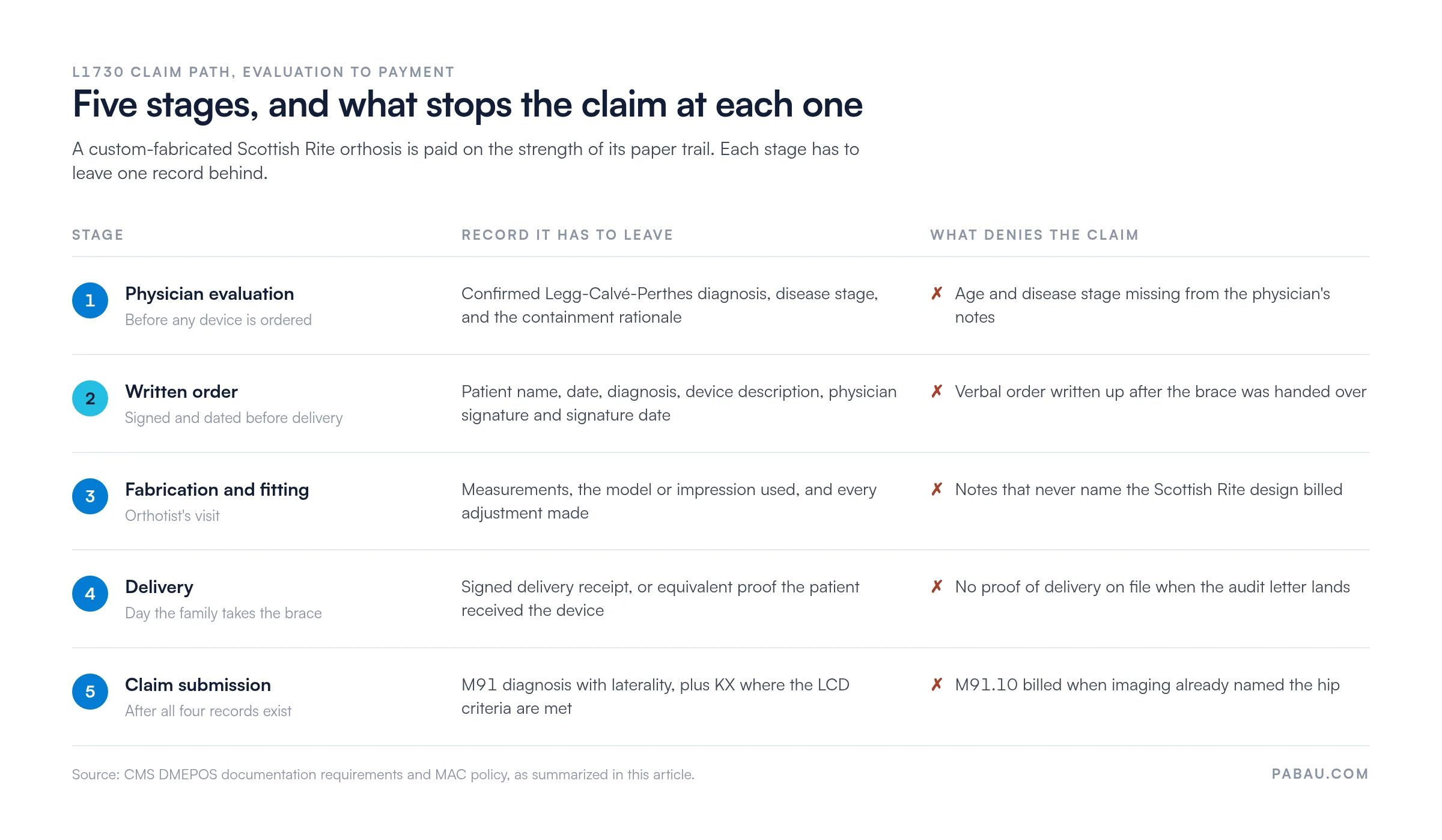
In practice, that means six documents in the patient file:
Coverage policies build medical necessity for L1730 around three points. The child has a confirmed Legg-Calvé-Perthes diagnosis. The disease is at a stage where containment is indicated. The child is ambulatory, so a brace suits better than casting or surgery.
Age and disease stage are the two details most often missing when a denial cites medical necessity. Both belong in the physician’s note, not the orthotist’s. Local Coverage Determination wording also differs across CGS, Palmetto GBA, Novitas, NGS, Noridian, and First Coast, so read your own.
Some DMEPOS items need a Written Order Prior to Delivery, known as a WOPD. CMS names them on its face-to-face and written order list, published with the DMEPOS order requirements. That list changes from year to year, so check the current version for your jurisdiction.
Where the requirement applies, delivering the brace before the signed order exists removes the basis for payment. A verbal order written up afterward does not satisfy it. Neither does an order missing the physician’s signature date.
If coverage was uncertain and no Advance Beneficiary Notice, or ABN, was issued, the supplier may also owe the family a refund. Policy wording varies between MACs, so read your own jurisdiction’s article rather than a neighboring one.
Photograph the signed delivery receipt on the day the family collects the brace. Attach it to the patient record before they leave. Receipts filed later are the ones missing when an audit request arrives 18 months on.
Modifier choice on L1730 is short. KX is the one that matters, and it tells Medicare the coverage criteria are documented and on file. Append it where the policy requires it, or expect an automatic denial.
When a claim does deny, the remittance tells you which stage failed. Reading the medical billing denial codes on the response saves a blind resubmission. The CARC and RARC pair names the missing element. Fix that element, then send the claim again.
Most L1730 denials are catchable in about a minute, if someone looks. Work down this list before the claim leaves your system.
The same discipline helps on the family-facing side. A clear superbill gives parents a document they can submit themselves when a plan pays out of network. It carries the code, the diagnosis, the date of service, and the charge, which is what most reimbursement forms ask for.
L1730 appears on the CMS Master List of DMEPOS items potentially subject to conditions of payment. CMS builds that list from codes where documentation problems turn up often enough to justify a closer look.
Being listed does not mean prior authorization applies everywhere. It means a MAC may add pre-payment review, probe audits, or sampling for suppliers with volume in the code. Some jurisdictions have gone further and required prior authorization for specific DMEPOS items, so check your own policy articles.
An ABN is your protection when coverage is genuinely uncertain. Issue it before delivery and keep the signed copy in the patient file. The family can then be billed if the claim denies. Without one, the write-off is yours.
Every code in the L1700-L1755 range treats the same disease. They differ only by device design, which makes the choice a documentation question rather than a clinical one.
All five are custom fabricated, so that phrase never tells you which code to use. Read the fitting note, find the design name, then match it. Billing L1730 for a Toronto brace is a coding error, and it becomes a compliance problem if it pays more.
Orthotic billing usually fails on assembly, not on effort. The order sits in one system and the fitting note in another. The delivery receipt sits in a drawer, and the claim goes out before anyone links them.
Practice management software like Pabau keeps those records against one patient file. Clinical notes, consent, fitting documentation, and delivery confirmation live on the same record the billing team works from. Nobody rebuilds the file from three places when an audit letter arrives.
That record then feeds Pabau’s audit-ready claims management. The claim goes to a clearinghouse with the supporting documentation attached. Pabau pre-fills the form from the record, and it checks the required fields before the claim can send. Modifier choice and diagnosis selection stay with your coders, where they belong.
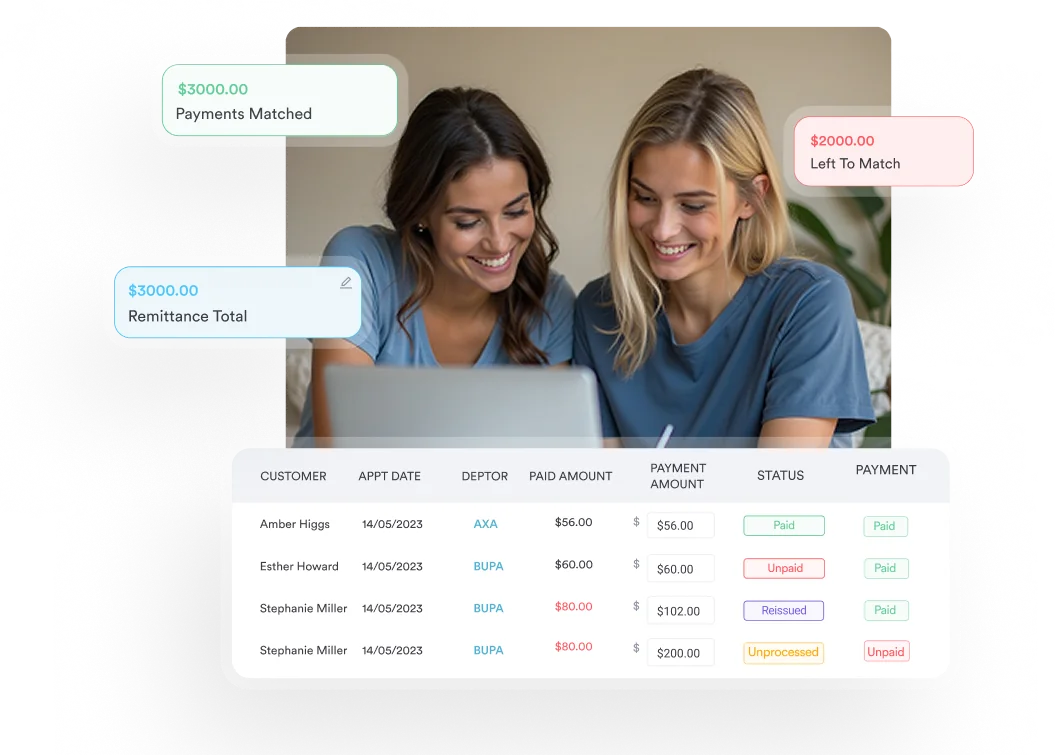
The payoff is ordinary and useful. A reviewer may ask for the file on a claim from 18 months ago. Someone pulls it in a minute instead of a morning.

Pabau holds clinical notes, orders, fitting records, and delivery confirmations on one patient record. The claim then goes out with that documentation attached, so your team stops rebuilding files at audit time.

L1730 is not a complicated code. It describes one brace design, pairs with one family of diagnosis codes, and asks for a file any careful supplier already builds.
Denials usually come down to sequence. An order gets signed after delivery. Laterality is left off the diagnosis. Nobody files the delivery receipt. Fix the order of operations, and most of these claims pay on first submission.
If your team spends audit weeks reassembling files, the software is doing less than it should. Book a demo to see how Pabau keeps orthotic documentation and claim submission on one patient record.

Need to understand the full DMEPOS billing process? What is medical billing covers the end-to-end workflow from claim creation to payment posting.
Dealing with claim denials on orthotic codes? Denial management in healthcare explains how to analyze CARC codes, build an appeals workflow, and track denial rates by payer.
Managing billing compliance across a multi-provider practice? Medical billing compliance outlines the documentation standards and internal audit steps that protect DMEPOS suppliers from post-payment recovery.
L1730 bills as one unit. The descriptor covers a complete Scottish Rite orthosis, which uses a single pelvic band and a swivel bar across both thighs. Bilateral disease does not add a second unit. Record which hip or hips are affected in the diagnosis code and the clinical note instead.
A custom-fabricated orthosis is built from raw materials over a model or impression of that patient. A custom-fitted device starts as a prefabricated item and is then modified to fit. Every Legg-Perthes code from L1700 to L1755 is custom fabricated, so the distinction never separates codes inside that range.
Usually yes, where the record supports it. Payers replace DMEPOS items that are lost, stolen, damaged beyond repair, or no longer functional after a change in the patient’s condition. Growth counts as a change. A replacement needs its own physician order and its own delivery documentation.
Medicare pays L1730 only to enrolled DMEPOS suppliers. They must meet the supplier standards and hold accreditation from a CMS-approved organization. Some treating practitioners are exempt from accreditation for items furnished to their own patients. Keep the accreditation certificate and the surety bond on file.