HCPCS Code G0163: Skilled nursing observation and assessment
What is HCPCS Code G0163? HCPCS Code G0163 is a deleted Level II code for skille...

Last Updated: Oct 15, 2026
Billable Code
L2060 is the HCPCS Level II code for a custom-fabricated hip knee ankle foot orthosis with torsion control. The device carries bilateral torsion cables, a ball bearing hip joint, and a pelvic band or belt. Despite what several secondary references still say, the code carries no Legg Perthes designation. Orthoses for Legg-Calvé-Perthes disease are coded L1700 through L1755.
The ball bearing hip joint separates L2060 from L2050, which carries a plain hip joint on an otherwise identical device. Billing errors on this code usually trace back to that one component, or to the bilateral versus unilateral split across the L2040-L2090 range.
Let Pabau's smart automation suggest the right codes, reduce claim denials, and keep your practice compliant—effortlessly.
Automate repetitive tasks and focus on what matters most—your patients.
Reduce coding errors and ensure compliance with the latest regulations.
Clean claims, fewer denials, and faster reimbursements.
Powerful insights and reporting to help your practice thrive.
HIPAA compliant SOC 2 certified GDPR-compliant Trusted by 4,000+ clinics worldwide

L2060 is a custom-fabricated HKAFO with torsion control, bilateral torsion cables, a ball bearing hip joint, and a pelvic band or belt
The ball bearing hip joint is the only component separating L2060 from L2050, so confirm it on the device before choosing either code
L2060 carries no Legg Perthes designation, and orthoses for Legg-Calvé-Perthes disease are billed under L1700 through L1755
CMS lists L2060 on the Master List of DMEPOS items, but not on the required face-to-face or prior authorization lists
Only enrolled DMEPOS suppliers may bill L2060 under Medicare Part B, and a written order must reach the file before delivery
Pabau’s claims management software helps DMEPOS practices track documentation, apply modifiers correctly, and submit clean claims
HCPCS code L2060 describes a custom-fabricated hip knee ankle foot orthosis with torsion control. The device carries bilateral torsion cables, a ball bearing hip joint, and a pelvic band or belt.
That wording is the long descriptor maintained by the Centers for Medicare and Medicaid Services (CMS). The code sits in the HCPCS Level II L-code series, which covers orthotic and prosthetic procedures and devices.
The L-code series runs from L0112 through L4631. L2060 sits in the hip knee ankle foot orthosis subgroup, L2040 through L2090, which sorts HKAFOs by the components they include. “Torsion control” means the device carries cables or straps that manage rotational forces between the pelvis and the foot.
A brace that stops short of the hip is a knee-ankle-foot orthosis, coded L2000 through L2038. HCPCS code L2034 sits in that range and covers a custom-fabricated full-plastic device with one upright. Check that the orthosis reaches the pelvis before you bill from the HKAFO subgroup.
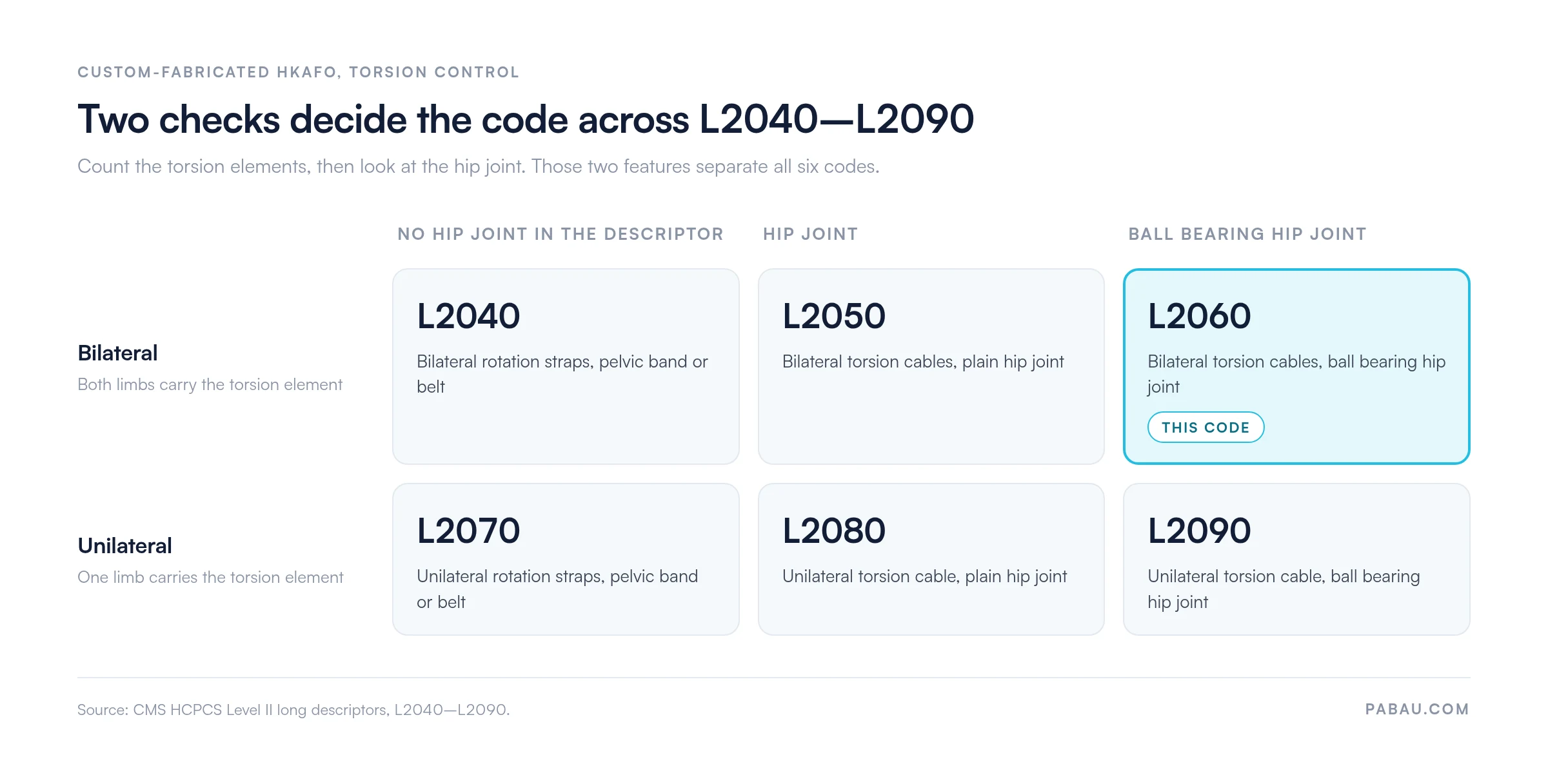
Two details decide which code in that subgroup you bill. The first is whether the torsion element is bilateral or unilateral. The second is whether the hip joint is a plain joint or a ball bearing joint. A ball bearing hip joint is what places a device in L2060 rather than L2050.
Several secondary coding references describe L2060 as the “Legg Perthes type” HKAFO. The CMS descriptor contains no such designation, and it never has. Orthoses for Legg-Calvé-Perthes disease sit in a separate HCPCS family, L1700 through L1755, where each code names a specific historic design.
The two families do different jobs. An L1700-series orthosis holds the femoral head in the acetabulum while it revascularizes, usually in a child. An L2060 HKAFO controls rotation of both lower limbs and supports the leg from the pelvis to the foot.
Billing L2060 for a Legg-Calvé-Perthes brace describes a device the patient never received. It also invites recoupment on post-payment review, because the delivered item will not match the descriptor on the claim. Check the descriptor against the parts on the bench before the claim goes out.
L2060 is indicated when a patient needs rotational control of both lower limbs together with support running from the pelvis to the foot. The bilateral torsion cables resist internal or external rotation on each side. The ball bearing hip joint reduces friction through hip flexion and extension, which matters most for patients who stand or walk in the device.
Several musculoskeletal and neuromuscular conditions can warrant that combination. The treating physician has to document how this patient’s presentation makes a torsion-control HKAFO with a ball bearing hip joint medically necessary. A recorded gait assessment naming the rotational findings usually supports the order and precedes the fitting.
Saying that a device is “indicated” for a condition does not by itself establish Medicare coverage. The clinical findings behind the order have to sit in the beneficiary’s medical record before the claim is submitted. A note that names the rotational deficit and the components needed to correct it carries more weight than a diagnosis alone.
L2060 is priced under the DMEPOS fee schedule, not the Medicare Physician Fee Schedule. CMS sets a national limitation amount (NLA) for each DMEPOS code.
Medicare Part B then pays 80% of the lesser of the supplier’s charge or the NLA, once the beneficiary’s annual deductible is met. DMEPOS rates are adjusted every year, so pull the current figure from the CMS DMEPOS fee schedule lookup tool rather than a stored copy.
Rates also vary by competitive bidding area (CBA). In CBAs where L2060 is included in a bidding round, contract suppliers must use the bid rate rather than the NLA. Suppliers outside a CBA use the NLA.
Verify the applicable rate for your billing locality before submitting a claim. Confirm as well that the fee schedule file you are pricing from is current for the date of service.
Tracking electronic remittance advice (ERA) on L2060 claims lets DMEPOS billing teams spot rate discrepancies and locality mismatches before they become systemic denials.
Medicare Part B covers L2060 when medical necessity criteria are met, a treating physician orders the item, and an enrolled DMEPOS supplier submits the claim. Coverage is not automatic. CMS lists L2060 on the Master List of DMEPOS items potentially subject to conditions of payment. The applicable Medicare Administrative Contractor (MAC) may therefore ask for more documentation before it pays.
Sitting on the Master List is not the same as carrying a condition of payment. As of the July 2026 updates, L2060 appears on neither of the two lists that do.
It is absent from the Required Face-to-Face Encounter and Written Order Prior to Delivery List, and from the Required Prior Authorization List. The standard DMEPOS rules still apply in full.
There is also no local coverage determination that names L2060 as a covered base code. The Ankle-Foot/Knee-Ankle-Foot Orthosis LCD (L33686) lists KAFO and AFO base codes, and the HKAFO torsion-control range is not among them. CMS assigns L2060 coverage code C, which leaves the decision to contractor judgment on the documentation submitted.
The revenue cycle checkpoint for L2060 starts at the eligibility stage. Confirm that the beneficiary is enrolled in Medicare Part B and has not exhausted their DMEPOS benefit for a substantially equivalent item. Eligibility verification should capture both points before the device is fitted.
No LCD publishes a covered-diagnosis list for L2060, because no LCD names it as a base code. The diagnosis you submit still has to explain why a device with these components was supplied. The codes below describe conditions a torsion-control HKAFO is used to manage. Treat them as a starting point, then confirm current MAC guidance before you bill.
Code to the highest level of specificity the record supports, and use a laterality-specific code wherever one exists. Confirm each descriptor against the ICD-10-CM code index before the claim goes out. The AAPC’s HCPCS code reference confirms current code descriptions. The MAC’s own billing articles set out what its reviewers expect to see in the note.
Modifier selection on L2060 claims is one of the more denial-prone steps in the billing workflow. Four modifiers apply to DMEPOS orthotic claims: KX, GA, GY, and GZ.
Each one tells the payer something specific about your documentation, so the wrong choice produces either a denial or a compliance flag. Because no LCD covers L2060, check your MAC’s current billing article before you append KX.
KX is an attestation, not a formality. Appending it says the published policy criteria are met and the proof is on file. Where a MAC publishes no criteria for L2060, or where your documentation falls short of them, leave KX off the claim.
Run an internal documentation audit before each L2060 claim batch. Confirm three details on every claim. The written order is dated before the device was dispensed. The medical record names the rotational deficit and the components supplied. The modifier matches your documentation status rather than your expectation of payment. An unsupported KX or a missing GA is among the most common reasons L2060 claims are reopened during post-payment review.
CMS and the applicable MAC expect a specific set of documents on file before an L2060 claim is submitted. “On file” means held in the supplier’s records at the time of billing and retrievable on request. Documentation created after the claim goes out does not count.
Certificates of Medical Necessity no longer belong on this list. CMS discontinued CMNs and DME Information Forms for dates of service on or after January 1, 2023. Claims that still carry that information are rejected.
The steps below consolidate the CMS conditions of payment, MAC documentation expectations, and standard DMEPOS practice into one sequence. A billing team can work through it from intake to submission. Getting the claim right on the first pass avoids the 30-to-90-day delays that denials and resubmissions add.
The most common L2060 miscoding error is picking an adjacent code from the same HKAFO subgroup. Read the range in two steps.
First, decide whether the torsion element is bilateral or unilateral. L2040, L2050, and L2060 are bilateral, while L2070, L2080, and L2090 are unilateral. Second, check the hip joint, because a plain joint and a ball bearing joint are separate codes. The grid below maps both checks onto the six codes.
None of these six codes carries a Legg Perthes designation. Verify each descriptor in the CMS HCPCS Level II file or through the AAPC HCPCS code reference before billing. CMS wording is authoritative, and secondary sources sometimes abbreviate descriptions in ways that hide a billing-critical component.
L2060 claims are denied more often than their clinical complexity warrants, because the errors are almost always administrative rather than clinical. The patterns below come from DMEPOS audit findings and MAC post-payment review results. Working through them before submission prevents the most frequent denial scenarios.
Systematic denial management in healthcare workflows catch most of these errors before they reach the payer. Build a pre-submission checklist that validates the order date, the modifier, the ICD-10 code, and the supplier number on every L2060 claim.
Keep a code-specific checklist for L2060 separate from your general DMEPOS workflow. The ball bearing hip joint and the two-cable requirement are easy to overlook when volume is high, and both decide the code. Check the components against the descriptor, the modifier against the documentation, and the diagnosis against the clinical note. That one pass stops most L2060 denials before they happen.
Most orthotic suppliers track L2060 requirements across separate systems. The clinical note lives in the EMR, the fabrication record sits with the orthotist, and the order date is confirmed by email. When a MAC asks for the file two years later, someone has to reassemble it from three places.
Practice management software like Pabau keeps the clinical record, the order, the fitting note, and the claim on one patient timeline. Documentation checklists can be attached to the code itself. The component detail that separates L2060 from L2050 then gets captured at the fitting, rather than reconstructed later.
Your billing team can see whether a claim is ready before it goes out. Your reviewers can pull a complete file on request. Fewer claims come back, and the ones that do come back with a reason you can answer from the record.

Pabau’s claims management software helps orthotic suppliers manage physician orders, documentation checklists, modifier logic, and claim submission. L2060 and adjacent DMEPOS claims submit clean the first time.

L2060 covers one specific HKAFO build: Bilateral torsion cables, a ball bearing hip joint, a pelvic band or belt, custom fabricated. Every billing decision on the code follows from those components.
The avoidable denials come from three habits. The first is picking a neighboring code without checking the hip joint. The second is appending KX with no published criteria behind it. The third is a diagnosis the clinical note never ties to rotational control.
If you took this code for the Legg Perthes orthosis, that family is L1700 through L1755 and none of it overlaps with L2060.
Pabau’s claims management software gives DMEPOS billing teams one place to track orders, documentation status, modifier logic, and submission across orthotic codes. To see how it handles DMEPOS workflows end to end, book a demo with the team.

Need to understand DMEPOS denial patterns before they hit your cash flow? Denial management in healthcare explains the most common DMEPOS claim adjustment reasons and how to address them systematically.
Want to build a clean claim process for orthotic billing? Clean claim submission covers the structural requirements every DMEPOS claim must meet before it reaches the payer.
Looking for the broader context of medical billing compliance for DMEPOS suppliers? Medical billing compliance requirements outlines the documentation and supplier standards that apply to covered DMEPOS items.
HCPCS code L2060 reports a custom-fabricated hip knee ankle foot orthosis with torsion control. The device carries bilateral torsion cables, a ball bearing hip joint, and a pelvic band or belt. DMEPOS suppliers bill it under Medicare Part B when a treating physician orders the device. The record has to show why the patient needs bilateral rotational control alongside hip-to-foot support.
Medicare pays 80% of the national limitation amount (NLA) set in the CMS DMEPOS fee schedule, after the beneficiary’s deductible is met. Rates change annually and vary by competitive bidding area. Verify the current 2026 NLA for L2060 through the CMS DMEPOS fee schedule lookup tool for your billing locality before submitting a claim.
No local coverage determination publishes a covered-diagnosis list for L2060. Diagnoses that commonly support the device include G80.1 (spastic diplegic cerebral palsy) and Q05.8 (sacral spina bifida without hydrocephalus). Others are G82.22 (incomplete paraplegia), Q65.89 (other specified congenital deformities of hip), and B91 (sequelae of poliomyelitis). Code to the highest specificity the record supports, and confirm current MAC guidance before billing.
Four modifiers apply to L2060 claims. KX attests that published policy criteria are met and the documentation supports coverage. GA signals that an advance beneficiary notice is on file because coverage is uncertain. GY marks an item that is statutorily excluded, where a denial is needed for secondary insurance. GZ marks a claim expected to deny with no ABN issued. Because no LCD covers L2060, check your MAC’s billing article before appending KX.
L2050 describes the same bilateral torsion-cable HKAFO with a plain hip joint rather than a ball bearing hip joint. L2090 carries the ball bearing hip joint but only a single torsion cable. L2060 needs both features together: Two torsion cables and a ball bearing hip joint. Check the finished device against all three descriptors before you pick a code.
No. The CMS descriptor for L2060 contains no Legg Perthes designation. Orthoses for Legg-Calvé-Perthes disease are billed under L1700 through L1755, which name specific designs. Those designs are the Toronto, Newington, Tachdijan trilateral, Scottish Rite, and Patten bottom types. Some secondary references still attach the Legg Perthes label to L2060, but the CMS file does not.
Medicare Part B can cover L2060 when the documentation supports medical necessity. CMS assigns the code coverage code C, so the contractor decides each claim on the record submitted. No LCD names L2060 as a covered base code. It sits on the CMS Master List of DMEPOS items potentially subject to conditions of payment. It is on neither the required face-to-face list nor the prior authorization list.