

HCPCS code E0198: Water pressure pad billing guide
HCPCS code E0198 is a water pad for a standard mattress HCPCS code E0198 is the ...

Last Updated: Oct 13, 2026
S0390 is the HCPCS Level II code for routine foot care, billed per visit. It covers removal and trimming of corns, calluses and nails, plus preventive maintenance in specific medical conditions such as diabetes.
S0390 sits in the HCPCS Level II temporary national code set, the S-codes. Medicaid programs and many commercial payers accept it, but Medicare excludes it outright. The code has been effective since January 1, 2001 and remains valid for 2026. Two errors account for most denials. The first is submitting to Medicare rather than Medicaid or a commercial payer. The second is omitting the qualifying ICD-10-CM diagnosis that establishes medical necessity.
Let Pabau's smart automation suggest the right codes, reduce claim denials, and keep your practice compliant—effortlessly.
Automate repetitive tasks and focus on what matters most—your patients.
Reduce coding errors and ensure compliance with the latest regulations.
Clean claims, fewer denials, and faster reimbursements.
Powerful insights and reporting to help your practice thrive.
HIPAA compliant SOC 2 certified GDPR-compliant Trusted by 4,000+ clinics worldwide

HCPCS code S0390 is a non-Medicare temporary national code used by Medicaid and commercial payers for routine foot care per visit.
Diabetes mellitus and peripheral vascular disease are the primary qualifying systemic conditions that establish medical necessity for S0390.
Submitting S0390 to Medicare is a top billing error, because Medicare bills routine foot care with CPT codes 11055-11057 and 11719-11721.
Pabau’s claims management software helps podiatry and specialty practices flag payer-specific code rules and track S0390 claim outcomes.
HCPCS code S0390 describes routine foot care rendered per visit. It covers removal and trimming of corns, calluses, and nails, plus preventive maintenance in conditions such as diabetes mellitus. The code sits in the HCPCS Level II S-code range, which CMS designates as temporary national codes. S-codes exist for non-Medicare payers, mainly state Medicaid agencies and commercial insurers.
S0390 is a per-visit code, so every eligible encounter is billed separately. Bundling several visits into one claim triggers an automatic denial, and so does billing more than one unit for a single visit.
The services bundled under S0390 cover three distinct procedures performed during a single routine foot care visit.
All three procedures may be performed in the same visit and billed under a single unit of S0390. Billing separate units for each procedure is unbundling, and unbundling is a payer audit trigger.
The “per visit” descriptor is what payers audit. Podiatry claims software can enforce single-unit submission automatically, which cuts the manual review a billing team does on S0390 claims.
HCPCS code S0390 is a Medicaid and commercial payer code. Medicare does not accept S0390 under any circumstances.
State Medicaid agencies and commercial insurers adopt S-codes voluntarily. Medicare does not recognize them as covered services, so submitting S0390 on a Medicare claim draws an automatic denial. There is no appeals pathway on the code itself.
Medicare Advantage plans sometimes accept S-codes because they operate under commercial plan rules rather than traditional Medicare billing requirements. Verify S0390 acceptance with each Medicare Advantage plan before submission.
Both decisions land before the clinician picks up an instrument, and the chart below sets them out in order.
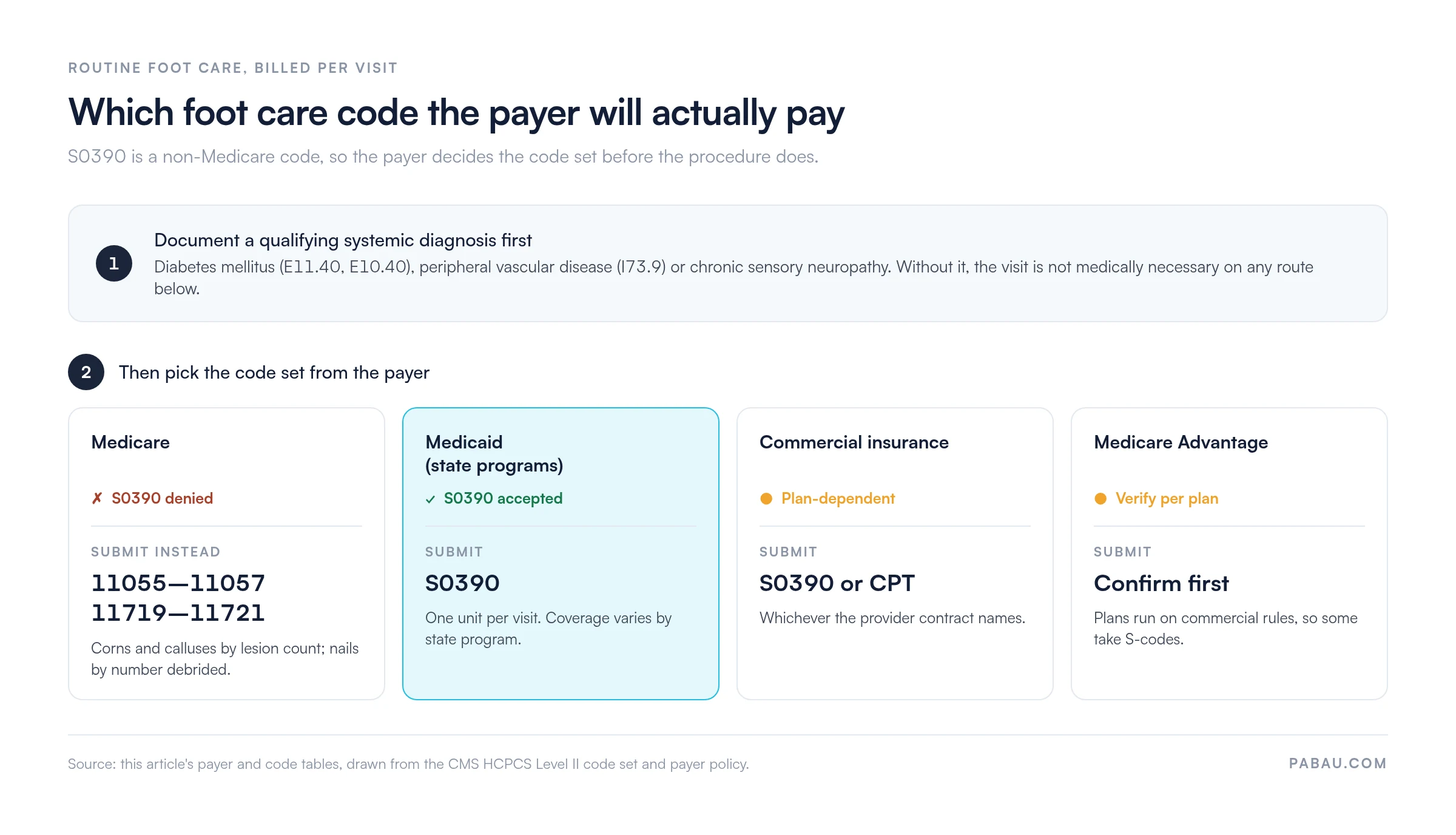
Medical necessity for HCPCS code S0390 requires documentation of a qualifying systemic condition that makes routine foot care clinically necessary rather than cosmetic. Diabetes mellitus and peripheral vascular disease are the two conditions most consistently accepted across Medicaid programs and commercial payers. For practices treating high-risk patients, accurate diagnosis documentation is the step that decides whether the claim is paid.
Payer-specific criteria vary. Aetna’s Clinical Policy Bulletin 0046 and CMS billing article A56232 both list diabetes and PVD as primary qualifying conditions. For other systemic diagnoses, confirm coverage in the payer’s clinical policy bulletin before scheduling the visit as billable.
Every S0390 claim requires a supporting ICD-10-CM diagnosis code that establishes medical necessity. The diagnosis must reflect the patient’s qualifying systemic condition, not just the foot care procedure itself.
When billing S0390 for a diabetic patient with documented neuropathy, E11.40 is more specific than E11.9 and more likely to clear medical necessity review. Always pick the highest-specificity code the chart supports.
The wider ICD-10-CM code reference shows the diabetes and vascular subcategories these diagnoses sit under. That helps when a chart names a complication the table above does not cover. For a second check on coverage, the AAPC HCPCS code lookup cross-references S0390 with covered diagnoses by payer.
Run an ICD-10-CM specificity audit on your S0390 claims before the billing cycle closes. Swap E11.9 for E11.40 whenever neuropathy is documented in the chart. That single change reduces clinical review requests from major Medicaid managed care organizations. The effect is largest in high-volume practices billing 50 or more S0390 visits per month.
Reimbursement rates for HCPCS code S0390 vary by state Medicaid fee schedule and commercial payer contract. There is no single national Medicare payment amount because Medicare does not cover S0390.
Medicaid rates range from roughly $18 to $45 per visit depending on state locality and managed care plan. Treat those figures as indicative. Verify current rates against your state’s official Medicaid fee schedule and your own payer contracts.
The CMS Physician Fee Schedule lookup tool covers Medicare rates only and will not show S0390 payment data. For Medicaid rates, contact your state Medicaid agency or managed care organization directly.
S0390 and the CPT foot care codes cover similar clinical procedures but apply to entirely different payer contexts. Using the wrong code set for the wrong payer is the fastest path to denial. S0390 is one code per visit for Medicaid and commercial payers. Medicare instead requires individual CPT codes that separate by procedure type and by the number of lesions or nails treated.
For practices billing both Medicaid and Medicare patients, keeping separate billing workflows by payer matters. A single intake process that defaults to one code set regardless of payer creates systematic denials. Medicare’s nail debridement codes trip practices up most often, so check CPT 11721 before submitting a Medicare foot care claim.
S0390 claims without adequate documentation are the second most common denial trigger after payer mismatch. The chart note must do two jobs. It has to establish medical necessity and describe the procedures performed.
A note that records only “nail trimming performed” without referencing the qualifying diagnosis will fail clinical review at most Medicaid programs. Chart documentation for each S0390 visit should contain all of the following elements.
A superbill that pre-populates the qualifying ICD-10-CM codes and foot care procedure codes leaves the coder less to reconstruct after the visit. For practices seeing high volumes of diabetic patients, building that into the visit workflow removes the most common S0390 audit exposure.
S0390 claim denials cluster around four root causes. Working through each one at the front end reduces denial rates without a code-by-code review after submission. Set payer-specific rules before the claim goes out rather than handling denials reactively.
Reading the remittance code on each S0390 rejection tells you whether the cause was a payer mismatch, missing documentation, or a frequency cap. Each of the three takes a different fix, so one blanket rework queue will not clear them.
Modifiers on S0390 claims are payer-specific and should be verified against each payer’s billing guidelines before use. Incorrect modifier attachment can trigger additional reviews or convert a payable claim into a denial.
The GY modifier does not guarantee payment from Medicare Advantage plans. It tells the plan the service falls outside traditional Medicare coverage, and the plan may still cover it as a supplemental benefit. Treat GY as an informational flag rather than a coverage guarantee.
Modifier verification by payer belongs on the pre-submission checklist, where it costs a minute instead of a rework cycle.
Build a payer-specific modifier matrix for your top 10 payers. For each payer, record whether GY is required for non-covered services and whether state Medicaid wants a provider-type modifier on S0390. Note as well whether modifier 59 needs prior authorization documentation. Review the matrix quarterly, when payer contracts renew.
In a lot of foot care practices, the payer check happens last. The front desk books the visit and the clinician charts it. Only at submission does the biller work out whether the plan takes S0390 or a CPT code. Medicare denials then arrive in batches, weeks after the visits they belong to.
Pabau, practice management software built for specialty and allied health practices, holds the payer, the diagnosis and the code in one patient record. The insurer is attached when the appointment is booked. The qualifying ICD-10-CM diagnosis sits on the patient’s problem list, and the claim is built from the note the clinician signed.
Because every Pabau subscription includes every feature, claims handling, charting and reporting run on the same dataset. You can pull every S0390 visit by payer and by month, so a frequency cap shows up before a claim breaches it rather than after.

Pabau helps practices manage payer-specific billing rules, track HCPCS code S0390 claim outcomes, and keep documentation complete for every visit. See how it works for high-volume foot care billing.

S0390 is a simple code carrying one hard constraint. It is not a Medicare code, and no amount of documentation will change that.
Two checks carry most of the outcome. Confirm the payer accepts S-codes before the visit is booked, and pair every claim with the most specific qualifying diagnosis the chart supports. Practices that move both checks ahead of the visit stop reworking denials and start getting paid on the first pass.
Pabau keeps the payer rule, the diagnosis and the code in the same record, so a mismatch surfaces before the claim leaves the practice. Book a demo to see how routine foot care billing runs in a multi-payer practice.

Need to understand how claim denials are managed systematically? Denial management in healthcare covers the workflows that reduce denial rates across payer types.
Want to see where coding accuracy sits in the wider billing cycle? Revenue cycle management fundamentals explains how diagnosis coding connects to clean claim submission.
Looking for the rules that govern billing documentation? Medical billing compliance sets out what payers and auditors expect a claim file to contain.
Want the charge capture side of this workflow? What a superbill is shows how to pre-populate diagnosis and procedure codes before the visit ends.
HCPCS code S0390 bills routine foot care per visit for Medicaid and commercial payer patients. It covers the removal and trimming of corns, calluses, and nails, plus preventive maintenance. The patient must have a qualifying systemic condition such as diabetes mellitus or peripheral vascular disease. It is a non-Medicare code and cannot be submitted on Medicare claims.
No. S0390 is explicitly excluded from Medicare coverage. Medicare uses CPT codes 11055-11057 for corn and callus removal and CPT codes 11719-11721 for nail debridement. Submitting S0390 on a Medicare claim results in an automatic denial with no coverage pathway on the code itself.
The most commonly accepted diagnoses are E11.40 (Type 2 diabetes mellitus with diabetic neuropathy) and I73.9 (peripheral vascular disease). E10.40 covers Type 1 diabetic neuropathy. E11.9 is accepted by most payers but may prompt additional documentation requests. Use the highest-specificity code supported by chart documentation.
S0390 is a single per-visit code for Medicaid and commercial payers. It bundles every routine foot care procedure, nail trimming and corn or callus removal included. CPT 11721 is a Medicare procedure code for debridement of six or more dystrophic nails in a single visit. S0390 cannot be used for Medicare patients. CPT 11721 cannot substitute for S0390 on Medicaid claims.
Yes. Diabetes mellitus is the primary qualifying condition for S0390 medical necessity. Virtually all Medicaid programs and most commercial payers accept it. Document the active ICD-10-CM diagnosis (E11.40 or E11.9) in the visit note and reference it on the claim. Practices billing high volumes of diabetic foot care visits should also verify frequency limits with each payer.
You need the qualifying ICD-10-CM diagnosis and a description of the procedures performed, naming which corns, calluses, or nails were treated. Add a foot condition assessment, practitioner credentials and NPI, and the visit date. Some state Medicaid programs also require a physician order or referral. Leaving out the qualifying diagnosis is what most often triggers clinical review or denial.



