

CCSD code G5100: Bypass of duodenum billing guide
CCSD code G5100 bills a bypass that leaves the duodenum in place CCSD code G5100...

Last Updated: Oct 16, 2026
V2305 is the HCPCS Level II code for spherocylinder, trifocal, plano to plus or minus 4.00d sphere, 4.25 to 6.00 cylinder, per lens.
Trifocal spherocylinder lenses sit in the V2300–V2399 range of HCPCS Level II vision appliance codes. V2305 covers the 4.25 to 6.00d cylinder band. A lens finished at 4.00d cylinder belongs to V2304, and one measured above 6.00d belongs to V2306. Billing a neighboring code is one of the most common audit triggers in optical billing.
Let Pabau's smart automation suggest the right codes, reduce claim denials, and keep your practice compliant—effortlessly.
Automate repetitive tasks and focus on what matters most—your patients.
Reduce coding errors and ensure compliance with the latest regulations.
Clean claims, fewer denials, and faster reimbursements.
Powerful insights and reporting to help your practice thrive.
HIPAA compliant SOC 2 certified GDPR-compliant Trusted by 4,000+ clinics worldwide

HCPCS code V2305 covers spherocylinder trifocal lenses with a plano to ±4.00d sphere and a 4.25 to 6.00d cylinder.
A lens finished at 4.00d cylinder belongs to V2304, and one measured above 6.00d belongs to V2306.
Every V2305 line needs one laterality modifier, LT or RT, plus one equipment-condition modifier such as NU.
Medicare covers trifocal lenses only after cataract surgery with an intraocular lens, under CMS Policy Article A52499.
Billing the code also requires active DMEPOS supplier enrollment, which is separate from Medicare provider enrollment.
HCPCS code V2305 describes a spherocylinder, trifocal lens. Its sphere runs from plano to plus or minus 4.00 diopters, and its cylinder from 4.25 to 6.00 diopters. The short description used on claims is “Lens sphcy trifocal 4.0/4.25.” It sits within the Lenses, Trifocal section of HCPCS Level II. That system is maintained by the Centers for Medicare and Medicaid Services (CMS) for supplies and services not covered by CPT.
The code is valid for fiscal year 2026. It falls under Vision Items and Services, HCPCS Level II Category V. Claims go out on a CMS-1500 form or its 837P electronic equivalent.
Medicare reimbursement for HCPCS code V2305 is set through the DMEPOS fee schedule, not the Physician Fee Schedule. DMEPOS stands for Durable Medical Equipment, Prosthetics, Orthotics and Supplies. Rates vary by Medicare Administrative Contractor (MAC) jurisdiction and geographic locality.
CMS publishes annual DMEPOS fee schedule updates. The 2026 allowable rates for vision appliances can be verified through the CMS DMEPOS fee schedule.
Because V2305 rates are locality-adjusted, a practice billing in California may receive a different allowable than one in Texas. Pull your jurisdiction’s rate from the CMS DMEPOS fee schedule before quoting coverage amounts to patients.
State Medicaid programs set their own rates independently. Medi-Cal (California) and ForwardHealth (Wisconsin) both maintain separate vision appliance fee schedules that differ from Medicare allowables. Never apply a Medicare rate to a Medi-Cal claim without first checking the state schedule.
Five modifiers apply to HCPCS code V2305, split between laterality modifiers and equipment-condition modifiers. Using the wrong modifier, or omitting one where it is required, is a leading cause of claim denial for vision appliance codes. The table below shows each modifier, its definition, and when to use it.
For bilateral dispensing, bill two line items, one with LT and one with RT. Do not submit a single line without a laterality modifier for a bilateral pair.
Medicare edits frequently reject unlateralized lens claims. The denial reason often reads as a missing modifier rather than a coverage issue. Practices using claims management software can configure modifier rules at the service level to catch these before submission.
Always pair an equipment-condition modifier (NU, RR, or UE) with a laterality modifier (LT or RT) on every V2305 line item. A claim missing either category of modifier will often generate a CO-4 or CO-16 denial from Medicare. Build a claim template that requires both fields before the line can be saved.
Every V2305 claim requires a supporting ICD-10-CM diagnosis code that establishes medical necessity. Trifocal spherocylinder lenses are prescribed for patients with presbyopia combined with refractive error, so several diagnosis codes apply routinely. The crosswalk below lists the pairings used most often in optometry and ophthalmology settings.
Select the most specific lateralized code available. H52.21 (right eye regular astigmatism) is preferable to H52.23 (bilateral) when the claim covers only the right lens. Mismatching diagnosis laterality with the LT/RT modifier is another common cause of automated denials.
Billing V2305 correctly requires five steps, each tied to a specific documentation element. Skipping any step increases denial risk under Medicare’s DMEPOS claim editing rules.
Three errors account for most V2305 denials. The first is billing a bilateral pair on a single line with no laterality modifier. The second is reading the lens power off the prescription instead of the final lab specification. The third is submitting a claim before DMEPOS enrollment is active.
Each error generates its own CARC denial reason. Reading the medical billing denial codes on the remittance tells you which of the three happened, so the correction goes in the right place.
Medicare coverage for trifocal lenses under HCPCS code V2305 is governed by CMS Policy Article A52499 (Refractive Lenses). Standard Medicare Part B does not cover routine vision care, and that exclusion takes in routine refraction and routine eyeglass dispensing.
Coverage applies only where the lens is medically necessary after cataract surgery with insertion of an intraocular lens. CMS defines a short list of other qualifying circumstances.
For most patients receiving trifocals for presbyopia or refractive error, Medicare will deny V2305 as a non-covered routine vision service. Obtain an Advance Beneficiary Notice of Noncoverage (ABN) before dispensing whenever coverage is uncertain.
The patient can then elect to proceed and accept financial responsibility. That signature protects the practice from write-off liability on a claim that was never covered.
DMEPOS coverage policy carries record-keeping obligations of its own. Keep the ABN, the prescription, and the clinical notes in one patient record that can be retrieved on audit request.
V2305 is one of several trifocal lens codes separated by sphere and cylinder power ranges. Choosing the wrong one after a rounding error or a misread prescription is a frequent cause of post-payment audit recovery. The table below sets the adjacent trifocal codes against their power parameters.
The cylinder range is the most common source of confusion between adjacent codes. V2305 covers only the 4.25d to 6.00d cylinder band. Sphere separates the codes too, so that same band on a plus or minus 4.25d to 7.00d sphere is V2309.
A lens finished at 4.00d cylinder belongs to V2304, and one above 6.00d belongs to V2306.
Plotted on a single cylinder scale, the four bands show exactly where each boundary falls.
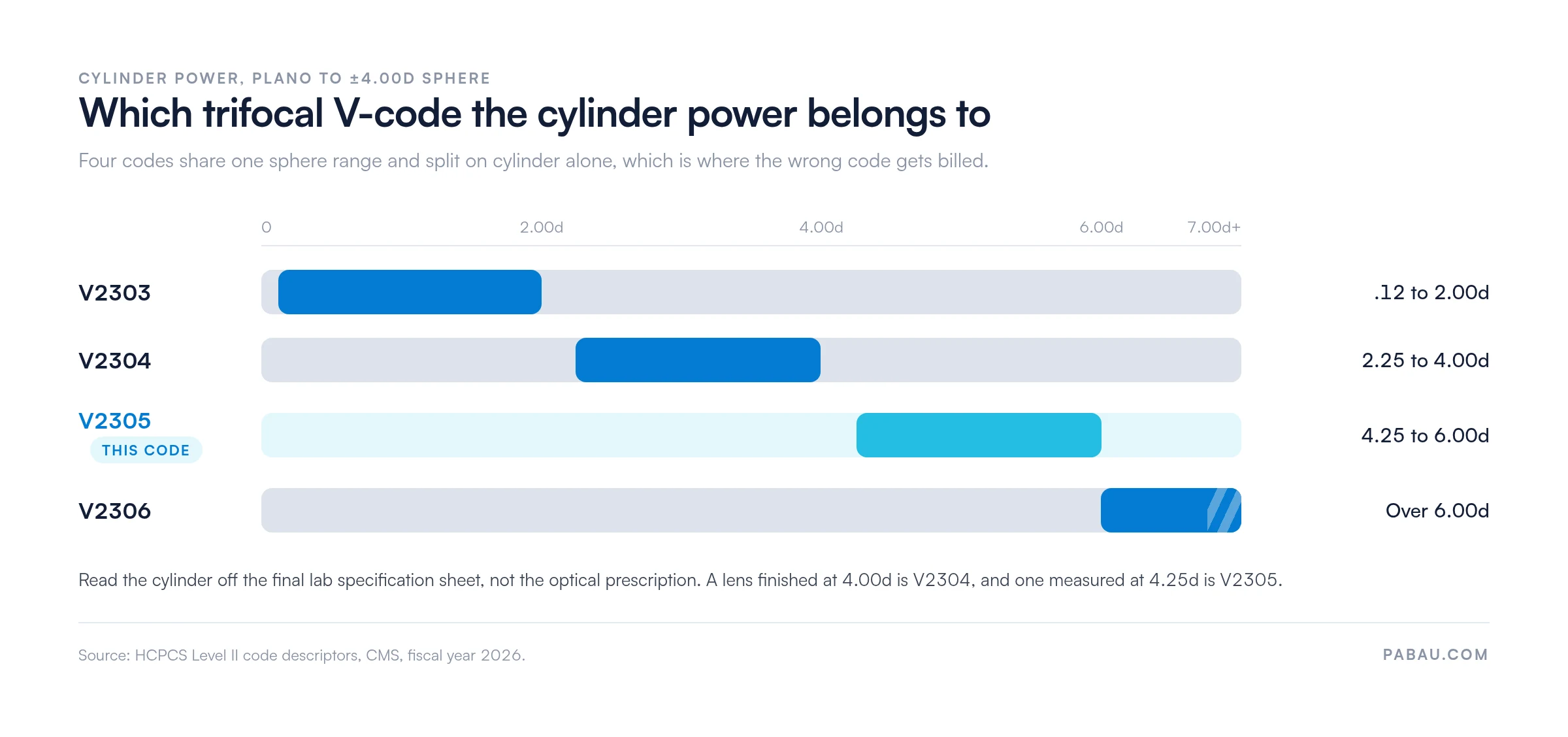
Verify the power from the lab specification sheet rather than the optical prescription. Labs sometimes adjust parameters during manufacturing.
HCPCS code V2305 is billed by optometrists, ophthalmologists, and licensed dispensing opticians who supply the physical lens. To bill V-series vision appliance codes to Medicare, the billing entity must be an enrolled DMEPOS supplier under CMS standards.
Medicare provider enrollment on its own is not enough. DMEPOS enrollment sits alongside the broader insurance credentialing work, and each payer runs to its own timeline.
Provider type affects how and where the code is billed. The table below summarizes the typical billing pathways for vision appliance codes like V2305.
Scope of practice for optometrists and dispensing opticians varies by state. Confirm that your state’s licensure permits dispensing and billing for vision appliances before you submit V2305 claims. Keeping the dispense record beside the billing record means the supporting material is ready if a DMEPOS audit lands.
Before billing V2305 to Medicare for the first time, confirm your DMEPOS supplier number is active using the CMS Supplier Directory. A lapsed or inactive supplier number will cause every claim to deny on provider eligibility, regardless of clinical documentation quality. Verify the number annually when your enrollment renewal is due.
A complete V2305 claim rests on five records. They are the prescription, the lab specification, the medical necessity notes, the ABN where one applies, and the supplier enrollment file. Missing any of them gives the payer grounds to recoup the payment on review.
The record has to support every element of the claim, from the code selection to the modifier to the diagnosis. Storing dispense records alongside claim data keeps audit documentation in one place, rather than spread across several filing systems.

In most optical practices the V2305 claim is assembled by hand. Someone reads the lab specification, picks the code, adds the laterality modifier, adds NU, then goes looking for the prescription when a payer queries it. Each of those pieces usually lives somewhere different.
Practice management software like Pabau holds the dispense record, the claim, and the supporting documents in one patient record. Modifier rules sit on the service itself, so a V2305 line carries its laterality and equipment-condition modifiers before anyone submits it.
Billing staff can see which V-code lines are still missing a modifier or a diagnosis, and remittances post back against the line they paid. When a payer asks for the prescription or the ABN, it sits in the record the claim came from.

Pabau’s claims management tools help optometry and ophthalmology practices build modifier rules, verify diagnosis pairings, and track claim status for V-code submissions in one place.

V2305 comes down to one measurement. Take the cylinder from the final lab specification, and the choice between V2304, V2305, and V2306 stops being a judgment call. The modifier pair and the diagnosis code then follow from what was actually dispensed.
Two requirements sit outside the coding altogether. DMEPOS supplier enrollment has to be active before the first claim goes out. The post-cataract benefit then decides whether Medicare pays for the lens at all, and an ABN covers the patients it does not.
Build those checks into the claim rather than the reviewer’s memory, and the three common V2305 denials stop recurring. Book a demo to see how Pabau handles vision appliance billing from the dispense record through to remittance.

Need to understand how medical billing works before optimising your V-code workflow? What is medical billing walks through the end-to-end revenue cycle from claim creation to payment posting.
Want to stop V-code denials recurring month after month? Denial management in healthcare sets out how to work denials by reason code instead of one claim at a time.
Not yet enrolled with the payers you want to bill? How to get credentialed with insurance companies walks through the application, the timelines, and the documents each payer asks for.
HCPCS code V2305 is the billing code for a spherocylinder trifocal lens. Its sphere power runs from plano to plus or minus 4.00 diopters, and its cylinder power from 4.25 to 6.00 diopters. It is a HCPCS Level II code used by optometrists, ophthalmologists, and dispensing opticians to bill Medicare and other payers for this specific lens type.
Medicare Part B covers V2305 only for patients who have had cataract surgery with insertion of an intraocular lens, under the post-cataract vision appliance benefit. For most other patients, standard Medicare does not cover routine vision services, and V2305 will deny as non-covered. An ABN should be issued before dispensing whenever coverage is uncertain.
Five modifiers apply: LT (left side) and RT (right side) for laterality, and NU (new equipment), RR (rental), and UE (used DME) for equipment condition. Each V2305 line item should carry one laterality modifier and one equipment-condition modifier. For bilateral dispensing, bill two separate lines with LT and RT respectively.
Bill bilateral V2305 dispensing as two separate claim lines. Use modifier LT on the left lens line and modifier RT on the right lens line. Do not submit a single line without a laterality modifier for a bilateral pair. Each line also requires an equipment-condition modifier (typically NU for new lenses).
The cylinder power range separates them. V2305 covers a cylinder from 4.25 to 6.00 diopters, while V2303 covers a cylinder from .12 to 2.00 diopters. Both codes share the same sphere range (plano to ±4.00d). Use the final lab specification sheet, not the optical prescription, to confirm which code applies.
Five records are required. The first is a valid written prescription, signed and dated, showing all lens parameters. You also need the lab specification sheet confirming the manufactured lens power, plus clinical notes establishing medical necessity. Add an ABN where Medicare coverage is uncertain, and keep DMEPOS supplier enrollment records current. All documents must be on file at the time of claim submission.
The most common pairings are H52.4 (presbyopia), H52.21-H52.23 (regular astigmatism, lateralized), H52.11-H52.13 (myopia), and H52.01-H52.03 (hypermetropia). Use the most specific lateralized code available. Match the diagnosis laterality to the LT or RT modifier on the same claim line to avoid automated denials.



