HCPCS code T2014: Prevocational habilitation billing guide
HCPCS code T2014 pays for one day of prevocational training HCPCS code T2014 car...

Last Updated: Oct 9, 2026
T2013 is the HCPCS Level II code for habilitation, educational, waiver; per hour. It covers habilitative services delivered under a state-approved Medicaid educational waiver, where one unit equals one hour of direct service.
State Medicaid waiver programs are the paying authority, and Medicare fee-for-service does not cover the code. Denials usually trace back to a missing waiver authorization or to units that do not match the session logs.
Let Pabau's smart automation suggest the right codes, reduce claim denials, and keep your practice compliant—effortlessly.
Automate repetitive tasks and focus on what matters most—your patients.
Reduce coding errors and ensure compliance with the latest regulations.
Clean claims, fewer denials, and faster reimbursements.
Powerful insights and reporting to help your practice thrive.
HIPAA compliant SOC 2 certified GDPR-compliant Trusted by 4,000+ clinics worldwide

T2013 reports habilitation services in educational waiver programs, billed per hour (1 unit = 1 hour of direct service).
State Medicaid pays for T2013 under waiver authority, and Medicare fee-for-service does not typically cover it.
Claims require a current habilitation plan, waiver authorization, and service logs as minimum documentation.
Reimbursement rates vary by state Medicaid program, and no national fee schedule rate exists for T2013.
Pabau’s claims management software supports HCPCS Level II code entry and Medicaid claim submission for waiver services.
HCPCS code T2013 is a Level II Healthcare Common Procedure Coding System code with the official descriptor “Habilitation, educational, waiver; per hour.” The Centers for Medicare and Medicaid Services (CMS) maintains it. The code is used exclusively in Medicaid waiver billing for habilitation services delivered in educational settings.
The code sits in the T2012-T2041 block of HCPCS codes, which covers Medicaid waiver services. T2013 applies when a qualified provider delivers habilitative supports under a state-approved educational waiver program. The individual’s habilitation plan must also authorize the service.
Habilitation refers to services that help individuals with disabilities acquire, maintain, or improve functional skills they have never fully developed. That covers self-help, socialization, communication, and adaptive behavior. This distinguishes T2013 sharply from rehabilitation, which restores skills lost after injury or illness.
The distinction drives coding accuracy. Billing a rehabilitation code for a habilitative service, or the reverse, is a common audit trigger.
The educational waiver framework adds a second condition. The service must be authorized under a state-approved Individualized Education Program (IEP) or a comparable educational waiver plan. A general Medicaid behavioral health authorization does not cover it. Occupational therapists, speech-language pathologists, and other qualified providers working in school-based settings bill T2013 most often.
T2013 is funded through state Medicaid waiver programs, not Medicare fee-for-service. Medicare does not typically reimburse this code. Medicare’s statutory benefit structure covers medically necessary treatment, and skill acquisition for developmental disabilities sits outside that definition.
Coverage depends on two conditions. The state must hold an approved Medicaid waiver that includes educational habilitation services. The individual’s waiver authorization must also list T2013 as a covered service type. Practices serving patients with dual coverage should verify the waiver type before billing.
There is no single national reimbursement rate for HCPCS code T2013. Rates are set by each state’s Medicaid program and may vary further by waiver type, provider type, and geographic region within a state. The CMS Physician Fee Schedule lookup tool does not return rates for T-codes, because these are state-administered waiver codes outside the national RBRVS fee schedule.
To find current rates for T2013, consult your state Medicaid agency’s fee schedule or your state’s waiver program billing manual. Rates typically reflect hourly service delivery and may be tiered by provider qualification level.
Once claims are adjudicated, read the remittance advice for underpaid or denied T2013 lines. Appeal windows on waiver claims are short, so a weekly review beats a monthly one.
Each unit of T2013 represents one full hour of direct habilitation service. Partial hours are not billable as a full unit, and billing one unit for 45 minutes is an overcoding error. Many state Medicaid programs allow rounding to the nearest quarter hour. Confirm that in your state’s waiver billing manual before you apply it.
A clean T2013 claim carries the waiver authorization number, the rendering provider’s NPI, and the correct place of service code. Service logs must also match the billed units. Practice management software like Pabau keeps that evidence attached to the claim. Pabau’s claims management software records HCPCS Level II codes against each service and submits Medicaid claims from the same screen.
Documentation for T2013 must show that a waiver authorized the service and that a qualified provider delivered it. The record must also carry enough detail to support the number of units billed. Missing one of those elements is enough to trigger a full claim denial or a post-payment audit recoupment.
Audit your T2013 service logs monthly before submitting claims. Cross-reference the start and end times in session notes against the units billed. A session log showing 50 minutes billed as one full hour gives a payer reason to review the whole batch.
HCPCS Level II modifiers give payers additional context about how a service was delivered. Requirements vary by state Medicaid program, so confirm the applicable modifiers in your state’s waiver billing manual before you append them. The AAPC HCPCS code reference lists modifier guidance alongside the code descriptor.
The same education-level tiers run across the rest of the waiver range. Code T2034 for crisis intervention takes HM, HN and HO on identical credential logic. A missing or incorrect modifier there returns a CO-4 denial.
Selecting the wrong T-code within the waiver services range is a frequent miscoding error. Two axes decide the answer. The first is the setting where the service was delivered, and the second is the unit the waiver authorization counts. The grid below maps the six habilitation codes onto both.
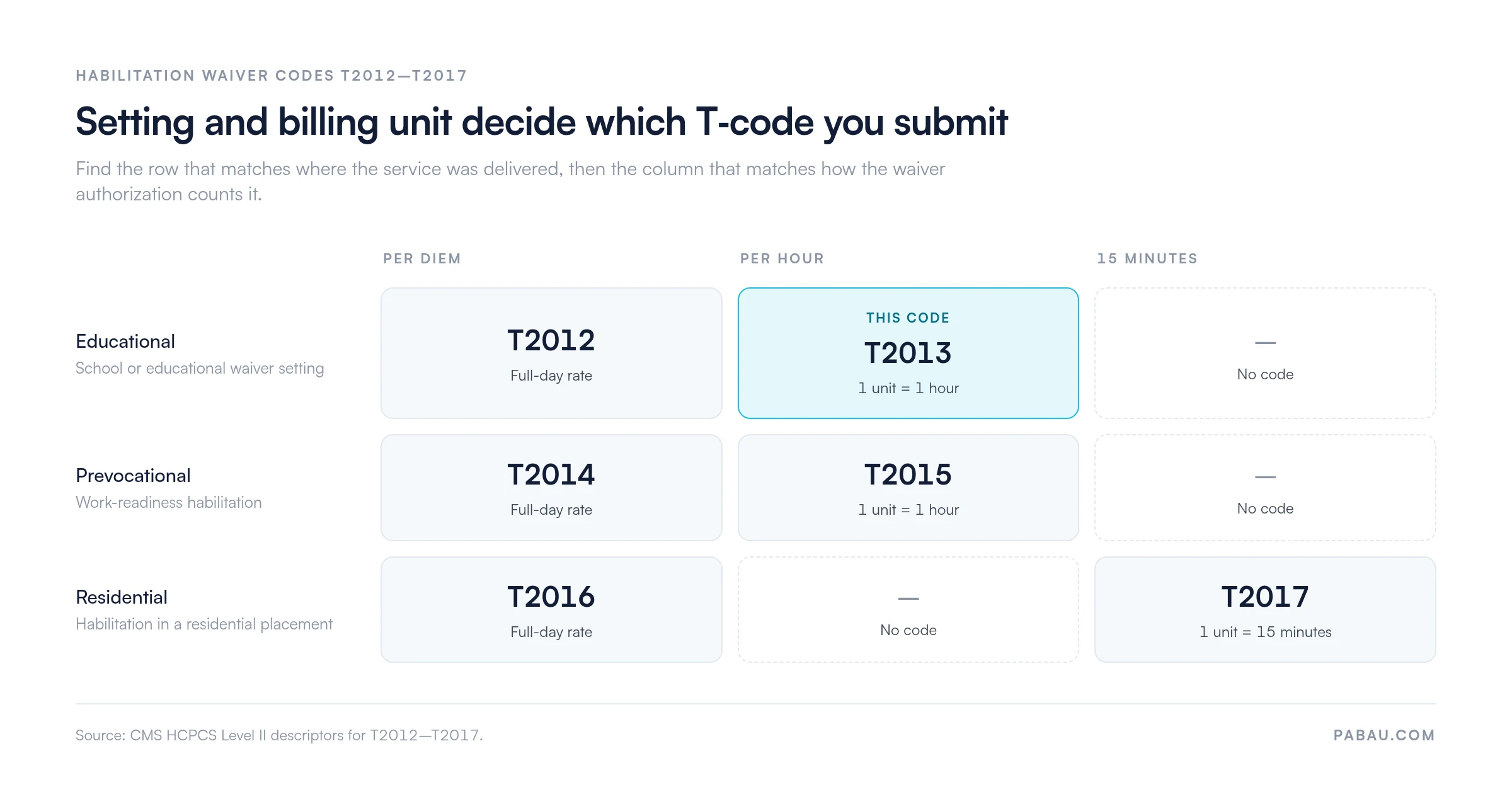
The table below adds each code’s official descriptor and the differentiator to check before you submit.
The most common mix-up is between T2012 and T2013. Both cover educational waiver habilitation, and only the billing unit separates them. Where the waiver authorizes services in daily units, T2012 applies. Where it authorizes hourly units, T2013 is correct.
The same two axes sort the non-habilitation codes in this range. HCPCS code T2027 covers specialized childcare under a waiver, and it bills in 15-minute units rather than hours.
Unit selection is only half the claim. The diagnosis reported has to support medical necessity for habilitation, so check the individual’s authorization against the ICD-10-CM codes you submit.
T2013 sits where educational program billing and waiver program compliance meet, and that combination produces repeat denials. Most of them fall into six patterns. A denial management workflow built for T-code waiver claims catches them before they become recoupments.
A pre-submission review against those six points catches most T2013 denials before the claim leaves the practice. Build the check into the weekly billing run rather than the monthly one, since waiver appeal windows close fast.
Set a calendar alert for every T2013 waiver authorization expiry at the time of service setup, not when the claim is being prepared. Catching an expiration two weeks out leaves time to request renewal, so sessions keep billing against a live authorization.
Waiver services often leave their evidence in three places. Session times sit in a paper log or a therapist’s notes. The waiver authorization lives on a shared drive, and the claim is keyed into a separate billing portal. Every hand-off is a chance for the billed units to drift from the log.
Pabau holds them together. The service record carries the appointment, the session note and the HCPCS code. Units on the claim then come from the times a clinician recorded, not from a second round of data entry.
Claims go out from the same platform, and remittances come back against the invoice they belong to. Billing staff can see which T2013 lines paid, which were short-paid, and which need an appeal before the window closes.

Pabau handles HCPCS Level II code entry, Medicaid claim submission and service documentation in one platform. Your team manages T2013 billing without switching systems.

T2013 is a narrow code with a wide denial surface. Nearly every rejection traces back to the unit billed, the authorization behind it, or the note supporting it.
The fix is mostly a workflow question. Where session times, authorization dates and claim lines sit in different systems, the checking never stops. Hold them in one place and the pre-submission review takes minutes.
Book a demo to see how Pabau records waiver sessions, attaches the HCPCS code and submits the Medicaid claim from one platform.

Need to understand how Medicaid claims reach a payer? Medical claims clearinghouse guide explains the electronic claim submission path from practice to Medicaid adjudication.
Getting denials back from Medicaid with confusing reason codes? Denial codes in medical billing decodes the most common Medicaid claim adjustment reason codes and what to do with each one.
Billing multiple waiver service types and need consistent documentation? Superbill best practices covers how to structure encounter records that support both HCPCS and CPT code claims without creating audit discrepancies.
HCPCS code T2013 bills habilitation services provided in an educational waiver setting. One unit of service equals one hour of direct delivery. It applies when a qualified provider works under a state-approved Medicaid waiver program and the individual holds an active waiver authorization for educational habilitation services.
T2013 is covered by Medicaid through state waiver programs, not by Medicare fee-for-service. Medicare does not include habilitation services in its standard benefit structure. Coverage under Medicaid depends on whether the individual’s specific waiver program authorizes educational habilitation services under this code.
There is no national reimbursement rate for T2013. Rates are set individually by each state Medicaid agency and may vary by provider qualification level, waiver type, and region. To find current rates, consult your state Medicaid agency’s fee schedule or waiver program billing manual directly.
Habilitation services help individuals with disabilities acquire functional skills they have never had. Rehabilitation services restore skills lost to injury or illness. T2013 covers habilitation only. Billing a rehabilitation CPT code when the service is habilitative in nature is a common audit trigger and a claim integrity issue.
T2013 is billed per hour, where one unit equals one hour of direct habilitation service. Billing one unit for less than a full hour counts as overcoding, except where state policy explicitly permits rounding. Always confirm your state’s rounding rules in the applicable Medicaid waiver billing manual before submitting.
The T2012-T2041 range covers Medicaid waiver services. It includes educational habilitation (T2012 per diem, T2013 per hour), prevocational habilitation (T2014, T2015), residential habilitation (T2016, T2017), and day habilitation codes. Each code differs by service setting, billing unit, and waiver program type. Select the code that matches the service setting and the authorization unit.