

CPT Code 30801: Superficial turbinate ablation billing guide
CPT Code 30801: Official descriptor and procedure overview The American Medical ...

Last Updated: Nov 27, 2026
L1650 is the HCPCS Level II code for hip orthosis, abduction control of hip joints, static, adjustable, (ilfled type), prefabricated, includes fitting and adjustment.
The brace holds both hips apart in a fixed position that the supplier can adjust. It is mainly used for infants and young children with stable hips and developmental dysplasia. Choosing L1650 over L1640, L1660 or L1686 turns on whether the brace is static, prefabricated and for non-surgical use.
Let Pabau's smart automation suggest the right codes, reduce claim denials, and keep your practice compliant—effortlessly.
Automate repetitive tasks and focus on what matters most—your patients.
Reduce coding errors and ensure compliance with the latest regulations.
Clean claims, fewer denials, and faster reimbursements.
Powerful insights and reporting to help your practice thrive.
HIPAA compliant SOC 2 certified GDPR-compliant Trusted by 4,000+ clinics worldwide

HCPCS Code L1650 describes a static, adjustable hip abduction orthosis of the Ilfeld type that is prefabricated, with fitting and adjustment included.
Static abduction bracing is used for stable hips or residual acetabular dysplasia, not for unstable or dislocated hips.
Post-operative hip abduction braces belong to L1681, L1685 and L1686, so a post-surgical device is never billed as L1650.
L1640 is the custom-fabricated static option and L1660 the plastic prefabricated one, so construction decides the code.
CMS assigns L1650 a carrier-judgment coverage code, so each payer’s own policy sets the documentation bar.
HCPCS Code L1650 is the Level II code for a prefabricated, static, adjustable hip abduction orthosis of the Ilfeld type.
CMS maintains the HCPCS Level II code set, which covers orthotics, and its file lists L1650 under that descriptor. The brace holds both hips apart in a set position, and the supplier can adjust that position.
A systematic review of hip dysplasia splinting groups the Ilfeld splint with static braces. It finds static bracing effective only for stable hips or residual acetabular dysplasia.
The official CMS descriptor reads: Hip orthosis, abduction control of hip joints, static, adjustable, (ilfled type), prefabricated, includes fitting and adjustment. Each element separates L1650 from a neighboring hip orthosis code.
L1650 sits in the hip orthosis run of the CMS HCPCS Level II file, which spans L1600 to L1690. The October 2026 file lists it as added on January 1, 1982, with coverage code C for carrier judgment. Its pricing indicator places it on the orthotics and prosthetics fee schedule.
L1650 fits a patient whose treating clinician wants the hips held in a fixed, adjustable abduction position. In the clinical literature, that is mainly developmental dysplasia of the hip (DDH) in infants and young children. The review above limits static bracing to two situations:
Diagnosis codes on these claims usually sit in ICD-10-CM category Q65, Congenital deformities of hip. Acetabular dysplasia, for example, indexes to Q65.89, Other specified congenital deformities of hip. Code the diagnosis the clinician documents, and check it against the payer’s covered list.
Several devices look like L1650 on a delivery ticket but carry their own codes:
Make the delivery note describe the device in the descriptor’s own terms: static, adjustable, Ilfeld type, prefabricated. A note that says “hip brace” alone gives a reviewer no way to tell L1650 from L1660 or L1686.
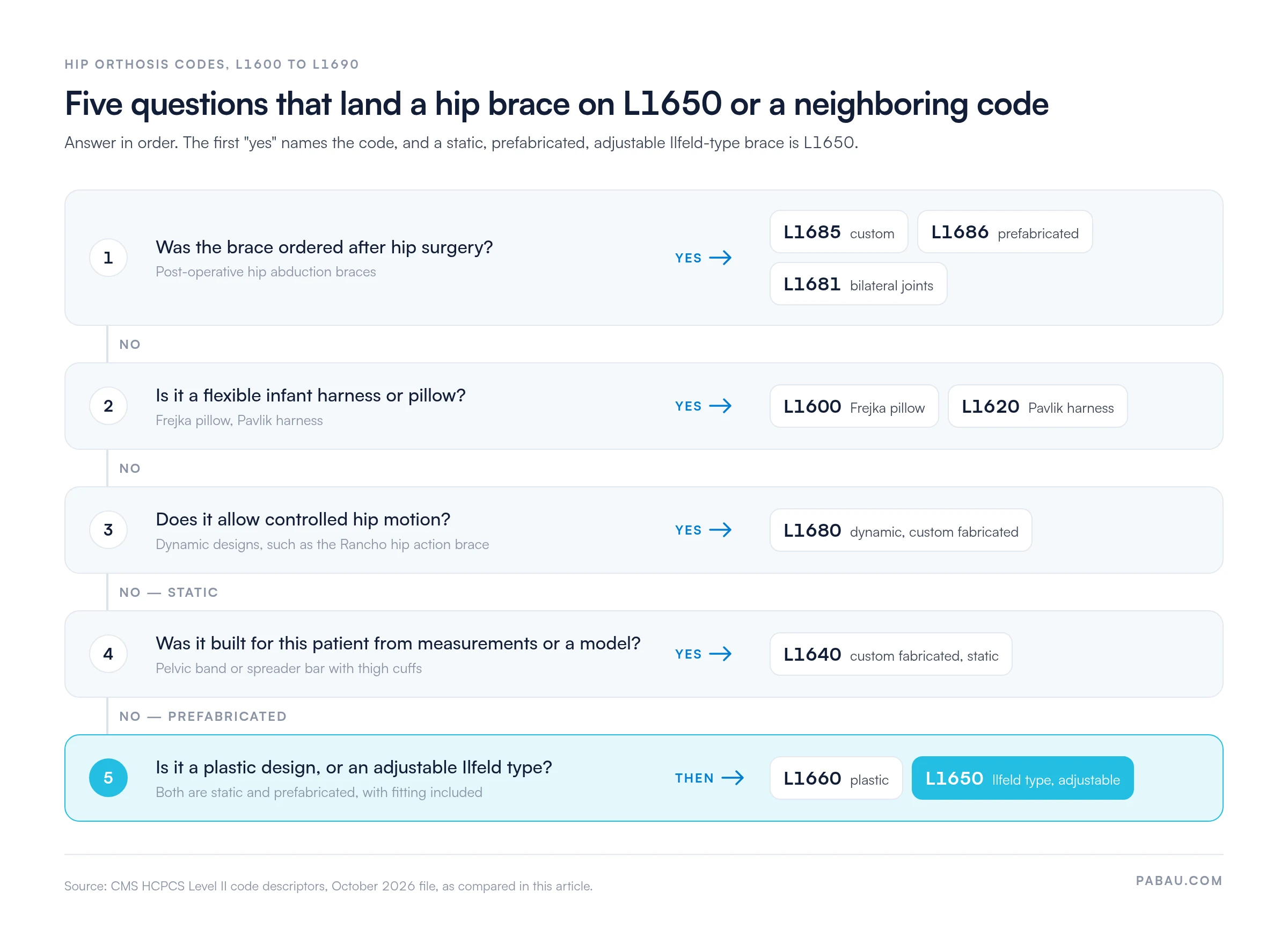
Within L1600 to L1690, the choice turns on three questions. Is the brace static or dynamic? Is it prefabricated or custom fabricated? Is it for post-operative use? The table compares L1650 with the codes it is most often confused with.
L1640 and L1650 are both static abduction braces, so fabrication settles the code. A brace built for the patient from measurements or a model is L1640, while a stock Ilfeld-type brace is L1650. If the surgeon ordered the brace after a hip procedure, start from L1685 and L1686. The decision path below puts the main hip codes from this section in the order a coder rules them out.
CMS gives L1650 coverage code C, which means the Medicare contractor decides coverage case by case. Before you bill Medicare, search the CMS Medicare Coverage Database for any local coverage determination or policy article your DME MAC applies to hip orthoses. The DME MACs’ standard documentation article, A55426, applies to every DMEPOS claim, including this one.
Because static abduction bracing is mainly used for infants and young children, the payer is often a Medicaid plan or a commercial insurer. Each one publishes its own orthotics policy, and many ask for prior authorization on hip orthoses. Confirm the policy and any authorization requirement before you dispense the brace.
A complete documentation package is the best defense on any orthotic claim. Following billing compliance requirements for DMEPOS means having each document on file before the claim goes out.
Medicare requires a standard written order for DMEPOS items, and most other payers ask for an equivalent prescription. It names the patient, the order date and a description of the item, plus the quantity. It also carries the treating practitioner’s name or NPI and their signature.
Describe the item closely enough to support L1650, such as “static adjustable hip abduction orthosis, Ilfeld type”.
The treating clinician’s notes should support why a static abduction brace is needed now. For a child with DDH, that usually means:
The supplier’s own records then add the fitting and adjustment notes and the proof of delivery. Fitting is part of the code, so it is documented but never billed as a separate line.
A replacement brace needs its own justification.
CMS lists hip orthoses, L1650 included, as an approved Recovery Audit topic. Under it, a claim is denied when an identical hip orthosis for the same site was paid within its reasonable useful lifetime. A child who has outgrown the brace needs that change of condition written into the record.
The L1650 descriptor covers abduction control of both hip joints in one device. Bill one unit per brace. Do not split it into RT and LT lines unless the payer’s billing guidance asks for side modifiers. Two liability modifiers apply when coverage is in doubt:
Understanding denial codes in medical billing helps you trace each L1650 denial to its cause. These are the patterns to check first.
A denied L1650 claim is not automatically a write-off. Effective denial management workflows follow these steps:
Medicare pays L1650 from the DMEPOS fee schedule, which CMS publishes by state and updates each year. Medicaid plans and commercial insurers pay from their own fee schedules or contracts. Look up the current rate for your state and payer, and never rely on a prior-year figure.
Fitting and adjustment are built into the L1650 descriptor. The allowed amount already covers that work, so no separate fitting charge is billed alongside it.
Orthotic suppliers and pediatric orthopedic practices billing L1650 juggle an order, imaging reports, fitting notes and payer authorizations for each brace. Pabau, a practice management platform with built-in claims management, keeps those pieces on the patient record.
A structured clean claim workflow lets you check the code, modifiers and documents before each L1650 claim goes out.

Pabau keeps orders, authorizations and clinical notes on the patient record and sends claims through its clearinghouse. Your L1650 claims go out with their paperwork attached.

Getting L1650 right starts before the claim is built, with the device itself. A static, adjustable, prefabricated Ilfeld-type brace is L1650, while a post-operative, plastic or custom-made brace is not.
Then check the payer’s policy, because carrier judgment means each insurer sets its own bar. A record that shows a stable hip and the prescribed abduction position is what holds up on review.
Book a demo to see how Pabau keeps orders, authorizations and orthotic claims together on one patient record.

Need a foundation in DME billing principles? Medical billing fundamentals explains the end-to-end claim lifecycle for DMEPOS and physician practices alike.
Struggling with remittance advice denial codes? Denial codes in medical billing breaks down CARC and RARC codes and what each one requires to resolve.
Want to reduce your overall denial rate? Denial management workflows covers the redetermination and reconsideration process for DMEPOS and medical billing claims.
Is the static brace custom made? HCPCS code L1640 covers the custom-fabricated static hip abduction orthosis with a pelvic band or spreader bar.
Is the stock brace made of plastic? HCPCS code L1660 explains how the prefabricated plastic static abduction brace is coded and documented.
HCPCS Code L1650 covers a static, adjustable hip abduction orthosis of the Ilfeld type that is prefabricated, with fitting and adjustment included. It holds both hips apart in a set position. It is mainly used for stable hips with developmental dysplasia or residual acetabular dysplasia.
No, L1650 is a hip orthosis. The double-upright ankle-foot orthosis with free plantar dorsiflexion is a different code, L1990. Check the device type before choosing between the two.
Both are static hip abduction orthoses, but fabrication differs. L1640 is custom fabricated with a pelvic band or spreader bar and thigh cuffs. L1650 is a prefabricated, adjustable Ilfeld-type brace.
No, post-operative hip abduction braces have their own codes. Use L1685 for a custom-fabricated brace and L1686 for a prefabricated one. L1681 covers a prefabricated brace with bilateral hip joints and adjustable flexion, extension and abduction.
Medicare can cover L1650, but CMS assigns it coverage code C, carrier judgment. Your DME MAC decides each claim against the medical record. Many L1650 patients are children, so Medicaid and commercial policies apply more often.
The usual causes are a hip brace billed under the wrong code, a record that does not show medical necessity, or an incomplete order. Replacement braces are also denied when an identical device was paid within its reasonable useful lifetime.




