HCPCS code E0280: Bed cradle Medicare billing guide
HCPCS code E0280 describes the cradle frame, not the bed HCPCS code E0280 is the...

Last Updated: Oct 15, 2026
L1660 is the HCPCS Level II code for hip orthosis, abduction control of hip joints, static, plastic, prefabricated, includes fitting and adjustment.
The static qualifier is what separates L1660 from L1680. L1680 covers a dynamic, custom-fabricated Rancho hip action orthosis with adjustable hip motion control. Getting that call wrong on a Medicare DMEPOS claim produces a denial that is hard to appeal without a new order.
Let Pabau's smart automation suggest the right codes, reduce claim denials, and keep your practice compliant—effortlessly.
Automate repetitive tasks and focus on what matters most—your patients.
Reduce coding errors and ensure compliance with the latest regulations.
Clean claims, fewer denials, and faster reimbursements.
Powerful insights and reporting to help your practice thrive.
HIPAA compliant SOC 2 certified GDPR-compliant Trusted by 4,000+ clinics worldwide

L1660 describes a static, plastic, prefabricated hip orthosis that controls abduction of the hip joints, fitting and adjustment included.
L1680 covers a dynamic, custom-fabricated Rancho hip action orthosis with adjustable hip motion control, so it never substitutes for L1660.
No code in the L1600-L1690 hip orthosis family includes a thoracic extension. That feature belongs to spinal orthoses instead.
Payment comes from the Medicare DMEPOS fee schedule rather than the physician fee schedule, and the allowed amount varies by locality.
A written order prior to delivery and a documented face-to-face evaluation are required on every L1660 claim billed to Medicare.
Pabau’s claims management software checks DMEPOS modifier requirements and flags incomplete orders before the claim is submitted.
HCPCS code L1660 is classified under the HCPCS Level II system maintained by CMS, within the L-code orthotic category. The full official descriptor reads: Hip orthosis, abduction control of hip joints, static, plastic, prefabricated, includes fitting and adjustment.
Four elements in that descriptor determine whether L1660 is the right code. All four must match the actual device dispensed.
L1660 sits inside the L1600-L1690 hip orthosis code family. That family opens with flexible infant devices, including the Frejka type coded L1600 and the Pavlik harness coded L1620. It closes with L1690, a combination lumbo-sacral, hip and femur orthosis.
L1660 falls in the middle of the range. It is a rigid plastic shell, supplied prefabricated, that holds the hip at a fixed abduction angle. A prefabricated postoperative hip abduction orthosis, ordered after qualifying orthopedic surgery, routes to L1686 instead.
CMS updates the DMEPOS fee schedule annually. L1660 is paid from that schedule and not from the physician fee schedule, and the allowed amount depends on the beneficiary’s payment locality. Check the current file on the CMS DMEPOS fee schedule page, or your DME MAC’s published rates, before submitting any claim.
For reference, the table below shows the structure of how L1660 reimbursement is calculated. Actual dollar figures should always be verified against the current CMS fee schedule, as rates change each January 1.
Pabau is practice management software with built-in claims management, and it feeds fee schedule data straight into the billing workflow. Underpayments surface at posting, so a practice can act before writing off the balance.
Medicare coverage for L1660 requires a supporting diagnosis that meets medical necessity criteria defined in the applicable Local Coverage Determination (LCD). The diagnoses below are commonly accepted; always verify against the current LCD from your MAC before billing, because covered diagnosis lists are updated annually.
Diagnoses that auditors scrutinize most closely are post-surgical stabilization codes paired with arthroplasty implant codes. If the record does not include a surgeon’s note recommending the orthosis by type and duration, expect a coverage denial on audit. Attach the linked diagnosis to the order at the point of care, not at billing time.
Medicare DMEPOS billing rules require a specific documentation package before the device is even dispensed. Missing any single element below is sufficient grounds for a full claim denial on audit. A checklist run before delivery catches the missing element then, rather than weeks later in a post-payment review.
Practices that submit L1660 claims electronically can run ICD-10 and HCPCS catalog checks at the same time. Those checks flag a mismatched diagnosis and procedure code pair before the 837P file leaves the practice. That pre-submission scrub is where the documentation checklist above pays off.
Bill L1660 when the brace is static and prefabricated. Bill L1680 when the device is dynamic and custom fabricated for one patient. Both codes provide abduction control of the hip joints, which is why coders reach for the wrong one. The descriptors separate on two axes at once.
The official L1680 descriptor names features L1660 does not carry:
Neither descriptor mentions a thoracic extension. No code in the L1600-L1690 hip orthosis family includes one, so that feature never decides between these two codes. Thoracic extension language belongs to spinal and scoliosis orthoses in the L0000-L1499 range.
Billing L1680 for an off-the-shelf plastic abduction brace is an upcoding exposure, because L1680 pays for custom fabrication that never happened. Billing L1660 for a custom Rancho hip action orthosis leaves the supplier short by the difference.
Two facts decide which code applies: how the orthosis controls the hip, and whether it is prefabricated or custom. The grid below maps the range against both.
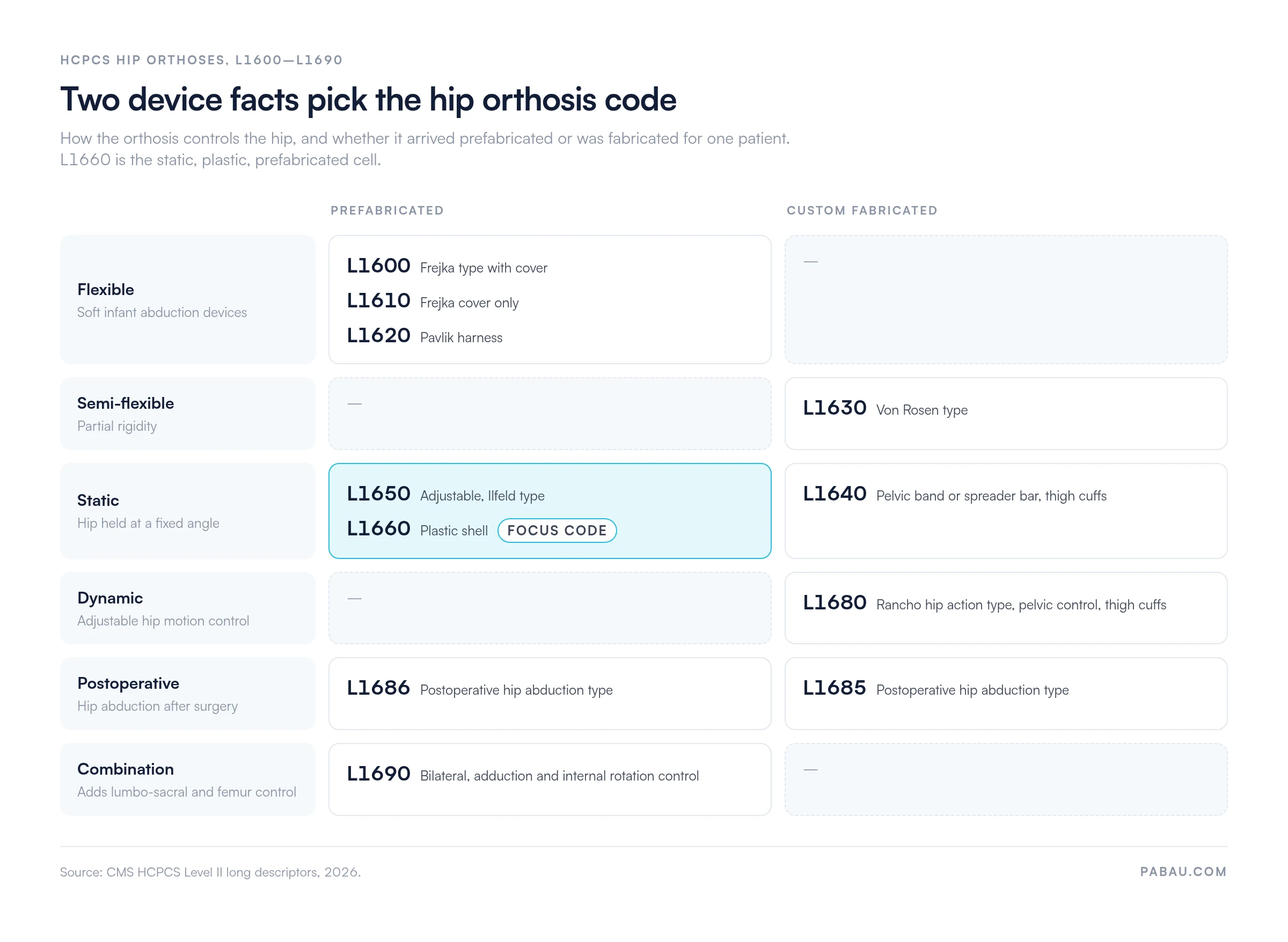
The hip orthosis family runs from L1600 through L1690. The table carries the CMS long descriptor for each code, cross-checked against AAPC’s HCPCS Level II reference. Read the whole wording, not just the first clause.
*CMS closes L1600, L1610 and L1620 with one shared phrase. Each is a prefabricated item trimmed, bent, molded, assembled, or customized to fit one patient by a qualified individual.
Medicare does not universally require prior authorization for prefabricated hip orthoses, but MAC-level policies vary. Run insurance eligibility verification to confirm the MAC jurisdiction’s current policy before delivery. Some jurisdictions have issued special policies requiring advance determination for DMEPOS items above a cost threshold.
Key payer-specific points for L1660 prior authorization:
Suppliers who put prior authorization tracking into the ordering workflow avoid most of this. The check happens before the device is ordered, not after the patient has left with it.
L1660 denials cluster around a predictable set of documentation and coding errors. Understanding the pattern makes most of them preventable. For a full breakdown of the CARC codes tied to these denials, see the guide to denial codes in medical billing.
Track denial reason codes at the code level rather than only by payer, and the pattern surfaces quickly. A biller who sees three KX-modifier denials in a week knows the ordering workflow is missing a sign-off step. Fixing that one step clears most of these denials before the 837P reaches the clearinghouse.
Modifier selection on L1660 claims affects both payment and audit risk. The wrong modifier can trigger an automatic denial. A missing modifier on a covered claim leaves money on the table. Practices that dispense DMEPOS supplies alongside treatment should build modifier logic into their charge-entry templates.
The payer source changes materially depending on patient age. Adult patients are typically covered under Medicare Part B (DMEPOS) or commercial insurance. Pediatric patients are more often covered under state Medicaid programs, including EPSDT (Early and Periodic Screening, Diagnostic, and Treatment) benefits. That applies especially to congenital hip dysplasia and Legg-Calve-Perthes disease.
Key differences in the billing approach:
Audit your last 10 L1660 claims and check three things: (1) Is the WOPD date before the delivery date on every claim? (2) Does the KX modifier appear on all Medicare claims where documentation is complete? (3) Is the ICD-10 code in the current MAC LCD? Fixing these three points clears the most common causes of preventable L1660 denials.
Most DMEPOS suppliers find an L1660 coding error only when the remittance arrives. By then the device has been delivered, the order is weeks old, and the appeal needs paperwork nobody collected at the time.
Pabau moves that check to the point of care. The order, the face-to-face note and the linked diagnosis sit on the same patient record. A claim cannot leave the practice with a written order missing. Modifier logic runs as the charge is entered, so a Medicare claim that meets LCD criteria carries KX before anyone reviews it.
Claims then go out electronically through the Claim.MD integration, with ICD-10 and HCPCS pairing checked before the 837P file leaves the practice. Suppliers billing across several MAC jurisdictions get one view of which denial reasons keep repeating. That points at the workflow step to fix, rather than another claim to rework.

Pabau checks DMEPOS modifier requirements at charge entry, flags orders that are missing a signature, and submits clean 837P claims electronically. See how it handles orthotic billing.

L1660 has a narrow descriptor, yet the documentation and modifier rules around it create steady denial exposure for DMEPOS suppliers. Four checks account for most avoidable losses on hip orthosis claims. They are the written order prior to delivery, the KX modifier, an LCD-matched diagnosis, and the L1660-versus-L1680 call. Get the fabrication method from the invoice before you code, and that last one stops being a risk.
Pabau builds HCPCS modifier logic and pre-submission scrubbing into the billing workflow, so L1660 errors surface before the 837P leaves the practice. Book a demo to see how it handles DMEPOS claim workflows end to end.

Need a full denial workflow? Denial management in healthcare covers the end-to-end process of tracking, appealing, and preventing claim denials across payer types.
Submitting claims electronically? Pabau’s Claim.MD clearinghouse integration explains how 837P electronic claim submission works with real-time eligibility checking.
Want to understand the wider revenue cycle? Revenue cycle management explained walks through every step from patient registration through payment posting.
HCPCS code L1660 covers a prefabricated, static, plastic hip orthosis that provides abduction control of the hip joints, including fitting and adjustment. It does not cover custom-fabricated devices or dynamic designs with adjustable hip motion control. Those route to other codes in the family. L1680 covers a custom-fabricated Rancho hip action orthosis, and L1685 covers a custom postoperative hip abduction orthosis.
Medicare requires a written order prior to delivery (WOPD), signed by the prescribing clinician. It also requires a face-to-face evaluation note and a medical necessity narrative in the clinical record. The order itself must carry the device specifications. The WOPD has to be signed and dated before the device is dispensed.
Medicare does not universally require prior authorization for L1660. Individual MAC jurisdictions may still have advance determination policies. A replacement device within the frequency period typically needs prior authorization. Always verify the current policy with your MAC before delivery.
Commonly covered ICD-10-CM diagnoses include Q65.0-Q65.2 for congenital hip dysplasia and M16.0-M16.9 for hip osteoarthritis. M87.05-M87.059 covers avascular necrosis of the femoral head, and M91.10-M91.12 covers Legg-Calve-Perthes disease. Fracture codes in the S72 range support post-operative stabilization. Confirm covered diagnoses against the applicable MAC LCD before billing.