HCPCS code P9058: Red blood cells, leukocytes reduced, CMV-negative, irradiated
HCPCS code P9058: Official descriptor and key attributes HCPCS code P9058 report...

Last Updated: Oct 26, 2026
L1686 is the HCPCS Level II code for hip orthosis, abduction control of hip joint, postoperative hip abduction type, prefabricated, includes fitting and adjustment. A custom-fabricated version of the same device is billed with L1685.
Most denials trace back to two mistakes: Missing documentation (physician order, medical necessity records) or billing the prefabricated code for a custom-fabricated device.
Let Pabau's smart automation suggest the right codes, reduce claim denials, and keep your practice compliant—effortlessly.
Automate repetitive tasks and focus on what matters most—your patients.
Reduce coding errors and ensure compliance with the latest regulations.
Clean claims, fewer denials, and faster reimbursements.
Powerful insights and reporting to help your practice thrive.
HIPAA compliant SOC 2 certified GDPR-compliant Trusted by 4,000+ clinics worldwide

HCPCS code L1686 covers a prefabricated postoperative hip abduction orthosis, including fitting and adjustment, billed under the Medicare Part B DME benefit.
Medical necessity must be supported by a physician order, clinical notes and ICD-10-CM diagnosis codes. The codes should tie to a qualifying condition such as total hip replacement or hip fracture repair. No CMN applies to L1686.
A custom-fabricated postoperative hip abduction orthosis is billed with L1685, so match the code to how the device was made.
From October 15, 2026, the nationwide PPA program will require prior authorization for L1686 only from newly enrolled or fully re-owned DMEPOS suppliers.
Pabau’s claims management software helps DME suppliers and orthotics practices track documentation status and submit clean L1686 claims electronically.
HCPCS code L1686 covers a hip orthosis for abduction control of the hip joint, postoperative hip abduction type, prefabricated, including fitting and adjustment. The key word is prefabricated: The device is manufactured as a finished item and fitted to the patient. It is not custom fabricated to a patient-specific mold.
A custom-fabricated postoperative hip abduction orthosis is billed with L1685 instead. Billing L1686 for a custom-fabricated device misuses the code and creates audit risk.
The code bundles fitting and adjustment into the allowable. Orthotist time spent adjusting range-of-motion stops or padding after dispensing is not billable on top of L1686. The exception is a distinct, separately payable service.
L1686 sits in the L-series of HCPCS Level II codes, which covers orthotic and prosthetic devices. Medicare pays it under Part B as durable medical equipment (DME). According to the Centers for Medicare and Medicaid Services (CMS) HCPCS overview, Level II codes cover items and services billed outside the physician fee schedule.
L1686 is appropriate when a physician orders a prefabricated hip abduction orthosis to control hip position after qualifying orthopedic surgery. The most common scenario is total hip replacement (hip arthroplasty). Holding the hip in abduction reduces the risk of prosthetic dislocation during early recovery.
Other indications include hip fracture repair (ORIF or hemiarthroplasty), hip labral repair, and periacetabular osteotomy where postoperative abduction positioning is clinically indicated. Per the DME MAC documentation requirements, the medical record should show the diagnosis and why abduction control is needed.
Supporting ICD-10-CM diagnosis codes that pair with L1686 claims include:
The diagnosis code must reflect the patient’s condition at the time of dispensing. Payers flag a medical necessity mismatch in two common cases. One is a pre-operative code used after surgery. The other is an osteoarthritis code used when the device was ordered for post-fracture management. Structured medical billing workflows that link the dispensing event to the post-operative note make this error far less likely.
The L-series contains several hip orthosis codes that are easy to confuse. The wrong code causes repeat denials and can lead to overpayment findings on audit. The prefabricated versus custom-fabricated split matters most.
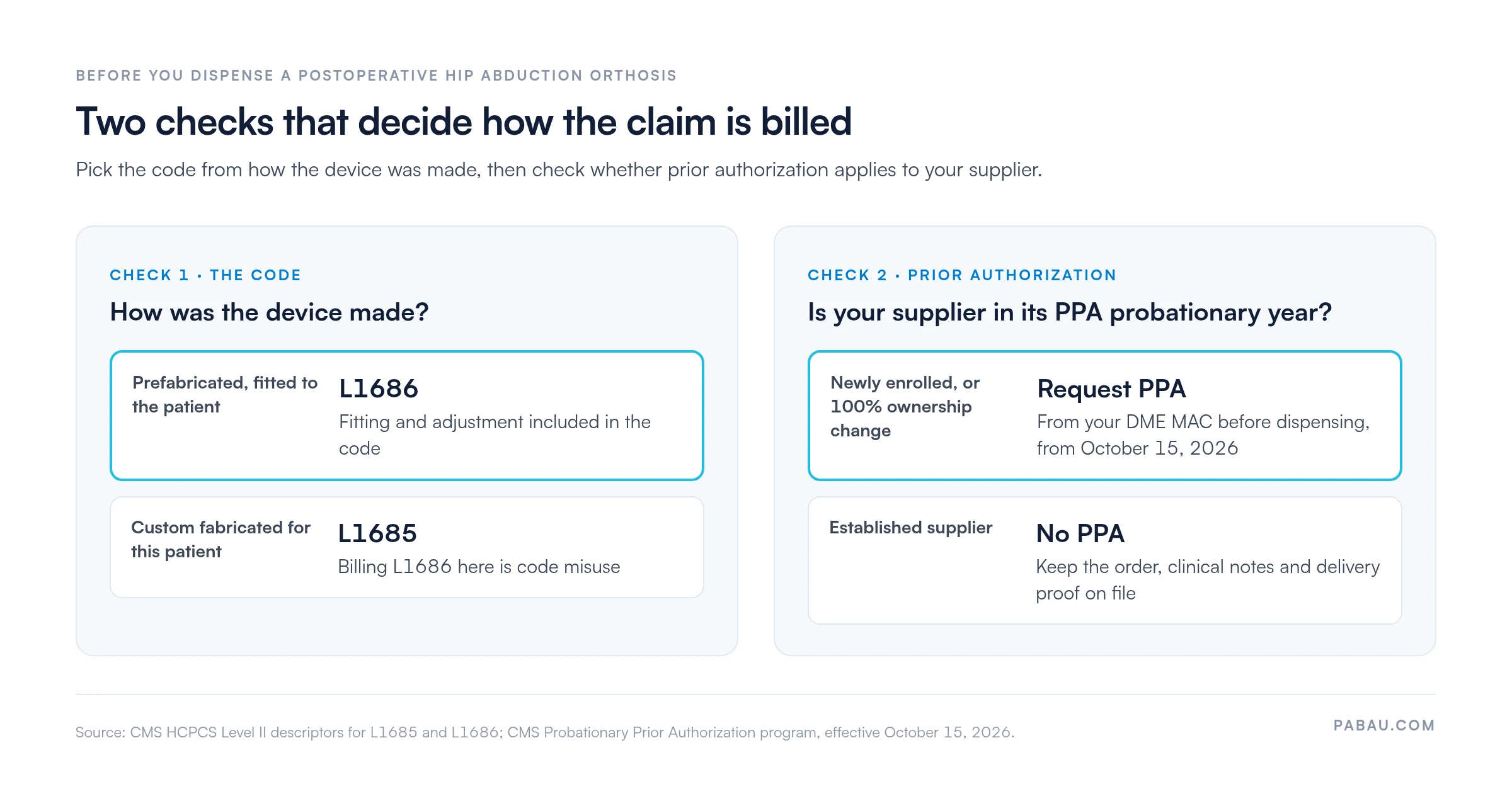
Both L1685 and L1686 describe a postoperative hip abduction orthosis. What separates them is fabrication. L1685 is custom fabricated for the patient, while L1686 is prefabricated and includes fitting and adjustment.
Billing L1686 for a custom-fabricated device is misuse, and billing L1685 for a stocked prefabricated brace is upcoding. Two checks settle the claim before the device leaves your hands, as the chart below shows.
When a device is dispensed before surgery and used afterward, keep both the operative report date and the dispensing date in the file.
Medicare covers L1686 under Part B as a DME item when three conditions are met. The device must be medically necessary, ordered by a treating physician, and dispensed by an enrolled DME supplier. Claims go to the DME MACs: Noridian (Jurisdictions A and D) and CGS (Jurisdictions B and C). Palmetto GBA is the PDAC, which handles coding verification and is not a DME MAC.
Medical necessity criteria typically require all of the following to be documented:
CMS lists L1686 under the nationwide Probationary Prior Authorization (PPA) program, which takes effect October 15, 2026. It will apply only to newly enrolled DMEPOS suppliers, or suppliers with a 100% ownership change, during a one-year probationary period.
A supplier in that window will request a decision from its jurisdictional DME MAC (JA/JD Noridian, JB/JC CGS) before dispensing. Established suppliers will not be subject to it. Confirm your enrollment status and the current code list with your DME MAC before the start date.
Medicare Advantage plans, Medicaid managed-care plans and commercial payers may apply additional criteria. Checking insurance eligibility before dispensing is standard practice for high-value DME items.
A complete file before the claim goes out prevents most L1686 denials. Required documentation includes:
Keeping this file organized is easier with billing compliance workflows that flag missing documents before the claim submission window closes.
L1686 claims are submitted on the CMS-1500 claim form (paper) or the 837P electronic transaction. DME suppliers billing Medicare submit to their jurisdictional DME MAC. The following steps reflect standard billing practice for prefabricated hip orthoses.
A wrong or missing modifier is a common reason an L1686 claim comes back. The following table covers the modifiers suppliers most often consider for this code.
Check your DME MAC’s modifier requirements before each billing cycle. Noridian and CGS, the DME MACs, publish modifier guidance in their policy articles. Read the current article for L1686 rather than relying on a modifier list from another code.
L1686 denials cluster around a predictable set of root causes, and most are preventable with a pre-submission checklist. For denial patterns across DME codes, the denial management in healthcare guide covers the underlying causes and appeal strategies.
Medicare reimburses L1686 as a purchased DME item under the DMEPOS fee schedule, which CMS updates each year. Fee schedule amounts vary by state, within national floors and ceilings. The current allowable is published on the CMS DMEPOS fee schedule page.
Look up the current allowable in the DMEPOS fee schedule before quoting patients or planning revenue, because rates update annually on January 1. Commercial rates vary by contract.
Medicaid rates are set by individual states. Tracking allowed versus billed amounts by payer shows underpayment patterns quickly, so you can renegotiate or appeal with data in hand.
Look up L1686 fee schedule amounts using the CMS DMEPOS fee schedule search, not the Physician Fee Schedule lookup. These are separate tools. The Physician Fee Schedule lookup returns RVU-based rates for physician services. DMEPOS items including L-series orthotics are priced separately under the DMEPOS fee schedule and will not appear in the Physician Fee Schedule results.
Physical and occupational therapists in outpatient orthopedic settings often treat L1686 post-operative patients. The billing role belongs to the enrolled DME supplier, though. The treating therapist or physician’s practice bills L1686 only if that practice is also an enrolled DMEPOS supplier.
Therapists in practices that also dispense orthotics in-house should confirm their employer’s DMEPOS enrollment status before submitting any L-series codes. Billing L1686 under a non-enrolled NPI results in a denial and can trigger a compliance review. Software that separates DME billing from clinical service billing at the encounter level keeps the two apart.
Most orthotics teams keep the physician order, the operative note and the signed delivery ticket in different places. A claim can then go out before the delivery proof is filed, and it comes back denied weeks later.
Pabau, the practice management and billing platform we build, keeps those documents against the patient record. It runs validation checks in the background every time you send a claim. US practices can also run eligibility checks and post ERA remittances in the same place.
Each claim then moves through clear stages, from pending to paid or error, so your team sees which L1686 claims need attention. The outcome is fewer resubmissions and less time chasing paperwork after the brace has gone home.
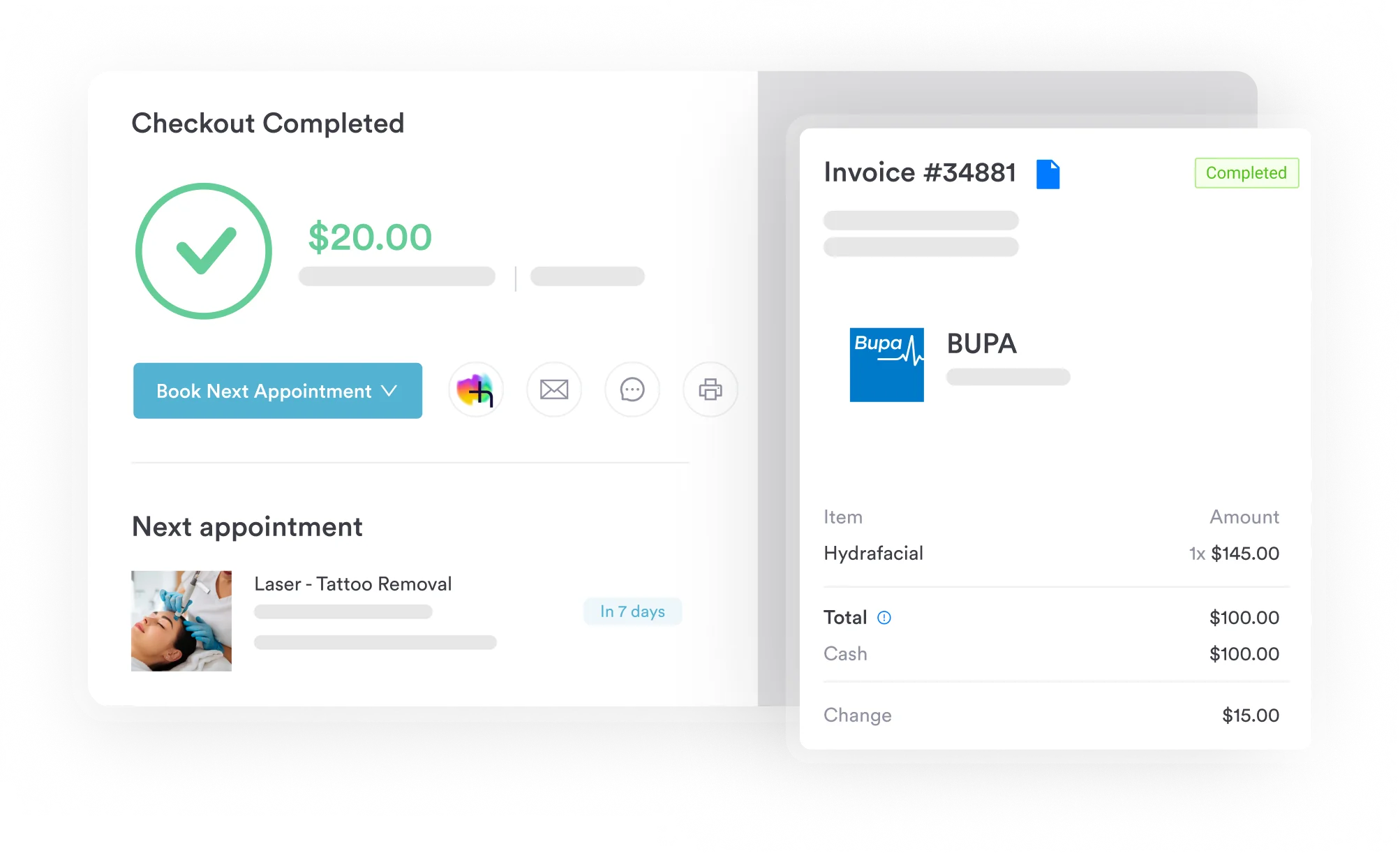

Pabau’s claims management tools help orthotics and DME suppliers track documentation status and submit clean HCPCS claims electronically, so fewer claims come back denied.

HCPCS code L1686 has a narrow descriptor, so the risk sits around it rather than in it. The PPA program for new suppliers, the documentation requirements, and the prefabricated-versus-custom distinction each produce predictable denials when overlooked.
Make the order, clinical notes and delivery proof a hard stop before any claim goes out. If your supplier enrolled recently, plan for PPA before October 15, 2026, not after the first denial.
Want those documents and your claims tracked in one place? Book a demo to see how Pabau keeps DME billing clean from order to payment.

Need to understand how clean claims reduce rework? What makes a clean medical claim covers the submission standards that prevent the most common DME billing rejections.
Managing billing across multiple payers? Revenue cycle management explained walks through the end-to-end process from order to payment posting.
Tracking denials across your orthotic code set? Denial codes in medical billing maps the most common CARC/RARC combinations and how to respond to each.
Billing a bilateral hip-femur orthosis? HCPCS code L1690 billing guide covers the prefabricated lumbo-sacral hip-femur orthosis.
Dispensing a dynamic abduction brace instead? HCPCS code L1680 billing guide explains when the hip abduction orthosis code applies.
HCPCS code L1686 is the billing code for a prefabricated hip orthosis for postoperative abduction control of the hip joint, including fitting and adjustment. Enrolled DMEPOS suppliers bill it under Medicare Part B as durable medical equipment.
L1686 covers a prefabricated postoperative hip abduction orthosis, also called a hip abduction brace. The device is manufactured as a finished item and fitted to the patient. A brace custom fabricated to a patient-specific mold is billed with L1685 instead.
Yes, Medicare covers L1686 under Part B as a DME item when a treating physician orders it and the record supports medical necessity. The device must be prefabricated and dispensed by an enrolled DMEPOS supplier. From October 15, 2026, newly enrolled suppliers and suppliers after a 100% ownership change will need PPA approval before dispensing.
You need a signed physician order that meets the DME MAC documentation requirements, clinical notes supporting the postoperative diagnosis, and a signed delivery ticket. Keep PPA approval on file where the program applies. Device documentation confirming the item is prefabricated is also needed.
Both codes describe a postoperative hip abduction orthosis, and the difference is fabrication. L1685 is custom fabricated, while L1686 is prefabricated and includes fitting and adjustment. Billing L1686 for a custom-fabricated device is misuse, and billing L1685 for a stocked prefabricated brace is upcoding.
Only for newly enrolled suppliers or after a 100% ownership change, from October 15, 2026. Under the nationwide PPA program, those suppliers will request a decision from their DME MAC before dispensing during a one-year probationary period. Established suppliers will not be subject to it.
Common causes are missing prior authorization where PPA applies, a missing order or delivery proof, and mismatched ICD-10-CM codes. Billing the wrong fabrication code is another, such as L1686 for a custom-fabricated brace. Medical necessity denials occur when notes omit the surgery performed and the rationale for abduction control.