CCSD code G5100: Bypass of duodenum billing guide
CCSD code G5100 bills a bypass that leaves the duodenum in place CCSD code G5100...

Last Updated: Oct 16, 2026
L0635 is the HCPCS Level II code for a prefabricated lumbar-sacral orthosis (LSO) with sagittal-coronal control and a lumbar flexion design. A rigid posterior frame runs from the sacrococcygeal junction to T-9, rigid lateral frames add strength, and a lateral articulating design flexes the lumbar spine. Fitting and adjustment at dispensing are included in the code.
L0636 describes the same design when it is custom fabricated for one patient. Medicare Part B covers L0635 as durable medical equipment (DME) under the DME MAC spinal orthoses LCD. Other payers set their own documentation and prior authorization rules.
Let Pabau's smart automation suggest the right codes, reduce claim denials, and keep your practice compliant—effortlessly.
Automate repetitive tasks and focus on what matters most—your patients.
Reduce coding errors and ensure compliance with the latest regulations.
Clean claims, fewer denials, and faster reimbursements.
Powerful insights and reporting to help your practice thrive.
HIPAA compliant SOC 2 certified GDPR-compliant Trusted by 4,000+ clinics worldwide

HCPCS Code L0635 covers a prefabricated lumbar-sacral orthosis with sagittal-coronal control and a lumbar flexion design. Its custom-fabricated counterpart is L0636.
Medicare Part B covers L0635 as DME when the record meets the medical necessity criteria in the DME MAC spinal orthoses LCD.
Missing or incomplete documentation, such as the written order, the face-to-face note or proof of delivery, is the leading cause of L0635 claim denials.
The fabrication method decides the code, so supplier records must show whether the brace was prefabricated or custom fabricated.
Pabau’s claims management software keeps orders, signed forms and claim status on the patient record, so files get checked before submission.
HCPCS Code L0635 describes a prefabricated lumbar-sacral orthosis (LSO) with sagittal-coronal control and a lumbar flexion design. A rigid posterior frame and rigid lateral frames support the spine, and a lateral articulating design flexes the lumbar spine.
The code sits within the HCPCS Level II L-code series maintained by the Centers for Medicare and Medicaid Services (CMS). That series runs from L0100 to L9900. Orthotics occupy L0100–L4999, and prosthetics occupy L5000–L9900.
The word that separates L0635 from L0636 is “prefabricated.” The manufacturer builds the brace in standard sizes before the patient encounter. The supplier fits and adjusts it for the patient at dispensing, and that fitting is bundled into the code. When the same design is custom fabricated for one patient, the correct code is L0636 instead.
The official CMS descriptor for L0635 is one long sentence, so the list below breaks it into six groups. In appeal letters, quote the full descriptor verbatim from the CMS HCPCS file rather than paraphrasing it.
Key construction requirements follow from those elements. The brace needs a rigid posterior frame that reaches T-9 and rigid lateral support. It also needs the articulating mechanism that flexes the lumbar spine. A soft corset, an elastic support, or a rigid brace without the flexion design does not meet this standard.
The anterior panel is optional, which separates L0635 from L0637 and its required rigid anterior and posterior frame. “Prefabricated” means the brace was manufactured before the patient encounter, not built from a patient-specific cast or measurements.
Understanding what is bundled into L0635 prevents both undercoding and the upcoding errors that trigger audits. The code reimburses a single unit of service that includes the following.
Included in L0635:
Not covered by L0635 (bill separately or not at all):
Billing a prefabricated brace as custom fabricated (L0636) is upcoding, and orthotic coding errors draw close audit attention. The supplier’s delivery and fabrication records must support whichever code is billed.
Three neighboring LSO codes are easy to confuse with L0635. Three questions separate them, asked in order: which planes the brace controls, how its frame is built, and how it was made. The decision path below walks through them, and the table after it maps each code to its defining characteristics.
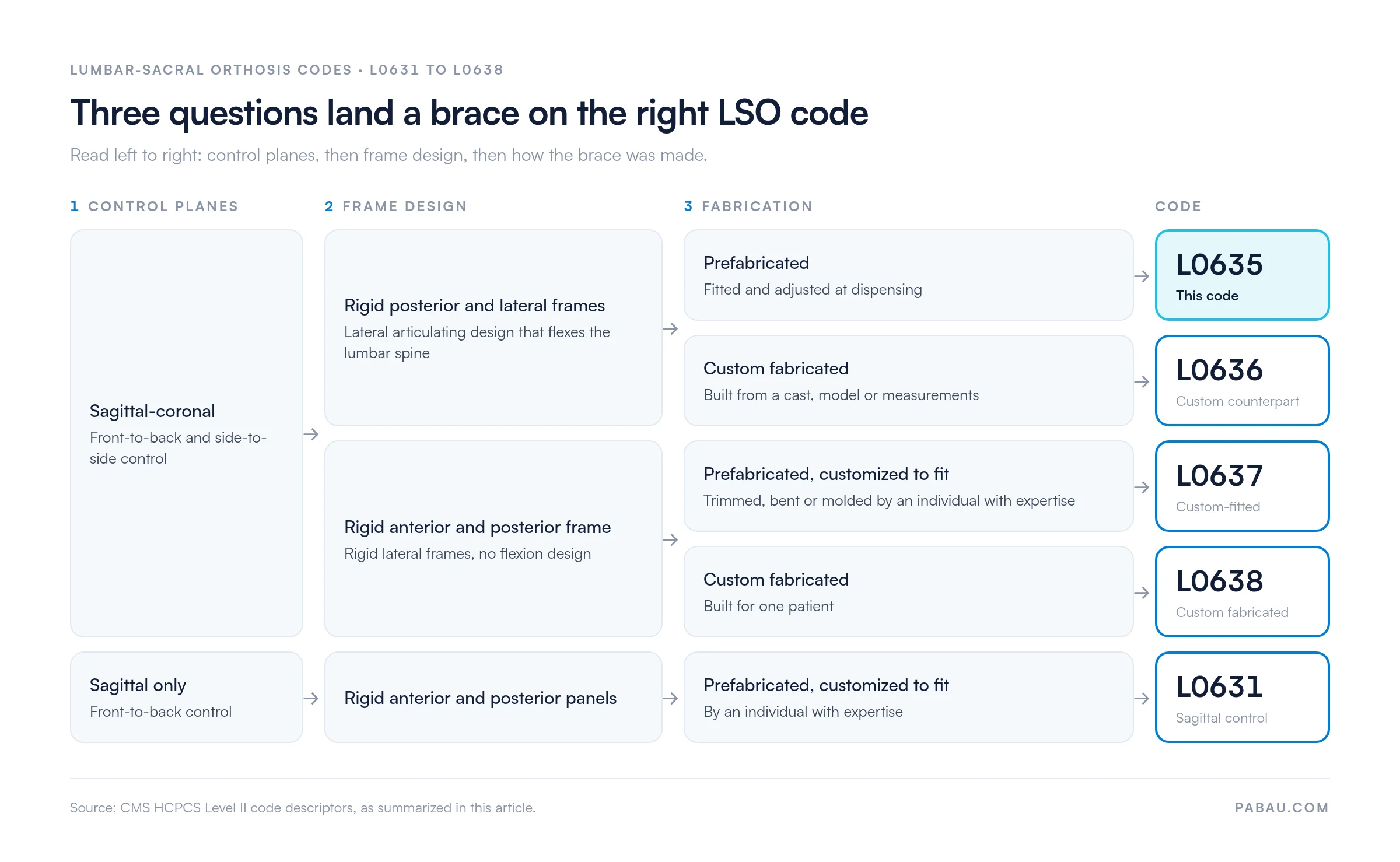
The most audited error in this group is a fabrication mismatch between L0635 and L0636. Billing L0636 for a stock brace is upcoding, and billing L0635 for a brace built to measurements misstates the device.
Suppliers must retain fabrication records, model numbers, and fitting notes to support the code on audit. When in doubt, contact your DME MAC or the PDAC for coding verification.
Medical necessity for HCPCS Code L0635 rests on the diagnosis and the clinical notes behind it. The DME MAC spinal orthoses LCD, L33790, covers an LSO ordered for one of four reasons.
The LCD sets indications rather than a list of covered codes, so the diagnosis has to support one of them. The ICD-10-CM codes below are commonly used. Verify them against the current LCD and the payer’s own policy before billing.
Specificity matters. Some payers reject a nonspecific low back pain code as too weak to justify an LSO brace, particularly in post-acute or elective contexts.
The more specific codes need matching notes. Use M54.51 when imaging supports a vertebral source of pain, and M51.16 only when the record documents radiculopathy.
All four DME MAC jurisdictions publish the same spinal orthoses LCD. Noridian administers Jurisdictions A and D, while CGS administers the other two. Medicare Advantage plans and commercial payers may keep their own diagnosis lists, so check each plan’s policy.
Medicare Part B covers L0635 as a DME benefit when the ordering physician or qualified non-physician practitioner establishes medical necessity in the patient’s medical record. Coverage is governed by the applicable DME MAC LCD for spinal orthoses.
Reimbursement is paid at the DMEPOS fee schedule allowable rate. That rate changes annually. Never use a figure from a prior year’s fee schedule or a third-party estimate as if it is current.
Look up L0635 in the CMS DMEPOS fee schedule files for the payment year, which list the allowable for each state. Building that check into your medical billing compliance routine each January keeps old rates off new claims.
Ordering provider requirements: L0635 is on the CMS Required Face-to-Face Encounter and Written Order Prior to Delivery list. The treating practitioner must see the patient face to face within the six months before the written order. The ordering provider must be enrolled in Medicare and must document findings that support the medical necessity of external spinal stabilization.
Nurse practitioners, physician assistants, and clinical nurse specialists may order DME. Payers vary on whether they recognize all provider types, so verify with the specific payer.
Incomplete documentation is the leading driver of L0635 claim denials on audit. Every element below must be in the file before the claim is submitted. Assemble it at dispensing, so a post-payment review months later finds a complete file.
Retain all documentation for a minimum of seven years. DME claims are subject to post-payment review by Recovery Audit Contractors (RACs) and the Targeted Probe and Educate (TPE) program. Both can request records well after initial payment.
Denial patterns for HCPCS Code L0635 are consistent across DME MAC jurisdictions. Understanding the root cause of each denial shortens the appeals cycle. Robust denial management in healthcare depends on catching these issues before submission rather than after.
Medicare’s spinal orthoses policy article (A52500) requires no modifier on L0635, including KX. Its only required modifier, CG, applies to six flexible-brace codes, not L0635. Situational modifiers still matter, such as RA for a replacement or GA when an ABN is on file.
The claims management software your billing team uses should flag missing modifiers before submission. The table below lists the modifiers you may see on an HCPCS Code L0635 claim.
KX modifier note: Some DME MAC policies, such as knee orthoses, require KX to attest that LCD criteria are met. The spinal orthoses policy sets no KX requirement for L0635. Coverage still rests on the documentation, which reviewers check on audit.
Run a documentation checklist before every L0635 delivery and claim. Confirm the written order arrived before delivery and the face-to-face note falls within six months before it. Then check for a signed delivery receipt and a covered diagnosis. Document who performed the check and when. This record protects the practice in a post-payment audit.
HCPCS Code L0635 bundles the device, initial fitting, and basic adjustment into one unit of service. Several scenarios arise where billers incorrectly add separate codes for services that are already included, or miss separately billable accessories that are genuinely allowed.
Never separately bill with L0635:
May be billed separately, when documented:
The National Correct Coding Initiative (NCCI) edits govern bundling relationships between procedure codes. While NCCI edits primarily apply to physician services, DME MACs publish equivalent policy edits for DMEPOS codes. Before billing accessory codes alongside L0635, review the DME MAC billing guidance or ask the PDAC (Pricing, Data Analysis and Coding) contractor.
The AAPC’s HCPCS code lookup tool and the PGM Billing HCPCS lookup are useful references for checking adjacent codes before submission.
L0635 denials usually trace back to the paperwork around the brace. A written order goes missing, a delivery receipt goes unsigned, or a modifier lands on the claim before the file is complete. Billing teams then rebuild the file months later, during a post-payment review.
Pabau, the practice management and billing platform we build, keeps the documentation and the claim side by side. Orders, clinical notes and signed delivery forms sit on the patient record, so your team can check them before the claim goes out.
Claim status and modifiers are tracked in the same place, which makes a pre-submission documentation check part of the routine.
The outcome is fewer avoidable denials and an audit file that is already assembled when a contractor asks for it.

Pabau helps practices and DME suppliers manage documentation, modifiers, and claim status in one place, reducing the admin burden that leads to avoidable denials.

Code L0635 when the brace has the lateral articulating flexion design and arrived prefabricated, then make sure the supplier’s records prove both. If either fact is missing from the file, the claim is exposed, however clean the coding looks.
The practical move is a short check before every LSO claim goes out. Confirm the written order arrived before delivery and the face-to-face note falls within six months before it. Then check for a signed delivery receipt and a diagnosis that supports an LCD indication.
To see how Pabau keeps orders, delivery records and claim status on one patient record for DME billing, book a demo.

Want to understand how claims move from submission to payment? What is revenue cycle management covers the full billing lifecycle, from eligibility verification through remittance posting.
Looking for guidance on handling denied claims? Denial codes in medical billing explains common CARC denial reason codes and how to respond to each.
Billing a custom-made LSO with no flexion design? HCPCS code L0634 covers the custom-fabricated sagittal-coronal LSO with a rigid posterior frame.
Is the brace a sagittal-only LSO? HCPCS code L0631 explains how to bill the custom-fitted sagittal-control brace.
HCPCS Code L0635 covers a prefabricated lumbar-sacral orthosis (LSO) with sagittal-coronal control and a lumbar flexion design. It has a rigid posterior frame, rigid lateral frames, and a lateral articulating design that flexes the lumbar spine. The code includes the device, initial fitting, and basic adjustment at dispensing. It does not cover custom fabrication (L0636), separately billed accessories, or replacement devices, which need the RA modifier on a new claim.
L0635 and L0636 share the same descriptor, with one difference. L0635 is prefabricated and fitted at dispensing, while L0636 is custom fabricated for one patient from a cast, model, or measurements. Billing L0636 for a prefabricated brace is an upcoding error with audit exposure. The supplier’s fabrication and delivery records determine which code applies.
Yes, Medicare Part B covers L0635 as a DME benefit. Medical necessity must be documented, and the claim must meet the DME MAC’s Local Coverage Determination criteria. L0635 is on the CMS face-to-face and written order prior to delivery list. The treating practitioner must see the patient within six months before the order, and the supplier must receive the order before delivery. No KX modifier is required.
The DMEPOS fee schedule allowable rate for L0635 updates annually. No specific dollar figure should be treated as permanently current. Verify the current rate for your state using the CMS DMEPOS fee schedule lookup tool at cms.gov, searching under the current payment year.
Prior authorization requirements for L0635 vary by payer. L0635 is not on the CMS Required Prior Authorization List for traditional Medicare. From October 15, 2026, newly enrolled suppliers and suppliers with certain ownership changes need prior authorization for L0635. That rule comes from the CMS DMEPOS Probationary Prior Authorization List. Medicare Advantage plans and commercial insurers may impose their own PA requirements. Always verify PA obligations with the specific payer before dispensing the device.
Required documentation includes a signed written order received before delivery and a face-to-face note from the six months before that order. You also need medical necessity justification, such as imaging and functional findings, a signed proof-of-delivery receipt, and a fitting note. Some commercial payers also ask for their own medical necessity form. All records must be on file before the claim is submitted.
No other LSO code (such as L0631, L0636, or L0637) can be billed on the same claim for the same patient for the same device. Separately billable accessory codes may apply for replacement components after the initial dispensing, but these must be verified against the applicable DME MAC policy. The initial fitting and adjustment are bundled into L0635 and cannot be billed separately.