CPT code 54162: Lysis of penile post-circumcision adhesions
CPT code 54162: official descriptor and procedure overview CPT code 54162 is def...

Last Updated: Oct 20, 2026
L0634 is the HCPCS Level II code for lumbar-sacral orthosis, sagittal-coronal control, with rigid posterior frame/panel(s), posterior extends from sacrococcygeal junction to t-9 vertebra, lateral strength provided by rigid lateral frame/panel(s), produces intracavitary pressure to reduce load on intervertebral discs, includes straps, closures, may include padding, stays, shoulder straps, pendulous abdomen design, custom fabricated.
Let Pabau's smart automation suggest the right codes, reduce claim denials, and keep your practice compliant—effortlessly.
Automate repetitive tasks and focus on what matters most—your patients.
Reduce coding errors and ensure compliance with the latest regulations.
Clean claims, fewer denials, and faster reimbursements.
Powerful insights and reporting to help your practice thrive.
HIPAA compliant SOC 2 certified GDPR-compliant Trusted by 4,000+ clinics worldwide

HCPCS Code L0634 covers a custom-fabricated lumbar-sacral orthosis (LSO) with sagittal-coronal control and a rigid posterior frame extending from the sacrococcygeal junction to T-9.
The brace has to be built from a cast or from measurements. Billing L0634 for a stock brace adjusted at delivery is upcoding.
L0637 and L0639 are the custom-fitted codes for a prefabricated device modified at the point of delivery.
A Certificate of Medical Necessity must be on file before submission, and the diagnosis must appear on your contractor’s coverage list.
Practice management software like Pabau tracks the order, the CMN, and the delivery receipt against each DMEPOS claim before it goes out.
The code is maintained by the Centers for Medicare and Medicaid Services (CMS) as part of the DMEPOS code set. CMS publishes a long descriptor for every L code, and that wording is what an audited claim gets measured against.
Lumbar-sacral orthosis (LSO), sagittal-coronal control, with rigid posterior frame/panel(s), posterior extends from sacrococcygeal junction to T-9 vertebra, lateral strength provided by rigid lateral frame/panel(s), produces intracavitary pressure to reduce load on intervertebral discs, includes straps, closures, may include padding, stays, shoulder straps, pendulous abdomen design, custom fabricated.
Two phrases in that descriptor do most of the work. Sagittal-coronal control means the brace limits motion front-to-back and side-to-side, not front-to-back alone. Custom fabricated means the device was built from raw materials, using a cast or measurements of the patient’s body.
Both phrases are coding criteria rather than product marketing. A brace that misses either one belongs under a different code in the range, and the difference in payment is what auditors look for.
Medicare covers HCPCS Code L0634 when the orthosis is medically necessary for a covered diagnosis. Coverage is governed by the applicable Local Coverage Determination (LCD) and CMS Policy Article A52500 on Spinal Orthoses.
The conditions below are the ones most commonly associated with L0634 claims. Coverage still turns on the LCD in force for your contractor jurisdiction.
Every L0634 claim needs a supporting ICD-10 diagnosis code that maps to a covered condition. The table below lists the diagnoses paired with L0634 most often. Our ICD-10-CM code library carries the full official descriptor for each one, which is worth checking because covered diagnoses vary by Medicare Administrative Contractor (MAC).
L0634 is paid under the Medicare DMEPOS fee schedule, which CMS updates every year. Custom-fabricated spinal orthoses pay more than prefabricated devices, because of the labor and materials that go into building one.
The 2026 allowed amount varies by geographic pricing region, since the schedule applies a locality-based payment adjustment.
For exact figures, work from the CMS DMEPOS fee schedule. Published rates change every January 1. Never take a specific dollar amount from a third-party listing without checking it against the official CMS fee file for the current year.
State Medicaid programs set their own rates independently of Medicare. If you bill both, keep a separate fee schedule reference for each one. Lumbar orthosis reimbursement is a flagged category for Medicaid audits in several states, so the extra step is worth taking.
Pull the current CMS DMEPOS fee file each January and load the allowed amount for your locality into your billing system. Practices that keep billing on prior-year rates usually find the underpayment or overpayment during an audit, long after the correction window has closed.
Custom-fabricated DMEPOS items attract closer scrutiny than off-the-shelf equipment. The payment is larger, and the custom distinction is hard for a reviewer to verify without records.
Documentation on an L0634 claim has to establish three things. The device was necessary, it was custom-fabricated rather than prefabricated, and a qualified supplier provided it. Missing any one of the three is enough to deny the claim or trigger a recoupment later.
A CMN is a standardized CMS form, completed by the ordering physician, that certifies medical necessity for a covered item.
For custom-fabricated spinal orthoses including L0634, it has to be on file with the supplier before the claim goes out. The form captures the diagnosis, the expected length of need, and the physician’s attestation that the item is medically required.
Under CMS Policy Article A52500, a supplier that bills without a valid CMN on file faces claim denial. In an audit, that also means recoupment of amounts already paid.
The CMN must be signed by the treating physician, not by the supplier or the patient, and it cannot be backdated. If the patient’s condition changes and a new period of medical necessity begins, the physician completes a new one.
Auditors treat the form as evidence rather than paperwork, and they routinely deny claims where it is unsigned, undated, or completed by the wrong person.
Modifiers are required on most DMEPOS claims to communicate purchase type, condition, and coverage status. Using the wrong one, or omitting a required one, is among the most common reasons an L0634 claim stalls.
The table below covers the modifiers used most often with this code. The AAPC HCPCS code reference carries the full list with current descriptions.
The KX modifier carries particular weight. Appending it to an L0634 claim declares that documentation meeting coverage criteria exists in the supplier’s file. An auditor who pulls a KX-modified claim and finds thin documentation can deny it and refer the case for further review. Only append KX when the file genuinely meets every LCD requirement.
The L0628 to L0640 range covers lumbar-sacral orthoses at different control levels and fabrication methods. Picking the wrong code, even by one position, produces underpayment or an upcoding allegation. Three attributes separate them: rigidity, the planes of motion controlled, and how the device was made.
The custom-fabricated versus prefabricated distinction is the highest-risk coding decision in this range. Billing L0634 for a device bought in a stock size and adjusted at delivery is upcoding, however carefully the fitting was documented. L0637 is the code that exists for a prefabricated item custom-fitted at the point of delivery.
A stock brace dispensed with no expert fitting at all is off-the-shelf. That points to L0649, which carries the same descriptor as L0634 and differs only in fabrication.
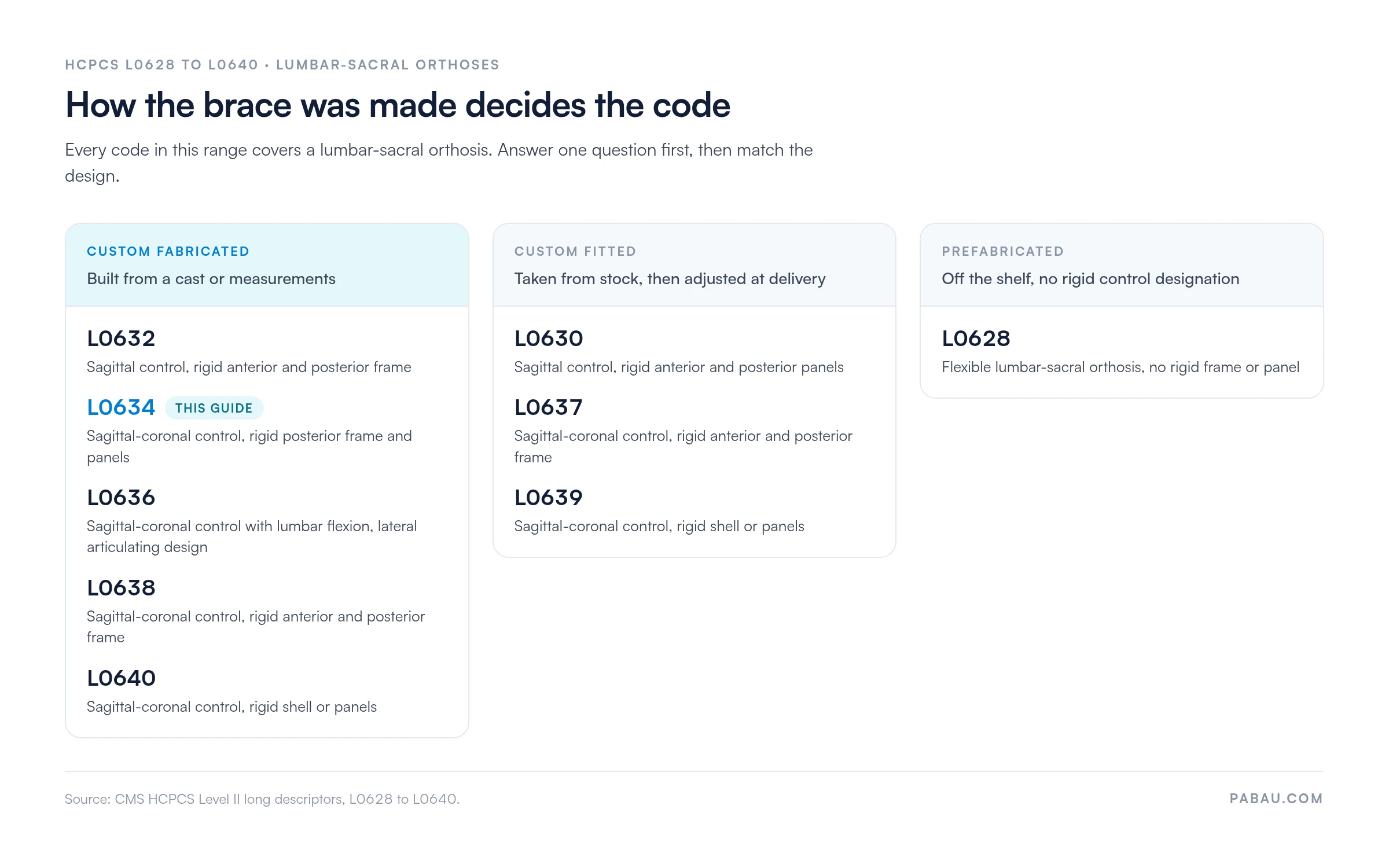
So the fabrication route decides the code before the design does. A brace made from scratch on a cast or a set of measurements sits in the custom-fabricated column with L0634. A rigid-shell LSO with sagittal-coronal control built the same way is billed as HCPCS code L0640.
One taken from inventory and modified sits under L0637 or HCPCS code L0639, depending on whether it uses a rigid frame or a rigid shell. The grid below sorts the whole range by that single question.
DMEPOS claims for custom-fabricated orthoses fail at a higher rate than most other Part B claims. For L0634 the pattern is consistent: the records do not clearly support the diagnosis, the fabrication, or both. The guidance below covers the denial reasons that come up most and how to head them off.
Most L0634 denials fall into three categories: missing documentation, non-covered diagnoses, and coding errors. Denial management for DMEPOS claims needs a workflow that catches these before submission rather than after.
Getting the claim right the first time is faster and cheaper than working a denial. The resubmission cycle typically adds 30 to 60 days to the payment timeline. It also spends staff hours on appeals that the practice never bills for.
Audit your own L0634 claims once a quarter. Pull a sample of 10 claims. Check each one for a signed CMN, a fabrication record, and a proof of delivery. Then confirm the ICD-10 code matches the applicable LCD. Finding a missing document in-house costs far less than finding it during a Medicare audit.
DMEPOS billing for custom orthoses carries more documentation steps than most other Medicare Part B claims. A supplier is tracking physician orders, CMN status, fabrication records, delivery receipts, and modifiers across dozens of active cases at once. Miss one document and a payment can reverse months after it arrived.
Practice management software like Pabau keeps each of those records attached to the patient and to the claim. Pabau’s tools for cleaner claims management hold document attachments, modifier detail, and claim status in one view. Your team can confirm the CMN, the fabrication record, and the correct modifier are all on file before the claim leaves the building.
For a supplier filing high-dollar custom orthoses every month, that adds up quickly. A lower first-pass denial rate shortens the payment cycle and takes appeal work off your billers. Your team spends its day on patients instead of paperwork.

Pabau tracks documentation, modifiers, and claim status in one place, so your team spends less time chasing records and more time delivering care. See how it works for orthotic providers.

One question decides an L0634 claim. Was this brace built for this patient, or bought in a size and adjusted to fit? Answer it before the device is made, not after a denial lands. That answer sets the code, the records you have to keep, and the audit exposure you carry for years.
If the brace was built for the patient, the file has to prove it. Measurements, casting notes, and lab work orders are what turn a custom-fabrication claim into a paid one. If it came off the shelf, L0637 or L0639 pays less and holds up under review, which is the better trade.
Suppliers filing these claims every month get further with a system that holds the paperwork than with a filing cabinet and a spreadsheet. Book a demo to see how Pabau tracks the CMN, the fabrication record, and the delivery receipt against every DMEPOS claim.

Need a primer on how medical billing works end to end? What is medical billing follows the process from patient encounter through to payment, including DMEPOS considerations.
Building a compliance-first billing operation? Medical billing compliance covers HIPAA requirements, documentation standards, and audit readiness for healthcare suppliers.
Chasing a higher first-pass acceptance rate? Clean claim sets out what a payer checks on submission and how to clear those checks every time.
Capturing every billable element at the point of service? Superbill breaks down the fields a complete charge document needs before it reaches billing.
HCPCS Code L0634 is used to bill a custom-fabricated lumbar-sacral orthosis (LSO) with sagittal-coronal control. Its rigid posterior frame extends from the sacrococcygeal junction to the T-9 vertebra. It is a DMEPOS Level II code billed to Medicare and other payers. A physician orders this type of back brace for a covered diagnosis such as lumbar spinal stenosis, degenerative disc disease, spondylolisthesis, or post-surgical spinal stabilization.
Yes, Medicare covers L0634 when medical necessity is documented and the claim meets the Local Coverage Determination for the supplier’s MAC jurisdiction. The device must be custom-fabricated rather than prefabricated. The ordering physician must complete a Certificate of Medical Necessity, and the diagnosis must appear on the covered diagnosis list in the LCD. Claims that miss any of those three conditions are typically denied.
You need a written physician order, a completed and signed Certificate of Medical Necessity (CMN), and medical records establishing the covered diagnosis. You also need fabrication records showing the device was made to order, which means measurements, casting notes, or lab work orders. Fitting notes and a signed proof of delivery complete the file. Every document has to be on file with the supplier before the claim goes to Medicare.
The modifiers used most often with L0634 are KX for documentation on file and NU for new equipment. GA applies where an Advance Beneficiary Notice covers a potentially non-covered claim, and GY marks a statutory exclusion. NU applies to most standard L0634 claims for a new custom orthosis. Append KX only when the documentation file genuinely meets every LCD coverage criterion.
L0634 is a custom-fabricated LSO, built from raw materials using a cast or measurements of the patient’s body. L0637 is a custom-fitted LSO, meaning a prefabricated device modified at the point of delivery to fit the patient. Billing L0634 for a device taken from stock inventory and adjusted is upcoding, however the fitting was documented. The fabrication method decides the code, not the quality of the fit.
Yes, a CMN is required to bill L0634 to Medicare. The ordering physician has to complete and sign it before the claim is submitted. It documents the patient’s diagnosis, the medical necessity for the custom orthosis, and the expected duration of need. A CMN cannot be backdated, and a claim submitted without a valid one on file is subject to denial and recoupment.