CCSD code H4430: Examination of rectum under anaesthetic
CCSD code H4430 pays for the examination alone CCSD code H4430 is the UK private...

Last Updated: Oct 20, 2026
K0043 is the HCPCS Level II code for footrest, lower extension tube, replacement only, each.
The words "replacement only" sit inside the descriptor itself, so they act as a billing instruction rather than a product note.
Let Pabau's smart automation suggest the right codes, reduce claim denials, and keep your practice compliant—effortlessly.
Automate repetitive tasks and focus on what matters most—your patients.
Reduce coding errors and ensure compliance with the latest regulations.
Clean claims, fewer denials, and faster reimbursements.
Powerful insights and reporting to help your practice thrive.
HIPAA compliant SOC 2 certified GDPR-compliant Trusted by 4,000+ clinics worldwide

HCPCS code K0043 covers a footrest lower extension tube, replacement only, each. It is a HCPCS Level II code for durable medical equipment.
K0043 is a replacement-only code. It cannot be billed on a new wheelchair delivery, only as a replacement part on a chair the patient already has.
Medicare Part B covers K0043 under the DMEPOS benefit per CMS Policy Article A52504, when the chair is covered and the need is documented.
Component replacements like K0043 take the RB modifier, not RA. RA covers the replacement of a complete item rather than one part of it.
Practice management software like Pabau keeps the physician order, the proof of delivery, and the claim itself on one record.
The Centers for Medicare and Medicaid Services (CMS) maintains HCPCS Level II codes for durable medical equipment, prosthetics, orthotics, and supplies (DMEPOS). K0043 sits in the K-series, which covers wheelchair options and accessories. Its full descriptor reads: Footrest, lower extension tube, replacement only, each.
The lower extension tube is the vertical component that connects the footrest hanger to the footplate assembly. When it fails through wear, damage, or breakage, K0043 lets the supplier bill for that part on its own. The whole footrest assembly does not need rebilling, which is the point of a code this narrow.
Medicare reimburses K0043 under the DMEPOS fee schedule administered by CMS. Payment amounts vary by geographic locality, because the fee schedule applies regional pricing multipliers.
The CMS Physician and DMEPOS Fee Schedule lookup carries the current figures. Verify the rate against the DMEPOS fee file for your own MAC jurisdiction, because locality amounts are not static.
Four facts about K0043 reimbursement apply across every locality:
To find the current locality rate, open the CMS HCPCS Level II reference and download the annual DMEPOS fee schedule file. Filter it by code K0043. Billing at the wrong amount is a common trigger for post-payment audits, so check the figure before the claim goes out.
CMS Policy Article A52504 governs when K0043 is covered under Medicare Part B. Coverage is not automatic. Every condition below has to be met before the claim is payable.
Confirm the beneficiary’s Part B status before you submit. Check whether the deductible has been met, and whether a secondary payer is on file for the remaining 20%.
Check the beneficiary’s wheelchair base code before billing K0043. If the chair is not a covered Medicare DME item, the extension tube replacement will deny alongside it. Pull the original equipment claim from the beneficiary’s file and confirm the base code appears on Medicare’s covered wheelchair list before you submit.
Getting K0043 right at submission comes down to three things: applying the replacement-only constraint, choosing the correct modifier, and keeping the documentation tight. Here is how each one works in practice.
“Replacement only” in the K0043 descriptor is a billing instruction, not just a product description. It means K0043 cannot be bundled into a new wheelchair claim.
When a supplier delivers a complete new chair with footrests attached, those footrests are already inside the base equipment cost. K0043 becomes billable only when the tube is replaced on a chair the patient already owns.
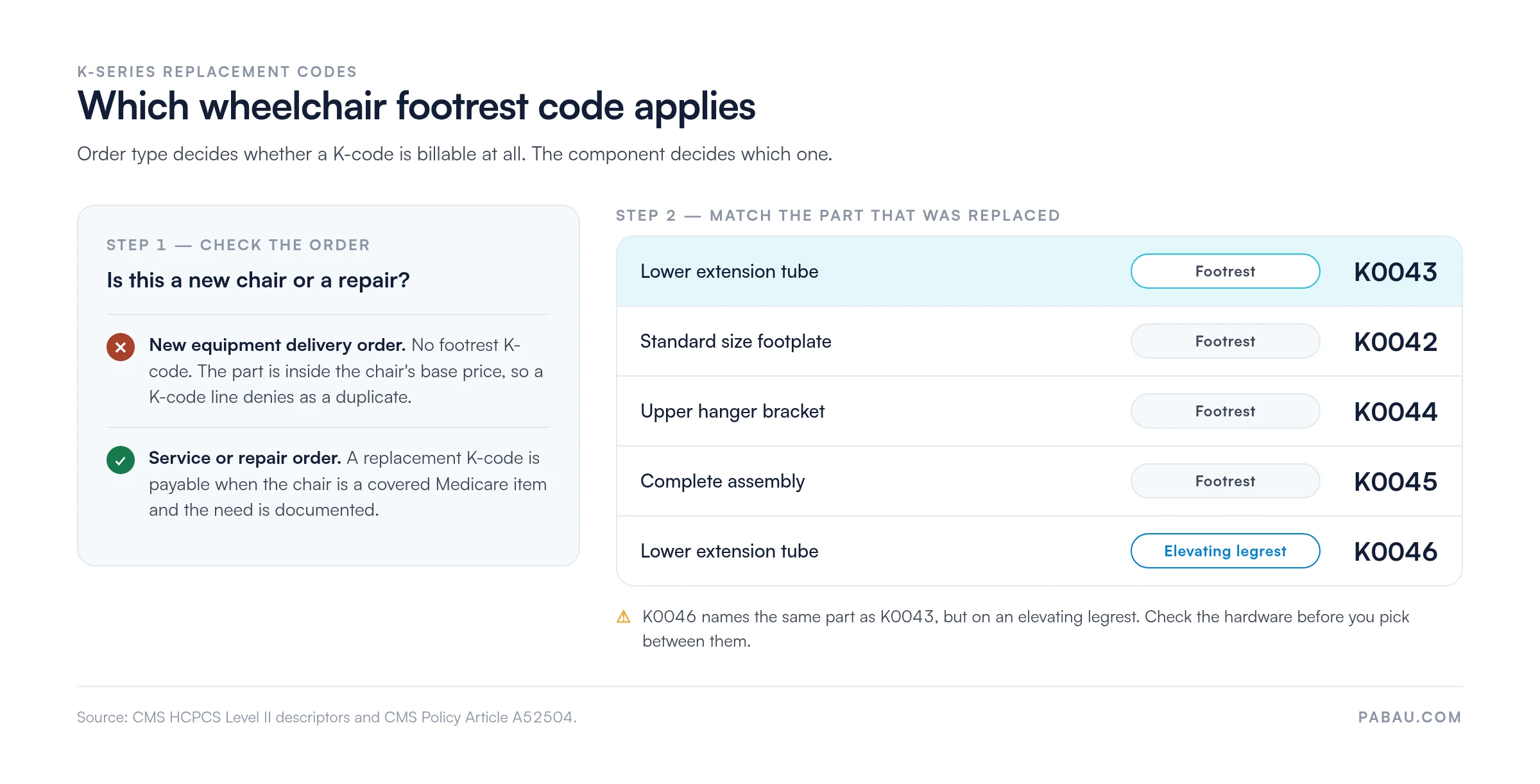
One test settles most cases. If the claim sits on a new equipment delivery order, K0043 is almost certainly wrong. If it sits on a service or repair order for an existing chair, K0043 may be right. The chart below runs the same two questions in order, starting with the order type and ending with the part.
Per CMS Policy Article A52504, the claim file for K0043 should hold:
The paperwork should mark this as a replacement transaction rather than an initial equipment delivery. Practice management software like Pabau keeps that paperwork attached to the claim. Our claims management software flags a missing physician order or an unsigned POD before the claim leaves the practice.
Modifier choice matters just as much. RB signals the replacement of a part furnished as part of a repair, which is exactly what K0043 describes. RA covers the replacement of a whole DME, orthotic, or prosthetic item, so it does not fit a single component. Confirm the requirement in your DME MAC’s LCD before billing.
K0043 sits in a short group of replacement codes that billers regularly mix up. Four of them cover footrest components. K0046 names the same lower extension tube on an elevating legrest, which is different hardware. The table below gives each descriptor and the distinction that decides the code.
The most frequent misuse in this group is billing K0045 when only the lower extension tube was replaced. K0045 carries a higher reimbursement rate, so coding it for a single component is both a billing error and a compliance risk. Bill only for what was supplied.
For verification steps on codes outside this group, see the CGS Medicare coding guidance. Our HCPCS code index covers the rest of the Level II set, including the other wheelchair accessory families.
Four patterns account for most K0043 rework. Each one is visible on the claim before it is submitted.
New wheelchair claims bundle accessory components into the base equipment price. Attaching K0043 to the same delivery order as a new power or manual chair will trigger an edit. The payer reads K0043 as a duplicate of a component the chair’s base code already covers, so the line denies. Keep K0043 on service and repair orders only.
Component replacements like K0043 take the RB modifier, which signals the replacement of a part furnished as part of a repair. RA is the wrong pick here, because it covers the replacement of a complete DME, orthotic, or prosthetic item. Submitting without RB where your DME MAC requires it will deny.
Applying a modifier your jurisdiction does not recognize adds an inconsistency flag instead. The AAPC HCPCS code reference outlines standard modifier guidance, but your MAC’s LCD takes precedence.
POD requirements for replacement accessories match those for initial equipment. You need a beneficiary or caregiver signature, an item description, and a delivery date.
A K0043 claim submitted without a valid POD will deny on audit, even where the part was genuinely provided and medically necessary. Building a POD checklist into the delivery workflow prevents that.
K0045 covers the complete footrest assembly. Where only the lower extension tube was replaced, K0043 is the correct code. Billing K0045 in that scenario overstates what was supplied and exposes the supplier to recovery audits.
A clean claim submission process includes a pre-submission review. In it, the biller checks the HCPCS code against the part that was delivered, not against the work order description. Work orders sometimes list assembly-level items for the technician’s convenience.
Build a K-series decision aid into your billing team’s quick-reference guide. Start with the order type, because a new chair delivery rules out a replacement code before coding begins. Then match the part: footplate (K0042), footrest lower extension tube (K0043), upper hanger bracket (K0044), or complete footrest assembly (K0045). If the hardware is an elevating legrest rather than a fixed footrest, the lower extension tube becomes K0046.
Consistent pre-submission audits keep most K0043 claims out of the rework queue altogether.
Most DME billing teams track K0043 across three places at once: the technician’s work order, the supplier portal, and a spreadsheet of open claims. Those three records do not talk to each other, so a missing proof of delivery usually surfaces only after the payer has denied the line.
Pabau keeps the order, the supporting documentation, and the claim on one record. Billers can confirm the physician order and the signed POD are attached before the claim goes out. Denial reason codes come back against that same record, rather than into a separate report.
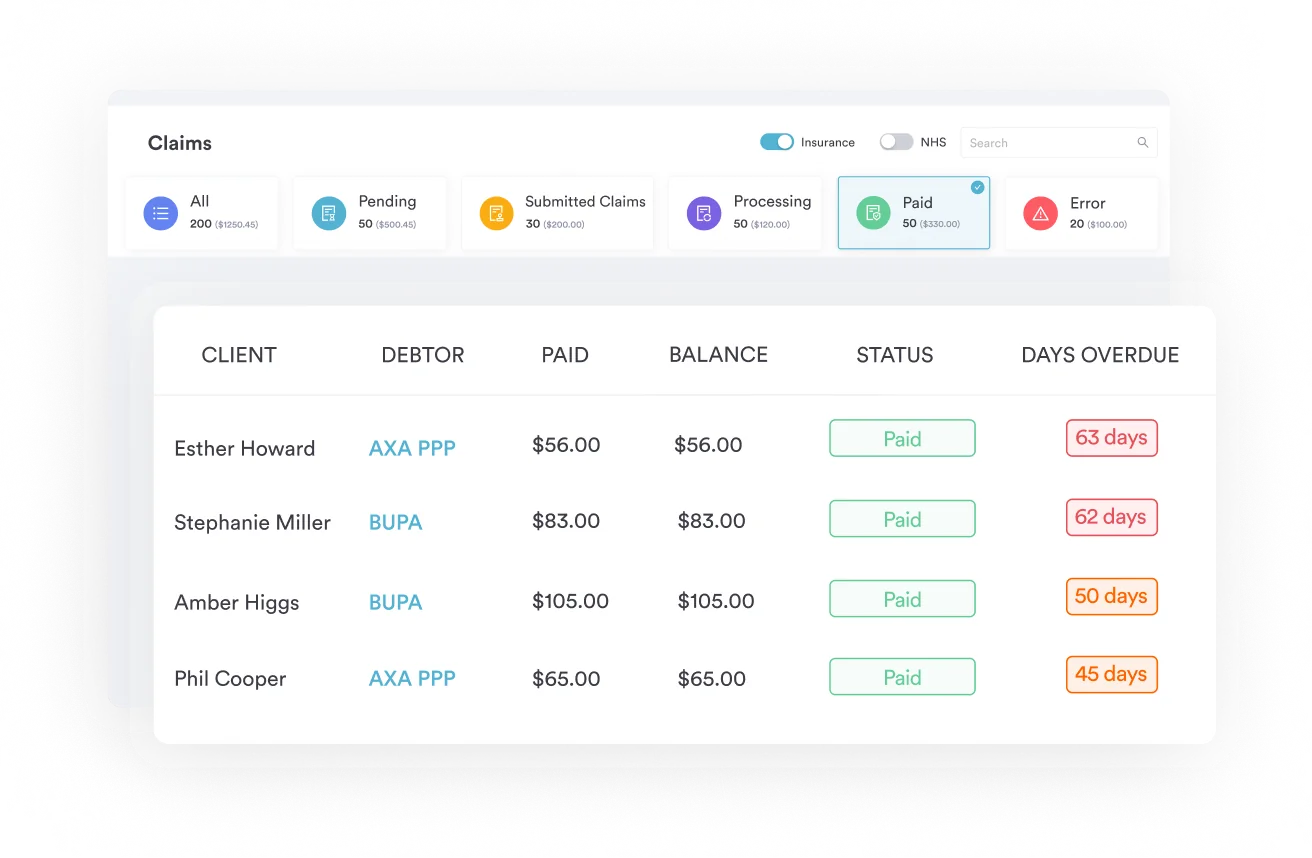
For a supplier billing the K0042 to K0046 replacement codes every week, that single view turns rework into an exception. The missing document gets found at submission, not six weeks later during an appeal.

Pabau helps DME suppliers manage claims, keep documentation attached to the order, and reduce denials. That covers HCPCS codes including K0043 and the wider wheelchair accessory series.

K0043 denials are almost always preventable. The replacement-only constraint, the RB modifier, and the POD requirement are defined rules rather than judgment calls. Applying them at submission removes a rework cycle that costs billing teams more time than the original claim review did.
The trade-off worth remembering is that the K-series rewards precision over speed. Coding K0045 because the work order said “footrest” is quicker today and expensive at audit. Book a demo to see how Pabau holds DME documentation and claim status on a single record.

Need to understand how claim denials are managed? Denial management in healthcare covers the processes and tools practices use to reduce and recover from claim rejections.
Looking for a broader DME billing compliance framework? Medical billing compliance requirements outlines the core obligations suppliers must meet when billing Medicare and commercial payers.
Want to understand how clearinghouses process HCPCS claims? Medical claims clearinghouse guide explains how claims move from supplier to payer and where edits are applied.
Not sure what belongs on the billing document itself? What a superbill is walks through the fields a payer expects and how each one is populated.
Reading a denial and unsure what the codes mean? Electronic remittance advice explains how payers report adjustments and where the denial reason appears.
HCPCS code K0043 is a Level II DME code for a footrest lower extension tube, replacement only, each. It bills Medicare and other payers for the vertical tube that connects a wheelchair’s footrest hanger to its footplate assembly. The code applies only when that part is replaced on an existing covered wheelchair.
Yes. The phrase “replacement only” is embedded in K0043’s official descriptor, which makes it a billing instruction. K0043 cannot be billed when a new wheelchair is delivered, because the footrest counts as part of the base equipment at that point. It is billable only when an existing covered chair needs a replacement extension tube.
A valid K0043 claim requires a written physician order for the replacement part. It also needs documentation that the beneficiary’s existing wheelchair is a Medicare-covered item. Add a clinical note supporting medical necessity and a signed proof of delivery from the beneficiary or caregiver. These requirements are governed by CMS Policy Article A52504.
K0043 covers the lower extension tube on a fixed footrest. K0046 covers the lower extension tube on an elevating legrest. The two parts look similar, so the hardware they belong to is what decides the code. Check whether the chair has fixed footrests or elevating legrests before billing either one.
RB is the modifier for a component replacement like K0043, because it signals the replacement of a part furnished as part of a repair. RA applies to the replacement of a whole DME, orthotic, or prosthetic item, so it does not fit a single part. Confirm the requirement in your DME MAC’s Local Coverage Determination before billing.
Yes, K0043 is covered under Medicare Part B’s DMEPOS benefit. Coverage requires a Medicare-covered wheelchair, documented medical necessity, and a written order from the treating physician. The supplier must also be a Medicare-enrolled DMEPOS provider. Coverage is not guaranteed and depends on meeting all criteria in CMS Policy Article A52504.
No. K0043 cannot be billed as part of a new wheelchair delivery. The replacement-only designation means it is payable only when replacing a component on an existing covered chair. Attaching K0043 to a new equipment delivery order will result in a claim denial.