

HCPCS code E0198: Water pressure pad billing guide
HCPCS code E0198 is a water pad for a standard mattress HCPCS code E0198 is the ...

Last Updated: Oct 13, 2026
J7326 is the HCPCS Level II code for hyaluronan or derivative, gel-one, for intra-articular injection, per dose.
Let Pabau's smart automation suggest the right codes, reduce claim denials, and keep your practice compliant—effortlessly.
Automate repetitive tasks and focus on what matters most—your patients.
Reduce coding errors and ensure compliance with the latest regulations.
Clean claims, fewer denials, and faster reimbursements.
Powerful insights and reporting to help your practice thrive.
HIPAA compliant SOC 2 certified GDPR-compliant Trusted by 4,000+ clinics worldwide

HCPCS code J7326 describes Hyaluronan or derivative, Gel-One, for intra-articular injection, per dose — bill 1 unit per single-dose administration (the entire 30 mg/3 mL syringe), not 30 units.
Medicare Part B covers J7326 under the MAC’s current LCD for intraarticular hyaluronan injections at ASP+6% reimbursement, subject to failed conservative therapy documentation and diagnosis requirements.
Missing NDC on the claim, incorrect ICD-10 linkage, and absent prior authorization are the three most common denial drivers for J7326 claims.
Pabau’s claims management software can be pre-configured for Gel-One billing workflows, linking J7326, the correct ICD-10 code, and NDC to reduce denial risk.
HCPCS code J7326 is the product-specific code for Gel-One, Zimmer Biomet’s single-injection cross-linked hyaluronate viscosupplement. Using a sibling code like J7325 (Synvisc-One) for a Gel-One administration is an automatic denial, because payers map the code to the manufacturer’s NDC.
Get the code right and the claim has a clean path through adjudication. Get it wrong, and no amount of documentation fixes it.
The official CMS HCPCS Level II descriptor for J7326 reads: Hyaluronan or derivative, Gel-One, for intra-articular injection, per dose. Billing unit is per dose, not per milligram. Because Gel-One is dispensed as a single 30 mg/3 mL syringe intended for one injection, practices bill 1 unit of J7326 per injection encounter, not 30 units.
Pabau’s claims management software allows practices to pre-configure the unit count, NDC, and ICD-10 code for Gel-One as a saved billing template, so each encounter generates an accurate claim without manual re-entry.
J7326 applies when a clinician administers Gel-One as viscosupplementation therapy for knee osteoarthritis. The injection targets the synovial joint to supplement natural hyaluronic acid lost through degenerative joint disease.
Conservative therapy failure is the gatekeeper: Payers require documented evidence that the patient has already tried and not adequately responded to physical therapy. Solid patient compliance documentation through each stage of conservative treatment is what makes this evidence audit-proof.
The diagnosis code paired with J7326 must specifically identify the affected knee and the osteoarthritis subtype. Laterality matters: M17.11 (right primary osteoarthritis) and M17.12 (left primary osteoarthritis) are the most common pairings.
Using a non-specific code like M17.9 may trigger a medical necessity review or denial depending on the MAC jurisdiction. Cross-check the MAC’s current LCD for intraarticular hyaluronan injections, and its companion coding article, for the complete accepted ICD-10 list before submission, as CMS periodically updates the covered diagnosis list.
Unspecified codes create the same exposure outside orthopedics. Burn billing runs into it at T30.0, the unspecified option in its family, where a more specific code usually exists.
Medicare Part B covers Gel-One under the viscosupplementation benefit, but coverage is not uniform across the country. Each Medicare Administrative Contractor (MAC) may have its own coverage policy, and the applicable LCD governs which patients and diagnoses qualify.
Practices billing to a physical therapy or orthopedic practice through a different MAC jurisdiction than their state default should verify the active LCD before billing J7326 for the first time.
There is no single current national LCD governing intraarticular hyaluronan injections — coverage runs through each Medicare Administrative Contractor’s (MAC’s) own current LCD, for example L39529 (Intraarticular Knee Injections of Hyaluronan, with companion coding article A56157) or L39260 (Hyaluronic Acid Injections for Knee Osteoarthritis).
Confirm the specific policy in your jurisdiction, since criteria can vary. Across MACs, the medical necessity bar that claims must clear typically includes:
Commercial payers follow varying standards. Some align closely with the Medicare LCD. Others require additional radiographic evidence of joint space narrowing or impose stricter prior authorization rules. Always verify the individual payer’s medical policy for viscosupplementation before the injection date, not after.
Diagnosis-driven coverage rules are not unique to viscosupplementation. Severity-banded burn codes such as T31.50 are chosen from the body surface extent documented, so the note must support the band billed.
With integrated stock control, each administered dose is deducted automatically, keeping billed units aligned with used units.
Medicare reimburses J7326 under the Part B drug reimbursement methodology: ASP (Average Sales Price) plus 6%. The ASP base is recalculated quarterly by CMS and changes each January, April, July, and October.
Because specific dollar figures shift every quarter, practices should check the current rate directly through the CMS Physician Fee Schedule lookup tool rather than relying on published snapshots that may be out of date.
The ASP+6% add-on covers the practice’s cost of acquiring the drug plus a handling margin. It does not cover the administration fee. The intraarticular injection administration is billed separately using the appropriate injection CPT code (typically 20610 for large joint injection), which carries its own RVU-based reimbursement. Forgetting to bill the administration code separately is a common revenue leakage point.
Gel-One uses the buy-and-bill model for office administration. The workflow has three stages:
MAC jurisdiction also affects the allowable rate. Practices in high-cost areas may receive slightly higher reimbursements than the national average. Using AAPC’s HCPCS code lookup alongside the CMS quarterly ASP file gives practices the most accurate current rate for their locality.
Prior authorization for J7326 is payer-dependent. Medicare Fee-for-Service does not require prior authorization for viscosupplementation in most MAC jurisdictions, but Medicare Advantage plans frequently do. Commercial payers vary widely: Some require PA for every injection course, others only for repeat courses within a benefit year.
Tracking authorization status in secure patient data systems tied to the clinical record prevents the most common denial scenario: Claim submission after a PA has expired or before one has been obtained.
When PA is required, the supporting documentation package typically needs to include:
Pabau’s automated billing workflows include a prior authorization tracking module that attaches PA approval records directly to the patient encounter. This keeps authorization status visible during claim generation rather than requiring staff to check a separate system before submission.
Authorization packets fail when the diagnosis on the form and the one on the claim disagree. A burn case authorized under T31.30 has to reach the claim line with that exact code.
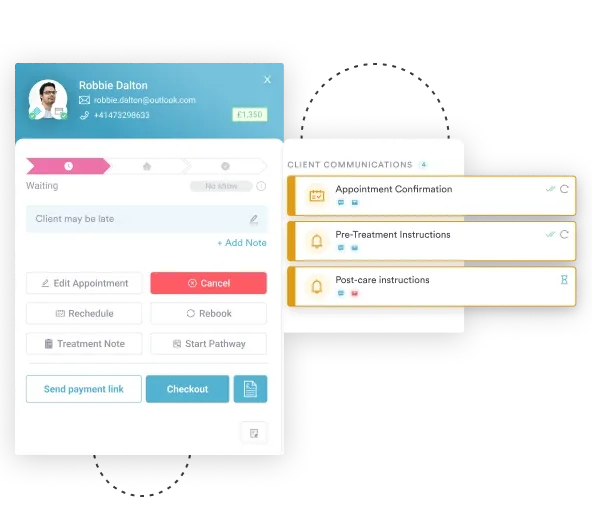

Pabau pre-configures J-code billing workflows for buy-and-bill injectables, linking the HCPCS code, NDC, ICD-10 pairing, and prior authorization status to each encounter so your team submits clean claims the first time.

Documentation errors are responsible for a significant share of J7326 post-payment recoupments. The MAC’s current LCD for intraarticular hyaluronan injections requires specific evidence in the medical record, and a payer audit will look for every item on this checklist.
Incomplete records can trigger more than a denial on the current claim. They can also prompt retrospective reviews of previous claims for the same patient. A rejected electronic claim never reaches adjudication, so it does not appear in denial reporting.
Required documentation at a minimum:
Using digital intake forms and structured clinical note templates reduces the risk of missing a documentation field under audit pressure. Pabau’s procedure note templates can be configured to prompt clinicians for laterality, failed conservative therapy details, and injection site documentation at each encounter, satisfying the applicable MAC LCD’s compliance requirements before the note is signed.
Template design pays off wherever a code depends on a measured value. Recording burn surface area at the time of assessment is what lets a coder land on T31.0 rather than estimate later.
A body pain chart can help standardize how the pain-limits-function evidence gets recorded at each visit, giving auditors a consistent functional-impact record instead of free-text notes that vary by clinician.
Proper documentation also supports HIPAA compliance for medical offices when records are requested during audits.

The table below covers the modifiers most relevant to Gel-One billing:
RT and LT modifiers are required when billing laterality matters for payer adjudication. JW and JZ were made mandatory for Part B drug claims to improve wastage reporting accuracy overall, but requirements for J7326 specifically vary by MAC.
Confirm against the current CMS JW/JZ Modifier Policy HCPCS Codes list and your MAC’s billing guidance before submitting, since not all hyaluronan J-codes currently appear on that reference list.
J7326 sits within a family of hyaluronan J-codes (J7321 through J7325), each tied to a specific product and injection series. The most common billing error in this category is using the single-injection code for a multi-injection product or vice versa. The table below clarifies the key differences to prevent product-code mismatch denials.
Practices administering multiple viscosupplement products should use practice management software that maps each product’s NDC to its specific HCPCS code. Without that mapping, a staff member selecting the wrong code at charge entry creates a denial that takes significantly more time to fix than it took to prevent.
Neighboring codes in any family invite the same selection error. Whole ranges of burn codes sit a digit apart, and T31.22 sits inside one such range, so charge entry must be exact.
Review the full hyaluronan J-code family via the CMS list of HCPCS codes to confirm current code-product assignments.
Gel-One claims have a narrow margin for error. Each item below represents a pattern that triggers denials or post-payment audits in orthopedic and rheumatology practices using viscosupplementation billing. When a claim on this code comes back unpaid, the denial reason codes on the remittance name the cause.
Configuring prescription management software that records NDC at the point of drug administration, and using structured billing workflows tied to clinical documentation, prevents the majority of these failure modes before claims leave the practice.
Post-payment reviewers sample by code, not by specialty. If an auditor pulls a burn claim billed as T31.44, the chart has to justify the extent recorded that day.
HCPCS code J7326 billing hinges on three things getting right simultaneously: The correct product-code match, complete LCD-compliant documentation, and a clean claim with the NDC and modifiers attached before submission. Any one of those failing creates a denial that costs more to fix than it would have cost to prevent.
Pabau’s claims management software lets orthopedic, rheumatology. Every encounter generates a claim ready for submission without manual reconstruction. To see how that works in practice, book a demo with the Pabau team.

Coding a follow-up visit for a thumb injury? ICD-10 code S60.931D covers a subsequent encounter for an unspecified superficial injury of the right thumb.
Coding a thumb laceration with a retained object? ICD-10 code S61.122D covers a left thumb laceration with a foreign body and nail damage.
Coding a finger puncture wound? ICD-10 code S61.238A covers a puncture wound of a finger other than the index, middle, ring, or little finger.
HCPCS code J7326 is used to bill for Gel-One, a cross-linked hyaluronate viscosupplement manufactured by Zimmer Biomet, when administered as a single intra-articular injection for knee osteoarthritis. The code is billed per dose: Practices bill 1 unit per single-dose administration, regardless of the syringe’s total volume (30 mg/3 mL).
Medicare reimburses J7326 at ASP (Average Sales Price) plus 6%, which changes every quarter. Practices should pull the current rate from the CMS quarterly ASP drug pricing file or the CMS Physician Fee Schedule lookup tool rather than relying on static published figures, which may no longer reflect the current quarter’s rate.
Medicare Fee-for-Service typically does not require prior authorization for J7326 in most MAC jurisdictions, but Medicare Advantage plans and many commercial payers do. Prior auth requirements vary by plan and benefit year, so practices should verify each payer’s current policy before scheduling the injection, not after.
The most commonly paired ICD-10 codes are M17.11 (primary osteoarthritis, right knee) and M17.12 (primary osteoarthritis, left knee). M17.31 (unilateral post-traumatic osteoarthritis, right knee) and M17.0 (bilateral primary osteoarthritis) may also apply depending on the clinical situation. The ICD-10 code must be laterality-specific and match the injection site.
J7325 covers Synvisc and Synvisc-One (hylan G-F 20, manufactured by Sanofi), while J7326 is product-specific to Gel-One (cross-linked sodium hyaluronate, manufactured by Zimmer Biomet). Both are single-injection options, but each code is tied to its specific product’s NDC. Using the wrong code for the product administered is an automatic denial.
The drug itself is billed under HCPCS J7326, while the injection procedure is billed under CPT 20610 (arthrocentesis, aspiration, or injection of a major joint or bursa). Both codes are typically submitted together on the same claim: J7326 for the Gel-One drug reimbursement and 20610 for the physician’s work in performing the injection.



