CPT code 52648: Laser ablation of the prostate billing guide
What CPT code 52648 covers, and what it bundles in CPT code 52648 is the code fo...

Last Updated: Oct 21, 2026
J7301 is the HCPCS Level II code for levonorgestrel-releasing intrauterine contraceptive system (skyla), 13.5 mg.
Per the CMS HCPCS overview, Level II codes cover injectable and infusible drugs, durable medical equipment, and supplies that CPT does not capture.
J7301 sits in that drug and device category because the practice purchases, stores, and administers Skyla before billing the payer. That makes medical billing for the device work differently from a standard office visit.
Let Pabau's smart automation suggest the right codes, reduce claim denials, and keep your practice compliant—effortlessly.
Automate repetitive tasks and focus on what matters most—your patients.
Reduce coding errors and ensure compliance with the latest regulations.
Clean claims, fewer denials, and faster reimbursements.
Powerful insights and reporting to help your practice thrive.
HIPAA compliant SOC 2 certified GDPR-compliant Trusted by 4,000+ clinics worldwide

HCPCS Code J7301 is the Level II J-code for Skyla, a levonorgestrel intrauterine system approved for up to three years.
Bill J7301 as one unit alongside CPT 58300 for the insertion, with an ICD-10-CM code that matches the chart note.
The most common coding error is swapping J7301 with J7298, the code for the 52 mg Mirena system.
Medicare Part B coverage depends on your MAC and the clinical context, and Medicaid terms vary by state program.
Practice management software like Pabau links the J7301 chart note straight to the claim, so nothing is re-entered by hand.
The table below consolidates the core code attributes billers and coders need before building a claim.
Skyla is a T-shaped intrauterine system made by Bayer that releases levonorgestrel at roughly 14 mcg per day at first, decreasing over time. The FDA approved it for up to three years of contraception.
Its frame is smaller in diameter than the Mirena system, which bills under which bills under J7298. That makes it an option for patients who have not had a prior pregnancy.
Clinically, Skyla is indicated for contraception in patients with a uterus. Its smaller frame and lower hormone dose set it apart within the levonorgestrel IUS family. For billing, the 13.5 mg dose is the defining detail.
J7301 covers Skyla specifically, and no other levonorgestrel system at a different strength.
CMS reimburses J7301 under the Medicare Part B drug pricing methodology, which pays the average sales price (ASP) plus a percentage markup. Rates update quarterly from manufacturer-reported ASP data.
Because ASP shifts each quarter, treat the figures below as general benchmarks. Verify current rates against the CMS Physician Fee Schedule lookup before billing.
What you paid for the device and what the payer returns for it decide the margin on every insertion. Practices running OB/GYN EMR software can track device cost against what each claim actually pays. That flags any payer whose contracted rate has dropped below breakeven.
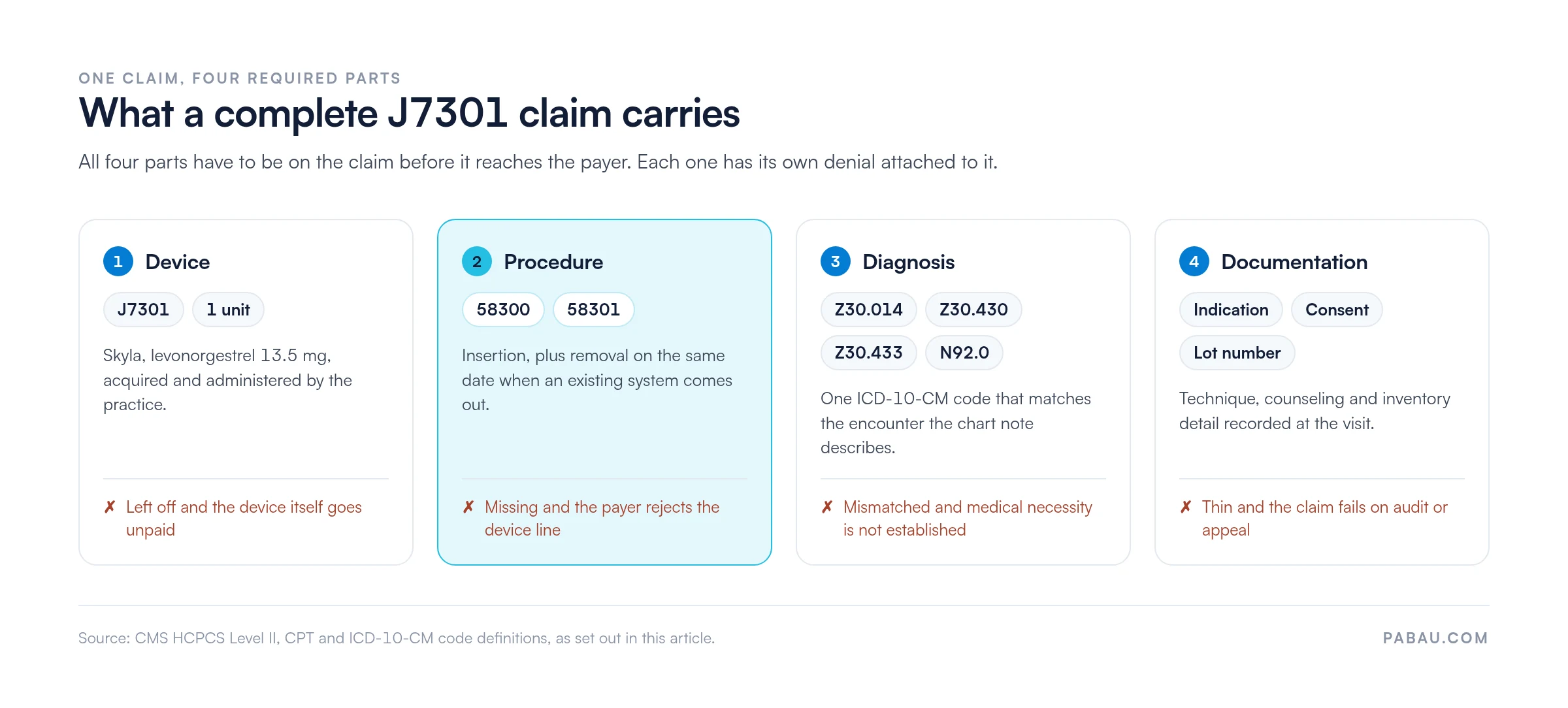
A J7301 claim needs four elements in place before it goes out: the device, the procedure, the diagnosis, and the documentation. Miss any one of them and the claim comes back denied. Each element also carries its own failure mode, which is easier to hold in mind side by side.
Under buy-and-bill, the practice purchases Skyla from a distributor, administers it, and then bills the payer. The patient never buys the device. The workflow runs in three steps, and the claim cannot precede the service date.
J7301 covers the device only. The insertion or removal procedure needs its own CPT code on the same claim. Submitting J7301 without the companion CPT is one of the most common errors on IUS claims. It denies because the payer has no procedure code to attach the device to.
When removal and insertion happen in the same encounter, both CPT codes are usually billed alongside J7301. Some payers apply a multiple-procedure payment reduction to 58301 when it is billed with 58300 on the same date.
Verify your payer’s policy before you assume full reimbursement on both. The usual clean claim rules still apply, which means correct modifiers, valid diagnosis codes, and matching service dates.
Every J7301 claim needs a diagnosis code that establishes medical necessity. For contraceptive IUS insertion, the ICD-10-CM codes below are the standard choices. The diagnosis has to match the clinical scenario documented in the chart note.
Documentation has to support whichever diagnosis code you select. A chart note that records only “patient requests IUD”, with no clinical indication, fails the medical necessity threshold for most payers.
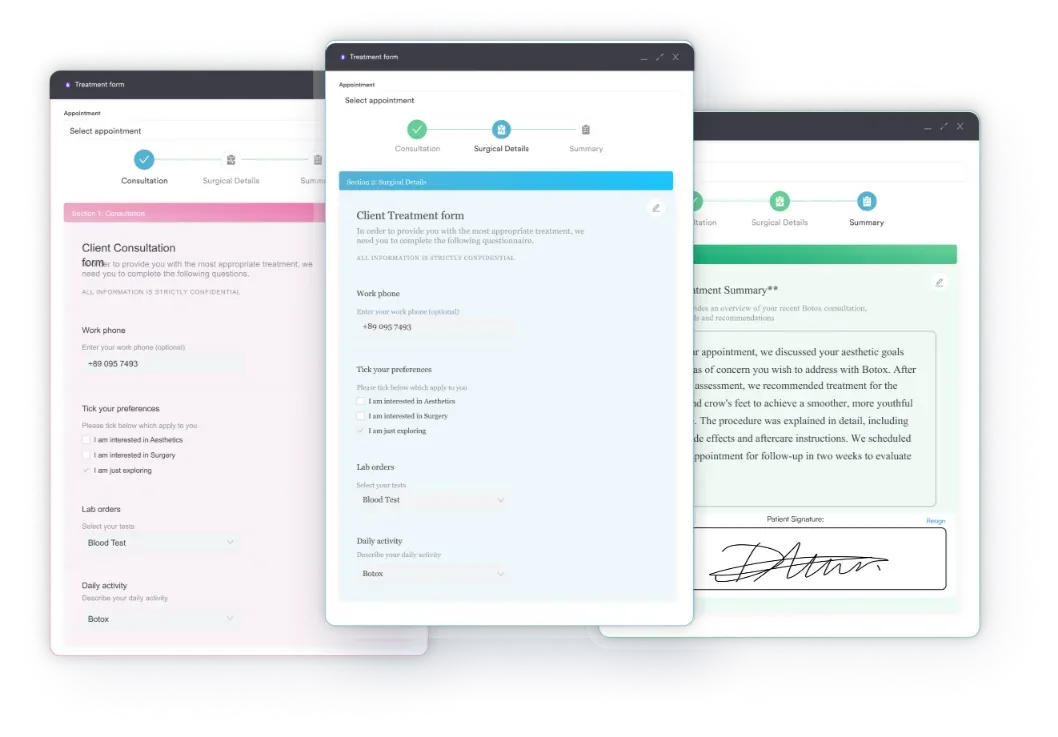
Practices using digital intake forms can pre-populate the counseling visit note with structured fields for indication, counseling given, and consent. That leaves the biller much less to chase before submission.
Have your billing team check ICD-10 code selection against the chart note before any J7301 claim goes out. Z30.014 and Z30.430 are easy to confuse. Z30.014 covers the prescription encounter, while Z30.430 covers the insertion itself. The wrong one is a common audit trigger on family planning claims.
Coverage for J7301 varies by payer type and is never universal. Check the rules before each insertion rather than after a denial arrives.
Medicare Part B may cover J7301 under preventive services provisions, but coverage depends on the clinical context and the Medicare Administrative Contractor (MAC) jurisdiction. Because coverage policy can shift between policy years, confirm the current ruling with your MAC before you schedule Medicare beneficiaries for Skyla insertion. Do not assume universal coverage from a prior-year determination. Co-claiming restrictions in the Australian schedule decide which items can appear on the same day.
Federal law requires Medicaid programs to cover family planning services and supplies, which generally includes IUS devices.
State implementation varies, so coverage terms, prior authorization requirements, and reimbursement rates differ across jurisdictions. Practices serving Medicaid patients in several states need a separate verification step for each state program.
Commercial payers may require prior authorization for J7301, and some apply step-therapy rules such as documentation of an earlier contraceptive trial. Requirements are payer-dependent and plan-specific, so there is no uniform rule to lean on.
Before insertion, check the payer’s portal or call the number on the patient’s insurance card. A documented prior authorization process keeps that check from being skipped on a busy day.
Denials still happen on device claims. Learning the denial codes that come back on them helps your team fix rejections faster. Build the denial management workflow before claim volume forces one on you.
J7301 is one of six active HCPCS J-codes covering intrauterine contraceptive devices. Each code maps to one device at one dose, and they are not interchangeable.
The newest of them, J7299, took effect on January 1, 2026 for the copper Miudella system. Paragard, the other copper device, bills under HCPCS code J7300. Use the AAPC Codify HCPCS lookup to confirm current code status and descriptions before you bill.
The most common crossover error is swapping J7301 and J7298. Both devices release levonorgestrel, so staff who never handle the stock may assume one code covers the whole family.
Chart documentation has to name the exact brand and dose to support the code you submit. Practices using sexual health clinic software with procedure-specific templates can enforce brand-to-code matching at the point of care rather than at claim review.
Run a quarterly audit of J7301 claims. Compare the device brand documented in the chart against the HCPCS code submitted. Mirena-to-J7301 crossover errors and missing companion CPT codes are the two most common denial triggers on IUS claims. Catching them before submission takes minutes, while appealing them after denial takes weeks.
Most J7301 billing errors start where the chart note ends and the claim begins. A practice that documents in one system and bills in another carries the codes across by hand. Every hand-off is a chance to drop one. Practice management software like Pabau removes that hand-off entirely.
Pabau’s claims management software connects the clinical note directly to the claim. The ICD-10 code, the J7301 device code, and the companion CPT code all carry forward from the encounter record without re-entry.
Your biller opens a complete, documentation-supported claim instead of a form that needs the chart checked line by line. Claims reach payers through our Claim.MD integration, so submissions and remittances land beside the note they came from.
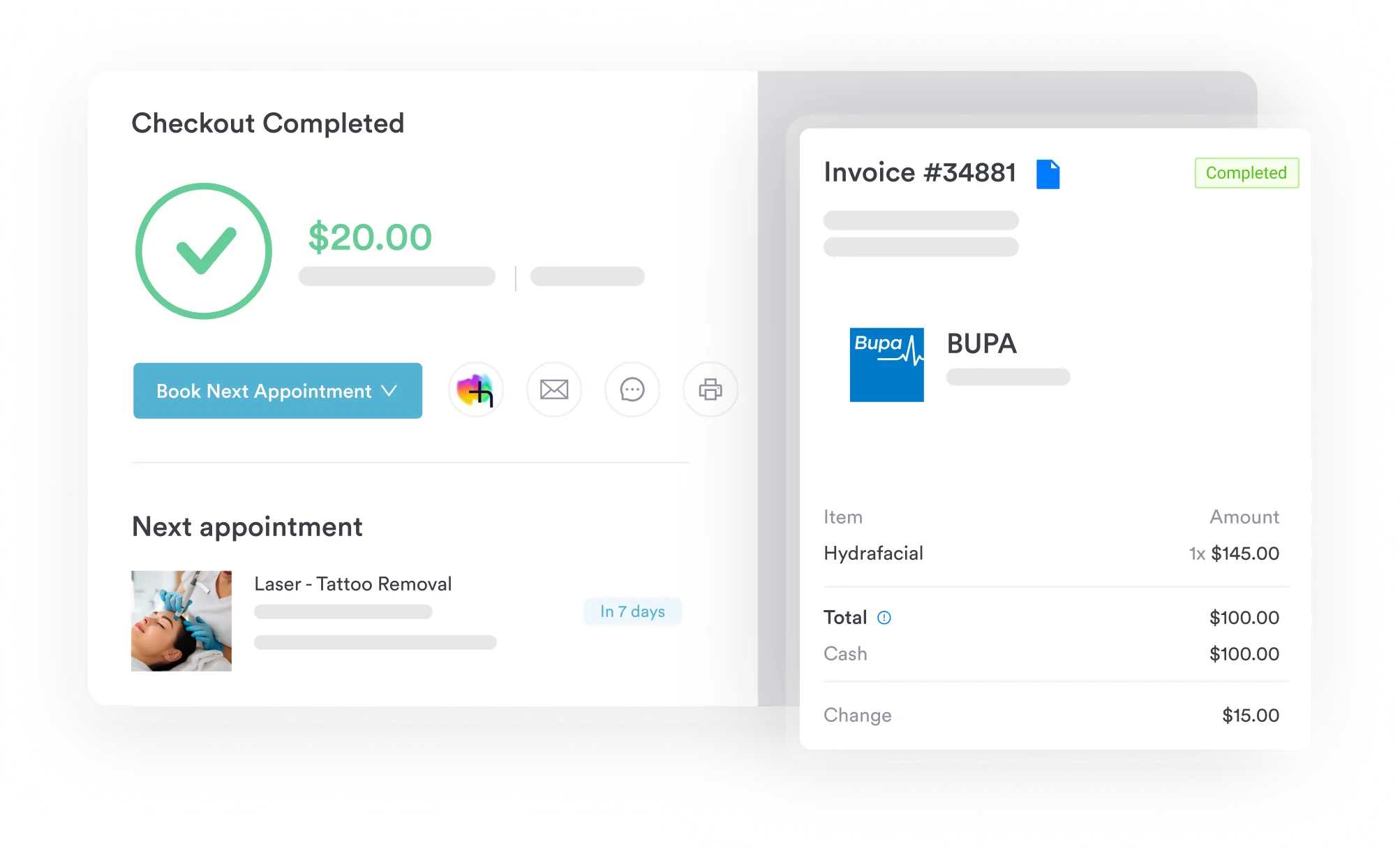
Pabau also tracks inventory for buy-and-bill devices. Skyla acquisition cost and lot numbers are recorded at purchase, matched to the encounter at insertion, and reconciled against what the payer actually paid. That gives practice managers a clear view of margin per device rather than a claim total.

Pabau connects clinical documentation, IUS device billing, and claims submission in one workflow, so nothing gets re-typed between systems.

J7301 claims fail at predictable points. The wrong sibling code, a missing companion CPT, an unsupported diagnosis, or an unchecked prior authorization will each stop a claim on its own.
The fix for all four is the same. Whatever records the insertion should also build the claim, so no code is ever copied across by hand. That is a workflow decision more than a coding one, and it is worth making before your IUS volume grows.
If your team still keys J7301 claims from the chart, that step is where the denials come from. Book a demo to see how Pabau handles IUS device billing from insertion through remittance.

Billing the 19.5 mg Kyleena system instead? HCPCS Code J7296 sets out the dose, duration, and companion coding for that device.
Offering a subdermal implant as well as an IUS? HCPCS Code J7307 covers the etonogestrel implant and the CPT codes that pair with it.
Billing other buy-and-bill drugs in women’s health? HCPCS Code J1410 walks through the same acquire, administer, and claim sequence for an injectable.
Working with state Medicaid family planning programs? HCPCS Code H1000 shows how state-specific H-codes and their documentation rules work in practice.
Coding an adrenal gland contusion? ICD-10 code S37.812A guide covers this initial encounter code and how it differs from the laceration code.
HCPCS Code J7301 is the Level II J-code for Skyla, the levonorgestrel-releasing intrauterine contraceptive system containing 13.5 mg of levonorgestrel and manufactured by Bayer. It is used by OB/GYN and family planning providers to bill payers for the device cost when inserting Skyla under the buy-and-bill model.
CPT 58300 (insertion of intrauterine device) is the primary companion code billed with J7301. When removing an existing IUS in the same encounter before inserting Skyla, CPT 58301 (removal of intrauterine device) is also billable. An evaluation and management code may be added separately if a significant, distinct E/M service was provided.
Medicare Part B may cover J7301 under preventive services provisions, but coverage is not universal. It depends on the Medicare Administrative Contractor (MAC) jurisdiction and the specific clinical context. Verify current coverage with your MAC before scheduling Medicare beneficiaries for Skyla insertion.
J7301 covers Skyla (levonorgestrel 13.5 mg, approved up to 3 years), while J7298 covers Mirena (levonorgestrel 52 mg, approved up to 8 years). Both are levonorgestrel IUS devices but are coded separately because of their different doses and FDA-approved durations. Using J7301 on a Mirena claim is an incorrect code assignment.
Three ICD-10-CM codes cover most J7301 claims. Z30.430 fits an insertion visit, Z30.433 fits a same-session removal and reinsertion, and Z30.014 fits an initial contraceptive prescription encounter. The chart note must document the clinical indication that matches the code you select.
Medicaid is generally required to cover family planning services and supplies, which includes IUS devices like Skyla. Coverage details, prior authorization requirements, and reimbursement rates vary by state program. Verify your state’s specific Medicaid policy before assuming coverage, and build a state-by-state verification step into your eligibility workflow for Medicaid patients.