CPT Code 62284: Injection procedure for myelography
CPT Code 62284: official descriptor and procedure overview The American Medical ...

Last Updated: Oct 19, 2026
J7198 is the HCPCS Level II code for anti-inhibitor, per i.u..
The unit count on the claim must equal the figure on the medication administration record, which is where most J7198 denials start. Guidance comes from CMS, Palmetto GBA, and Noridian Healthcare Solutions.
Let Pabau's smart automation suggest the right codes, reduce claim denials, and keep your practice compliant—effortlessly.
Automate repetitive tasks and focus on what matters most—your patients.
Reduce coding errors and ensure compliance with the latest regulations.
Clean claims, fewer denials, and faster reimbursements.
Powerful insights and reporting to help your practice thrive.
HIPAA compliant SOC 2 certified GDPR-compliant Trusted by 4,000+ clinics worldwide

HCPCS Code J7198 describes anti-inhibitor coagulant complex (AICC), brand name Feiba NF, billed per international unit (IU).
Medicare Part B covers J7198 for hemophilia A or B with inhibitors when standard factor replacement therapy has failed or is contraindicated.
Providers must submit the exact IU administered, matching the medication administration record and physician order. Unit mismatches are the leading denial cause.
Practice management software like Pabau submits J7198 claims and tracks each one from a single dashboard.
HCPCS Code J7198 is the Level II code for anti-inhibitor coagulant complex (AICC), billed per international unit (IU). The official CMS descriptor is: Anti-inhibitor, per IU.
AICC is a plasma-derived clotting factor concentrate that bypasses the normal coagulation cascade. It is used in patients with hemophilia A or B who have developed inhibitors, meaning antibodies against standard factor VIII or IX products. Those antibodies leave the standard products ineffective. The CMS HCPCS system assigns J7198 within the broader clotting factor code cluster J7177-J7214, which covers the full range of plasma-derived and recombinant factor concentrates.
Medicare Part B covers anti-inhibitor coagulant complex (HCPCS Code J7198) as a Part B drug when dispensed and administered in a covered setting. Coverage follows CMS Billing and Coding Article A56433, which governs hemophilia factor products.
Checking eligibility before the infusion confirms that Part B is active and identifies any secondary coverage, before a unit of Feiba NF is drawn. Coverage is considered medically necessary when:
Aetna’s clinical policy bulletin (CPB 0131) mirrors the Medicare framework. AICC is covered for members with hemophilia A or B with inhibitors when standard factor therapy has failed. Commercial payer policies vary, so confirm coverage and prior authorization requirements with the specific payer before administering.
CMS Article A56433 lists the covered ICD-10-CM codes that must accompany a J7198 claim. Each code maps to a specific hemophilia or clotting factor disorder. Submitting an ICD-10 code not on this list is a common denial trigger.
Source: CMS Billing and Coding Article A56433. D66 and D67 are the most frequently billed codes alongside J7198, covering the two primary hemophilia types with inhibitors. Always confirm that the documented diagnosis code accurately reflects the patient’s inhibitor status, not just the underlying hemophilia diagnosis.
If the documented diagnosis sits outside this list, check the full ICD-10-CM code index before resubmitting under a different code.
Billing J7198 correctly requires three data points to agree on every claim. Those are the IU actually administered, the physician order, and the medication administration record (MAR). The charge capture record for each infusion visit should carry all three at the point of care.
J7198 is billed per international unit (IU) actually administered, not per vial. If a patient receives 3,000 IU, the claim must reflect 3,000 units. Rounding to vial sizes or submitting the ordered dose rather than the administered dose is incorrect and creates audit exposure.
Per CMS Article A56433, the following bill type codes apply to J7198 claims:
Valid places of service include outpatient hospital (POS 22) and infusion center (POS 22 or 19). Home (POS 12) applies when a home infusion provider administers the product. Modifier applicability depends on the payer and the place of service, so verify modifier requirements before submitting. The AAPC HCPCS code reference lists the current descriptors across the J-code range.
Run an eligibility check the day before each Feiba NF infusion. Confirm Medicare Part B is active, that the patient’s hemophilia with inhibitors diagnosis is on file, and that any prior authorization is current. A lapsed prior auth is the fastest way to convert a covered infusion into a zero-pay denial.
Palmetto GBA and Noridian Healthcare Solutions both specify what the medical record must contain to support a J7198 claim. Missing one element can cost the practice the payment. Strong clean claim submission practices depend on capturing every required data point at the point of care.
Those five elements are captured at three different moments, and each moment is the only chance to record its part honestly. The diagram below maps them onto the infusion episode.
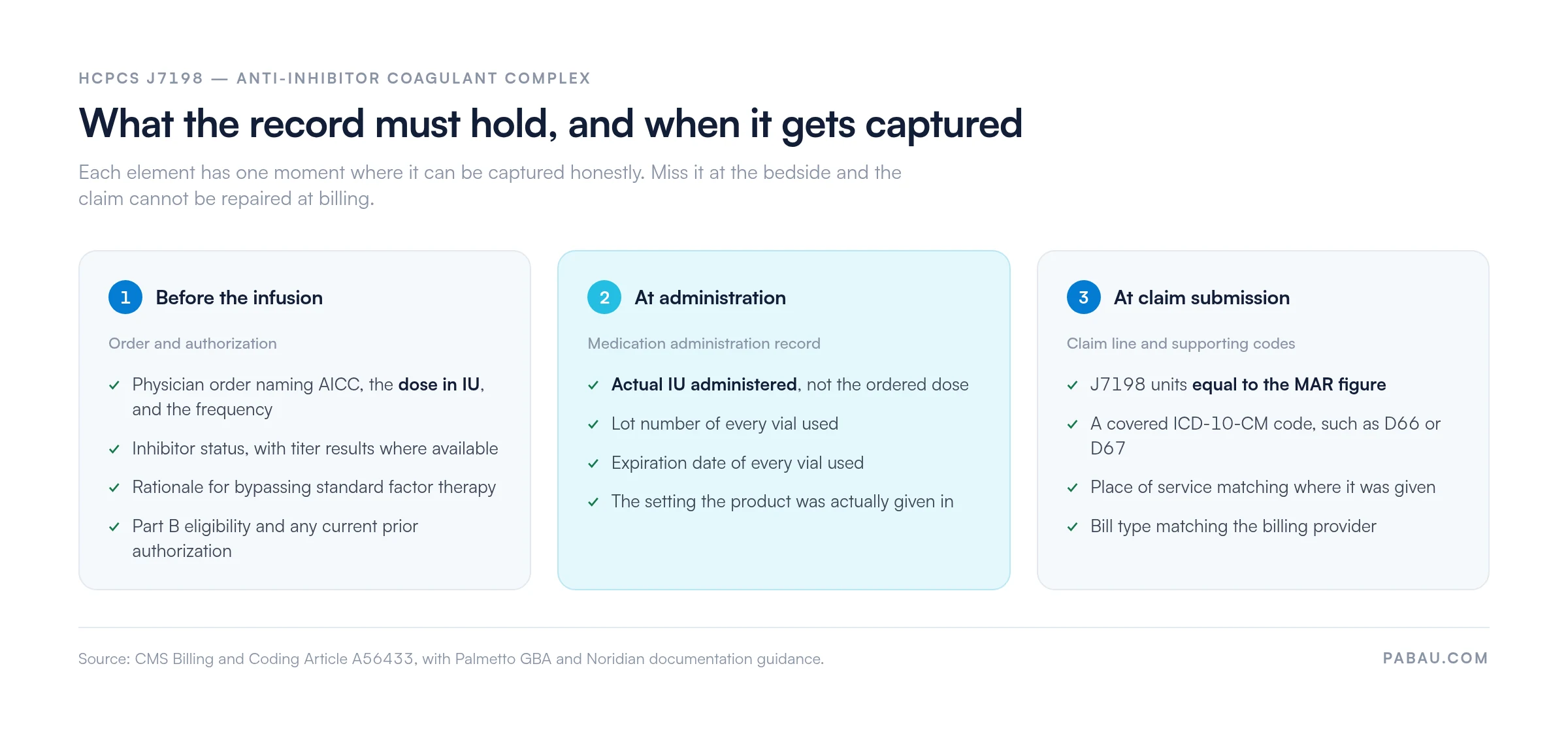
Document the lot number and expiration date of every Feiba NF vial at the time of administration, not at billing. Retroactively adding this information after a claim is submitted raises audit flags and, if the MAR lacks it, cannot be legitimately added post-hoc.
Structured intake forms and clinical note templates help infusion practices capture these data points the same way every time. That consistency is what keeps a billable infusion from becoming an uncollectable write-off.
Medicare reimburses J7198 under the Part B drug pricing methodology. For separately payable drugs given in a physician office or outpatient setting, that generally means Average Sales Price (ASP) plus 6%.
Because ASP-based rates update quarterly, no static dollar figure stays reliable for long. For current figures, consult:
Hospital outpatient departments may receive reimbursement through the Outpatient Prospective Payment System (OPPS) rather than the ASP methodology. Confirm the applicable payment mechanism with your billing team based on the provider type and place of service.
Palmetto GBA’s MAC guidance identifies the most frequent denial patterns for hemophilia clotting factor claims, including HCPCS Code J7198. Catching these before submission costs far less than appealing them afterward.
J7198 sits within the clotting factor code range J7177-J7214. Billers working with hemophilia products should know the adjacent codes to avoid selecting an incorrect code for the drug administered. The NLM HCPCS API provides programmatic access to the full code descriptor list for this range.
The drug class is what separates J7198 from its neighbors. Anti-inhibitor coagulant complex is a bypassing agent rather than a standard factor concentrate. Selecting J7192 (recombinant factor VIII) or J7193 (factor IX) for an AICC claim is a coding error that will likely trigger a clinical edit.
Infusion and specialty practices billing J7198 carry a heavier records burden than a standard office visit. Every administration needs the IU given, the vial lot number, and an order that matches both. Pabau keeps those details in the patient record instead of a spreadsheet.
Once the encounter is charted, Pabau’s streamlined claims management submits the claim and tracks its status from one screen. Claim data is pre-filled from the record, so nobody retypes a unit count that has to match the MAR.
The billing team can see which J7198 lines are still unpaid without asking the clinical team for a lot number. The record still has to be right at the point of care, and Pabau puts that capture and the claim in one system.

Pabau submits each claim from the record it was charted in and tracks its status on one dashboard. Your team sees a rejection within days instead of at month end.

J7198 asks more of the record than most drug codes do. The unit on the claim has to trace back to a MAR and an order that already agree with each other. That agreement gets built at the bedside, and billing cannot manufacture it later.
Practices that build the capture into the infusion workflow, rather than reconciling after the fact, hold better clean claim rates on factor products. To see how Pabau keeps the claim and the record in step, book a demo.

Need a clean claim checklist for specialty drug billing? Clean claim submission best practices covers the documentation and coding requirements that prevent technical denials across drug code claims.
Managing billing denials across your infusion practice? Denial management in healthcare outlines a structured workflow for tracking, appealing, and preventing common claim rejection patterns.
Want a deeper look at the revenue cycle for specialty practices? Revenue cycle management fundamentals explains how billing, coding, and documentation connect from charge capture through payment posting.
HCPCS Code J7198 bills anti-inhibitor coagulant complex (AICC), brand name Feiba NF. It applies to patients with hemophilia A or B who have developed inhibitors against standard factor replacement therapy. The code is billed per international unit (IU) administered.
J7198 covers anti-inhibitor coagulant complex (AICC), commercially known as Feiba NF, manufactured by Takeda (formerly Baxalta). It is a plasma-derived bypassing agent used when standard factor VIII or IX products are ineffective due to inhibitor development.
Bill the exact number of international units (IU) actually administered to the patient. The unit count on the claim must match the medication administration record (MAR) and the physician order exactly. Never round to vial sizes or bill the ordered dose if it differs from the administered dose.
Covered ICD-10-CM codes per CMS Article A56433 include D66 (hemophilia A), D67 (hemophilia B), D68.0, D68.1, D68.311, D68.312, D68.318, D68.32, D68.39, and D68.4. The diagnosis must reflect the patient’s inhibitor status, not just the underlying hemophilia type.
Yes. Medicare Part B covers HCPCS Code J7198 for patients with hemophilia A or B with inhibitors. Standard factor replacement therapy must have failed or be clinically contraindicated. The claim also needs a covered ICD-10-CM diagnosis code and complete documentation per CMS Article A56433.
Modifier requirements vary by payer and place of service. Some Medicare Administrative Contractors and commercial payers require specific modifiers for bypassing agent claims. Always verify modifier requirements with the applicable MAC or commercial payer before submitting a J7198 claim to avoid technical denial.