

CPT Code 98981: RTM Treatment Management Billing Guide
CPT code 98981: Definition and official descriptor CPT code 98981 is an add-on c...

Last Updated: Nov 9, 2026
J3358 is the HCPCS Level II code for ustekinumab, for intravenous injection, 1 mg. It is billed for the single weight-based IV induction dose of Stelara in Crohn's disease and ulcerative colitis.
One unit equals 1 mg, so the 260, 390 and 520 mg doses bill as 260, 390 or 520 units. Subcutaneous ustekinumab doses use J3357, and biosimilars use their own Q-codes.
Let Pabau's smart automation suggest the right codes, reduce claim denials, and keep your practice compliant—effortlessly.
Automate repetitive tasks and focus on what matters most—your patients.
Reduce coding errors and ensure compliance with the latest regulations.
Clean claims, fewer denials, and faster reimbursements.
Powerful insights and reporting to help your practice thrive.
HIPAA compliant SOC 2 certified GDPR-compliant Trusted by 4,000+ clinics worldwide

HCPCS code J3358 is ustekinumab for intravenous injection, billed per 1 mg, while J3357 is the subcutaneous code.
J3358 covers the single weight-based IV induction dose for Crohn’s disease and ulcerative colitis: 260, 390 or 520 mg.
Bill one unit per milligram, so the three doses are 260, 390 or 520 units, and 520 is also the Medicare MUE.
Each dose uses whole 130 mg vials, so the claim line normally carries the JZ modifier for zero waste.
Biosimilar ustekinumab products bill under their own Q-codes, never J3358, and the Medicare rate differs for each one.
HCPCS code J3358 describes “ustekinumab, for intravenous injection, 1 mg.” It covers the one-time IV induction infusion of ustekinumab in Crohn’s disease and ulcerative colitis. The maintenance doses that follow go under the skin and bill as J3357.
Ustekinumab is a monoclonal antibody that blocks interleukin-12 and interleukin-23 by binding the p40 subunit the two cytokines share. Janssen Biotech markets it as Stelara. J3358 took effect on January 1, 2018, according to the CMS HCPCS quarterly update files.
The split by route started a year earlier. A CGS Medicare coding notice confirmed that from January 1, 2017, J3357 covered only subcutaneous ustekinumab. J3358 now sits among the HCPCS Level II J-codes for drugs given other than by mouth, listed in our HCPCS library for billers.
Report the 11-digit NDC of the vial you infused alongside J3358. CMS’s October 2026 NDC-HCPCS crosswalk maps both Janssen vials above to J3358, each at 130 billing units per vial. Pull the NDC from the carton in hand rather than from a saved list.
IV ustekinumab is labeled for induction in moderately to severely active Crohn’s disease and ulcerative colitis, so those are the diagnoses that support J3358. Psoriasis and psoriatic arthritis are treated with subcutaneous doses only, which bill under J3357.
Code to the highest specificity the chart supports. If the note documents a complication such as rectal bleeding or an abscess, report the matching K50 or K51 complication code instead.
Bill one unit for every milligram infused. The induction dose depends on the patient’s body weight on the day of the infusion, and each band uses whole 130 mg vials.
The chart follows each band through to the claim line, using a 72 kg patient as the worked example.
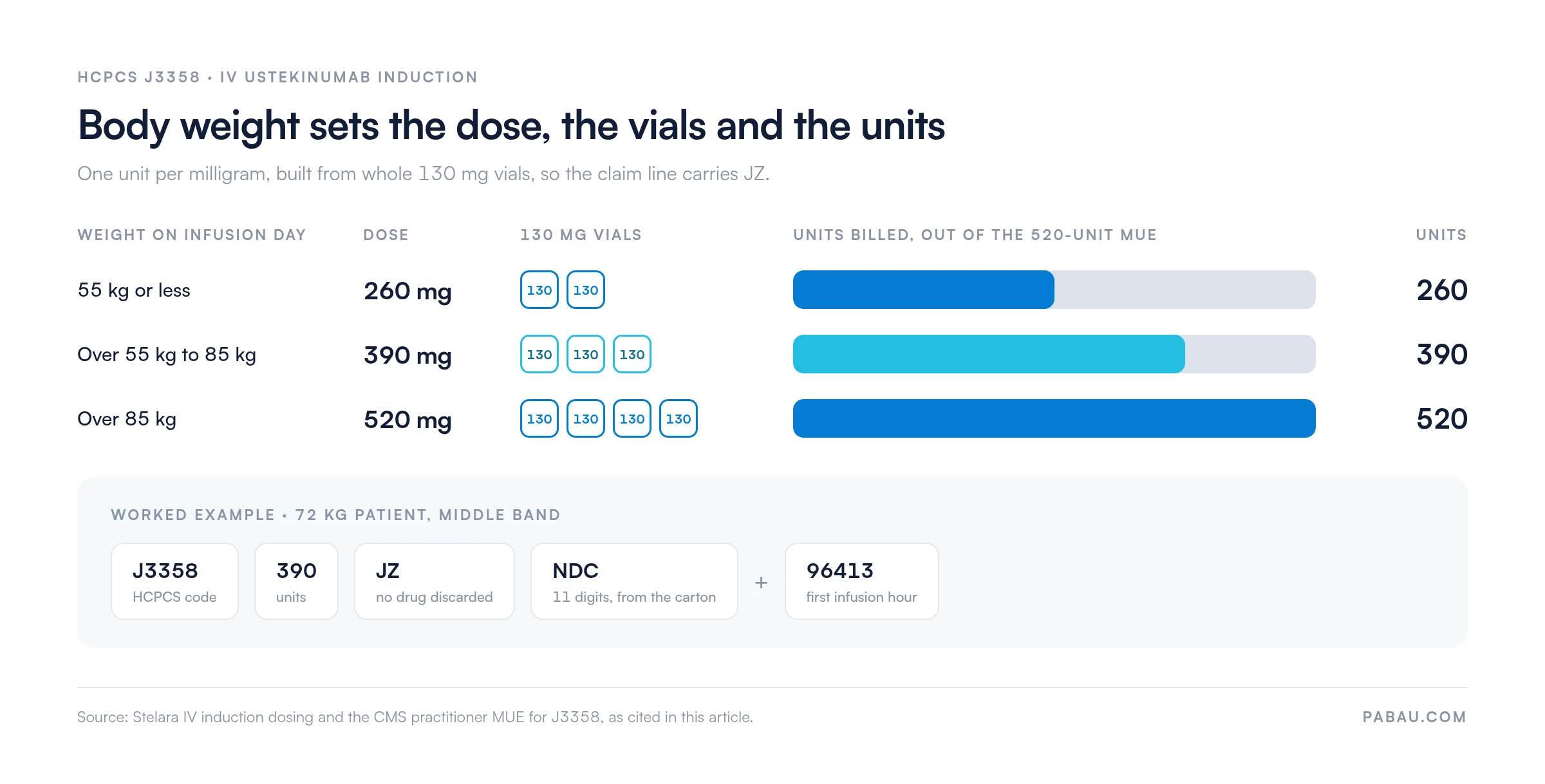
Two errors account for most unit problems. Some billers enter the number of vials, so a 390 mg dose goes out as 3 units instead of 390. Others bill a dose that doesn’t match the documented weight band, which a payer reviewing the chart will reject.
The CMS medically unlikely edit for J3358 is 520 units per date of service, matching the top weight band. Units above 520 on one date of service are denied, and no labeled dose exceeds it.
J3358 is on the CMS list of single-dose container drugs subject to the JW and JZ modifier policy. Separately paid Medicare Part B claims must carry one or the other on every J3358 line.
A JW line on a J3358 claim deserves a second look. With doses built from whole vials, discarded drug usually means the dose or the weight band was recorded wrongly.
Choose by route. J3358 is the IV infusion given once at the start of treatment for Crohn’s disease or ulcerative colitis. J3357 covers every subcutaneous dose, including IBD maintenance and the psoriasis and psoriatic arthritis doses.
The first subcutaneous dose, 90 mg, is due eight weeks after the IV infusion. Check that the authorization covers both routes before that visit, since some plans approve the IV induction and the maintenance doses separately.
Bill the infusion with CPT 96413 for the first hour. Stelara IV is diluted in 250 mL of 0.9% sodium chloride and infused over at least one hour, so 96413 usually stands alone.
Some commercial payers expect 96365 for biologic infusions instead. Check the payer’s drug administration policy before you bill the first induction.
An ustekinumab biosimilar is never billed with J3358. Each biosimilar has its own Q-code, and you report the code for the product you infused. The table lists the codes and Medicare payment limits in CMS’s October 2026 ASP files.
Wezlana and Pyzchiva have separate IV codes, while the other five biosimilars share one code across the vial and the syringes. For a shared code, the NDC on the claim tells the payer which form you infused. Several biosimilar limits include the temporary add-on of 8% of the reference product’s ASP.
Before an IV induction, check which ustekinumab product the payer prefers. If the plan names a biosimilar, the authorization, the vial pulled and the Q-code on the claim all have to match that product.
Medicare Part B pays J3358 at ASP plus 6%, set per milligram and updated each quarter. The October to December 2026 payment limit is $10.249 per unit, based on second-quarter 2026 sales data. Recheck it whenever CMS posts a new quarter’s file.
At that rate, the drug portion of a 390 mg induction is about $3,997 before adjustments. The patient owes 20% coinsurance, and the 2% Medicare sequestration cut reduces the amount paid to the practice.
Medicaid rates for J3358 vary by state, because each state agency sets its own physician-administered drug fee schedule. Check the state fee schedule each quarter, since it doesn’t move in step with Medicare’s ASP updates.
Most commercial plans, Medicare Advantage plans and Medicaid programs require prior authorization before an IV ustekinumab induction. Original Medicare has no national prior authorization requirement for J3358, but the claim must still meet your MAC’s coverage rules.
Request authorization for the IV induction and the subcutaneous maintenance doses together where the payer allows it. Record the authorization number before the infusion date, so the claim is complete when it goes out. A sound claims management workflow keeps that number with the claim.
Since January 1, 2026, a CMS rule requires Medicare Advantage, Medicaid and CHIP plans to decide standard requests within 7 calendar days. Expedited requests must be decided within 72 hours. Employer-sponsored commercial plans aren’t bound by that rule, so build in extra lead time for them.
Take an illustrative patient: a 72 kg adult with moderately to severely active Crohn’s disease, starting ustekinumab. Here’s how the induction travels from booking to remittance.
Eight weeks later, the first 90 mg subcutaneous dose bills as J3357. That second claim is where a wrong code most often slips in.
Complete documentation at the time of the infusion prevents most J3358 denials. Good medical billing compliance treats this list as a pre-submission check rather than a retrospective audit.
J3358 denials follow predictable patterns. The Claim Adjustment Reason Code (CARC) and Remittance Advice Remark Code (RARC) on the remittance point you to the fix.
For Original Medicare, the first appeal level is a redetermination by your Medicare Administrative Contractor (MAC). File it within 120 days of receiving the initial determination.
Include the infusion record, the weight used for dosing, the NDC and the authorization if there is one. Tracking each denial by CARC on receipt, as part of denial management, tells your team whether to correct and resubmit or appeal.
For commercial medical-necessity denials, a peer-to-peer review with the plan’s medical director is often the fastest route. Ask for it promptly, because many plans limit how long after the denial it can be held.
Log every J3358 denial by CARC and review the list each month. If authorization denials lead, fix the intake step that books infusions before an approval is on file.
An IV ustekinumab claim passes through several hands. The infusion nurse records the dose, the front desk holds the authorization, and the biller retypes both into the claim. Each handoff is a chance for 390 units to go out as 3.
Pabau, the practice management and billing platform we build, tracks the authorization code, its dates and its sessions on the patient’s case. Your team gets a warning when the code is missing, so an unauthorized induction doesn’t reach the payer. Claims are created as CMS-1500 (837P) claims from that same case.
In the US, claims go out through Claim.MD, with eligibility checks before the infusion and secondary claims where a second payer applies. Remittances post back as ERAs, so you can see which J3358 claims were paid, short-paid or denied.
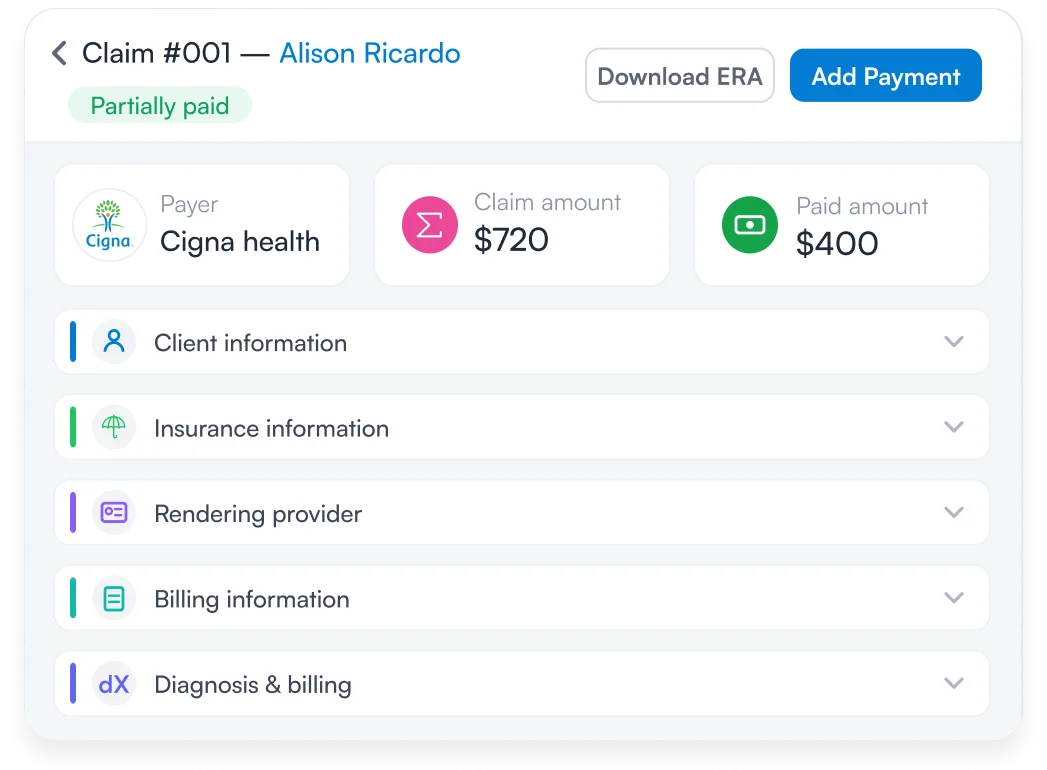

Pabau tracks each authorization on the patient’s case, warns when one is missing and submits CMS-1500 claims through Claim.MD. ERA remittances post back, so your team sees each J3358 payment or denial.

J3358 is a once-per-course code, and that is where its risk sits. A practice may bill it only a few times a year. That makes the weight band, the whole-vial units and the JZ modifier easy to forget.
Write the induction steps into your infusion checklist, from the weight check to the JZ modifier and the authorization number. Then confirm the product before the vial is opened, because a biosimilar switch changes the code.
Book a demo to see how Pabau carries those details from the patient record to a clean claim.

Need a broader overview of HCPCS billing fundamentals? Medical billing fundamentals explains how physician-administered drug claims flow from administration to reimbursement.
Seeing repeat denials across your biologic drug claims? Denial management in healthcare covers how to build a systematic tracking and appeal process.
Want to understand what a clean drug claim looks like before submission? What makes a clean claim walks through the fields payers check first on physician-administered drug submissions.
Submitting the authorization request yourself? Medical prior authorization form lays out the clinical and drug details payers ask for.
J3358 is the intravenous code, used once for the induction dose. J3357 is the subcutaneous code, used for IBD maintenance and for psoriasis and psoriatic arthritis doses. The route on the date of service decides the code.
Part B. Clinical staff give the IV induction in an office or hospital outpatient department, so it bills as a physician-administered drug. Subcutaneous doses a patient injects at home usually fall under Part D instead.
Hospitals usually report J3358 under revenue code 0636, drugs requiring detailed coding, with the units and NDC on the same line. The infusion itself goes on its own line with 96413.
Yes. Since January 1, 2025, hospitals paid under OPPS report the TB modifier on drugs bought through the 340B program. The JG modifier no longer applies. State Medicaid programs may set their own rule.
Normally no. The label calls for a single IV induction dose, so J3358 appears once per treatment course. A repeat IV dose is off-label, so document the clinical reason and expect a medical-necessity review.




