

ICD-10 Code R63.4: Abnormal weight loss
ICD-10 code R63.4: Definition, billability and code structure ICD-10 code R63.4 ...

Last Updated: Nov 13, 2026
Billable Code Specific Code
K50.90 is the billable ICD-10-CM code for Crohn's disease, unspecified, without complications. It applies when the record confirms Crohn's disease but names no intestinal site and documents no complication.
It sits in the K50-K52 noninfective enteritis and colitis block and is valid in the current ICD-10-CM code set. Once a colonoscopy, imaging or pathology report for the encounter names the site, a site-specific K50 code replaces it.
Let Pabau's smart automation suggest the right codes, reduce claim denials, and keep your practice compliant—effortlessly.
Automate repetitive tasks and focus on what matters most—your patients.
Reduce coding errors and ensure compliance with the latest regulations.
Clean claims, fewer denials, and faster reimbursements.
Powerful insights and reporting to help your practice thrive.
HIPAA compliant SOC 2 certified GDPR-compliant Trusted by 4,000+ clinics worldwide

K50.90 is billable when the record confirms Crohn’s disease but names no intestinal site and documents no complication.
When a same-episode report names the site before the claim is finalized, K50.00, K50.10 or K50.80 replaces K50.90.
Ulcerative colitis (K51.-) is the one Excludes1 condition at K50, and indeterminate colitis takes its own code, K52.3.
Biologic infusions bill as therapeutic IV infusion (96365, plus add-on 96366), and commercial plans usually want prior authorization first.
Pabau, our practice management platform, pre-fills claims from the patient record, checks required fields and submits them through Claim.MD.
ICD-10 code K50.90 is the billable diagnosis code for Crohn’s disease, unspecified, without complications. It appears in the ICD-10-CM tabular list in the CDC/NCHS FY2027 release, which applies to services from October 1, 2026. It is a terminal code, so it needs no further characters to go on a claim.
The descriptor carries two qualifiers. “Unspecified” refers to the intestinal site, not the disease. The physician may have confirmed Crohn’s disease completely, and only the location is still unknown. “Without complications” means the record documents no rectal bleeding, obstruction, fistula, abscess or other K50 complication.
Because the category header reads “Crohn’s disease [regional enteritis],” a note that says regional enteritis or granulomatous enteritis supports the same code.
K50.90 fits only while no site and no complication are documented. Once the note or that encounter’s workup names the small intestine, the large intestine or both, a site-specific code applies.
Category K50 carries one key Excludes1 condition: ulcerative colitis (K51.-). The two can’t be coded together, so query the physician when a note documents both.
Indeterminate colitis is a separate code, not an Excludes1 note. Code K52.3 instead when the clinician documents indeterminate colitis.
The specificity rules come from the ICD-10-CM Official Guidelines. Section I.B.2 covers the level of detail in coding, and Section I.B.18 covers unspecified codes. Together they say to assign the most specific code the record supports.
K50.90 is the least specific code in the K50 family. The family has four site branches: small intestine, large intestine, both, and unspecified. Each branch has six complication codes per site, plus the without-complications code.
The path below shows the order to read the note in, and where K50.90 lands at the end of it.
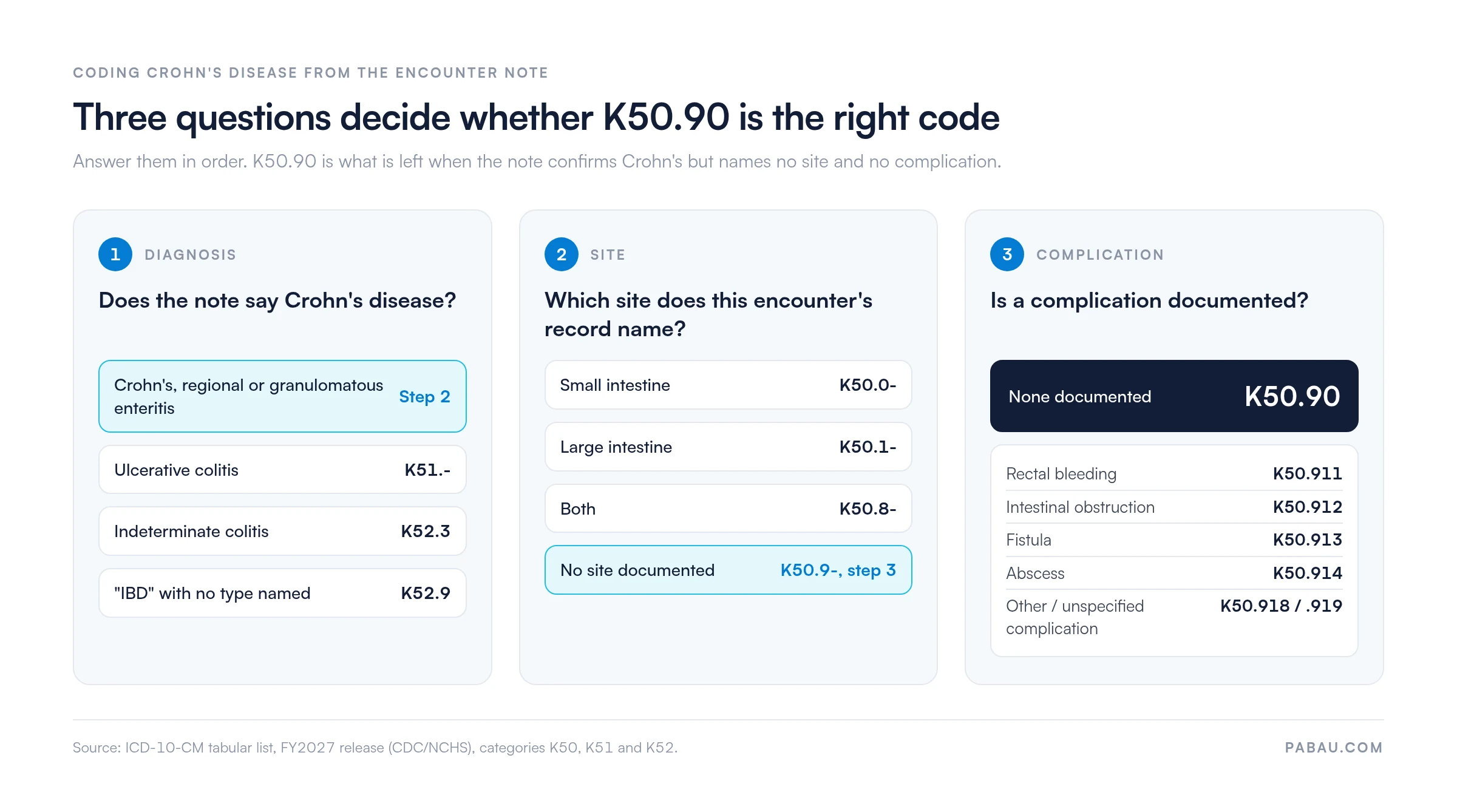
When the colonoscopy report for the encounter places disease in the terminal ileum, K50.00 replaces K50.90. Disease confined to the colon takes K50.10. K50.90 stays on the claim only while the site is still unknown.
K50.90 (Crohn’s disease, unspecified, without complications) and K51.90 (ulcerative colitis, unspecified, without complications) are easy to swap by mistake. Their descriptors follow the same pattern. The physician’s diagnosis, backed by clinical and pathology findings, is the only thing that separates them.
When the note reads “indeterminate colitis,” neither code fits. Documentation of “indeterminate colitis” maps to K52.3, and “IBD, unspecified” maps to K52.9. Assigning K50.90 in either case codes a diagnosis the physician didn’t make.
A clean claim submission for K50.90 rests on five elements in the medical record. If one is missing, a payer can downcode the encounter or ask for records.
Code from the documentation for that encounter. A site-specific report from the same episode of care, available before the claim is finalized, supports the more specific code.
Here’s how K50.90 usually plays out over one patient’s first month with a GI practice. The patient and the timeline are illustrative.
The first claim wasn’t a coding error. K50.90 was the most specific code the first visit’s documentation supported, and the switch happened at the encounter that produced the site.
K50.90 has to support medical necessity for each procedure billed with it. These are the CPT codes it pairs with most often in gastroenterology and primary care.
Biologic infusions such as infliximab bill as therapeutic IV infusion. Use 96365 for the first hour and add-on 96366 for each additional hour. Many commercial payers require prior authorization for these drugs. Some also expect step-therapy history or a complication-level K50.91x code, not K50.90 alone.
Diagnostic colonoscopy is the pairing you’ll see most, and our 45378 reference covers that code’s billing rules in more depth.
Before billing 96365 for a biologic infusion with K50.90, check the payer’s prior authorization rules. Many commercial plans ask for documented step-therapy history, such as a trial of a conventional immunomodulator, before they approve a biologic. A missing authorization comes back as CARC 197.
Medicare covers diagnostic and management services for Crohn’s disease when the record supports medical necessity. No National Coverage Determination covers colonoscopy for Crohn’s, since NCD 210.3 covers screening only. Diagnostic colonoscopy coverage is set by the MAC’s LCDs and billing articles, so check your jurisdiction’s list of covered diagnosis codes.
Original Medicare doesn’t generally require prior authorization for Crohn’s biologic infusions. Prior authorization is mainly a commercial and Medicare Advantage requirement, and it usually triggers on two services.
K50.90 denials follow a familiar pattern. The table maps each reason to its claim adjustment reason code (CARC), as defined in the X12 CARC list, and the fix that clears it.
CARC 16 always arrives with at least one remark code, so read both before you correct the claim. Our guide to denial codes explains the other adjustment codes you’ll meet on a GI remittance.
Good denial management workflows for K50.90 start before submission. A check that flags a site report sitting next to a K50.90 claim cuts CARC 16 denials. Reviewing electronic remittance advice by CPT-to-ICD pair over a rolling 90 days also shows coding drift early.
The ICD-10-CM Official Guidelines allow an unspecified code when the documentation supports nothing more specific. Section I.B.2 sets the level-of-detail rule, and Section I.B.18 covers unspecified codes. Neither lets a coder assume a site or complication the physician didn’t document. You’ll find each year’s guidelines on CMS’s ICD-10 page.
K50.90 holds up in three situations.
Audits target unspecified codes when a more specific one was supported. A common finding is K50.90 billed after the same episode’s colonoscopy report placed disease in the terminal ileum.
Sound medical billing compliance means coding from the documentation for that encounter. A site-specific report from the same episode of care, available before the claim is finalized, supports the more specific code.
Run these checks before a K50.90 claim leaves the practice. Each one maps to a denial in the table above.
In a busy GI practice, the physician often confirms Crohn’s disease before the billing team sees the full workup. K50.90 goes on the first claim, and nobody revisits it when the colonoscopy report arrives.
Pabau keeps the note and the claim on one patient record. Its claims management software pre-fills claims from that record. A built-in ICD-10-CM code lookup lets billers search the full K50 family when coding.
Before submission, Pabau checks the required claim fields and sends CMS-1500/837P claims through Claim.MD, our US clearinghouse integration. Eligibility checks run before the visit, and ERA remittances post back to the record. Authorization codes, dates and sessions sit on the patient’s case, with a warning when one is missing.
With each stage of revenue cycle management in one system, your team can trace a K50.90 denial straight back to the note behind it.

Pabau pre-fills claims from the patient record, offers ICD-10-CM and CPT code lookup and checks required claim fields. Claims, eligibility checks and ERAs run through Claim.MD.

K50.90 earns its place at the start of a Crohn’s workup, before any report names a site. A site-defining colonoscopy or biopsy report from the same episode that arrives before the claim is submitted moves the claim to K50.00, K50.10 or K50.80.
So build the recode into your routine. Check for a site report before every Crohn’s claim, keep K51 off the same claim, and get authorization before a biologic infusion.
Pabau keeps the note, the code lookup and the Claim.MD submission on one record, so that check happens where the coding does. Book a demo to see how it handles your Crohn’s disease claims.

Need a full denial management framework? Denial management in healthcare covers the end-to-end process for tracking, appealing and preventing claim denials.
Want to understand how claims reach payers? Claim.MD clearinghouse guide explains how electronic claim submission works and what a clearinghouse checks.
Billing the colonoscopy that follows? CPT code 45380 covers colonoscopy with biopsy, the procedure that often settles the Crohn’s site.
Building a clean billing process from scratch? What is medical billing walks through each stage from patient registration to payment posting.
Yes, when the physician documents one. Category K50 carries a “use additional code” note for manifestations such as pyoderma gangrenosum (L88). List K50.90 first, then the manifestation code.
The ICD-9-CM equivalent was 555.9, regional enteritis of unspecified site. You’ll still meet it in older records and conversion tables when tracing a long Crohn’s history.
Sequence O99.61- (diseases of the digestive system complicating pregnancy) first, with the trimester character. Then add K50.90, or the site-specific K50 code, to identify the Crohn’s disease.
Yes. Crohn’s disease codes, K50.90 included, map to a payment HCC in the CMS-HCC risk adjustment model. The condition still has to be documented and addressed at a face-to-face encounter each year.



