

CPT Code 98981: RTM Treatment Management Billing Guide
CPT code 98981: Definition and official descriptor CPT code 98981 is an add-on c...

Last Updated: Nov 9, 2026
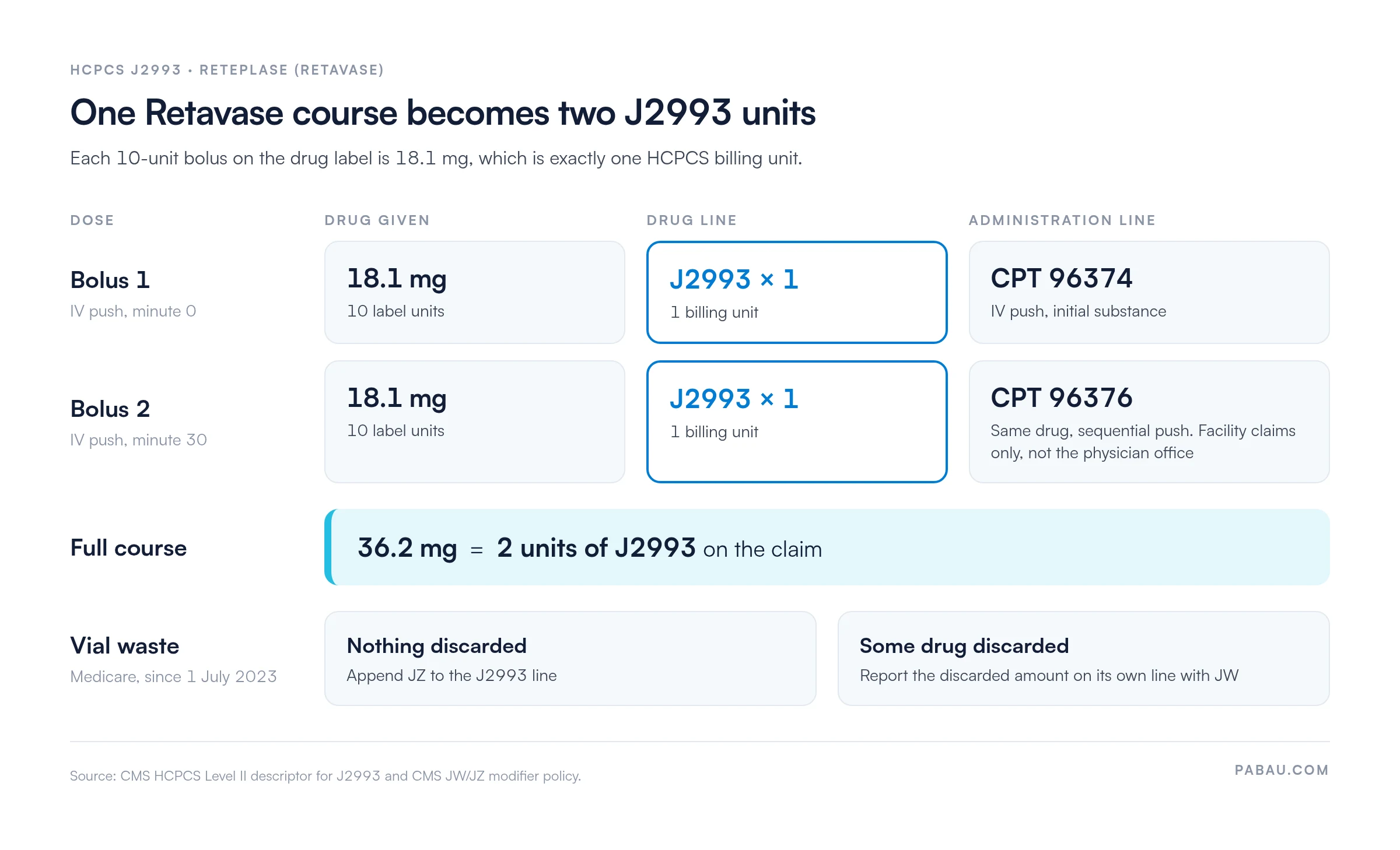
J2993 is the HCPCS Level II code for injection, reteplase, 18.1 mg. One billing unit equals one 18.1 mg bolus of Retavase, so the standard two-bolus regimen for acute myocardial infarction bills as two units.
Coders sometimes confuse it with neighboring thrombolytic J-codes such as J2997 for alteplase, which bills per 1 mg. J2993 covers the drug only, so each IV push is billed separately with a CPT administration code.
Let Pabau's smart automation suggest the right codes, reduce claim denials, and keep your practice compliant—effortlessly.
Automate repetitive tasks and focus on what matters most—your patients.
Reduce coding errors and ensure compliance with the latest regulations.
Clean claims, fewer denials, and faster reimbursements.
Powerful insights and reporting to help your practice thrive.
HIPAA compliant SOC 2 certified GDPR-compliant Trusted by 4,000+ clinics worldwide

HCPCS Code J2993 reports reteplase under the official descriptor Injection, reteplase, 18.1 mg, and one billing unit equals 18.1 mg.
A full Retavase course is two 18.1 mg boluses, so it bills as two units of J2993 (36.2 mg in total).
Medicare requires JZ when none of the single-dose vial is discarded, or a JW line for the discarded amount.
NDC reporting is mandatory for Medicaid and required by most commercial payers, in the 11-digit format with qualifier N4.
Pair J2993 with CPT 96374 for the first IV push, while 96376 for the second bolus applies to facility claims only.
HCPCS Code J2993 is the Level II code CMS assigns to reteplase (Retavase), and its official descriptor reads “Injection, reteplase, 18.1 mg.”
One billing unit equals 18.1 mg, so a standard two-bolus course bills as two units. The code covers the drug only, and the IV push is billed separately with a CPT administration code. Unit sizes vary across drug codes. Alpha-1 proteinase inhibitor, for example, bills under the J0256 code at one unit per 10 mg.
J-codes are the HCPCS Level II range for drugs administered other than by mouth. Neighboring drug codes in this range are listed in our HCPCS code library. Per the CMS HCPCS overview, the code set is updated every year. Check the current descriptor in the CMS Alpha-Numeric HCPCS file before each billing cycle.
The table below summarizes the code’s key reference data.
Reteplase (brand name Retavase) is a recombinant plasminogen activator indicated for acute myocardial infarction (AMI). It works by catalyzing the cleavage of plasminogen into plasmin, which breaks down fibrin clots. FDA-approved use is limited to AMI. Document clinical justification for any off-label use, which faces payer-specific coverage review.
Reteplase is given as two 10-unit IV boluses 30 minutes apart, each 18.1 mg (36.2 mg total). Those 10 units are the drug label’s own dose units, not HCPCS billing units. Administration happens in the emergency department or another acute hospital setting. The setting decides which place of service code goes on the claim.
One unit of HCPCS Code J2993 equals 18.1 mg of reteplase administered. The standard regimen delivers two separate 10-unit boluses of 18.1 mg each, so a full treatment course bills two units of J2993. The diagram below maps each bolus to its claim lines.
Follow these steps to calculate billable units correctly:
A frequent unit error is billing one unit for the full two-bolus regimen. Each 18.1 mg bolus is a separate unit, and both are billable when both are given and documented. Underbilling by one unit loses revenue, while billing beyond what the MAR supports is a compliance risk.
The National Drug Code (NDC) identifies the exact manufacturer, product, and package size of the drug administered. Medicaid programs require NDC reporting on J-code claims, and most commercial payers and Medicare Advantage plans ask for it too. Traditional Medicare Part B does not universally require the NDC on the CMS-1500, but MAC guidance varies.
Correct NDC formatting on a J2993 claim requires three elements:
State Medicaid programs differ in their qualifier and quantity rules, so confirm each state’s billing guide before submitting. The PGM Billing HCPCS lookup tool can surface the NDC linked to J2993 for cross-reference.
Medicare Part B covers reteplase when it is given in an outpatient setting. For this drug, that usually means the emergency department or another hospital outpatient department (HOPD). In a physician office, Part B pays the Average Sales Price (ASP) plus 6%, net of sequestration. An HOPD is paid under the Outpatient Prospective Payment System (OPPS). A separately payable drug there usually earns ASP plus 6%. A packaged drug is paid within the facility fee. When the patient is admitted, the drug is paid within the inpatient stay instead. ASP rates change every quarter, so check the current CMS ASP pricing file before quoting a payment amount.
Local Coverage Determinations (LCDs) issued by Medicare Administrative Contractors (MACs) define medical necessity within each jurisdiction. There is no single national LCD for reteplase, so check the MAC portal for the jurisdiction where the service was rendered. Medicaid coverage is state-administered and varies in both covered indications and reimbursement method.
ASP rates for J2993 update every quarter (January, April, July, October). Set a quarterly reminder to pull the new ASP pricing file from CMS and update your fee schedule before the effective date. One missed update can leave a practice billing at a rate that no longer matches reimbursement, which means a quarter of reconciliation work.
Traditional Medicare Fee-for-Service (FFS) does not require prior authorization for most Part B drugs, including J2993, when the LCD criteria are met. Medicare Advantage plans and commercial payers, however, routinely require prior authorization (PA) for specialty injectables in this drug class.
Typical PA criteria for J2993 include:
When PA is denied, the practice can appeal with clinical documentation supporting medical necessity. Tracking PA status across a claim’s lifecycle is a core part of medical billing compliance. Reteplase is an emergency treatment for AMI, so care is not held while a PA request is pending. The criteria above apply mainly to non-emergent or scheduled outpatient use, and retrospective review rules vary by payer.
Every J2993 claim needs a medical record that shows medical necessity and confirms the drug was ordered, administered, and documented correctly. A missing document is the fastest route from submission to denial.
The minimum documentation set for a clean J2993 claim:
A J2993 claim missing any of these elements is exposed to denial. Building intake and documentation workflows around this checklist makes clean claim submission the routine outcome for J-code claims.
Modifiers appended to J2993 give the payer extra clinical or coverage information. A wrong or missing modifier often triggers a denial or a request for more documentation.
Always verify modifier requirements against the AAPC HCPCS code lookup and your MAC’s local billing articles before submission. Modifier rules vary by payer and plan year.
J2993 covers the drug cost only. The administration of reteplase needs a separate CPT code on the same claim. Choosing the wrong administration code, or leaving it off, leads to underpayment or a bundling edit denial.
Code the first bolus with 96374. A facility reports the second bolus of the same drug with 96376, while a physician office has no separate code for it.
Check CCI (Correct Coding Initiative) edits before pairing J2993 with any administration code. Some payers apply bundling edits that fold the administration payment into the drug payment, depending on the setting.
J2993 denials usually trace back to a small set of preventable errors. The table below maps each denial reason to its corrective action.
Systematic denial management across J-code claims means tracking denial reasons by code, not just by total volume. A pattern of unit-count denials on J2993 points to a unit-calculation step that is being skipped before submission.
Run a quarterly audit on all J2993 claims submitted in the prior 90 days. Pull the denial reason codes and sort them by frequency. If NDC errors or unit mismatches appear more than twice, trace them back to the step where the data is captured. Fixing that upstream capture point removes the whole category of denial instead of correcting claims one by one.
Reteplase belongs to a family of thrombolytic and tissue plasminogen activator (tPA) injectables, each with its own J-code. Billing the wrong code in this family is a common audit trigger, because the drugs look similar on a superbill.
The selection rule is simple: The drug named on the physician order must match the code descriptor. If the order names reteplase, the code is J2993. Alteplase bills under J2997 at 1 mg per unit, so a J2993-style unit count on it underbills by a wide margin. For any other thrombolytic, find that drug’s own J-code rather than defaulting to J3490.
A J2993 line carries more checks than most procedure codes. Units, NDC, prior authorization, the waste modifier, and the administration code all have to line up before submission. Many practices still check them by hand across a spreadsheet, a payer portal, and the clearinghouse.
In Pabau, the practice management platform we build, error-flagging claims management sits beside the patient record. Every claim is scrubbed for missing or invalid details before it leaves Pabau, with each fix linked to the field that needs it. Prior authorization codes are stored as cases that follow the appointment to the claim, and a claim missing one is flagged.
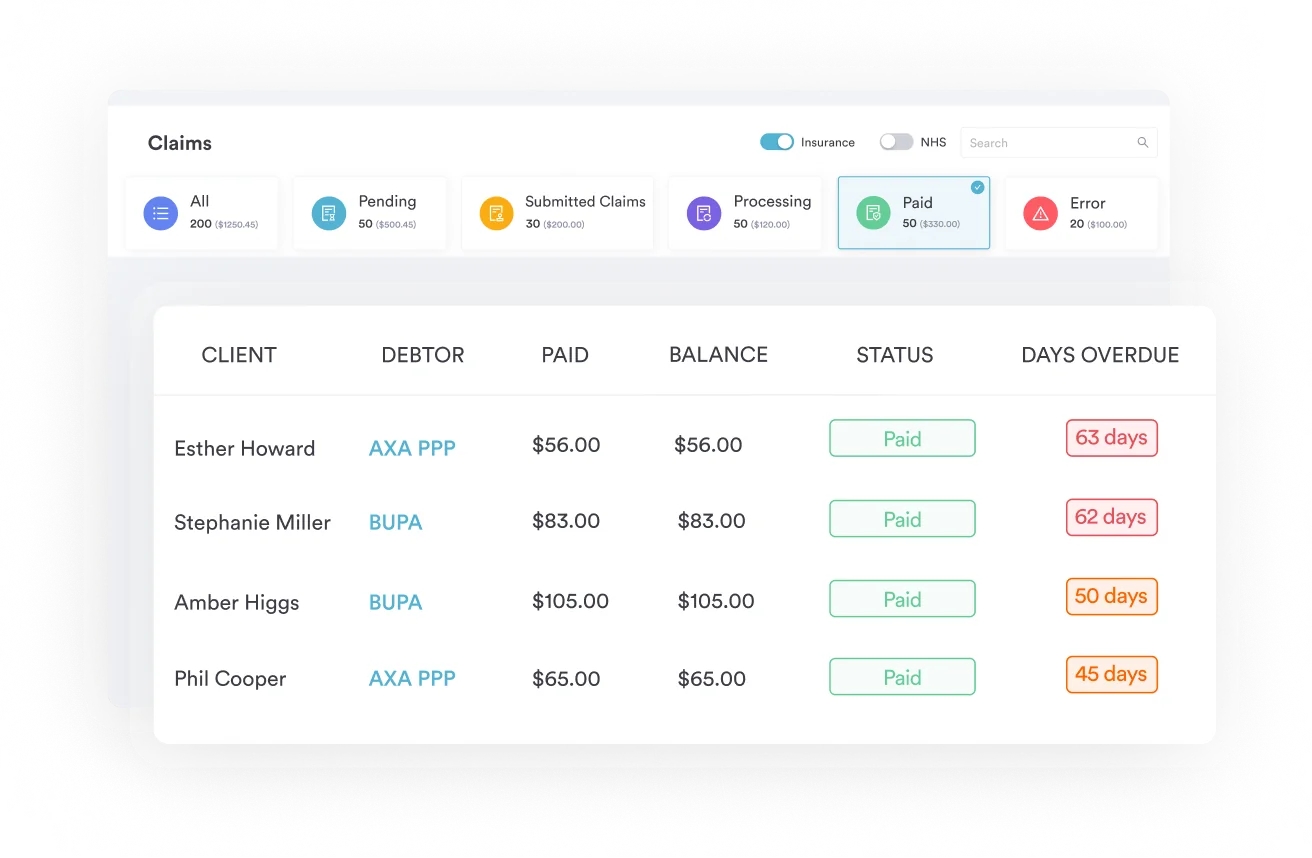
US practices check eligibility through Claim.MD before the visit and follow each claim from Pending to Paid on one dashboard. Rejected claims are marked “Needs action” with the reason, so your team corrects and resubmits them instead of hunting through payer letters. Coders still confirm the NDC and unit count against the MAR, but they work from one record instead of three systems.

Pabau scrubs every claim for missing or invalid details, links prior authorizations to the claim, and tracks each one from Pending to Paid. See how it fits your billing workflow.

J2993 rewards precision more than most drug codes. The arithmetic is simple once you separate the label’s 10-unit boluses from billing units. The risk sits in the details around it: the second bolus, the waste modifier, and the NDC.
Build those checks into the step where the dose is recorded, before anyone assembles the claim. A practice that does this sees fewer unit-count denials and spends less time reworking claims after the fact. The trade-off is a slightly longer MAR entry at the bedside, and it pays back on the first claim that goes through clean.
Still checking drug claims across separate tools? Book a demo to see how Pabau keeps J-code claims, authorizations, and denials in one place.

Need to understand how denials are categorized and appealed? Denial management in healthcare walks through the most common CARC codes and how to build an appeals workflow.
Billing alteplase instead of reteplase? HCPCS code J2997 covers the per-mg unit math for Activase and how it differs from J2993.
Coding the first IV push? CPT code 96374 explains when the initial IV push code applies and what documentation it needs.
Looking for a primer on revenue cycle fundamentals before your next audit? Revenue cycle management explained covers the billing process from eligibility through payment posting.
Want a checklist for what makes a clean claim before submission? Clean claim submission requirements outlines the data elements payers check before adjudicating a claim.
HCPCS Code J2993 covers reteplase (Retavase), and its official descriptor is Injection, reteplase, 18.1 mg. It is a Level II J-code that bills the drug separately from the IV push administration code.
Bill one unit of J2993 for each 18.1 mg of reteplase administered. The standard regimen is two 18.1 mg boluses, so a full course bills two units (36.2 mg). Verify the administered dose on the medication administration record, and add JZ or a JW line for vial waste.
Use the 11-digit NDC for the specific reteplase product drawn from your inventory, in 5-4-2 format with the N4 qualifier. Medicaid requires the NDC on J-code claims, and most commercial payers and Medicare Advantage plans ask for it too. Take the NDC from the vial used rather than from a generic drug reference.
Traditional Medicare Fee-for-Service generally does not require prior authorization for J2993 when LCD medical necessity criteria are met. Medicare Advantage plans and most commercial payers routinely require PA for specialty injectables in this drug class. Emergency AMI treatment is not held for PA, so these rules mainly affect non-emergent outpatient use.
Common denial reasons are a missing or badly formatted NDC, one unit billed for a two-bolus regimen, and a missing JW or JZ modifier. A missing prior authorization number and a diagnosis code the clinical notes don’t support also cause denials. A pre-submission checklist prevents each of them.
Most claims pair J2993 with CPT 96374 (IV push, single or initial substance) for the first reteplase bolus. In a facility setting, the second bolus of the same drug is reported with 96376, which a physician office cannot bill. J2993 itself covers only the drug cost.




