CPT Code 31653: EBUS With 3+ Mediastinal Stations
CPT code 31653: Official descriptor and clinical scope CPT code 31653 is the pro...

Last Updated: Oct 20, 2026
96376 is the CPT add-on code for each additional sequential intravenous push of the same substance or drug, provided in a facility. It covers therapeutic, prophylactic, and diagnostic pushes, and it is always reported with a primary code such as 96374 or 96365.
The repeat push qualifies only when more than 30 minutes have passed since the earlier push of that drug. Each qualifying push is one unit. A different drug pushed in sequence is reported with 96375, and the drug itself is billed separately under its HCPCS code.
Let Pabau's smart automation suggest the right codes, reduce claim denials, and keep your practice compliant—effortlessly.
Automate repetitive tasks and focus on what matters most—your patients.
Reduce coding errors and ensure compliance with the latest regulations.
Clean claims, fewer denials, and faster reimbursements.
Powerful insights and reporting to help your practice thrive.
HIPAA compliant SOC 2 certified GDPR-compliant Trusted by 4,000+ clinics worldwide

CPT Code 96376 is a facility-only add-on code, so Medicare does not pay it in a non-facility physician office.
The sequential push must repeat the exact substance given in the initial push (96374), more than 30 minutes after that push.
Using 96376 instead of 96375 when a different drug is given is the most common denial trigger on this code family.
The drug itself is billed separately under the appropriate HCPCS J-code, because 96376 covers the administration service only.
A drug name and a clock time recorded for every push is the documentation that keeps a 96376 claim payable.
CPT Code 96376 is the add-on code for each additional sequential intravenous push of the same substance or drug in a facility setting. It covers therapeutic, prophylactic, and diagnostic pushes given after the initial push of that drug. The American Medical Association, which owns the CPT code set, marks 96376 with a “+” symbol, so it cannot stand alone on a claim.
The code belongs to the 96360-96379 drug administration family. The table below places it among the push and infusion codes it sits beside.
The key distinction: 96376 is reported when the same drug comes back around for a repeat push. If a different drug is pushed sequentially, that is 96375. If this is the very first push of any drug, that is 96374. The procedural sequence in the clinical record decides which one goes on the claim.
The clinical scenario for 96376 is specific. A provider administers an initial IV push of Drug A (billed as 96374). More than 30 minutes later, Drug A is pushed again through the same IV access point. That repeat administration of the identical drug is what 96376 captures.
AMA CPT guidelines for the 96360-96379 family set that interval. More than 30 minutes must pass after the earlier push of the same drug before a repeat push counts as sequential. A repeat push given within 30 minutes is not reported as a second unit.
Common clinical contexts include:
The three codes most often confused with 96376 are 96374 (initial IV push), 96375 (sequential push, different substance), and 96365 (initial IV infusion). Each covers a distinct clinical event and billing context. Selecting the wrong one is the top source of denials in this code family.
The 96375 versus 96376 distinction is where most billing errors originate. Both are add-on sequential push codes. The single differentiator is whether the substance is identical to the initial push. Documentation can be ambiguous about drug identity, for example recording “antiemetic” without naming the agent. Payers then default to denial, because the same-substance requirement cannot be confirmed.
96365 versus 96376 errors appear when a drug goes in by slow infusion first. A rapid IV push of the same drug then follows later in the encounter. The infusion opening code (96365) is the primary. A subsequent push of a new substance then uses 96375 rather than 96376, because the “initial” event was an infusion rather than a push.
Put together, those rules reduce to four questions asked in order about every push after the first one.
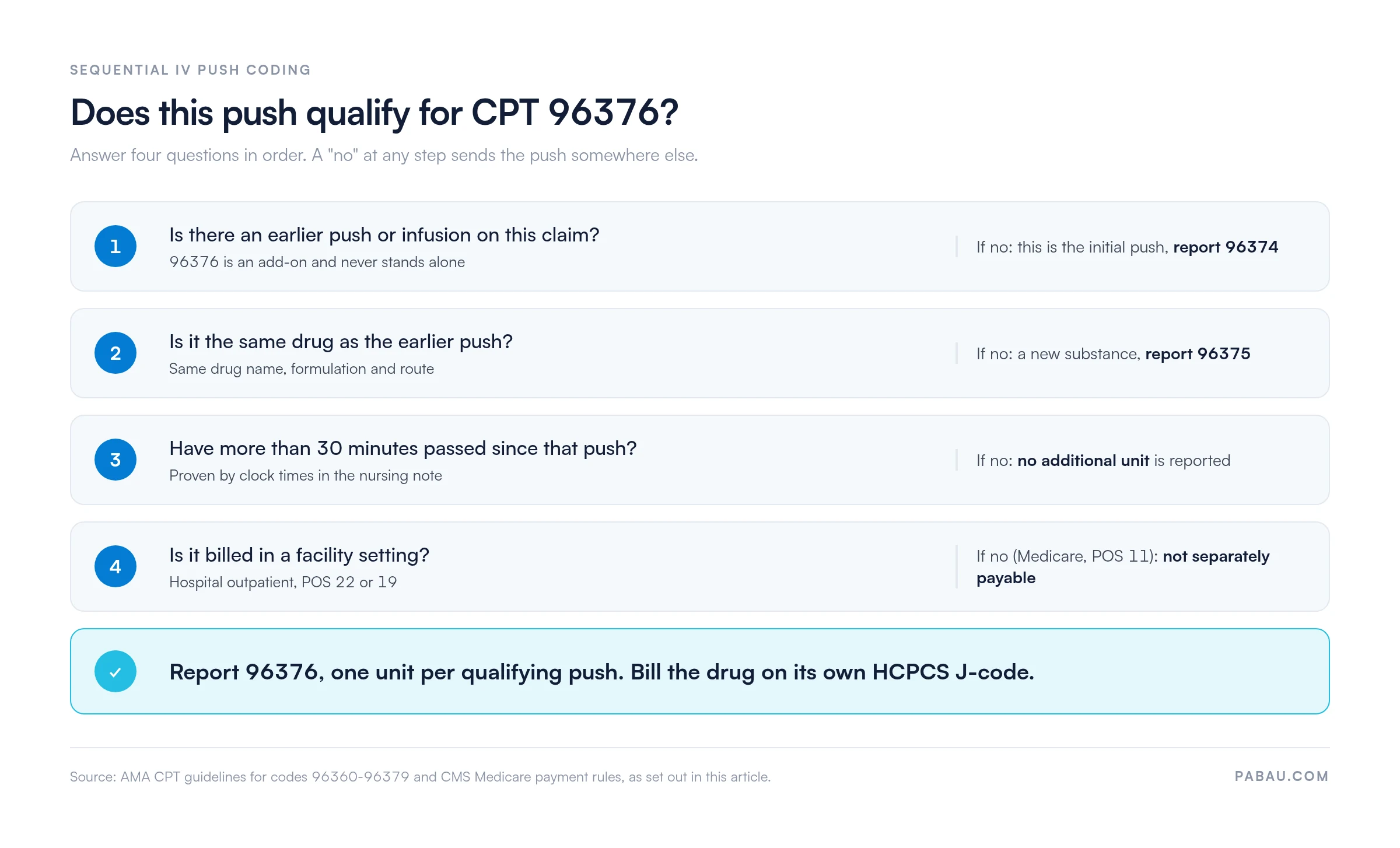
Billing CPT Code 96376 correctly requires confirming six conditions before the code appears on a claim. Miss any one and the claim either denies outright or is flagged for medical necessity review. Getting a clean claim on 96376 depends on confirming the sequence below before the encounter closes.
Flag infusion encounters for coder review when the nursing note is completed, before the chart reaches billing. When the nurse documents start times for each push, the coder can confirm the 30-minute interval and drug identity on the same day. Retroactive chart searches to justify 96376 add-on units are the single biggest cause of delayed claim submission in infusion-heavy practices.
The clinical record must support every element the payer evaluates when adjudicating a CPT 96376 claim. Missing a single field converts a payable encounter into a denial. For drug administration codes, payers expect both time-based and substance-based documentation. Capturing these fields at the point of care saves a trip back to the chart during billing reconciliation.
Payers conducting post-payment audits on infusion claims look specifically for time-entry gaps. A nursing note that records a push at 10:00 and a repeat of the same drug at 10:25 falls short of the 30-minute threshold. The claim may have already paid, but the practice faces recoupment risk on audit.
Medicare coverage for CPT Code 96376 is governed by CMS Hospital Outpatient Prospective Payment System policy. The code carries a facility-only payment status under the Medicare Physician Fee Schedule. CMS makes no separate payment to the physician for this service in a non-facility (office) setting. Payment flows through the facility’s OPPS claim instead.
For practices submitting claims through a clearinghouse, claim edits check add-on code pairings and place-of-service indicators before the claim reaches the payer. That step is where facility-versus-office mismatches surface as OCE edits rather than payer denials.
The 2026 Medicare payment rate for CPT Code 96376 in the facility setting is governed by the CMS Hospital Outpatient Prospective Payment System final rule.
Facility rates are subject to geographic wage index adjustment and differ by APC group assignment. Verify current rates using the CMS Physician Fee Schedule look-up tool for your locality, as national averages shift with annual OPPS rulemaking.
The drug or biologic is always billed separately under the appropriate HCPCS J-code, never bundled into the 96376 administration fee. The electronic remittance advice should then show separate line items for the administration code and the drug J-code. A single-line payment that bundles both signals a billing setup error worth investigating before the next submission.
The denial patterns on CPT Code 96376 are consistent across payers, and most trace back to one of six root causes. Each one is fixed upstream, in documentation or workflow, rather than by resubmitting the same incomplete claim. Our guide to decoding denial codes lists the CARC codes that typically accompany these rejections.
Build a claims edit rule that flags any claim containing 96376 without a same-date 96374 or 96365-family code. This single front-end edit catches the most common denial trigger before submission. Practices implementing this pre-submission check at the charge-entry stage typically see 96376 denial rates drop within the first billing cycle.
The denial patterns above are predictable, which makes them preventable through workflow checks rather than coder vigilance alone. Most 96376 errors start at charge capture, well before the claim is submitted.
Practice management software like Pabau keeps the nursing note, the invoice, and the claim in one system. Its error-catching claims management runs validation checks every time a claim is sent, so missing details get fixed before the payer sees them.
For infusion practices processing 50 or more administration encounters per week, manual review of every 96376 pairing stops being sustainable. Checks that run before submission move the correction point from post-denial to pre-claim, which cuts rework and shortens days in accounts receivable.

Pabau checks each claim for missing details before it goes out, then tracks it to payment in one Claims dashboard. US practices submit through Claim.MD without leaving Pabau.

Treat 96376 as a documentation code first. The nurse records the drug name and a clock time for every push. The coder can then confirm same-substance identity and the 30-minute interval before the chart reaches billing.
The trade-off is a slightly longer note on every infusion encounter. For a practice billing repeat pushes each week, that extra charting costs less than reworking one denied claim. It also protects paid claims from recoupment on audit.
Check the place of service before billing any Medicare unit, too, because an office claim for 96376 won’t be paid however good the note is. Book a demo to see how Pabau validates and tracks your infusion claims from submission to payment.

Coding the first push of the encounter? CPT Code 96374 covers the initial IV push that every 96376 unit depends on.
Was the repeat push a different drug? CPT Code 96375 explains how to bill a sequential push of a new substance.
Need a framework for managing infusion billing denials? Denial management in healthcare covers the systematic approach to tracking, appealing, and preventing claim rejections across drug administration codes.
Billing claims through a clearinghouse for the first time? Medical claims clearinghouse explains how clearinghouses validate claims before payer submission and which edits catch add-on code errors like 96376 pairings.
Want to understand how your 96376 revenue fits into the larger picture? Revenue cycle management walks through the end-to-end process from charge capture to payment posting for practices managing complex drug administration billing.
CPT Code 96376 is an add-on code for each additional sequential intravenous push of the same substance or drug in a facility setting. It is billed after an initial IV push has been reported. It applies only when the drug is identical to the one given in the initial push. More than 30 minutes must also separate the administrations.
No. CPT 96376 is an add-on code and cannot be reported without a parent primary code on the same claim. The primary code must be 96374 (initial IV push) or a code from the 96365-family (initial IV infusion). A claim with 96376 and no primary code fails CMS Outpatient Code Editor validation and is denied.
CPT 96375 is reported for each additional sequential IV push of a new (different) substance or drug. CPT 96376 is reported when the sequential push repeats the exact substance given in the initial push. Both are add-on codes, but selecting the wrong one based on drug identity is the most common denial trigger in this code family.
CPT 96374 is the primary code for the initial IV push of any therapeutic, prophylactic, or diagnostic substance and is not an add-on code. CPT 96376 is the add-on code for each subsequent push of that same substance, billed in addition to 96374. Without 96374 on the claim, 96376 cannot be reported.
Each additional sequential push of the same substance is one reportable unit of 96376. The unit count per encounter equals the number of repeat pushes of that drug after the initial one. Payer policies on maximum units vary, and there is no universal limit across Medicare and commercial payers. Confirm with each payer before billing more than two units in a single encounter.
Under Medicare, CPT 96376 is restricted to facility settings (hospital outpatient, POS 22 or POS 19, and similar facility designations). The code is not separately reimbursable by CMS in a non-facility physician office (POS 11). Commercial payer policies on this restriction vary and should be confirmed individually before billing in an office setting.