CPT code 38571: Laparoscopic pelvic lymphadenectomy
CPT code 38571 covers a full pelvic node dissection on both sides CPT code 38571...

Last Updated: Oct 20, 2026
J1830 is the HCPCS Level II code for injection, interferon beta-1b, 0.25 mg. Its descriptor allows Medicare billing only when a physician directly supervises the dose, not when the patient self-administers.
One unit equals 0.25 mg, the full dose of Betaseron, which patients inject under the skin every other day for relapsing multiple sclerosis. Medicare contractors list it on their self-administered drug exclusion lists, so check coverage before billing.
Let Pabau's smart automation suggest the right codes, reduce claim denials, and keep your practice compliant—effortlessly.
Automate repetitive tasks and focus on what matters most—your patients.
Reduce coding errors and ensure compliance with the latest regulations.
Clean claims, fewer denials, and faster reimbursements.
Powerful insights and reporting to help your practice thrive.
HIPAA compliant SOC 2 certified GDPR-compliant Trusted by 4,000+ clinics worldwide

HCPCS code J1830 bills interferon beta-1b (Betaseron, Extavia) at 0.25 mg per unit, so the full maintenance dose is 1 unit.
Betaseron is a subcutaneous injection for relapsing forms of multiple sclerosis, given every other day after a six-week titration.
Medicare contractors list J1830 on their self-administered drug exclusion lists, so Part B generally does not pay for the drug.
Pair J1830 with a specific G35 subcode, such as G35.A, because the old G35 code stopped being valid on October 1, 2025.
Report the 11-digit Betaseron NDC with the N4 qualifier, and add JB only where a payer asks for the subcutaneous route modifier.
HCPCS code J1830 reports injection, interferon beta-1b, 0.25 mg. Interferon beta-1b is sold as Betaseron by Bayer, and was also sold as Extavia, a Novartis-labeled version of the same drug.
Patients inject it under the skin every other day to treat relapsing forms of multiple sclerosis (MS). One unit of J1830 equals 0.25 mg, which is the full recommended dose.
The official descriptor carries a Medicare condition. The code may be used when the drug is given under the direct supervision of a physician. It is not for use when the drug is self-administered.
J-codes are HCPCS Level II codes maintained by CMS for drugs given other than by mouth. They cover the drug only, so the injection service goes on its own line with a CPT code.
The FDA label approves Betaseron for relapsing forms of MS in adults. That covers clinically isolated syndrome, relapsing-remitting disease, and active secondary progressive disease.
Primary progressive MS and non-active secondary progressive MS sit outside the label. A claim for those diagnoses is off-label, and most payers will want a medical necessity case before they pay.
Betaseron ships as a kit for home use. Each carton holds a 0.3 mg vial of powder, a prefilled syringe with 1.2 mL of diluent, and a vial adapter. Once mixed, 1 mL contains 0.25 mg, according to the Betaseron prescribing information.
Because patients inject themselves at home, most J1830 claims come from one setting. That is the training visit, where a nurse supervises the first injections and teaches the technique.
Report J1830 in units of 0.25 mg, so the full 0.25 mg maintenance dose is 1 unit. The label starts patients at a quarter of that dose and steps up over six weeks.
A titration dose smaller than 0.25 mg still reports as 1 unit, the usual rule when a dose is below the billing unit. The rest of the vial is discarded, so check how the payer wants that waste reported.
The vial holds 0.3 mg, but the labeled dose drawn up is 1 mL, or 0.25 mg. Bill the dose given, which keeps the line at 1 unit. The extra content in the vial is never billed as a second unit.
Medicare and most commercial payers require a National Drug Code (NDC) on every drug claim line. For J1830, the NDC identifies which Betaseron package the dose came from.
These NDCs come from the FDA NDC Directory and DailyMed listing for Betaseron. Extavia no longer has an active listing in the FDA NDC Directory, so a current claim will almost always carry a Betaseron NDC.
Practices focused on submitting a clean claim enter the NDC in this format:
Copy the NDC from the package in hand, not from a saved favorite. An NDC that does not match the dispensed product is a common reason for a drug line to deny.
J1830 needs a specific multiple sclerosis code from the G35 family. On October 1, 2025, the single code G35 became a category, and claims now need one of its subcodes.
Clinically isolated syndrome is on Betaseron’s label, but it has no G35 subcode of its own. Code the condition the neurologist documents, and confirm which code the payer accepts before the first claim.
A claim that still carries plain G35 is invalid for dates of service from October 1, 2025. Update templates and favorites lists so the old code cannot slip back onto a claim. Where the record does not name the MS type, G35.D is valid but tends to draw payer questions.
J1830 has no single required modifier, so the right choice depends on the payer and on who pays. These are the ones that come up on interferon beta-1b claims.
CMS requires JW or JZ on single-dose vial drugs that Part B pays separately. A self-administered drug that Medicare excludes is not paid separately, so those modifiers matter mainly for commercial plans.
Set the J1830 charge to default to 1 unit, the Betaseron NDC, and the N4 qualifier. Then the only field the biller checks at claim time is the payer’s modifier rule.
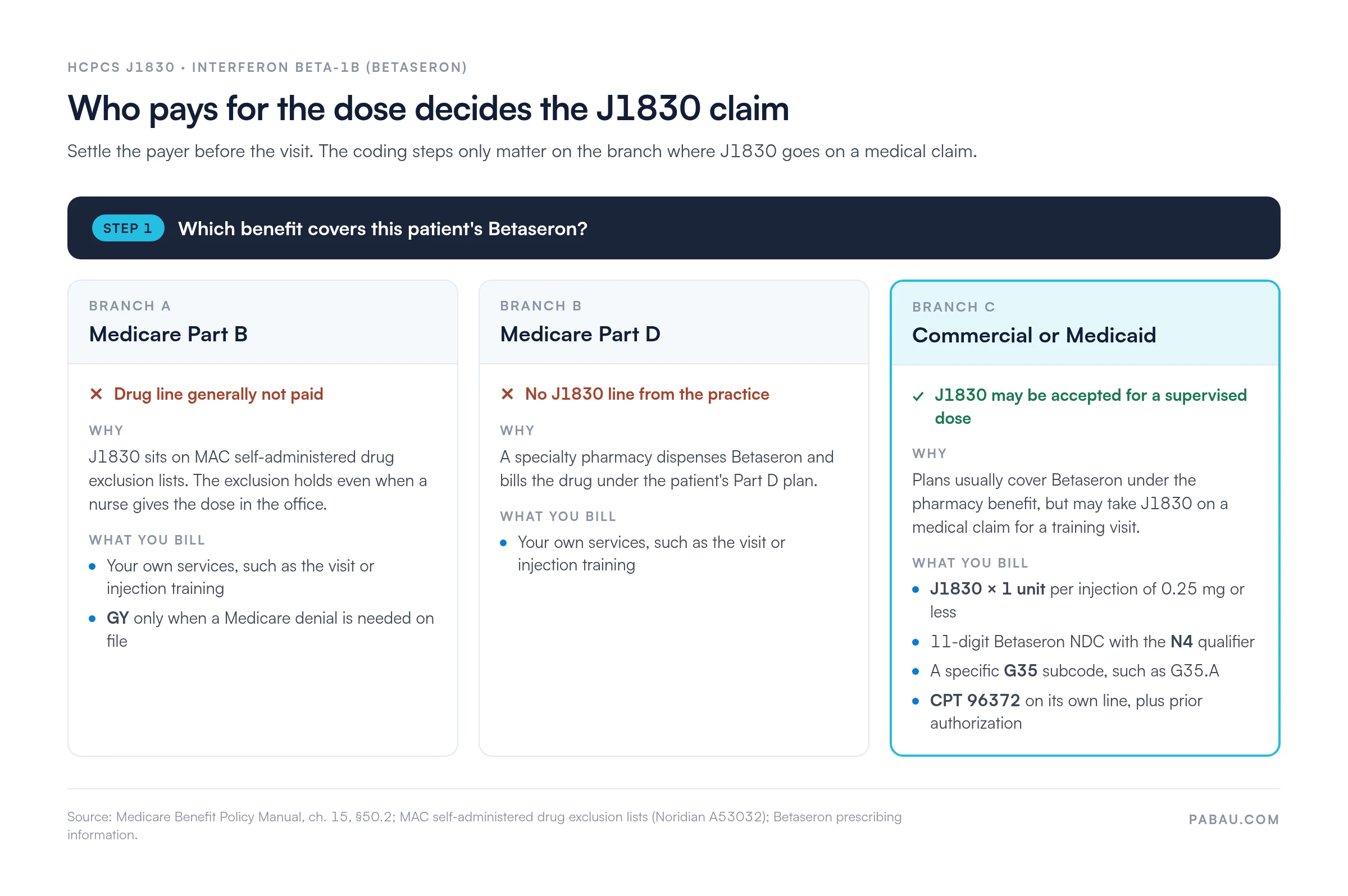
Medicare Part B generally does not pay for J1830. Part B excludes drugs that are usually self-administered, under the Medicare Benefit Policy Manual, Chapter 15, section 50.2.
Each Medicare Administrative Contractor (MAC) publishes a self-administered drug (SAD) exclusion list. J1830 (Betaseron) appears on the lists from Noridian, Palmetto GBA and CGS, including Noridian’s exclusion list (A53032).
Once a drug is on the SAD list, the exclusion applies even when a nurse gives the dose in the office. The descriptor’s “direct supervision” wording does not override the exclusion.
Most Medicare patients get Betaseron through a Part D plan instead, dispensed by a specialty pharmacy. The practice then bills only its own services, such as the visit or the injection training.
Check your own MAC’s list before you bill. The lists are updated through published articles, and each MAC sets its own effective dates.
Commercial plans and Medicaid programs usually cover Betaseron under the pharmacy benefit. A plan may still accept J1830 on a medical claim for a supervised dose, such as a training visit.
Prior authorization is standard for MS disease-modifying therapies. Typical criteria include:
Policies change at plan renewal, so check the current criteria before each new authorization. Record the approval number and its expiry date before the supervised injection is booked.
Across the three payer routes, only the commercial or Medicaid branch usually puts J1830 on a medical claim.
Bill the injection itself with CPT 96372, the code for a therapeutic subcutaneous or intramuscular injection. It goes on a separate line from J1830.
When Medicare excludes the drug, check your MAC’s guidance on whether the 96372 line is payable. Teaching time may also be part of an evaluation and management visit rather than a separate charge.
The most common wrong-code error is billing interferon beta-1a under J1830. Beta-1a and beta-1b are different drugs with different codes and billing units. Avonex, an intramuscular beta-1a, bills under J1826 at 30 mcg per unit.
Use the AAPC HCPCS Level II code lookup to cross-check descriptors when the order names a brand you do not recognize. Q3027, Q3028 and J1595 sit on Noridian’s self-administered drug exclusion list too, so the same Medicare problem applies to them.
Most J1830 denials trace back to one of a handful of causes. Good denial management strategies fix each cause at the workflow level, so the same error does not return on the next claim.
Documentation falls into two groups. One set must be in the chart on the day of service, and the other is needed only if the claim is audited.
Required at the time of service:
Required only if audited:
A structured superbill that captures the drug, dose, NDC and lot number at the point of care reduces audit risk. It also speeds up resubmission when a denial lands.
Photograph the Betaseron carton label and attach it to the visit record. The image captures the NDC, lot number and expiry date in one step.
Billing J1830 means checking the payer before the visit, then recording the NDC and dose during it. Many practices still track those steps across a spreadsheet, a paper log and the billing system.
Pabau, the practice management and billing platform we build, keeps the injection note, the charge and the claim in one patient record. Its claims management software tracks each claim through to payment and groups denials by reason.
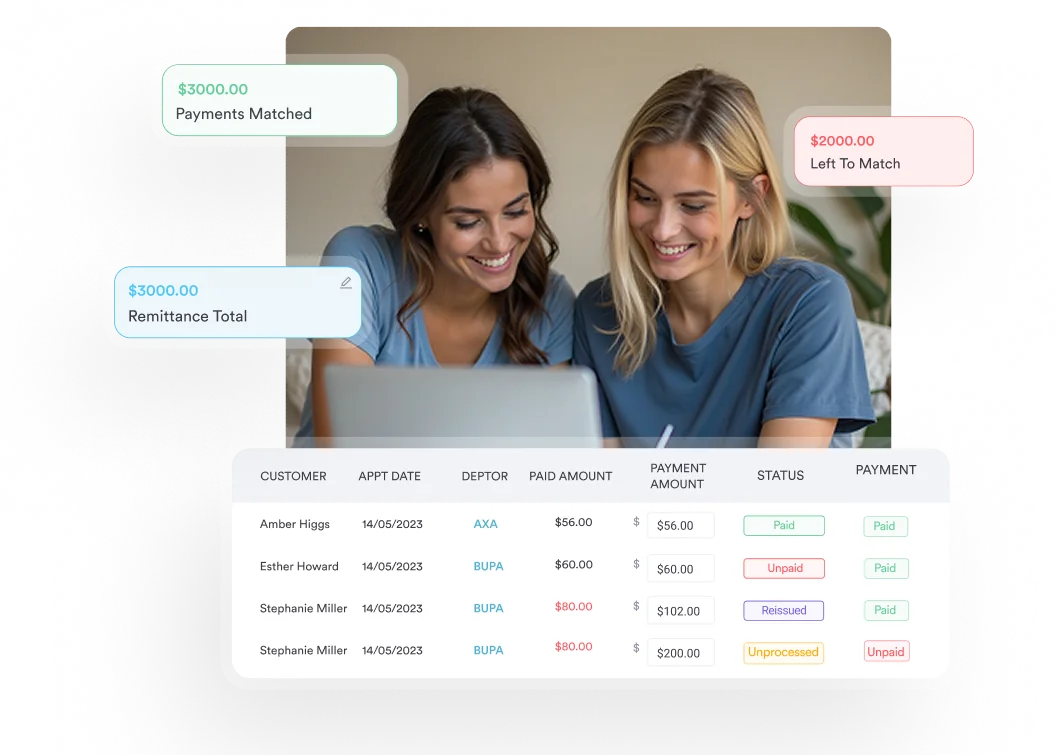
The outcome is fewer drug lines sent to the wrong payer, and a record that answers an audit request without a search through paper files.

Pabau keeps the injection note, NDC and charge in one record, then tracks each claim and denial by reason code. Interferon beta-1b claims go to the correct payer the first time.

J1830 is a small code with an outsized coverage question. Before you bill the dose, find out who pays for it, because Medicare Part B usually will not.
Get that decision right, and the rest of the claim is mechanical. Use 1 unit, a Betaseron NDC, a specific G35 subcode, and CPT 96372 on its own line. Get it wrong, and no amount of clean coding will rescue the claim.
Book a demo to see how Pabau helps your practice route specialty injectable claims to the right payer and keep their documentation audit-ready.

Need a framework for tracking drug claim denials? Denial management in healthcare covers the workflow steps to categorize, appeal, and prevent recurring claim rejections.
Want to understand how J-code drug billing fits the bigger picture? What is revenue cycle management explains the end-to-end process from patient encounter to collected payment.
Managing billing compliance across multiple payers? Medical billing compliance outlines the documentation and audit-readiness standards that protect practices during payer reviews.
HCPCS code J1830 describes injection, interferon beta-1b, 0.25 mg. Interferon beta-1b is sold as Betaseron and was also sold as Extavia. It is a subcutaneous injection for relapsing forms of multiple sclerosis.
Report 1 unit of J1830 for the full 0.25 mg maintenance dose. Titration doses of 0.0625 mg, 0.125 mg and 0.1875 mg are smaller than one billing unit, so they also report as 1 unit.
Medicare Part B generally does not cover J1830. Medicare contractors list it on their self-administered drug exclusion lists, so the exclusion applies even when the dose is given in the office. Most Medicare patients get Betaseron through Part D.
Use the G35 subcode that matches the documented MS type. G35.A covers relapsing-remitting MS, and G35.C1 covers active secondary progressive MS. Plain G35 is invalid for dates of service from October 1, 2025.
Report the 11-digit NDC from the Betaseron package used, such as 50419052401 for a single kit. Put the N4 qualifier before it, and use UN as the unit of measure unless the payer says otherwise.
No. Avonex and Rebif are interferon beta-1a, a different drug. Avonex bills under J1826 or Q3027, and Rebif bills under Q3028. J1830 is only for interferon beta-1b.