CPT code 41115: Lingual frenectomy billing and denial guide
CPT code 41115 covers removal of the lingual frenum CPT code 41115 is the Americ...

Last Updated: Oct 20, 2026
J1826 is the HCPCS Level II code for injection, interferon beta-1a, 30 mcg.
One point trips up practices new to buy-and-bill. The place of service code does not change what Medicare allows for the drug. It changes what Medicare pays for the injection code billed alongside it.
Let Pabau's smart automation suggest the right codes, reduce claim denials, and keep your practice compliant—effortlessly.
Automate repetitive tasks and focus on what matters most—your patients.
Reduce coding errors and ensure compliance with the latest regulations.
Clean claims, fewer denials, and faster reimbursements.
Powerful insights and reporting to help your practice thrive.
HIPAA compliant SOC 2 certified GDPR-compliant Trusted by 4,000+ clinics worldwide

HCPCS code J1826 describes injection, interferon beta-1a, 30 mcg, billed once per Avonex administration.
Medicare Part B pays J1826 at ASP plus 6%, and only when a provider administers the drug.
Every claim needs a supporting ICD-10 code such as G35, the NDC, and the correct place of service.
Place of service changes what Medicare pays for the injection code, not the allowed amount for the drug.
Pabau carries the documented code, NDC, and diagnosis onto the claim, so fewer J1826 lines come back.
HCPCS code J1826 is a Level II alphanumeric code maintained by the Centers for Medicare and Medicaid Services (CMS). Its official descriptor is: Injection, interferon beta-1a, 30 mcg. One unit equals one 30 mcg injection. Avonex, manufactured by Biogen, is the primary product billed under this code.
One common source of claim rejections is billing more than one unit when the patient receives a single 30 mcg dose. Avonex is dosed at 30 mcg once weekly by intramuscular injection. Bill one unit of J1826 per administration event.
Medicare Part B covers J1826 when the drug is administered by or incident to a physician in an outpatient or office setting. CMS Article A52571 lists interferon beta-1a on the self-administered drug exclusion list. Medicare will not cover J1826 when the patient self-administers at home.
Coverage applies only when the provider gives the injection during the encounter. Claims filed without documentation of provider administration are the leading cause of J1826 denials on Medicare.
CMS reimburses J1826 at the Average Sales Price (ASP) plus 6%. That methodology is the standard Part B drug reimbursement formula, and CMS updates ASP pricing quarterly. The allowed amount therefore changes four times a year. Do not hardcode a dollar figure in your billing system without confirming the current quarter’s rate from the CMS ASP drug pricing files.
Many payers, including Medicare, require the NDC number on the claim alongside J1826. The NDC identifies the exact drug product: manufacturer, product, and package size. Avonex 30 mcg/0.5 mL prefilled syringe carries NDC 59627-0013-03 (Biogen). Packaging changes can change that number, so verify it against the AAPC HCPCS code lookup or the FDA NDC directory before submission.
The claim form is the CMS-1500, or the 837P electronic equivalent. Report qualifier N4, then the 11-digit NDC, then the quantity and unit of measure. A missing NDC produces a rejection rather than a denial, which means the claim comes back unprocessed instead of adjudicated.
Verify the Avonex NDC number against your current drug inventory invoice before billing. Biogen periodically updates packaging, which changes the NDC suffix. A mismatched NDC triggers an immediate claim rejection and delays reimbursement for a high-cost drug.
Every J1826 claim needs at least one ICD-10-CM diagnosis code that establishes medical necessity for interferon beta-1a therapy. The primary indication is multiple sclerosis, particularly relapsing forms. Confirm each code is active in the current ICD-10-CM year before filing.
G35 is the code most MS practices bill with J1826. Some commercial payers ask for more specificity. Check the local coverage determination (LCD) and your payer contract before filing G36.9 or G37.9 as the primary diagnosis. If you need to confirm a descriptor first, the ICD-10 codes for billers hub lists each one in full.
Modifier selection for HCPCS code J1826 depends on the route of administration and the claim context. Using the wrong modifier, or omitting one that the payer requires, is a common reason J1826 claims are denied rather than paid.
For standard Avonex intramuscular administration at POS 11, most practices submit J1826 without a route-of-administration modifier unless the payer asks for one. Confirm modifier requirements with your Medicare Administrative Contractor (MAC) before your first J1826 claim.
The place of service (POS) code records where the injection was given. It does not change what Medicare allows for the drug, because Part B pays J1826 at ASP plus 6% in every setting. What the POS code does change is the payment for the administration code billed with it, since CPT 96372 carries separate facility and non-facility rates.
Report the POS that matches where the encounter happened, rather than choosing one to influence payment. An inaccurate POS is a compliance problem, and it will not lift the drug’s allowed amount.
Avonex is typically acquired through the buy-and-bill model. The practice purchases the drug, administers it during the encounter, and bills for both the drug (J1826) and the administration code. The practice carries the acquisition cost until reimbursement arrives, so a rejected line ties up money it has already spent. Denial management is what gets that money back on Part B drug claims.
Step four is where most J1826 lines fail, because six separate fields have to agree before the claim will adjudicate.
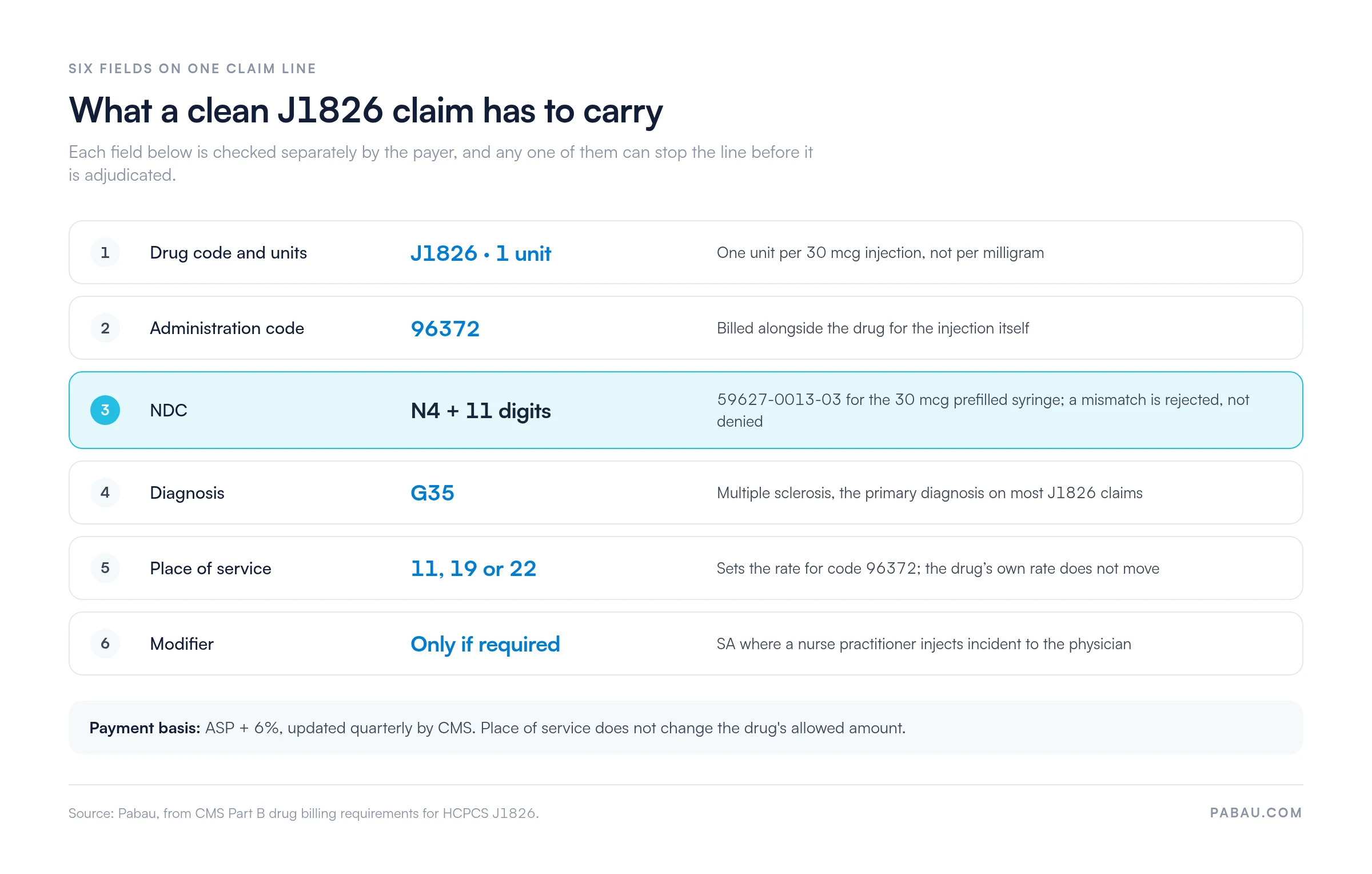
Incomplete documentation is the second most common reason J1826 claims are denied after adjudication. Medicare and most commercial payers expect a full documentation trail before approving a high-cost Part B drug. Build the checks into the encounter itself, so the record is complete before the charge leaves the office.
Coders working on MS drug billing will meet several codes adjacent to J1826. Knowing the distinctions prevents misbilling when a patient switches disease-modifying therapy (DMT). Two of the neighboring J-codes are not interferons at all, despite sitting a few digits away.
When a patient switches from Avonex (J1826) to Rebif, the code changes as well as the drug. Rebif is billed with Q3028, injection, interferon beta-1a, 1 mcg for subcutaneous use, so a 44 mcg dose is 44 units. Confirm the product, dose, and route before selecting the code on any DMT switch.
A high-cost injectable claim carries more moving parts than a standard office visit. The code, the units, the NDC, the diagnosis, the place of service, and any required modifier all have to match what the record says happened. Practices that manage this by hand depend on the biller catching every field, every time.
Pabau is practice management software that keeps the clinical record and the billing record in one system. When an Avonex administration is charted, the biller works from that entry instead of re-keying it from a printout. Our claims software for practices then submits the line and tracks its status through to the remittance.
The outcome is a shorter path between administration and payment on a drug the practice has already bought. Fewer lines come back for a missing NDC or a diagnosis that never made it onto the claim.

Pabau links each drug administration record to the claim it belongs on, then tracks that claim through to the remittance. Your billers confirm fields rather than re-key them.

J1826 is simple in its descriptor and demanding in its claim requirements. A verified NDC, an active companion diagnosis, an accurate place of service, and proof of provider administration all have to be present. Add whatever modifier the payer asks for, and the line adjudicates cleanly.
Practices paid on the first pass build those checks into the administration itself, rather than into claims review a week later. That is a workflow decision more than a coding one, and it is the one worth making before the next Avonex order arrives.
Book a demo to see how Pabau keeps the drug record and the claim in step for specialty injectables.

Need to understand the full lifecycle of a Part B drug claim? Medical billing fundamentals walks through how provider claims move from service to payment.
Want to reduce claim denials across your injectable drug portfolio? Denial management in healthcare explains how to build a structured appeals and prevention workflow.
Looking for the compliance requirements behind high-cost drug billing? Medical billing compliance covers the documentation and audit standards that apply to Part B injectables.
Not sure what makes a claim pass on the first submission? What is a clean claim sets out the fields payers check before a line is adjudicated.
Building the charge document behind the claim? Superbill explains which codes and patient details belong on it before billing.
HCPCS code J1826 is the Level II billing code for injection, interferon beta-1a, 30 mcg. It bills Medicare Part B and commercial payers for each Avonex administration given by a healthcare professional in an outpatient or office setting.
J1826 represents Avonex (interferon beta-1a), a disease-modifying therapy manufactured by Biogen and approved for relapsing forms of multiple sclerosis. One unit equals one 30 mcg intramuscular injection.
Avonex is billed to Medicare Part B using J1826 under the buy-and-bill model, where the practice purchases the drug and administers it in-office. The claim carries the NDC number, an ICD-10-CM diagnosis supporting MS, the place of service, and documentation of provider administration. Medicare reimburses at ASP plus 6%, updated quarterly.
Medicare reimburses J1826 at the Average Sales Price (ASP) plus 6%. The dollar amount changes each quarter when CMS updates the ASP drug pricing files, so check the current quarter before your billing cycle. Place of service does not change the drug rate.
Required documentation includes a signed physician order for Avonex and chart notes confirming the MS diagnosis and medical necessity. You also need an administration record carrying the NDC and lot number. Commercial payers usually want a prior authorization number as well. Keep drug acquisition invoices to support audits.
No. CMS Article A52571 lists interferon beta-1a on the self-administered drug exclusion list. Medicare Part B covers J1826 only when a provider administers the injection during an encounter. Home self-injection is not a covered Part B benefit under this code.