CPT Code 69610: Tympanic membrane patch repair (myringoplasty)
CPT code 69610: official descriptor and procedure overview CPT code 69610 descri...

Last Updated: Oct 19, 2026
J1670 is the HCPCS Level II code for injection, tetanus immune globulin, human, up to 250 units. It covers the drug supply only, billed as one unit per 250 IU, with any partial increment rounded up.
CPT 90389 describes the same product, and payers differ on which code they accept. Medicare uses J1670. Medicaid and many commercial plans also expect the vial's National Drug Code (NDC) on the claim line.
Let Pabau's smart automation suggest the right codes, reduce claim denials, and keep your practice compliant—effortlessly.
Automate repetitive tasks and focus on what matters most—your patients.
Reduce coding errors and ensure compliance with the latest regulations.
Clean claims, fewer denials, and faster reimbursements.
Powerful insights and reporting to help your practice thrive.
HIPAA compliant SOC 2 certified GDPR-compliant Trusted by 4,000+ clinics worldwide

J1670 covers the drug supply of tetanus immune globulin (human) at up to 250 IU per billed unit, not the injection service.
Units billed equal total IU administered divided by 250, rounded up to the next whole unit, so a 300 IU dose bills as 2 units.
Medicaid and many commercial payers require the NDC on the CMS-1500 or 837P, while Medicare Part B generally does not, so check your MAC.
Pabau’s claims management software captures dose, route and clinical documentation at the point of care, so J1670 claims start from a complete record.
HCPCS code J1670 is the Level II code for injectable tetanus immune globulin (TIG), maintained by the Centers for Medicare and Medicaid Services (CMS). The official descriptor reads: Injection, tetanus immune globulin, human, up to 250 units. It reports the drug supply in outpatient and physician office settings, one unit per 250 IU or part of it.
The drug is a pooled human plasma-derived passive immunization agent. In the United States it is sold as HyperTET (Grifols).
J-codes are reviewed every year and revised quarterly, so confirm the code’s active status against the CMS HCPCS Alpha-Numeric file each plan year. The table below summarizes the key attributes of HCPCS code J1670 as of the current CMS HCPCS release.
J1670 covers the drug cost of tetanus immune globulin only. It does not cover the injection service, any active tetanus vaccine, or wound debridement performed during the same encounter.
The distinction matters because coders occasionally apply J1670 when the patient received a tetanus toxoid vaccine (Td or Tdap) rather than passive immunization with TIG. These are different products with different codes.
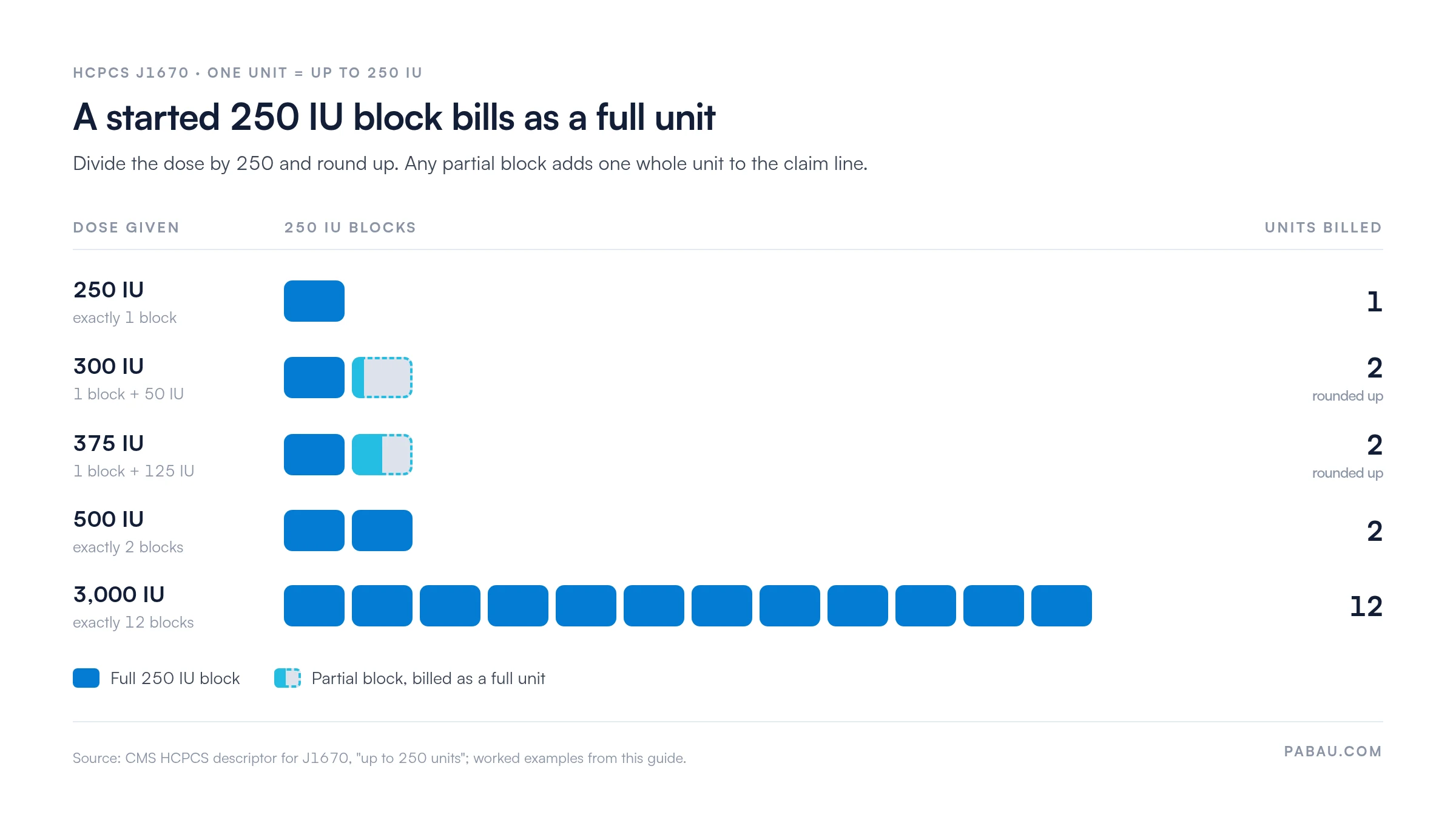
J1670 is billed in units of up to 250 IU. Divide the total dose administered by 250 and round up to the next whole unit. Because the descriptor says “up to 250 units”, any partial increment bills as a full unit.
The chart below shows why a 300 IU dose and a 500 IU dose land on the same claim line.
Beyond the unit count, many payers want the NDC for the specific vial dispensed on the claim. On CMS-1500 paper claims, the NDC goes in the shaded area of box 24 with qualifier N4. On 837P electronic claims, it is reported in the LIN segment with the unit of measure qualifier (UN for units) and the quantity dispensed.
NDC reporting is mandated for Medicaid drug claims under the Deficit Reduction Act, and many commercial payers require it by policy. Medicare Part B does not generally require an NDC on professional claims. Confirm with your Medicare Administrative Contractor (MAC), since some MACs publish supplemental drug billing instructions.
CPT 90389 is the CPT product code for tetanus immune globulin (human) for intramuscular use. J1670 is the HCPCS Level II code for the same drug. Both codes are active, so the choice depends on the payer.
Medicare uses J1670 for the TIG drug supply. Commercial and Medicaid plans differ, and some accept 90389 while others want J1670. Bill one code per dose, choosing the one the payer’s policy names.
If your charge description master (CDM) maps TIG to only one of the two codes, add payer-specific mapping. Medicare claims then carry J1670, and each commercial plan gets the code its policy names.
J1670 covers the drug only. In most outpatient and office settings, the injection service is billed separately with 96372. The correct companion depends on the clinical setting and the route of administration.
Some payers bundle the administration code with the drug J-code and deny 96372 as inclusive. Check your payer’s bundling edits before assuming separate reimbursement. When 96372 is denied as bundled, J1670 still pays at its allowed amount.
Run a quarterly claim edit review on all J1670 claims to confirm whether 96372 is paying separately or being bundled. If a specific payer consistently denies it, remove it from your charge template for that payer to avoid repeated denials and rework.
Under Medicare Part B, J-code drugs are generally paid at Average Sales Price (ASP) plus 6%, before sequestration. When ASP data are unavailable, Wholesale Acquisition Cost (WAC) plus 3% applies instead. Current payment limits are published in the CMS quarterly ASP drug pricing files.
TIG is not classified as a preventive immunization benefit under Medicare Part B. Coverage depends on medical necessity documentation showing post-exposure prophylaxis is clinically indicated. That typically means a wound with an uncertain or incomplete tetanus vaccination history, per CDC Advisory Committee on Immunization Practices (ACIP) guidance.
For Medicaid, reimbursement rates and coverage rules vary by state. Fee-for-service Medicaid programs set their own drug payment methodologies, and managed care plans within each state may layer on extra requirements. Check the state Medicaid fee schedule before submitting a J1670 claim, and confirm whether the plan requires prior authorization (see below).
Medicare Part B does not generally require prior authorization (PA) for J1670. The drug is given in response to an acute wound exposure, which makes a prospective authorization process clinically impractical in most cases. Still, confirm with the relevant MAC, as requirements can change through coverage determination updates.
Commercial insurers and many state Medicaid plans are a different story. Some plans require PA or concurrent notification even for emergency-adjacent services. Insurance eligibility verification at the time of service should include a check for active PA requirements on J-code drugs under the patient’s plan.
When PA is required, the documentation typically requested includes:
Incomplete documentation sits behind many J1670 denials. A clean J1670 claim needs the elements below in both the clinical record and on the claim form before submission. Digital clinical forms that capture these fields at the point of care stop missing details from surfacing only at the billing stage.
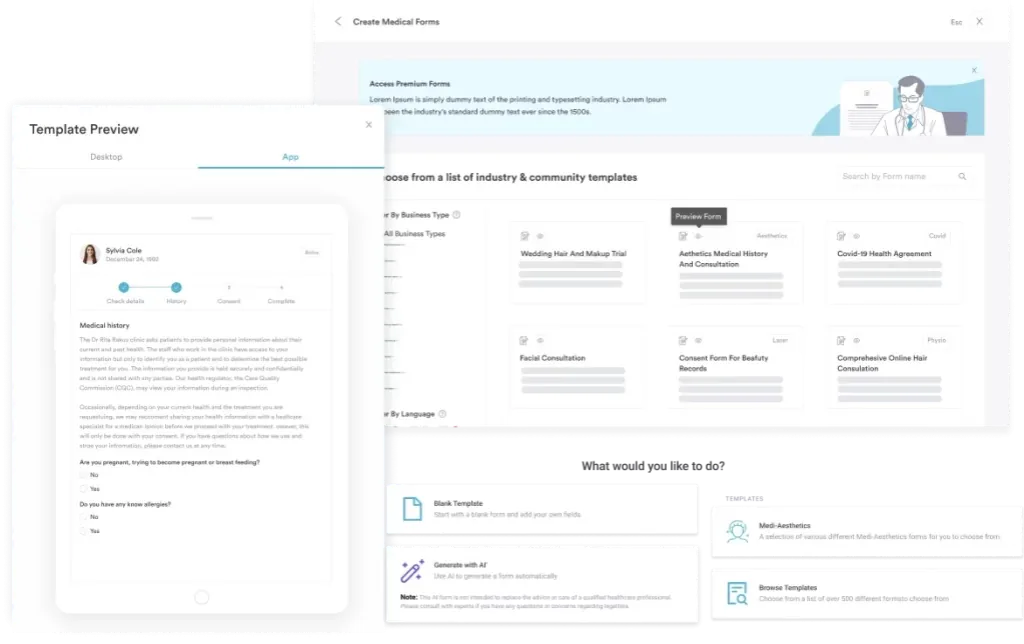
For practices handling medical billing in-house, a J1670 claim checklist built into the documentation workflow catches the most common submission errors early. A superbill that pre-populates the code, units field and NDC prompt cuts manual entry for clinical staff.
J1670 denials follow predictable patterns. The table below covers the most frequent denial reasons, the matching adjustment or remark code, and the corrective action for each.
Systematic denial management in healthcare for J-code drug claims means tracking denial codes by payer, not just by code. A pattern that shows up on Medicare claims may not appear on commercial claims, and vice versa. Payer-specific billing rules in your practice management system stop the same denial from recurring on resubmission.
Several codes sit close to J1670 in the HCPCS code set and in CPT, and they cause consistent coder confusion. The quick-reference table below matches each scenario to the right code.
When TIG and Tdap are given at the same encounter for wound prophylaxis, document each injection site separately. Bill J1670 for the TIG drug supply with 96372 for the TIG injection. Bill CPT 90715 for the Tdap vaccine with 90471 for its administration. Payer policies on co-administration vary, so confirm with each plan.
Practices billing J1670 often record the dose in the clinical note and rebuild it later on the claim. When the units, route or NDC are keyed in again at the billing stage, a mismatch with the note drives the denial patterns above.
Pabau’s claims management software keeps the clinical record and the claim in one system. Clinicians capture the dose, route and clinical indication in documentation fields at the point of care. Billing staff then build the J1670 claim line from that record, rather than chasing details after the visit.
For practices aiming for clean claim submission on drug codes, one platform removes the hand-off errors between clinical and billing teams.

Pabau captures dose, route and clinical documentation at the point of care, so your billing team builds J1670 claims from a complete record. See how it works for your team.

J1670 claims get paid when they are built from the dose record, not reconstructed at billing. Set your unit rule to round up, and map TIG to J1670 for Medicare and to each commercial payer’s preferred code.
Then confirm each payer’s NDC rule before the first claim goes out. Doing this once at setup costs far less than correcting CO-4 and CO-16 denials one remittance at a time.
Book a demo to see how Pabau keeps dose, route and wound documentation in the record your billing team works from.

Need a guide to common billing denial codes? Denial codes in medical billing covers the most frequent CARC and RARC codes and how to appeal them effectively.
Billing the TIG injection itself? CPT code 96372 explains when the injection service pays separately and which modifiers apply.
Giving Tdap at the same visit? CPT code 90715 covers the Tdap vaccine product code and how to bill it alongside TIG.
Want to understand how clearinghouses process J-code claims? Medical claims clearinghouse explains how electronic drug claims move from practice to payer and where errors are caught.
Looking for a practical overview of the 837P claim format? 837 file billing guide walks through the electronic claim structure used to submit HCPCS drug codes, including NDC segments.
HCPCS code J1670 covers the drug supply of tetanus immune globulin (human), billed per 250 IU administered. It does not cover the injection service, an active tetanus vaccine such as Td or Tdap, or wound care performed at the same encounter.
Divide the total IU administered by 250 and round up to the next whole unit. A 300 IU dose bills as 2 units, and a 3,000 IU dose bills as 12. Never report a fraction of a unit on the claim.
Medicare Part B generally does not require prior authorization for J1670. Commercial insurers and some state Medicaid plans may require it, or a concurrent notification. Verify the patient’s plan benefits during the eligibility check, before administration.
CPT 90389 is the CPT product code for tetanus immune globulin, and J1670 is the HCPCS Level II code for the same drug. Both are active. Medicare uses J1670, while other payers differ, so bill the code each payer’s policy names.
The most common reasons are a missing NDC number on the claim (CO-16/MA130), incorrect units billed (CO-4), and lack of medical necessity documentation (CO-50). Check the remittance advice remark code, correct the specific error, and resubmit as a corrected claim or appeal with supporting clinical documentation.
Yes. In most physician office and outpatient settings, CPT 96372 (injection, IM or SQ) is separately billable alongside J1670. Some payers bundle the administration code with the drug J-code, so check their bundling edits before expecting separate payment.
Medicaid coverage for J1670 varies by state. Fee-for-service Medicaid programs set their own drug payment methodologies, and managed care plans within each state may add prior authorization requirements. Check the applicable state Medicaid fee schedule and the patient’s plan documents before submitting a claim under Medicaid.